 Add to Chrome
 Add to Firefox
 Add to Edge
QUASAR: A Quantum-Classical Neural Network for SAR Satellite Physical-Layer Authentication
Aug 20, 2026
X-band SAR satellites (8-12 GHz) play a critical role in disaster response, environmental monitoring, and military intelligence. Yet, they lack robust physical-layer authentication (PLA), a security layer orthogonal to cryptographic solutions. Existing PLA systems, typically based on radio-frequency fingerprinting, are often limited to sub-6 GHz frequencies and rely on classical deep learning. However, this approach underfits the IQ phase nonlinearities that distinguish satellite hardware. In this paper, we present QUASAR, to the best of our knowledge the first quantum-classical hybrid architecture that fuses a CNN spectrogram encoder with a variational quantum circuit (VQC) to provide PLA to X-band SAR signals. Our solution enjoys two distinctive features: (i) it is markedly more data-efficient than classical machine learning, requiring only 10% of the training data to match the accuracy of classical baselines -- data collection being notoriously the most time-consuming phase of PLA; and, (ii) at an equal data budget, it improves classification accuracy over those baselines. In detail, we test our solution under three adversarial scenarios: replay, crafted-IQ injection, and space-borne spoofing. QUASAR rejects spoofed transmissions in 89.7%, 94.1%, and 81.3% of attempts, respectively, establishing the first quantum-enhanced physical-layer classifier for satellite constellations. The fully detailed framework and the supporting results, other than being interesting on their own, show a novel research avenue for physical-layer authentication.

Self-State Attacks on Self-Hosted AI Agents: How Far Can OS Defenses Go?
Jul 20, 2026Self-hosted AI agents read and write their own memory and configuration files to function. An agent may get compromised via corruption of its own state -- a compromise realized via legitimate OS system call invocation. We refer to this class of threats as self-state attacks. In this paper, we investigate the OS resilience to this class of attacks. Formally, we characterize a four-axis attack space (Target, Mechanism, Granularity, Temporal); investigate the structural limits of prevention, detection, and recovery; and introduce a workload-conditioned view of detectability. To instantiate the framework, we collect live activity traces from a representative self-hosted agent running across distinct workload profiles, and realize the attack space as a 23-cell matrix, 43 concrete operations on real self-state files, and injected into those traces. We then evaluate both canonical and workload-conditioned defense strategies. The empirical results show that a layered defense stack (access-control prevention on the instruction and configuration layers, workload-conditioned detection on the memory layer, and periodic backup for recovery) is effective on most attack cells while a small residual attack surface remains structurally indistinguishable at the OS level. These findings suggest that against the newly established class of self-state attacks, OS-level defense needs to be reconsidered, potentially opening new research directions in the field.
PumpSense: Real-Time Detection and Target Extraction of Crypto Pump-and-Dumps on Telegram
May 10, 2026Cryptocurrency pump-and-dump schemes coordinated via Telegram threaten market integrity. However, existing research addressing this specific threat has not yet produced solutions that combine reliable results with fast response. This is in part due to the absence of publicly available, message-level labeled data, as well as design choices. In this paper, we address both issues. In particular, we introduce a corpus of over 280,000 Telegram posts from 39 pump-organizing groups, all manually reviewed to identify 2,246 pump announcements and their targeted cryptocurrency and exchange. Leveraging this dataset, we define two tasks: real-time pump-announcement detection and target cryptocurrency/exchange extraction. For detection, we compare two machine-learning models: a lightweight tree-based LightGBM classifier (F1=0.79, latency=9.4 s/sample) and a transformer-based BGE-M3 (F1=0.83, latency=50 ms/sample). With our proposed approach, we show that message analysis can achieve near-instant pump detection at the level of individual Telegram message windows. Unlike prior work that relies purely on market data and typically detects pumps tens of seconds after abnormal trading activity is observed, our method operates directly on the coordination messages themselves and can be evaluated in microseconds per window on commodity hardware. To our knowledge, we also establish the first benchmark for manipulated coin and exchange extraction. We demonstrate that traditional rule-based extraction methods, widely relied upon in prior literature, are ineffective due to ticker ambiguity. In contrast, LLMs achieve the highest accuracy with a score of 0.91.
Cross-Cultural Transfer of Emoji Semantics and Sentiment in Financial Social Media
May 10, 2026Emojis are widely used in online financial communication, but it is unclear whether they provide transferable sentiment signals across languages, platforms, and asset communities. This study examines the extent to which emoji usage, semantics, and sentiment polarity remain stable across financial communities, and how these layers influence zero-shot sentiment transfer. Using large corpora of Twitter and StockTwits posts in four languages, we measure cross-community divergence and evaluate sentiment models trained under emoji-only, text-only, and text+emoji inputs. We find that emoji frequencies differ across communities, especially across languages, but their semantics and sentiment polarity are largely stable. Cross-asset transferability shows minimal degradation, while cross-language transfer remains the most challenging. Including emojis consistently reduces transfer gaps relative to text-only models. These results indicate that financial communication exhibits a partially shared ``emoji code,'' and that emojis provide compact, language-independent sentiment cues that improve model generalization across markets and platforms.
FinMoji: A Framework for Emoji-driven Sentiment Analysis in Financial Social Media
May 10, 2026This paper explores the use of emojis in financial sentiment analysis, focusing on the social media platform StockTwits. Emojis, increasingly prevalent in digital communication, have potential as compact indicators of investor sentiment, which can be critical for predicting market trends. Our study examines whether emojis alone can serve as reliable proxies for financial sentiment and how they compare with traditional text-based analysis. We conduct a series of experiments using logistic regression and transformer models. We further analyze the performance, computational efficiency, and data requirements of emoji-based versus text-based sentiment classification. Using a balanced dataset of about 528,000 emoji-containing StockTwits posts, we find that emoji-only models achieve F1 approximately 0.75, lower than text-emoji combined models, which achieve F1 approximately 0.88, but with far lower computational cost. This is a useful feature in time-sensitive settings such as high-frequency trading. Furthermore, certain emojis and emoji pairs exhibit strong predictive power for market sentiment, demonstrating over 90 percent accuracy in predicting bullish or bearish trends. Finally, our research reveals large statistical differences in emoji usage between financial and general social media contexts, stressing the need for domain-specific sentiment analysis models.
A Geometric Analysis of Small-sized Language Model Hallucinations
Feb 16, 2026Hallucinations -- fluent but factually incorrect responses -- pose a major challenge to the reliability of language models, especially in multi-step or agentic settings. This work investigates hallucinations in small-sized LLMs through a geometric perspective, starting from the hypothesis that when models generate multiple responses to the same prompt, genuine ones exhibit tighter clustering in the embedding space, we prove this hypothesis and, leveraging this geometrical insight, we also show that it is possible to achieve a consistent level of separability. This latter result is used to introduce a label-efficient propagation method that classifies large collections of responses from just 30-50 annotations, achieving F1 scores above 90%. Our findings, framing hallucinations from a geometric perspective in the embedding space, complement traditional knowledge-centric and single-response evaluation paradigms, paving the way for further research.
PRISM: Phase-enhanced Radial-based Image Signature Mapping framework for fingerprinting AI-generated images
Sep 18, 2025A critical need has emerged for generative AI: attribution methods. That is, solutions that can identify the model originating AI-generated content. This feature, generally relevant in multimodal applications, is especially sensitive in commercial settings where users subscribe to paid proprietary services and expect guarantees about the source of the content they receive. To address these issues, we introduce PRISM, a scalable Phase-enhanced Radial-based Image Signature Mapping framework for fingerprinting AI-generated images. PRISM is based on a radial reduction of the discrete Fourier transform that leverages amplitude and phase information to capture model-specific signatures. The output of the above process is subsequently clustered via linear discriminant analysis to achieve reliable model attribution in diverse settings, even if the model's internal details are inaccessible. To support our work, we construct PRISM-36K, a novel dataset of 36,000 images generated by six text-to-image GAN- and diffusion-based models. On this dataset, PRISM achieves an attribution accuracy of 92.04%. We additionally evaluate our method on four benchmarks from the literature, reaching an average accuracy of 81.60%. Finally, we evaluate our methodology also in the binary task of detecting real vs fake images, achieving an average accuracy of 88.41%. We obtain our best result on GenImage with an accuracy of 95.06%, whereas the original benchmark achieved 82.20%. Our results demonstrate the effectiveness of frequency-domain fingerprinting for cross-architecture and cross-dataset model attribution, offering a viable solution for enforcing accountability and trust in generative AI systems.
Hallucination Detection: A Probabilistic Framework Using Embeddings Distance Analysis
Feb 10, 2025
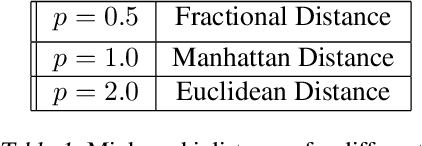
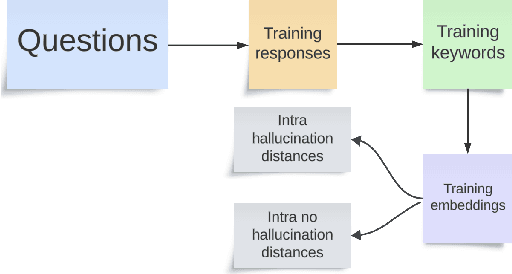
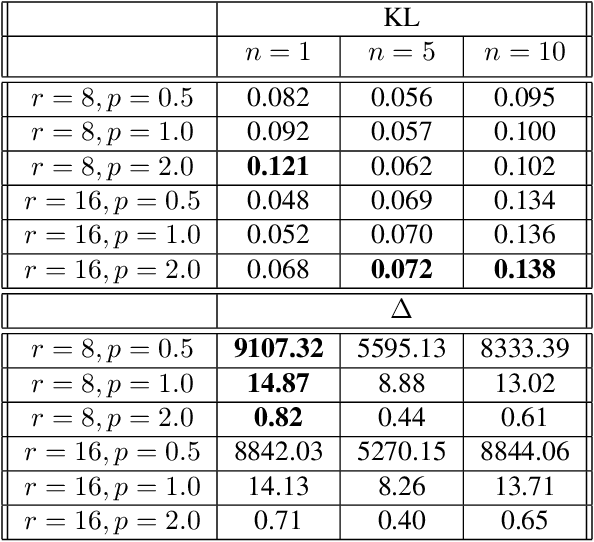
Hallucinations are one of the major issues affecting LLMs, hindering their wide adoption in production systems. While current research solutions for detecting hallucinations are mainly based on heuristics, in this paper we introduce a mathematically sound methodology to reason about hallucination, and leverage it to build a tool to detect hallucinations. To the best of our knowledge, we are the first to show that hallucinated content has structural differences with respect to correct content. To prove this result, we resort to the Minkowski distances in the embedding space. Our findings demonstrate statistically significant differences in the embedding distance distributions, that are also scale free -- they qualitatively hold regardless of the distance norm used and the number of keywords, questions, or responses. We leverage these structural differences to develop a tool to detect hallucinated responses, achieving an accuracy of 66\% for a specific configuration of system parameters -- comparable with the best results in the field. In conclusion, the suggested methodology is promising and novel, possibly paving the way for further research in the domain, also along the directions highlighted in our future work.
Inferring Power Grid Information with Power Line Communications: Review and Insights
Aug 21, 2023High-frequency signals were widely studied in the last decade to identify grid and channel conditions in PLNs. PLMs operating on the grid's physical layer are capable of transmitting such signals to infer information about the grid. Hence, PLC is a suitable communication technology for SG applications, especially suited for grid monitoring and surveillance. In this paper, we provide several contributions: 1) a classification of PLC-based applications; 2) a taxonomy of the related methodologies; 3) a review of the literature in the area of PLC Grid Information Inference (GII); and, insights that can be leveraged to further advance the field. We found research contributions addressing PLMs for three main PLC-GII applications: topology inference, anomaly detection, and physical layer key generation. In addition, various PLC-GII measurement, processing, and analysis approaches were found to provide distinctive features in measurement resolution, computation complexity, and analysis accuracy. We utilize the outcome of our review to shed light on the current limitations of the research contributions and suggest future research directions in this field.
Expanding Boundaries: Cross-Media Routing for Seamless Underwater and Aerial Communication
Jul 24, 2023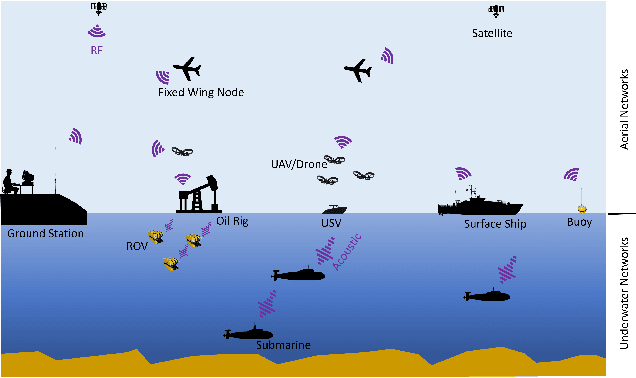
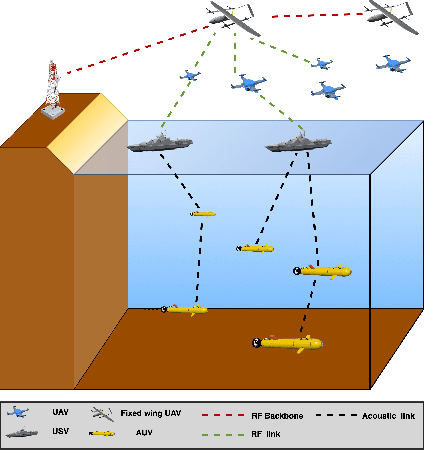
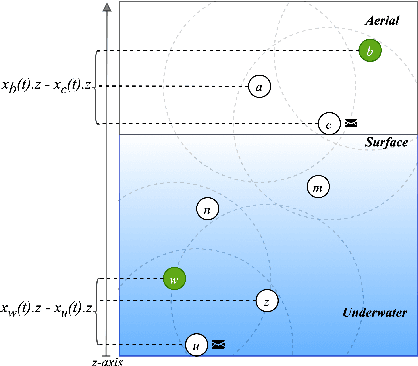
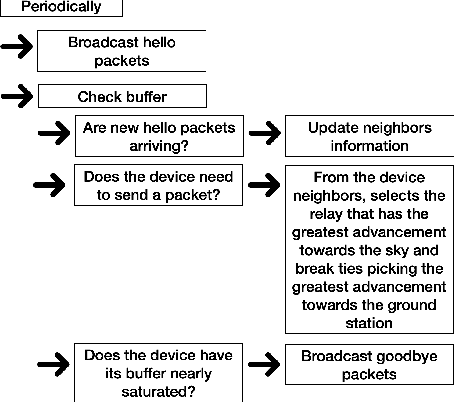
The colossal evolution of wireless communication technologies over the past few years has driven increased interest in its integration in a variety of less-explored environments, such as the underwater medium. In this magazine paper, we present a comprehensive discussion on a novel concept of routing protocol known as cross-media routing, incorporating the marine and aerial interfaces. In this regard, we discuss the limitation of single-media routing and advocate the need for cross-media routing along with the current status of research development in this direction. To this end, we also propose a novel cross-media routing protocol known as bubble routing for autonomous marine systems where different sets of AUVs, USVs, and airborne nodes are considered for the routing problem. We evaluate the performance of the proposed routing protocol by using the two key performance metrics, i.e., packet delivery ratio (PDR) and end-to-end delay. Moreover, we delve into the challenges encountered in cross-media routing, unveiling exciting opportunities for future research and innovation. As wireless communication expands its horizons to encompass the underwater and aerial domains, understanding and addressing these challenges will pave the way for enhanced cross-media communication and exploration.