 Add to Chrome
 Add to Firefox
 Add to Edge
Text Classification
Text classification is the process of categorizing text documents into predefined categories or labels.
Papers and Code
LabelFusion: Learning to Fuse LLMs and Transformer Classifiers for Robust Text Classification
Dec 11, 2025
LabelFusion is a fusion ensemble for text classification that learns to combine a traditional transformer-based classifier (e.g., RoBERTa) with one or more Large Language Models (LLMs such as OpenAI GPT, Google Gemini, or DeepSeek) to deliver accurate and cost-aware predictions across multi-class and multi-label tasks. The package provides a simple high-level interface (AutoFusionClassifier) that trains the full pipeline end-to-end with minimal configuration, and a flexible API for advanced users. Under the hood, LabelFusion integrates vector signals from both sources by concatenating the ML backbone's embeddings with the LLM-derived per-class scores -- obtained through structured prompt-engineering strategies -- and feeds this joint representation into a compact multi-layer perceptron (FusionMLP) that produces the final prediction. This learned fusion approach captures complementary strengths of LLM reasoning and traditional transformer-based classifiers, yielding robust performance across domains -- achieving 92.4% accuracy on AG News and 92.3% on 10-class Reuters 21578 topic classification -- while enabling practical trade-offs between accuracy, latency, and cost.

Generative Classifiers Avoid Shortcut Solutions
Dec 31, 2025Discriminative approaches to classification often learn shortcuts that hold in-distribution but fail even under minor distribution shift. This failure mode stems from an overreliance on features that are spuriously correlated with the label. We show that generative classifiers, which use class-conditional generative models, can avoid this issue by modeling all features, both core and spurious, instead of mainly spurious ones. These generative classifiers are simple to train, avoiding the need for specialized augmentations, strong regularization, extra hyperparameters, or knowledge of the specific spurious correlations to avoid. We find that diffusion-based and autoregressive generative classifiers achieve state-of-the-art performance on five standard image and text distribution shift benchmarks and reduce the impact of spurious correlations in realistic applications, such as medical or satellite datasets. Finally, we carefully analyze a Gaussian toy setting to understand the inductive biases of generative classifiers, as well as the data properties that determine when generative classifiers outperform discriminative ones.
Towards Open-Vocabulary Industrial Defect Understanding with a Large-Scale Multimodal Dataset
Dec 30, 2025We present IMDD-1M, the first large-scale Industrial Multimodal Defect Dataset comprising 1,000,000 aligned image-text pairs, designed to advance multimodal learning for manufacturing and quality inspection. IMDD-1M contains high-resolution real-world defects spanning over 60 material categories and more than 400 defect types, each accompanied by expert-verified annotations and fine-grained textual descriptions detailing defect location, severity, and contextual attributes. This dataset enables a wide spectrum of applications, including classification, segmentation, retrieval, captioning, and generative modeling. Building upon IMDD-1M, we train a diffusion-based vision-language foundation model from scratch, specifically tailored for industrial scenarios. The model serves as a generalizable foundation that can be efficiently adapted to specialized domains through lightweight fine-tuning. With less than 5% of the task-specific data required by dedicated expert models, it achieves comparable performance, highlighting the potential of data-efficient foundation model adaptation for industrial inspection and generation, paving the way for scalable, domain-adaptive, and knowledge-grounded manufacturing intelligence.
Generative diffusion models for agricultural AI: plant image generation, indoor-to-outdoor translation, and expert preference alignment
Dec 22, 2025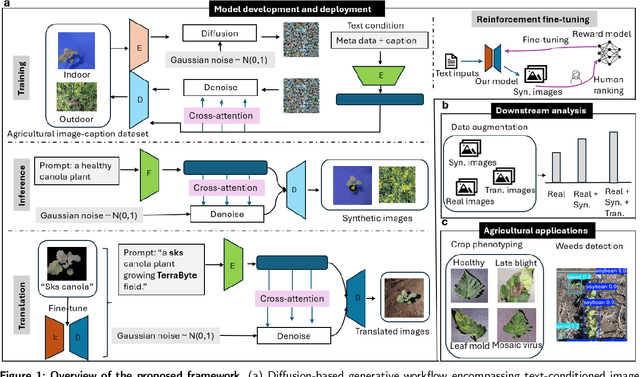
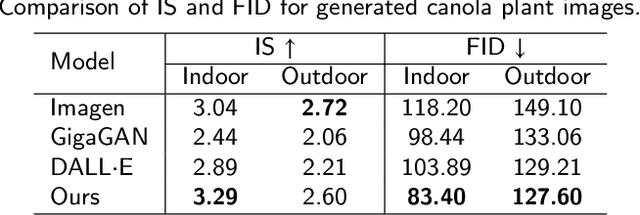
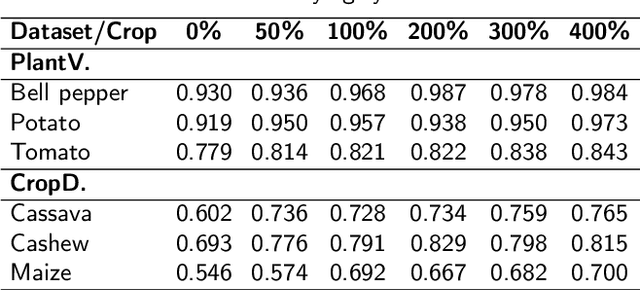
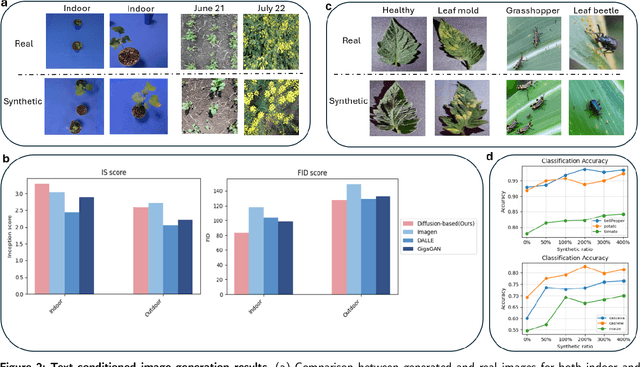
The success of agricultural artificial intelligence depends heavily on large, diverse, and high-quality plant image datasets, yet collecting such data in real field conditions is costly, labor intensive, and seasonally constrained. This paper investigates diffusion-based generative modeling to address these challenges through plant image synthesis, indoor-to-outdoor translation, and expert preference aligned fine tuning. First, a Stable Diffusion model is fine tuned on captioned indoor and outdoor plant imagery to generate realistic, text conditioned images of canola and soybean. Evaluation using Inception Score, Frechet Inception Distance, and downstream phenotype classification shows that synthetic images effectively augment training data and improve accuracy. Second, we bridge the gap between high resolution indoor datasets and limited outdoor imagery using DreamBooth-based text inversion and image guided diffusion, generating translated images that enhance weed detection and classification with YOLOv8. Finally, a preference guided fine tuning framework trains a reward model on expert scores and applies reward weighted updates to produce more stable and expert aligned outputs. Together, these components demonstrate a practical pathway toward data efficient generative pipelines for agricultural AI.
Seeing Beyond the Scene: Analyzing and Mitigating Background Bias in Action Recognition
Dec 17, 2025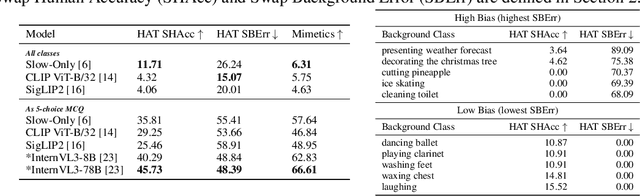
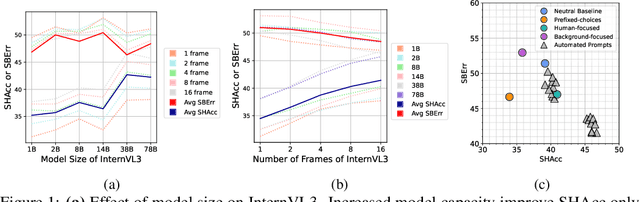
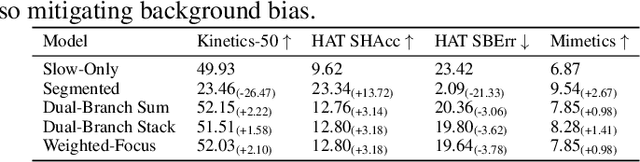

Human action recognition models often rely on background cues rather than human movement and pose to make predictions, a behavior known as background bias. We present a systematic analysis of background bias across classification models, contrastive text-image pretrained models, and Video Large Language Models (VLLM) and find that all exhibit a strong tendency to default to background reasoning. Next, we propose mitigation strategies for classification models and show that incorporating segmented human input effectively decreases background bias by 3.78%. Finally, we explore manual and automated prompt tuning for VLLMs, demonstrating that prompt design can steer predictions towards human-focused reasoning by 9.85%.
Semantic Distance Measurement based on Multi-Kernel Gaussian Processes
Dec 13, 2025Semantic distance measurement is a fundamental problem in computational linguistics, providing a quantitative characterization of similarity or relatedness between text segments, and underpinning tasks such as text retrieval and text classification. From a mathematical perspective, a semantic distance can be viewed as a metric defined on a space of texts or on a representation space derived from them. However, most classical semantic distance methods are essentially fixed, making them difficult to adapt to specific data distributions and task requirements. In this paper, a semantic distance measure based on multi-kernel Gaussian processes (MK-GP) was proposed. The latent semantic function associated with texts was modeled as a Gaussian process, with its covariance function given by a combined kernel combining Matérn and polynomial components. The kernel parameters were learned automatically from data under supervision, rather than being hand-crafted. This semantic distance was instantiated and evaluated in the context of fine-grained sentiment classification with large language models under an in-context learning (ICL) setup. The experimental results demonstrated the effectiveness of the proposed measure.
CLIP-Joint-Detect: End-to-End Joint Training of Object Detectors with Contrastive Vision-Language Supervision
Dec 28, 2025Conventional object detectors rely on cross-entropy classification, which can be vulnerable to class imbalance and label noise. We propose CLIP-Joint-Detect, a simple and detector-agnostic framework that integrates CLIP-style contrastive vision-language supervision through end-to-end joint training. A lightweight parallel head projects region or grid features into the CLIP embedding space and aligns them with learnable class-specific text embeddings via InfoNCE contrastive loss and an auxiliary cross-entropy term, while all standard detection losses are optimized simultaneously. The approach applies seamlessly to both two-stage and one-stage architectures. We validate it on Pascal VOC 2007+2012 using Faster R-CNN and on the large-scale MS COCO 2017 benchmark using modern YOLO detectors (YOLOv11), achieving consistent and substantial improvements while preserving real-time inference speed. Extensive experiments and ablations demonstrate that joint optimization with learnable text embeddings markedly enhances closed-set detection performance across diverse architectures and datasets.
Using Large Language Models To Translate Machine Results To Human Results
Dec 30, 2025Artificial intelligence (AI) has transformed medical imaging, with computer vision (CV) systems achieving state-of-the-art performance in classification and detection tasks. However, these systems typically output structured predictions, leaving radiologists responsible for translating results into full narrative reports. Recent advances in large language models (LLMs), such as GPT-4, offer new opportunities to bridge this gap by generating diagnostic narratives from structured findings. This study introduces a pipeline that integrates YOLOv5 and YOLOv8 for anomaly detection in chest X-ray images with a large language model (LLM) to generate natural-language radiology reports. The YOLO models produce bounding-box predictions and class labels, which are then passed to the LLM to generate descriptive findings and clinical summaries. YOLOv5 and YOLOv8 are compared in terms of detection accuracy, inference latency, and the quality of generated text, as measured by cosine similarity to ground-truth reports. Results show strong semantic similarity between AI and human reports, while human evaluation reveals GPT-4 excels in clarity (4.88/5) but exhibits lower scores for natural writing flow (2.81/5), indicating that current systems achieve clinical accuracy but remain stylistically distinguishable from radiologist-authored text.
ProGuard: Towards Proactive Multimodal Safeguard
Dec 29, 2025The rapid evolution of generative models has led to a continuous emergence of multimodal safety risks, exposing the limitations of existing defense methods. To address these challenges, we propose ProGuard, a vision-language proactive guard that identifies and describes out-of-distribution (OOD) safety risks without the need for model adjustments required by traditional reactive approaches. We first construct a modality-balanced dataset of 87K samples, each annotated with both binary safety labels and risk categories under a hierarchical multimodal safety taxonomy, effectively mitigating modality bias and ensuring consistent moderation across text, image, and text-image inputs. Based on this dataset, we train our vision-language base model purely through reinforcement learning (RL) to achieve efficient and concise reasoning. To approximate proactive safety scenarios in a controlled setting, we further introduce an OOD safety category inference task and augment the RL objective with a synonym-bank-based similarity reward that encourages the model to generate concise descriptions for unseen unsafe categories. Experimental results show that ProGuard achieves performance comparable to closed-source large models on binary safety classification, substantially outperforms existing open-source guard models on unsafe content categorization. Most notably, ProGuard delivers a strong proactive moderation ability, improving OOD risk detection by 52.6% and OOD risk description by 64.8%.
SuperCLIP: CLIP with Simple Classification Supervision
Dec 16, 2025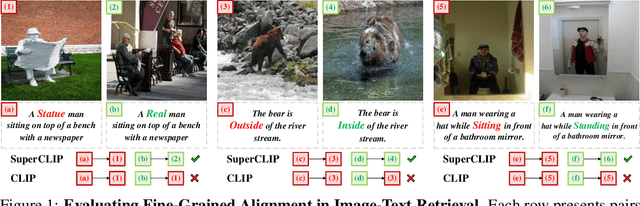

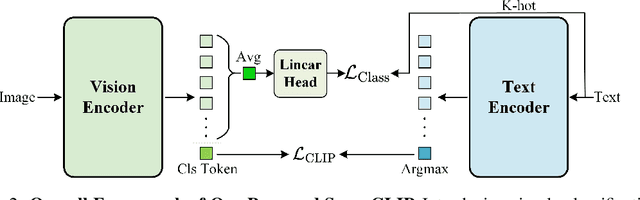
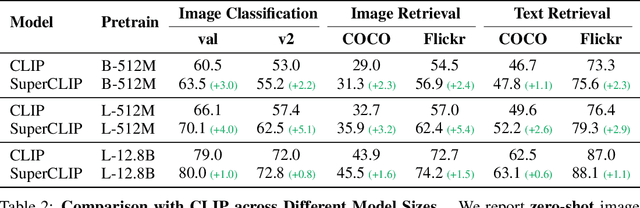
Contrastive Language-Image Pretraining (CLIP) achieves strong generalization in vision-language tasks by aligning images and texts in a shared embedding space. However, recent findings show that CLIP-like models still underutilize fine-grained semantic signals in text, and this issue becomes even more pronounced when dealing with long and detailed captions. This stems from CLIP's training objective, which optimizes only global image-text similarity and overlooks token-level supervision - limiting its ability to achieve fine-grained visual-text alignment. To address this, we propose SuperCLIP, a simple yet effective framework that augments contrastive learning with classification-based supervision. By adding only a lightweight linear layer to the vision encoder, SuperCLIP leverages token-level cues to enhance visual-textual alignment - with just a 0.077% increase in total FLOPs, and no need for additional annotated data. Experiments show that SuperCLIP consistently improves zero-shot classification, image-text retrieval, and purely visual tasks. These gains hold regardless of whether the model is trained on original web data or rich re-captioned data, demonstrating SuperCLIP's ability to recover textual supervision in both cases. Furthermore, SuperCLIP alleviates CLIP's small-batch performance drop through classification-based supervision that avoids reliance on large batch sizes. Code and models will be made open source.