 Add to Chrome
 Add to Firefox
 Add to Edge
DreamWAM: Beyond RGB Future Prediction for World Action Models
Aug 05, 2026
World Action Models (WAMs) learn action-relevant representations by predicting how the observed world will evolve. Most existing WAMs define this future in RGB space, where task-relevant state transitions are entangled with nuisance variations in texture, illumination, background, and viewpoint. We argue that WAMs should explicitly predict action-relevant future state rather than relying on RGB prediction alone. We introduce DreamWAM, which reformulates future prediction as structured world modeling beyond RGB, representing future states through complementary views of appearance, motion, geometry, and semantics. During training, DreamWAM combines joint latent denoising of RGB and motion with lightweight gated residual branches for geometry and semantics. Shared attention between VideoDiT and ActionDiT allows the action branch to learn from these future-state predictions, while all beyond-RGB supervision branches are disabled at inference and deployment remains RGB-only. Across both no-rollout and joint video-action inference, DreamWAM consistently improves the matched RGB-only baselines on LIBERO, from 97.30\% to 98.40\% and from 98.00\% to 98.90\%, respectively. The gains become larger under unseen LIBERO-Plus perturbations, from 51.36\% to 63.44\% and from 69.16\% to 75.47\%. The same robustness extends to real-world manipulation, where DreamWAM attains an average success rate of 74.4\% across unseen changes in lighting, background, and object layout, compared with 55.6\% for Fast-WAM-Joint. These results show that robust world-action learning depends not only on predicting the future, but on representing it in a form that matters for action. The code and models are publicly released at https://github.com/hustvl/DreamWAM.

Faster-WAM: Efficient Inference-Time Future Conditioning for Robust World Action Models
Aug 05, 2026World Action Models (WAMs) improve robot manipulation by learning how the environment evolves beyond the current observation. However, existing approaches face a fundamental dilemma: Joint-WAMs preserve future-aware representations during inference but incur prohibitive computation costs, while efficient alternatives remove future modeling at inference time and may lose the robustness benefits of temporal reasoning. In this work, we revisit the role of future representations in WAMs and show that inference-time future conditioning is critical for generalization under distribution shifts. This observation motivates Faster-WAM, an efficient future-conditioning WAM that preserves future representations while avoiding expensive video-action interaction. Faster-WAM introduces a sparse future-conditioning framework that computes future representations once and selectively reuses them throughout action denoising. Specifically, we propose SparseMoT to replace ubiquitous layer-wise fusion with selective video-action interaction at a compact subset of network stages, and Interval KV-Fusion to aggregate multi-depth future representations without increasing attention complexity. Experiments demonstrate that Faster-WAM achieves a substantially better performance-efficiency trade-off than existing WAMs. On the out-of-distribution LIBERO-Plus benchmark, Faster-WAM improves success rate from 49.14% to 73.57% compared with Fast-WAM, while running 2.21$\times$ faster than Joint-WAM. It further achieves state-of-the-art performance on LIBERO and RoboTwin 2.0, while demonstrating strong robustness in real-world manipulation.
TrustVLA: Mechanism-Guided Inference-Time Defense Against Vision-Language-Action Backdoors
Jul 14, 2026Vision-Language-Action (VLA) models are deployed through pipelines that end users cannot audit, and a poisoned VLA can behave normally on clean observations while a small visual trigger redirects a long-horizon robot policy before any failure becomes observable. Existing vision or language defenses rarely explain what a triggered VLA representation looks like or how to recover behavior without retraining. We study this gap through two independently proposed VLA attacks from groups with distinct injection strategies, BadVLA and INFUSE; the latter persists after downstream clean adaptation. Across the evaluated poisoned models, we identify a recurring internal mechanism: a \emph{compact causal footprint}, namely a small visual support that is attention-seeded, spatially compact, and \emph{causal} in a precise sense -- masking it returns a clean-calibrated evidence-evolution score to the normal operating region. This footprint motivates TrustVLA, a mechanism-guided inference-time defense that adapts the Dirichlet evidence framework from trusted classification to monitor per-token, per-layer epistemic uncertainty in VLA policies. With only a small clean calibration set, TrustVLA (i)~detects abnormal evidence evolution, (ii)~localizes the compact support by counterfactual mechanism-score drop, and (iii)~recovers the observation by localized inpainting. Across OpenVLA/LIBERO and $π_{0.5}$ transfer evaluations, TrustVLA reduces attack success while preserving clean-task performance, providing a retraining-free, mechanism-guided defense for visual-triggered VLA backdoors.
MotionVLA: Injecting Geometric Motion into Vision-Language-Action Model
Jun 06, 2026Vision-language-action (VLA) models increasingly condition robot policies on history, depth, or 4D features to resolve ambiguity in long-horizon manipulation. However, more spatiotemporal evidence is not necessarily better: when the injected evidence is not motion-consistent, it can introduce geometric drift, fragmented temporal cues, and unstable action generation. This raises a simple question: should a VLA remember past frames, or remember the motion that connects them? We introduce MotionVLA, a motion-history interface that converts a short past-only video window into compact, time-continuous trajectory-field tokens. Instead of treating history as a sparse set of ndependently lifted frames, MotionVLA represents recent observations as physically coherent motion evidence. Current visual tokens query this history to retrieve task-relevant motion information, which is then recoupled into the VLA stream under trajectory-grounded supervision. Experiments across simulation benchmarks and preliminary real-robot rollouts show that MotionVLA improves long-horizon manipulation while producing smoother and more direct executions. These results suggest that effective VLA memory is not just about providing more 4D context, but about exposing motion-consistent evidence that is usable for control.
SuperCLIP: CLIP with Simple Classification Supervision
Dec 16, 2025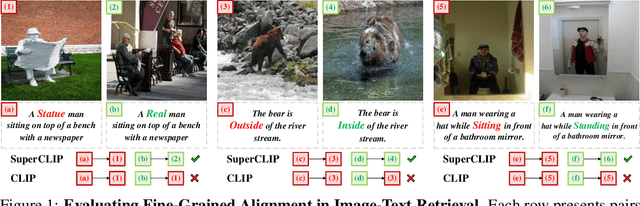

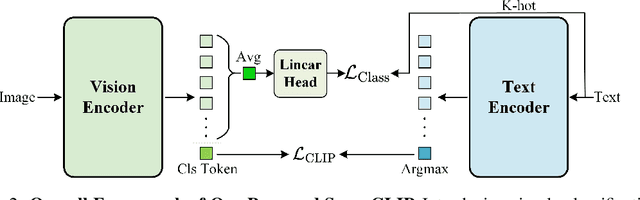
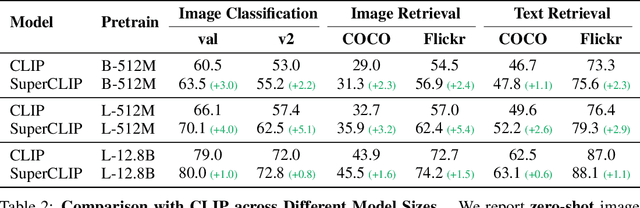
Contrastive Language-Image Pretraining (CLIP) achieves strong generalization in vision-language tasks by aligning images and texts in a shared embedding space. However, recent findings show that CLIP-like models still underutilize fine-grained semantic signals in text, and this issue becomes even more pronounced when dealing with long and detailed captions. This stems from CLIP's training objective, which optimizes only global image-text similarity and overlooks token-level supervision - limiting its ability to achieve fine-grained visual-text alignment. To address this, we propose SuperCLIP, a simple yet effective framework that augments contrastive learning with classification-based supervision. By adding only a lightweight linear layer to the vision encoder, SuperCLIP leverages token-level cues to enhance visual-textual alignment - with just a 0.077% increase in total FLOPs, and no need for additional annotated data. Experiments show that SuperCLIP consistently improves zero-shot classification, image-text retrieval, and purely visual tasks. These gains hold regardless of whether the model is trained on original web data or rich re-captioned data, demonstrating SuperCLIP's ability to recover textual supervision in both cases. Furthermore, SuperCLIP alleviates CLIP's small-batch performance drop through classification-based supervision that avoids reliance on large batch sizes. Code and models will be made open source.