 Add to Chrome
 Add to Firefox
 Add to Edge
Semantic Distance Measurement based on Multi-Kernel Gaussian Processes
Dec 13, 2025
Semantic distance measurement is a fundamental problem in computational linguistics, providing a quantitative characterization of similarity or relatedness between text segments, and underpinning tasks such as text retrieval and text classification. From a mathematical perspective, a semantic distance can be viewed as a metric defined on a space of texts or on a representation space derived from them. However, most classical semantic distance methods are essentially fixed, making them difficult to adapt to specific data distributions and task requirements. In this paper, a semantic distance measure based on multi-kernel Gaussian processes (MK-GP) was proposed. The latent semantic function associated with texts was modeled as a Gaussian process, with its covariance function given by a combined kernel combining Matérn and polynomial components. The kernel parameters were learned automatically from data under supervision, rather than being hand-crafted. This semantic distance was instantiated and evaluated in the context of fine-grained sentiment classification with large language models under an in-context learning (ICL) setup. The experimental results demonstrated the effectiveness of the proposed measure.

Learning a Single Model with a Wide Range of Quality Factors for JPEG Image Artifacts Removal
Sep 15, 2020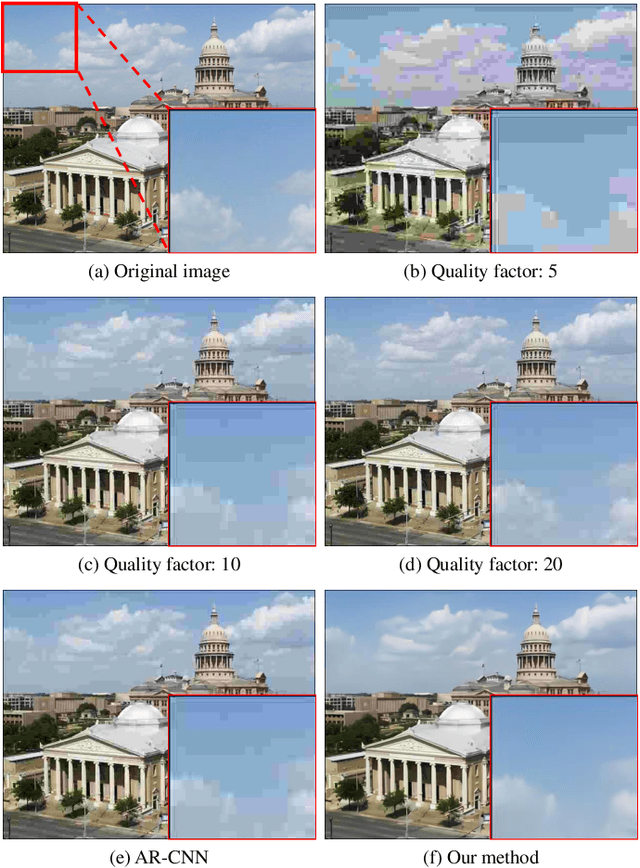
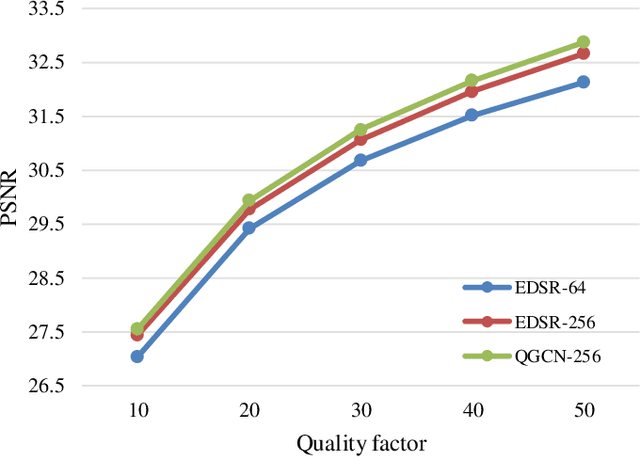
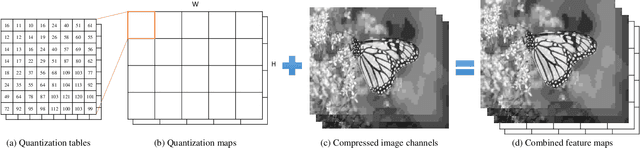
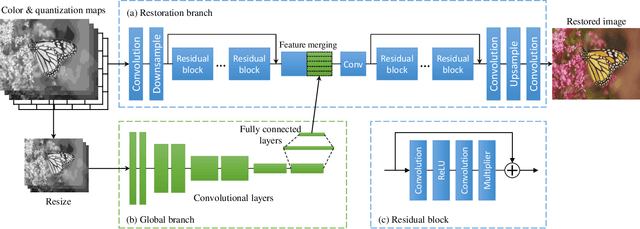
Lossy compression brings artifacts into the compressed image and degrades the visual quality. In recent years, many compression artifacts removal methods based on convolutional neural network (CNN) have been developed with great success. However, these methods usually train a model based on one specific value or a small range of quality factors. Obviously, if the test image's quality factor does not match to the assumed value range, then degraded performance will be resulted. With this motivation and further consideration of practical usage, a highly robust compression artifacts removal network is proposed in this paper. Our proposed network is a single model approach that can be trained for handling a wide range of quality factors while consistently delivering superior or comparable image artifacts removal performance. To demonstrate, we focus on the JPEG compression with quality factors, ranging from 1 to 60. Note that a turnkey success of our proposed network lies in the novel utilization of the quantization tables as part of the training data. Furthermore, it has two branches in parallel---i.e., the restoration branch and the global branch. The former effectively removes the local artifacts, such as ringing artifacts removal. On the other hand, the latter extracts the global features of the entire image that provides highly instrumental image quality improvement, especially effective on dealing with the global artifacts, such as blocking, color shifting. Extensive experimental results performed on color and grayscale images have clearly demonstrated the effectiveness and efficacy of our proposed single-model approach on the removal of compression artifacts from the decoded image.