 Add to Chrome
 Add to Firefox
 Add to Edge
LabelFusion-TS: Fusing Large Language Models, Transformer Encoders, and Financial Time Series for Monetary-Policy Stance Classification
Aug 12, 2026
Financial text is produced and interpreted within a market environment, yet financial text classifiers almost always receive text alone. We study whether financial time series are useful as an additional input on the task of classifying sentences from Federal Reserve communication as hawkish, dovish, or neutral. Our system, \lfts{}, extends the \lf{} architecture with this modality: a small voting network combines three independently trained components, a fine-tuned RoBERTa encoder, a prompted large language model (LLM), and a fused ensemble of time-series transformers over the market series of the months preceding publication. Because only about a thousand annotated sentences are available for training, the RoBERTa encoder is first pre-trained on sentences annotated automatically by the LLM and only then fine-tuned on the human labels. Trained on Federal Open Market Committee (FOMC) communication up to 2015 and evaluated on 2015--2022, the fused system achieves 70.2\% weighted F1 -- against 64.1\% for the zero-shot LLM -- and overtakes it with as few as 240 human-labelled sentences. We take this as initial evidence for market time series as an input modality in financial text classification.

CAFE: A Compound-AI Factorial Evaluation Framework
Jul 11, 2026We introduce CAFE (Compound-AI Factorial Evaluation), an open-source platform that brings design of experiments to the evaluation of compound AI systems (CAIS). Such systems expose many interchangeable choices - e.g. which retriever, model, or prompt - and practitioners rarely know which of them most affects answer quality. With CAFE, a practitioner registers each swappable component of a pipeline as a factor to build a factorial design over the chosen factors, run the resulting configurations, and score the answers on a shared rubric using a configurable LLM judge together with human raters. From these ratings it attributes answer-quality variance to the components and their interactions with mixed-effects models and reports effect sizes, significance, the best configuration, cost and latency trade-offs, and judge-human reliability. Whereas existing tools mostly either search for a good configuration or score outputs in isolation, CAFE also explains which component drives quality and whether an observed difference is significant. We validate CAFE on a retrieval-augmented question-answering (QA) pipeline over the HotpotQA benchmark dataset, where it recovers planted factor effects and stays calibrated under a permutation null. CAFE is released as a Python package and as a Web application.
Quality Without Usefulness: LLM-Generated XAI Narratives as Trust Heuristics Rather Than Decision Aids
May 26, 2026Prior work shows that Large Language Models (LLMs) can transform Explainable AI (XAI) outputs into Natural Language Explanations (NLEs) that score highly on quality metrics such as plausibility, coherence, and comprehensibility. But does explanation quality translate to practical usefulness? We investigate this question in a time-series energy forecasting domain through five controlled experiments (2,730 judgments across 60 test instances), each operationalising a distinct facet of usefulness studied in the XAI literature. Holding NLE quality constant at the high levels established by a prior factorial study, we find that NLEs do not improve task accuracy on any of the five tasks, while inflating self-reported confidence. A placebic control shows that this confidence boost is driven by text presence rather than content. In an out-of-distribution detection task, NLEs reduce the LLM judge's ability to flag unreliable predictions, providing false reassurance that masks model failure. We characterise these findings as the Quality-Usefulness Gap and argue that evaluation of the XAI-to-NLE pipeline must extend beyond text-quality metrics to downstream task performance.
From Uniform to Learned Knots: A Study of Spline-Based Numerical Encodings for Tabular Deep Learning
Apr 07, 2026Numerical preprocessing remains an important component of tabular deep learning, where the representation of continuous features can strongly affect downstream performance. Although its importance is well established for classical statistical and machine learning models, the role of explicit numerical preprocessing in tabular deep learning remains less well understood. In this work, we study this question with a focus on spline-based numerical encodings. We investigate three spline families for encoding numerical features, namely B-splines, M-splines, and integrated splines (I-splines), under uniform, quantile-based, target-aware, and learnable-knot placement. For the learnable-knot variants, we use a differentiable knot parameterization that enables stable end-to-end optimization of knot locations jointly with the backbone. We evaluate these encodings on a diverse collection of public regression and classification datasets using MLP, ResNet, and FT-Transformer backbones, and compare them against common numerical preprocessing baselines. Our results show that the effect of numerical encodings depends strongly on the task, output size, and backbone. For classification, piecewise-linear encoding (PLE) is the most robust choice overall, while spline-based encodings remain competitive. For regression, no single encoding dominates uniformly. Instead, performance depends on the spline family, knot-placement strategy, and output size, with larger gains typically observed for MLP and ResNet than for FT-Transformer. We further find that learnable-knot variants can be optimized stably under the proposed parameterization, but may substantially increase training cost, especially for M-spline and I-spline expansions. Overall, the results show that numerical encodings should be assessed not only in terms of predictive performance, but also in terms of computational overhead.
Not All News Is Equal: Topic- and Event-Conditional Sentiment from Finetuned LLMs for Aluminum Price Forecasting
Mar 10, 2026By capturing the prevailing sentiment and market mood, textual data has become increasingly vital for forecasting commodity prices, particularly in metal markets. However, the effectiveness of lightweight, finetuned large language models (LLMs) in extracting predictive signals for aluminum prices, and the specific market conditions under which these signals are most informative, remains under-explored. This study generates monthly sentiment scores from English and Chinese news headlines (Reuters, Dow Jones Newswires, and China News Service) and integrates them with traditional tabular data, including base metal indices, exchange rates, inflation rates, and energy prices. We evaluate the predictive performance and economic utility of these models through long-short simulations on the Shanghai Metal Exchange from 2007 to 2024. Our results demonstrate that during periods of high volatility, Long Short-Term Memory (LSTM) models incorporating sentiment data from a finetuned Qwen3 model (Sharpe ratio 1.04) significantly outperform baseline models using tabular data alone (Sharpe ratio 0.23). Subsequent analysis elucidates the nuanced roles of news sources, topics, and event types in aluminum price forecasting.
LLM-Augmented Changepoint Detection: A Framework for Ensemble Detection and Automated Explanation
Jan 06, 2026This paper introduces a novel changepoint detection framework that combines ensemble statistical methods with Large Language Models (LLMs) to enhance both detection accuracy and the interpretability of regime changes in time series data. Two critical limitations in the field are addressed. First, individual detection methods exhibit complementary strengths and weaknesses depending on data characteristics, making method selection non-trivial and prone to suboptimal results. Second, automated, contextual explanations for detected changes are largely absent. The proposed ensemble method aggregates results from ten distinct changepoint detection algorithms, achieving superior performance and robustness compared to individual methods. Additionally, an LLM-powered explanation pipeline automatically generates contextual narratives, linking detected changepoints to potential real-world historical events. For private or domain-specific data, a Retrieval-Augmented Generation (RAG) solution enables explanations grounded in user-provided documents. The open source Python framework demonstrates practical utility in diverse domains, including finance, political science, and environmental science, transforming raw statistical output into actionable insights for analysts and decision-makers.
From XAI to Stories: A Factorial Study of LLM-Generated Explanation Quality
Jan 05, 2026Explainable AI (XAI) methods like SHAP and LIME produce numerical feature attributions that remain inaccessible to non expert users. Prior work has shown that Large Language Models (LLMs) can transform these outputs into natural language explanations (NLEs), but it remains unclear which factors contribute to high-quality explanations. We present a systematic factorial study investigating how Forecasting model choice, XAI method, LLM selection, and prompting strategy affect NLE quality. Our design spans four models (XGBoost (XGB), Random Forest (RF), Multilayer Perceptron (MLP), and SARIMAX - comparing black-box Machine-Learning (ML) against classical time-series approaches), three XAI conditions (SHAP, LIME, and a no-XAI baseline), three LLMs (GPT-4o, Llama-3-8B, DeepSeek-R1), and eight prompting strategies. Using G-Eval, an LLM-as-a-judge evaluation method, with dual LLM judges and four evaluation criteria, we evaluate 660 explanations for time-series forecasting. Our results suggest that: (1) XAI provides only small improvements over no-XAI baselines, and only for expert audiences; (2) LLM choice dominates all other factors, with DeepSeek-R1 outperforming GPT-4o and Llama-3; (3) we observe an interpretability paradox: in our setting, SARIMAX yielded lower NLE quality than ML models despite higher prediction accuracy; (4) zero-shot prompting is competitive with self-consistency at 7-times lower cost; and (5) chain-of-thought hurts rather than helps.
LabelFusion: Learning to Fuse LLMs and Transformer Classifiers for Robust Text Classification
Dec 11, 2025LabelFusion is a fusion ensemble for text classification that learns to combine a traditional transformer-based classifier (e.g., RoBERTa) with one or more Large Language Models (LLMs such as OpenAI GPT, Google Gemini, or DeepSeek) to deliver accurate and cost-aware predictions across multi-class and multi-label tasks. The package provides a simple high-level interface (AutoFusionClassifier) that trains the full pipeline end-to-end with minimal configuration, and a flexible API for advanced users. Under the hood, LabelFusion integrates vector signals from both sources by concatenating the ML backbone's embeddings with the LLM-derived per-class scores -- obtained through structured prompt-engineering strategies -- and feeds this joint representation into a compact multi-layer perceptron (FusionMLP) that produces the final prediction. This learned fusion approach captures complementary strengths of LLM reasoning and traditional transformer-based classifiers, yielding robust performance across domains -- achieving 92.4% accuracy on AG News and 92.3% on 10-class Reuters 21578 topic classification -- while enabling practical trade-offs between accuracy, latency, and cost.
Mambular: A Sequential Model for Tabular Deep Learning
Aug 12, 2024The analysis of tabular data has traditionally been dominated by gradient-boosted decision trees (GBDTs), known for their proficiency with mixed categorical and numerical features. However, recent deep learning innovations are challenging this dominance. We introduce Mambular, an adaptation of the Mamba architecture optimized for tabular data. We extensively benchmark Mambular against state-of-the-art models, including neural networks and tree-based methods, and demonstrate its competitive performance across diverse datasets. Additionally, we explore various adaptations of Mambular to understand its effectiveness for tabular data. We investigate different pooling strategies, feature interaction mechanisms, and bi-directional processing. Our analysis shows that interpreting features as a sequence and passing them through Mamba layers results in surprisingly performant models. The results highlight Mambulars potential as a versatile and powerful architecture for tabular data analysis, expanding the scope of deep learning applications in this domain. The source code is available at https://github.com/basf/mamba-tabular.
Probabilistic Topic Modelling with Transformer Representations
Mar 06, 2024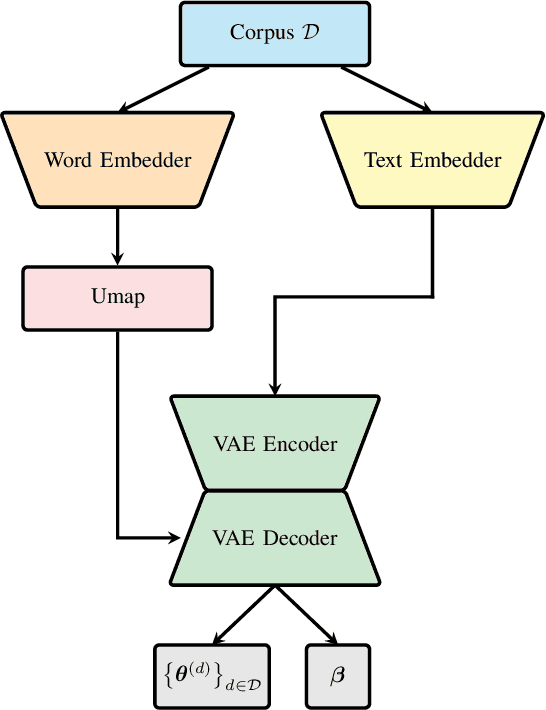
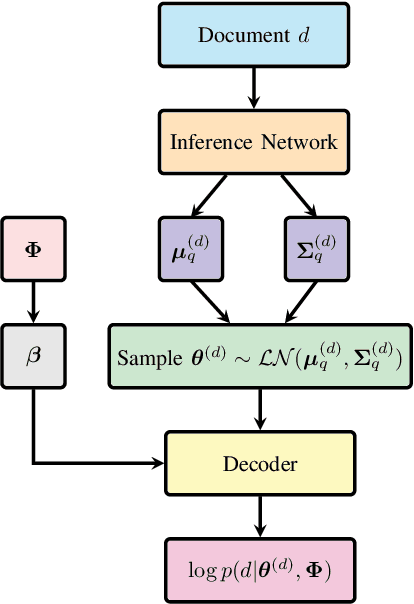
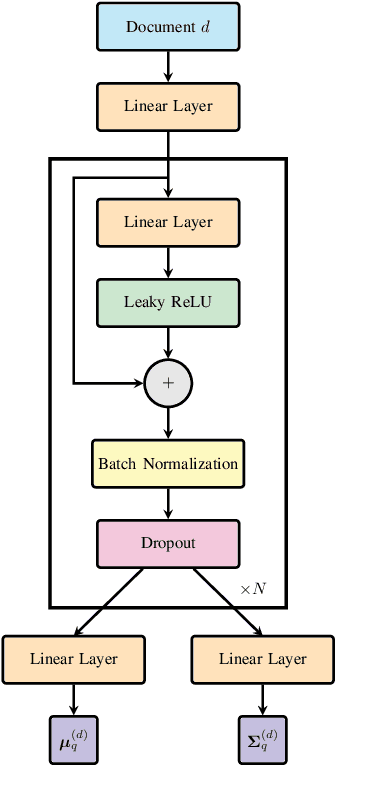
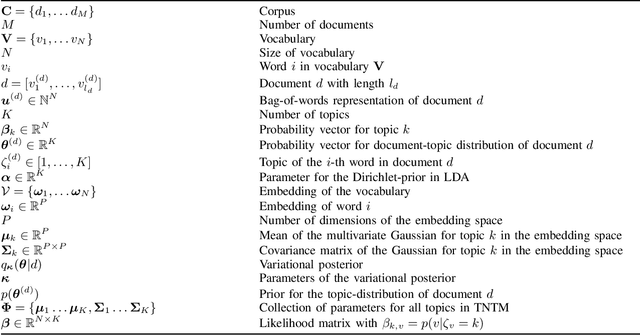
Topic modelling was mostly dominated by Bayesian graphical models during the last decade. With the rise of transformers in Natural Language Processing, however, several successful models that rely on straightforward clustering approaches in transformer-based embedding spaces have emerged and consolidated the notion of topics as clusters of embedding vectors. We propose the Transformer-Representation Neural Topic Model (TNTM), which combines the benefits of topic representations in transformer-based embedding spaces and probabilistic modelling. Therefore, this approach unifies the powerful and versatile notion of topics based on transformer embeddings with fully probabilistic modelling, as in models such as Latent Dirichlet Allocation (LDA). We utilize the variational autoencoder (VAE) framework for improved inference speed and modelling flexibility. Experimental results show that our proposed model achieves results on par with various state-of-the-art approaches in terms of embedding coherence while maintaining almost perfect topic diversity. The corresponding source code is available at https://github.com/ArikReuter/TNTM.