 Add to Chrome
 Add to Firefox
 Add to Edge
Unsupervised Text Style Transfer
Papers and Code
Unsupervised Text Style Transfer for Controllable Intensity
Jan 03, 2026
Unsupervised Text Style Transfer (UTST) aims to build a system to transfer the stylistic properties of a given text without parallel text pairs. Compared with text transfer between style polarities, UTST for controllable intensity is more challenging due to the subtle differences in stylistic features across different intensity levels. Faced with the challenges posed by the lack of parallel data and the indistinguishability between adjacent intensity levels, we propose a SFT-then-PPO paradigm to fine-tune an LLM. We first fine-tune the LLM with synthesized parallel data. Then, we further train the LLM with PPO, where the rewards are elaborately designed for distinguishing the stylistic intensity in hierarchical levels. Both the global and local stylistic features are considered to formulate the reward functions. The experiments on two UTST benchmarks showcase that both rewards have their advantages and applying them to LLM fine-tuning can effectively improve the performance of an LLM backbone based on various evaluation metrics. Even for close levels of intensity, we can still observe the noticeable stylistic difference between the generated text.

RLBind: Adversarial-Invariant Cross-Modal Alignment for Unified Robust Embeddings
Sep 17, 2025Unified multi-modal encoders that bind vision, audio, and other sensors into a shared embedding space are attractive building blocks for robot perception and decision-making. However, on-robot deployment exposes the vision branch to adversarial and natural corruptions, making robustness a prerequisite for safety. Prior defenses typically align clean and adversarial features within CLIP-style encoders and overlook broader cross-modal correspondence, yielding modest gains and often degrading zero-shot transfer. We introduce RLBind, a two-stage adversarial-invariant cross-modal alignment framework for robust unified embeddings. Stage 1 performs unsupervised fine-tuning on clean-adversarial pairs to harden the visual encoder. Stage 2 leverages cross-modal correspondence by minimizing the discrepancy between clean/adversarial features and a text anchor, while enforcing class-wise distributional alignment across modalities. Extensive experiments on Image, Audio, Thermal, and Video data show that RLBind consistently outperforms the LanguageBind backbone and standard fine-tuning baselines in both clean accuracy and norm-bounded adversarial robustness. By improving resilience without sacrificing generalization, RLBind provides a practical path toward safer multi-sensor perception stacks for embodied robots in navigation, manipulation, and other autonomy settings.
Hard Prompts Made Interpretable: Sparse Entropy Regularization for Prompt Tuning with RL
Jul 20, 2024With the advent of foundation models, prompt tuning has positioned itself as an important technique for directing model behaviors and eliciting desired responses. Prompt tuning regards selecting appropriate keywords included into the input, thereby adapting to the downstream task without adjusting or fine-tuning the model parameters. There is a wide range of work in prompt tuning, from approaches that directly harness the backpropagated gradient signals from the model, to those employing black-box optimization such as reinforcement learning (RL) methods. Our primary focus is on RLPrompt, which aims to find optimal prompt tokens leveraging soft Q-learning. While the results show promise, we have observed that the prompts frequently appear unnatural, which impedes their interpretability. We address this limitation by using sparse Tsallis entropy regularization, a principled approach to filtering out unlikely tokens from consideration. We extensively evaluate our approach across various tasks, including few-shot text classification, unsupervised text style transfer, and textual inversion from images. The results indicate a notable improvement over baselines, highlighting the efficacy of our approach in addressing the challenges of prompt tuning. Moreover, we show that the prompts discovered using our method are more natural and interpretable compared to those from other baselines.
Unsupervised Text Style Transfer via LLMs and Attention Masking with Multi-way Interactions
Feb 21, 2024Unsupervised Text Style Transfer (UTST) has emerged as a critical task within the domain of Natural Language Processing (NLP), aiming to transfer one stylistic aspect of a sentence into another style without changing its semantics, syntax, or other attributes. This task is especially challenging given the intrinsic lack of parallel text pairings. Among existing methods for UTST tasks, attention masking approach and Large Language Models (LLMs) are deemed as two pioneering methods. However, they have shortcomings in generating unsmooth sentences and changing the original contents, respectively. In this paper, we investigate if we can combine these two methods effectively. We propose four ways of interactions, that are pipeline framework with tuned orders; knowledge distillation from LLMs to attention masking model; in-context learning with constructed parallel examples. We empirically show these multi-way interactions can improve the baselines in certain perspective of style strength, content preservation and text fluency. Experiments also demonstrate that simply conducting prompting followed by attention masking-based revision can consistently surpass the other systems, including supervised text style transfer systems. On Yelp-clean and Amazon-clean datasets, it improves the previously best mean metric by 0.5 and 3.0 absolute percentages respectively, and achieves new SOTA results.
Prefix-Tuning Based Unsupervised Text Style Transfer
Oct 23, 2023Unsupervised text style transfer aims at training a generative model that can alter the style of the input sentence while preserving its content without using any parallel data. In this paper, we employ powerful pre-trained large language models and present a new prefix-tuning-based method for unsupervised text style transfer. We construct three different kinds of prefixes, i.e., \textit{shared prefix, style prefix}, and \textit{content prefix}, to encode task-specific information, target style, and the content information of the input sentence, respectively. Compared to embeddings used by previous works, the proposed prefixes can provide richer information for the model. Furthermore, we adopt a recursive way of using language models in the process of style transfer. This strategy provides a more effective way for the interactions between the input sentence and GPT-2, helps the model construct more informative prefixes, and thus, helps improve the performance. Evaluations on the well-known datasets show that our method outperforms the state-of-the-art baselines. Results, analysis of ablation studies, and subjective evaluations from humans are also provided for a deeper understanding of the proposed method.
A Survey of Text Style Transfer: Applications and Ethical Implications
Jul 23, 2024Text style transfer (TST) is an important task in controllable text generation, which aims to control selected attributes of language use, such as politeness, formality, or sentiment, without altering the style-independent content of the text. The field has received considerable research attention in recent years and has already been covered in several reviews, but the focus has mostly been on the development of new algorithms and learning from different types of data (supervised, unsupervised, out-of-domain, etc.) and not so much on the application side. However, TST-related technologies are gradually reaching a production- and deployment-ready level, and therefore, the inclusion of the application perspective in TST research becomes crucial. Similarly, the often overlooked ethical considerations of TST technology have become a pressing issue. This paper presents a comprehensive review of TST applications that have been researched over the years, using both traditional linguistic approaches and more recent deep learning methods. We discuss current challenges, future research directions, and ethical implications of TST applications in text generation. By providing a holistic overview of the landscape of TST applications, we hope to stimulate further research and contribute to a better understanding of the potential as well as ethical considerations associated with TST.
Unsupervised Text Style Transfer with Deep Generative Models
Aug 31, 2023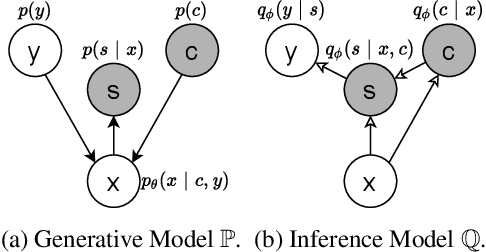
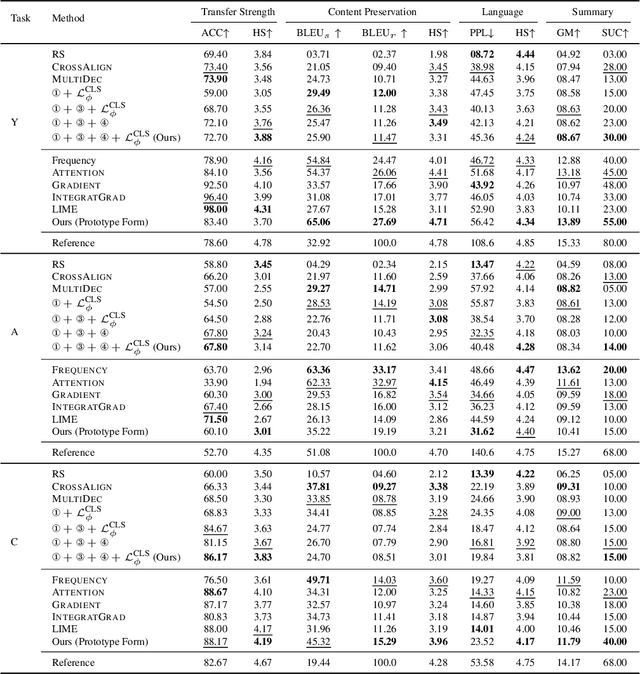
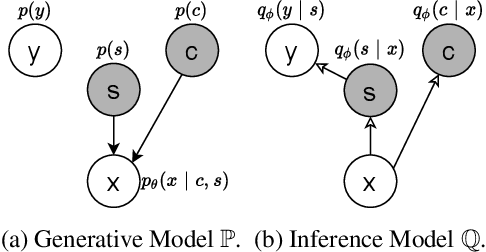
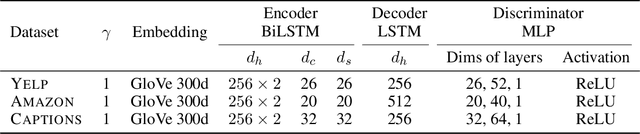
We present a general framework for unsupervised text style transfer with deep generative models. The framework models each sentence-label pair in the non-parallel corpus as partially observed from a complete quadruplet which additionally contains two latent codes representing the content and style, respectively. These codes are learned by exploiting dependencies inside the observed data. Then a sentence is transferred by manipulating them. Our framework is able to unify previous embedding and prototype methods as two special forms. It also provides a principled perspective to explain previously proposed techniques in the field such as aligned encoder and adversarial training. We further conduct experiments on three benchmarks. Both automatic and human evaluation results show that our methods achieve better or competitive results compared to several strong baselines.
MSSRNet: Manipulating Sequential Style Representation for Unsupervised Text Style Transfer
Jun 12, 2023Unsupervised text style transfer task aims to rewrite a text into target style while preserving its main content. Traditional methods rely on the use of a fixed-sized vector to regulate text style, which is difficult to accurately convey the style strength for each individual token. In fact, each token of a text contains different style intensity and makes different contribution to the overall style. Our proposed method addresses this issue by assigning individual style vector to each token in a text, allowing for fine-grained control and manipulation of the style strength. Additionally, an adversarial training framework integrated with teacher-student learning is introduced to enhance training stability and reduce the complexity of high-dimensional optimization. The results of our experiments demonstrate the efficacy of our method in terms of clearly improved style transfer accuracy and content preservation in both two-style transfer and multi-style transfer settings.
Distilling Text Style Transfer With Self-Explanation From LLMs
Mar 02, 2024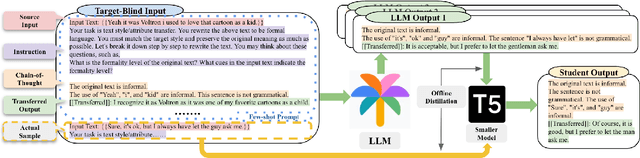


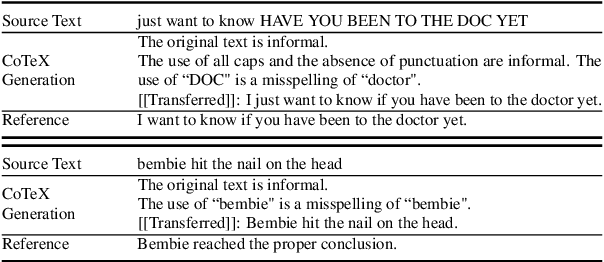
Text Style Transfer (TST) seeks to alter the style of text while retaining its core content. Given the constraints of limited parallel datasets for TST, we propose CoTeX, a framework that leverages large language models (LLMs) alongside chain-of-thought (CoT) prompting to facilitate TST. CoTeX distills the complex rewriting and reasoning capabilities of LLMs into more streamlined models capable of working with both non-parallel and parallel data. Through experimentation across four TST datasets, CoTeX is shown to surpass traditional supervised fine-tuning and knowledge distillation methods, particularly in low-resource settings. We conduct a comprehensive evaluation, comparing CoTeX against current unsupervised, supervised, in-context learning (ICL) techniques, and instruction-tuned LLMs. Furthermore, CoTeX distinguishes itself by offering transparent explanations for its style transfer process.
MultiParaDetox: Extending Text Detoxification with Parallel Data to New Languages
Apr 02, 2024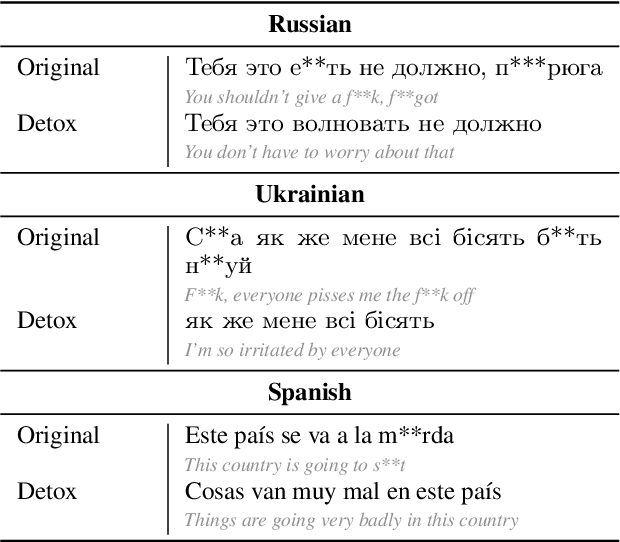

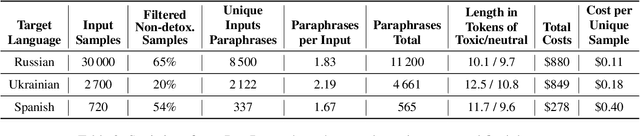

Text detoxification is a textual style transfer (TST) task where a text is paraphrased from a toxic surface form, e.g. featuring rude words, to the neutral register. Recently, text detoxification methods found their applications in various task such as detoxification of Large Language Models (LLMs) (Leong et al., 2023; He et al., 2024; Tang et al., 2023) and toxic speech combating in social networks (Deng et al., 2023; Mun et al., 2023; Agarwal et al., 2023). All these applications are extremely important to ensure safe communication in modern digital worlds. However, the previous approaches for parallel text detoxification corpora collection -- ParaDetox (Logacheva et al., 2022) and APPADIA (Atwell et al., 2022) -- were explored only in monolingual setup. In this work, we aim to extend ParaDetox pipeline to multiple languages presenting MultiParaDetox to automate parallel detoxification corpus collection for potentially any language. Then, we experiment with different text detoxification models -- from unsupervised baselines to LLMs and fine-tuned models on the presented parallel corpora -- showing the great benefit of parallel corpus presence to obtain state-of-the-art text detoxification models for any language.