 Add to Chrome
 Add to Firefox
 Add to Edge
Unsupervised Text Style Transfer for Controllable Intensity
Jan 03, 2026
Unsupervised Text Style Transfer (UTST) aims to build a system to transfer the stylistic properties of a given text without parallel text pairs. Compared with text transfer between style polarities, UTST for controllable intensity is more challenging due to the subtle differences in stylistic features across different intensity levels. Faced with the challenges posed by the lack of parallel data and the indistinguishability between adjacent intensity levels, we propose a SFT-then-PPO paradigm to fine-tune an LLM. We first fine-tune the LLM with synthesized parallel data. Then, we further train the LLM with PPO, where the rewards are elaborately designed for distinguishing the stylistic intensity in hierarchical levels. Both the global and local stylistic features are considered to formulate the reward functions. The experiments on two UTST benchmarks showcase that both rewards have their advantages and applying them to LLM fine-tuning can effectively improve the performance of an LLM backbone based on various evaluation metrics. Even for close levels of intensity, we can still observe the noticeable stylistic difference between the generated text.

RIDE: Difficulty Evolving Perturbation with Item Response Theory for Mathematical Reasoning
Nov 06, 2025Large language models (LLMs) achieve high performance on mathematical reasoning, but these results can be inflated by training data leakage or superficial pattern matching rather than genuine reasoning. To this end, an adversarial perturbation-based evaluation is needed to measure true mathematical reasoning ability. Current rule-based perturbation methods often generate ill-posed questions and impede the systematic evaluation of question difficulty and the evolution of benchmarks. To bridge this gap, we propose RIDE, a novel adversarial question-rewriting framework that leverages Item Response Theory (IRT) to rigorously measure question difficulty and to generate intrinsically more challenging, well-posed variations of mathematical problems. We employ 35 LLMs to simulate students and build a difficulty ranker from their responses. This ranker provides a reward signal during reinforcement learning and guides a question-rewriting model to reformulate existing questions across difficulty levels. Applying RIDE to competition-level mathematical benchmarks yields perturbed versions that degrade advanced LLM performance, with experiments showing an average 21.73% drop across 26 models, thereby exposing limited robustness in mathematical reasoning and confirming the validity of our evaluation approach.
Aligning Large Language Models to a Domain-specific Graph Database
Feb 28, 2024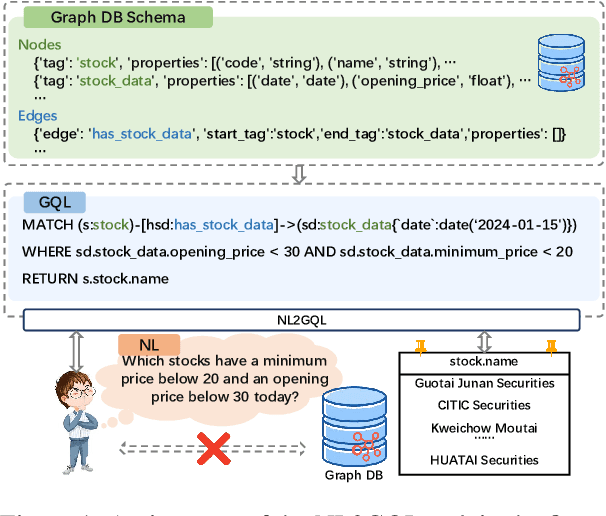
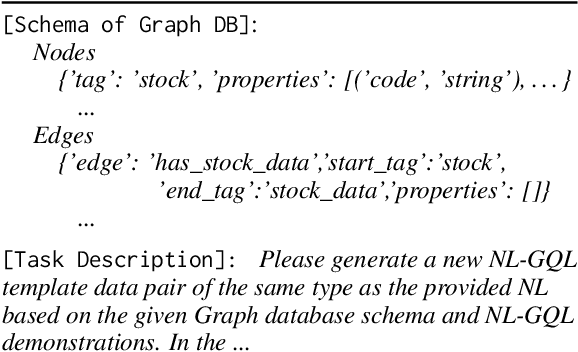
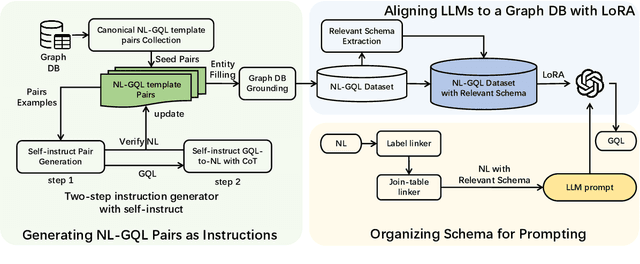
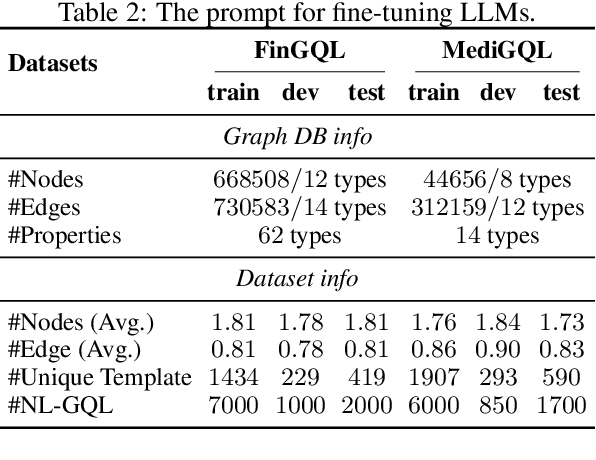
Graph Databases (Graph DB) are widely applied in various fields, including finance, social networks, and medicine. However, translating Natural Language (NL) into the Graph Query Language (GQL), commonly known as NL2GQL, proves to be challenging due to its inherent complexity and specialized nature. Some approaches have sought to utilize Large Language Models (LLMs) to address analogous tasks like text2SQL. Nevertheless, when it comes to NL2GQL taskson a particular domain, the absence of domain-specific NL-GQL data pairs makes it difficult to establish alignment between LLMs and the graph DB. To address this challenge, we propose a well-defined pipeline. Specifically, we utilize ChatGPT to create NL-GQL data pairs based on the given graph DB with self-instruct. Then, we use the created data to fine-tune LLMs, thereby achieving alignment between LLMs and the graph DB. Additionally, during inference, we propose a method that extracts relevant schema to the queried NL as the input context to guide LLMs for generating accurate GQLs.We evaluate our method on two constructed datasets deriving from graph DBs in finance domain and medicine domain, namely FinGQL and MediGQL. Experimental results demonstrate that our method significantly outperforms a set of baseline methods, with improvements of 5.90 and 6.36 absolute points on EM, and 6.00 and 7.09 absolute points on EX, respectively.