 Add to Chrome
 Add to Firefox
 Add to Edge
VetScore: Risk-Weighted Fact Verification for Veterinary Long-Form QA with Citations
Aug 04, 2026
Citation excerpts can be used to increase the reliability of generated outputs and their faithfulness to cited sources, which is especially important in high-stakes domains such as human and veterinary medicine. However, this does not guarantee that generated claims are faithful to the provided excerpts. We present VetScore, a multi-step evaluation method for veterinary long-form question answering, designed to assess how well are generated claims supported by the provided excerpts, weighing this information by each claim's harm potential. VetScore first segments the output and decomposes it into individual claims, then scores each claim with respect to its harm potential and evaluates its faithfulness to source excerpts, and finally calculates the overall risk-adjusted score. We collect an expert-annotated meta-evaluation dataset, evaluate our approach with a range of judge models, and show that it achieves high correlations with veterinary experts even with small judge models, while offering explainability across multiple dimensions.

PluraMath: Extending Mathematical Reasoning Evaluation Beyond High-Resource Languages
Jul 07, 2026Mathematical reasoning has become a central task for evaluating and tuning reasoning Large Language Models (LLMs), yet existing benchmarks remain heavily biased toward high-resource languages, with English and Chinese dominating both pre-training corpora and evaluation suites. The recently released PolyMath (Wang et al., 2025) dataset represents a significant step forward, yet its coverage is still limited to 18 only high-resource languages. To address this gap, we introduce PluraMath, an extension of PolyMath to 18 additional {underrepresented languages spanning 6 language families -- ranging from mid-resource to extreme low-resource settings. We constructed the dataset through a human-curated pipeline, where native speakers thoroughly validated pre-computed translations. Using PluraMath, we then benchmark 27 reasoning LLMs across four model scales -- small, mid-size, large, and closed-source ensembles -- probing the multilingual mathematical reasoning capabilities of state-of-the-art models under diverse linguistic conditions. Our fine-grained analysis confirms a persistent gap in mathematical reasoning performance between high-resource and underrepresented languages, with stronger results largely associated with better instruction-following ability. We fully open-source our dataset, data acquisition pipeline, and evaluation framework, with the goal of lowering the barrier to multilingual benchmark development for underrepresented communities.
UFAL-CUNI at SemEval-2026 Task 11: An Efficient Modular Neuro-symbolic Method for Syllogistic Reasoning
May 06, 2026This paper describes our system submitted to SemEval-2026 Task 11: Disentangling Content and Formal Reasoning in Large Language Models. We present an efficient modular neuro-symbolic approach, combining a symbolic prover with small reasoning LLMs (4B parameters). The system consists of an LLM-based parser that translates natural language syllogisms to a first-order logic (FOL) representation, an automated theorem prover, and two optional modules: machine translation for multilingual inputs and a symbolic retrieval component for the identification of relevant premises. The system achieves competitive accuracy and relatively low content effect on most subtasks. Our ablations show that this approach outperforms LLM-based zero-shot baselines in this parameter size range, but also reveal limited multilingual capabilities of small LLMs. Finally, we include a discussion of the task's main ranking metric and analyze its limitations.
Reasoning Gets Harder for LLMs Inside A Dialogue
Mar 20, 2026Large Language Models (LLMs) achieve strong performance on many reasoning benchmarks, yet these evaluations typically focus on isolated tasks that differ from real-world usage in task-oriented dialogue (TOD). In this setting, LLMs must perform reasoning inherently while generating text and adhering to instructions on role, format, and style. This mismatch raises concerns about whether benchmark performance accurately reflects models' reasoning robustness in TOD setting. We investigate how framing reasoning tasks within TOD affects LLM performance by introducing BOULDER, a new dynamic benchmark covering eight travel-related tasks that require arithmetic, spatial, and temporal reasoning with both commonsense and formal aspects. Each problem is presented in both isolated and dialogue-based variants, enabling controlled comparison while mitigating data contamination. Experiments on eight LLMs reveal a substantial and consistent performance gap between isolated and dialogue settings. Through ablations and qualitative analysis, we show that this gap is largely driven by the multi-turn nature of dialogue, with additional effects from role conditioning and tool-use requirements. Our results highlight the need to evaluate LLM reasoning in realistic interactive scenarios.
LLM Agents Implement an NLG System from Scratch: Building Interpretable Rule-Based RDF-to-Text Generators
Dec 20, 2025We present a novel neurosymbolic framework for RDF-to-text generation, in which the model is "trained" through collaborative interactions among multiple LLM agents rather than traditional backpropagation. The LLM agents produce rule-based Python code for a generator for the given domain, based on RDF triples only, with no in-domain human reference texts. The resulting system is fully interpretable, requires no supervised training data, and generates text nearly instantaneously using only a single CPU. Our experiments on the WebNLG and OpenDialKG data show that outputs produced by our approach reduce hallucination, with only slight fluency penalties compared to finetuned or prompted language models
SRS-Stories: Vocabulary-constrained multilingual story generation for language learning
Dec 20, 2025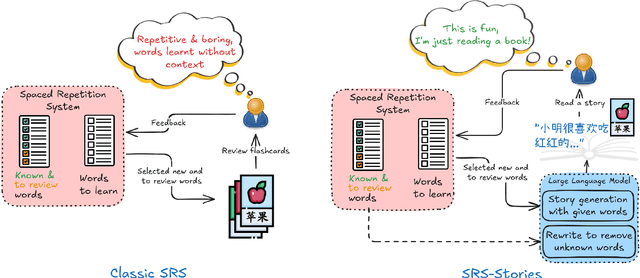
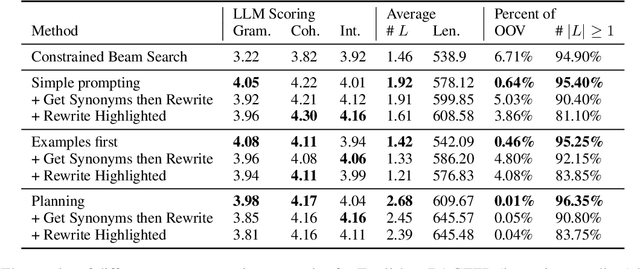
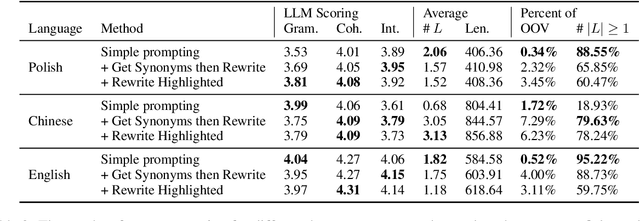
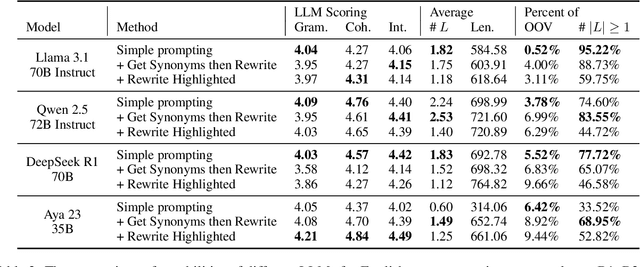
In this paper, we use large language models to generate personalized stories for language learners, using only the vocabulary they know. The generated texts are specifically written to teach the user new vocabulary by simply reading stories where it appears in context, while at the same time seamlessly reviewing recently learned vocabulary. The generated stories are enjoyable to read and the vocabulary reviewing/learning is optimized by a Spaced Repetition System. The experiments are conducted in three languages: English, Chinese and Polish, evaluating three story generation methods and three strategies for enforcing lexical constraints. The results show that the generated stories are more grammatical, coherent, and provide better examples of word usage than texts generated by the standard constrained beam search approach
OpeNLGauge: An Explainable Metric for NLG Evaluation with Open-Weights LLMs
Mar 14, 2025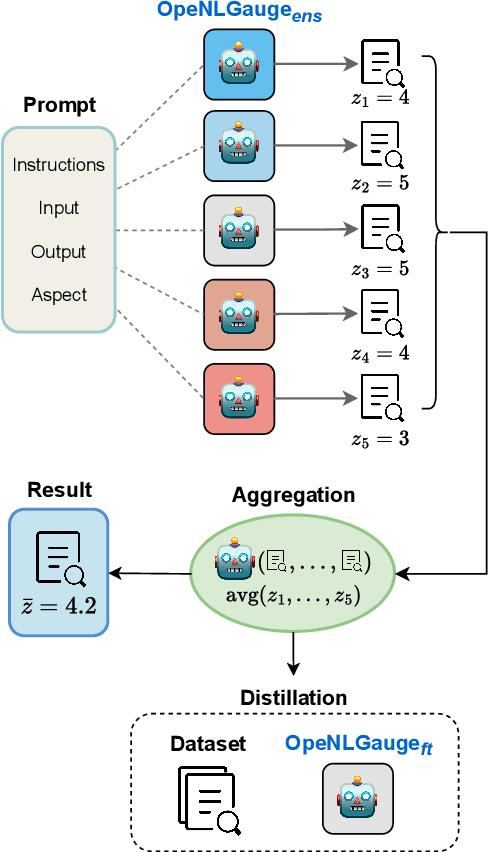
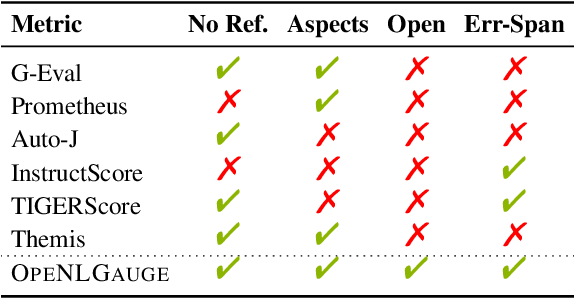
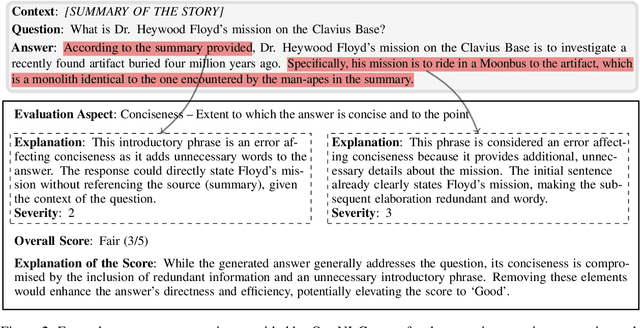
Large Language Models (LLMs) have demonstrated great potential as evaluators of NLG systems, allowing for high-quality, reference-free, and multi-aspect assessments. However, existing LLM-based metrics suffer from two major drawbacks: reliance on proprietary models to generate training data or perform evaluations, and a lack of fine-grained, explanatory feedback. In this paper, we introduce OpeNLGauge, a fully open-source, reference-free NLG evaluation metric that provides accurate explanations based on error spans. OpeNLGauge is available as a two-stage ensemble of larger open-weight LLMs, or as a small fine-tuned evaluation model, with confirmed generalizability to unseen tasks, domains and aspects. Our extensive meta-evaluation shows that OpeNLGauge achieves competitive correlation with human judgments, outperforming state-of-the-art models on certain tasks while maintaining full reproducibility and providing explanations more than twice as accurate.
Leveraging Large Language Models for Building Interpretable Rule-Based Data-to-Text Systems
Feb 28, 2025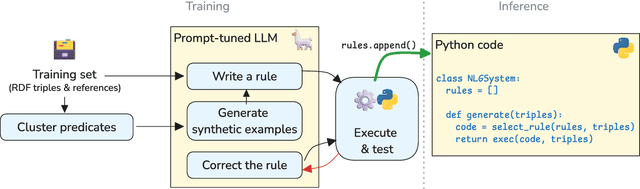


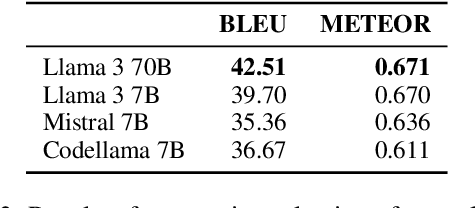
We introduce a simple approach that uses a large language model (LLM) to automatically implement a fully interpretable rule-based data-to-text system in pure Python. Experimental evaluation on the WebNLG dataset showed that such a constructed system produces text of better quality (according to the BLEU and BLEURT metrics) than the same LLM prompted to directly produce outputs, and produces fewer hallucinations than a BART language model fine-tuned on the same data. Furthermore, at runtime, the approach generates text in a fraction of the processing time required by neural approaches, using only a single CPU
Polish-ASTE: Aspect-Sentiment Triplet Extraction Datasets for Polish
Feb 27, 2025Aspect-Sentiment Triplet Extraction (ASTE) is one of the most challenging and complex tasks in sentiment analysis. It concerns the construction of triplets that contain an aspect, its associated sentiment polarity, and an opinion phrase that serves as a rationale for the assigned polarity. Despite the growing popularity of the task and the many machine learning methods being proposed to address it, the number of datasets for ASTE is very limited. In particular, no dataset is available for any of the Slavic languages. In this paper, we present two new datasets for ASTE containing customer opinions about hotels and purchased products expressed in Polish. We also perform experiments with two ASTE techniques combined with two large language models for Polish to investigate their performance and the difficulty of the assembled datasets. The new datasets are available under a permissive licence and have the same file format as the English datasets, facilitating their use in future research.
Counterfactual Explanations with Probabilistic Guarantees on their Robustness to Model Change
Aug 09, 2024


Counterfactual explanations (CFEs) guide users on how to adjust inputs to machine learning models to achieve desired outputs. While existing research primarily addresses static scenarios, real-world applications often involve data or model changes, potentially invalidating previously generated CFEs and rendering user-induced input changes ineffective. Current methods addressing this issue often support only specific models or change types, require extensive hyperparameter tuning, or fail to provide probabilistic guarantees on CFE robustness to model changes. This paper proposes a novel approach for generating CFEs that provides probabilistic guarantees for any model and change type, while offering interpretable and easy-to-select hyperparameters. We establish a theoretical framework for probabilistically defining robustness to model change and demonstrate how our BetaRCE method directly stems from it. BetaRCE is a post-hoc method applied alongside a chosen base CFE generation method to enhance the quality of the explanation beyond robustness. It facilitates a transition from the base explanation to a more robust one with user-adjusted probability bounds. Through experimental comparisons with baselines, we show that BetaRCE yields robust, most plausible, and closest to baseline counterfactual explanations.