 Add to Chrome
 Add to Firefox
 Add to Edge
Temporal Sentence Grounding
Papers and Code
Finding Optimal Video Moment without Training: Gaussian Boundary Optimization for Weakly Supervised Video Grounding
Feb 03, 2026
Weakly supervised temporal video grounding aims to localize query-relevant segments in untrimmed videos using only video-sentence pairs, without requiring ground-truth segment annotations that specify exact temporal boundaries. Recent approaches tackle this task by utilizing Gaussian-based temporal proposals to represent query-relevant segments. However, their inference strategies rely on heuristic mappings from Gaussian parameters to segment boundaries, resulting in suboptimal localization performance. To address this issue, we propose Gaussian Boundary Optimization (GBO), a novel inference framework that predicts segment boundaries by solving a principled optimization problem that balances proposal coverage and segment compactness. We derive a closed-form solution for this problem and rigorously analyze the optimality conditions under varying penalty regimes. Beyond its theoretical foundations, GBO offers several practical advantages: it is training-free and compatible with both single-Gaussian and mixture-based proposal architectures. Our experiments show that GBO significantly improves localization, achieving state-of-the-art results across standard benchmarks. Extensive experiments demonstrate the efficiency and generalizability of GBO across various proposal schemes. The code is available at \href{https://github.com/sunoh-kim/gbo}{https://github.com/sunoh-kim/gbo}.

Standardizing Longitudinal Radiology Report Evaluation via Large Language Model Annotation
Jan 23, 2026Longitudinal information in radiology reports refers to the sequential tracking of findings across multiple examinations over time, which is crucial for monitoring disease progression and guiding clinical decisions. Many recent automated radiology report generation methods are designed to capture longitudinal information; however, validating their performance is challenging. There is no proper tool to consistently label temporal changes in both ground-truth and model-generated texts for meaningful comparisons. Existing annotation methods are typically labor-intensive, relying on the use of manual lexicons and rules. Complex rules are closed-source, domain specific and hard to adapt, whereas overly simple ones tend to miss essential specialised information. Large language models (LLMs) offer a promising annotation alternative, as they are capable of capturing nuanced linguistic patterns and semantic similarities without extensive manual intervention. They also adapt well to new contexts. In this study, we therefore propose an LLM-based pipeline to automatically annotate longitudinal information in radiology reports. The pipeline first identifies sentences containing relevant information and then extracts the progression of diseases. We evaluate and compare five mainstream LLMs on these two tasks using 500 manually annotated reports. Considering both efficiency and performance, Qwen2.5-32B was subsequently selected and used to annotate another 95,169 reports from the public MIMIC-CXR dataset. Our Qwen2.5-32B-annotated dataset provided us with a standardized benchmark for evaluating report generation models. Using this new benchmark, we assessed seven state-of-the-art report generation models. Our LLM-based annotation method outperforms existing annotation solutions, achieving 11.3\% and 5.3\% higher F1-scores for longitudinal information detection and disease tracking, respectively.
Planner-Refiner: Dynamic Space-Time Refinement for Vision-Language Alignment in Videos
Aug 10, 2025Vision-language alignment in video must address the complexity of language, evolving interacting entities, their action chains, and semantic gaps between language and vision. This work introduces Planner-Refiner, a framework to overcome these challenges. Planner-Refiner bridges the semantic gap by iteratively refining visual elements' space-time representation, guided by language until semantic gaps are minimal. A Planner module schedules language guidance by decomposing complex linguistic prompts into short sentence chains. The Refiner processes each short sentence, a noun-phrase and verb-phrase pair, to direct visual tokens' self-attention across space then time, achieving efficient single-step refinement. A recurrent system chains these steps, maintaining refined visual token representations. The final representation feeds into task-specific heads for alignment generation. We demonstrate Planner-Refiner's effectiveness on two video-language alignment tasks: Referring Video Object Segmentation and Temporal Grounding with varying language complexity. We further introduce a new MeViS-X benchmark to assess models' capability with long queries. Superior performance versus state-of-the-art methods on these benchmarks shows the approach's potential, especially for complex prompts.
Weakly Supervised Temporal Sentence Grounding via Positive Sample Mining
May 10, 2025The task of weakly supervised temporal sentence grounding (WSTSG) aims to detect temporal intervals corresponding to a language description from untrimmed videos with only video-level video-language correspondence. For an anchor sample, most existing approaches generate negative samples either from other videos or within the same video for contrastive learning. However, some training samples are highly similar to the anchor sample, directly regarding them as negative samples leads to difficulties for optimization and ignores the correlations between these similar samples and the anchor sample. To address this, we propose Positive Sample Mining (PSM), a novel framework that mines positive samples from the training set to provide more discriminative supervision. Specifically, for a given anchor sample, we partition the remaining training set into semantically similar and dissimilar subsets based on the similarity of their text queries. To effectively leverage these correlations, we introduce a PSM-guided contrastive loss to ensure that the anchor proposal is closer to similar samples and further from dissimilar ones. Additionally, we design a PSM-guided rank loss to ensure that similar samples are closer to the anchor proposal than to the negative intra-video proposal, aiming to distinguish the anchor proposal and the negative intra-video proposal. Experiments on the WSTSG and grounded VideoQA tasks demonstrate the effectiveness and superiority of our method.
Burn After Reading: Do Multimodal Large Language Models Truly Capture Order of Events in Image Sequences?
Jun 12, 2025This paper introduces the TempVS benchmark, which focuses on temporal grounding and reasoning capabilities of Multimodal Large Language Models (MLLMs) in image sequences. TempVS consists of three main tests (i.e., event relation inference, sentence ordering and image ordering), each accompanied with a basic grounding test. TempVS requires MLLMs to rely on both visual and linguistic modalities to understand the temporal order of events. We evaluate 38 state-of-the-art MLLMs, demonstrating that models struggle to solve TempVS, with a substantial performance gap compared to human capabilities. We also provide fine-grained insights that suggest promising directions for future research. Our TempVS benchmark data and code are available at https://github.com/yjsong22/TempVS.
Contrast-Unity for Partially-Supervised Temporal Sentence Grounding
Feb 18, 2025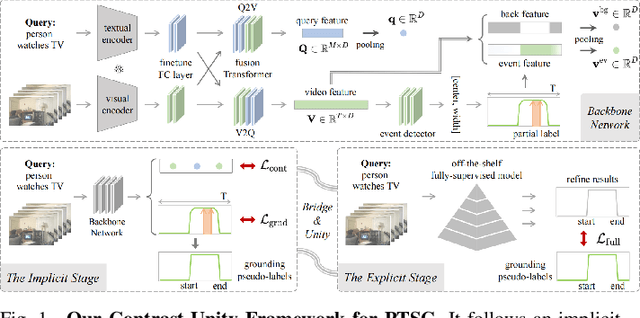
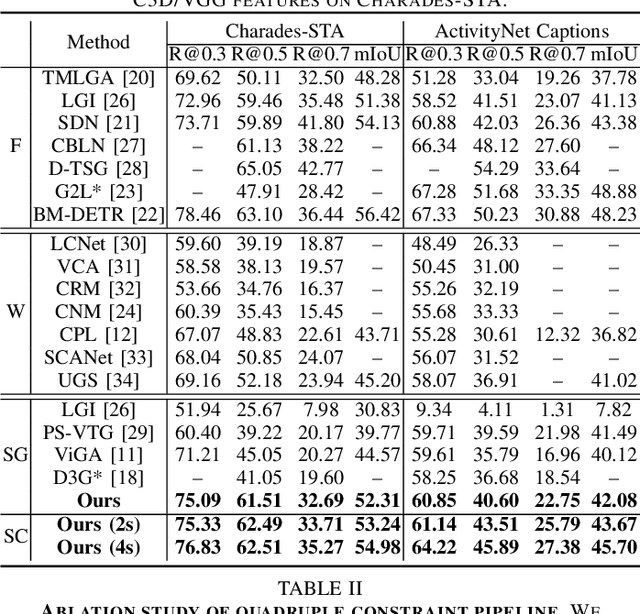
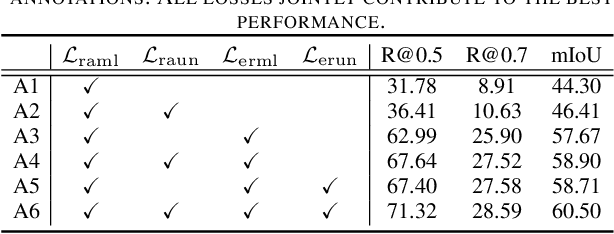
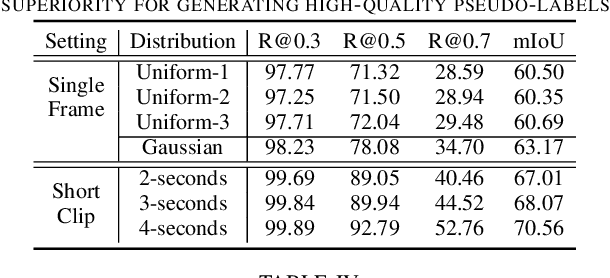
Temporal sentence grounding aims to detect event timestamps described by the natural language query from given untrimmed videos. The existing fully-supervised setting achieves great results but requires expensive annotation costs; while the weakly-supervised setting adopts cheap labels but performs poorly. To pursue high performance with less annotation costs, this paper introduces an intermediate partially-supervised setting, i.e., only short-clip is available during training. To make full use of partial labels, we specially design one contrast-unity framework, with the two-stage goal of implicit-explicit progressive grounding. In the implicit stage, we align event-query representations at fine granularity using comprehensive quadruple contrastive learning: event-query gather, event-background separation, intra-cluster compactness and inter-cluster separability. Then, high-quality representations bring acceptable grounding pseudo-labels. In the explicit stage, to explicitly optimize grounding objectives, we train one fully-supervised model using obtained pseudo-labels for grounding refinement and denoising. Extensive experiments and thoroughly ablations on Charades-STA and ActivityNet Captions demonstrate the significance of partial supervision, as well as our superior performance.
Chronocept: Instilling a Sense of Time in Machines
May 12, 2025Human cognition is deeply intertwined with a sense of time, known as Chronoception. This sense allows us to judge how long facts remain valid and when knowledge becomes outdated. Despite progress in vision, language, and motor control, AI still struggles to reason about temporal validity. We introduce Chronocept, the first benchmark to model temporal validity as a continuous probability distribution over time. Using skew-normal curves fitted along semantically decomposed temporal axes, Chronocept captures nuanced patterns of emergence, decay, and peak relevance. It includes two datasets: Benchmark I (atomic facts) and Benchmark II (multi-sentence passages). Annotations show strong inter-annotator agreement (84% and 89%). Our baselines predict curve parameters - location, scale, and skewness - enabling interpretable, generalizable learning and outperforming classification-based approaches. Chronocept fills a foundational gap in AI's temporal reasoning, supporting applications in knowledge grounding, fact-checking, retrieval-augmented generation (RAG), and proactive agents. Code and data are publicly available.
Intentional Gesture: Deliver Your Intentions with Gestures for Speech
May 21, 2025When humans speak, gestures help convey communicative intentions, such as adding emphasis or describing concepts. However, current co-speech gesture generation methods rely solely on superficial linguistic cues (\textit{e.g.} speech audio or text transcripts), neglecting to understand and leverage the communicative intention that underpins human gestures. This results in outputs that are rhythmically synchronized with speech but are semantically shallow. To address this gap, we introduce \textbf{Intentional-Gesture}, a novel framework that casts gesture generation as an intention-reasoning task grounded in high-level communicative functions. % First, we curate the \textbf{InG} dataset by augmenting BEAT-2 with gesture-intention annotations (\textit{i.e.}, text sentences summarizing intentions), which are automatically annotated using large vision-language models. Next, we introduce the \textbf{Intentional Gesture Motion Tokenizer} to leverage these intention annotations. It injects high-level communicative functions (\textit{e.g.}, intentions) into tokenized motion representations to enable intention-aware gesture synthesis that are both temporally aligned and semantically meaningful, achieving new state-of-the-art performance on the BEAT-2 benchmark. Our framework offers a modular foundation for expressive gesture generation in digital humans and embodied AI. Project Page: https://andypinxinliu.github.io/Intentional-Gesture
Diversified Augmentation with Domain Adaptation for Debiased Video Temporal Grounding
Jan 14, 2025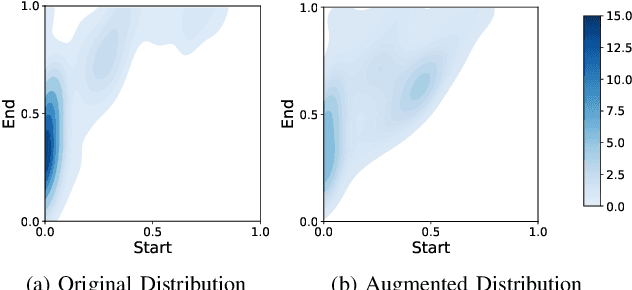
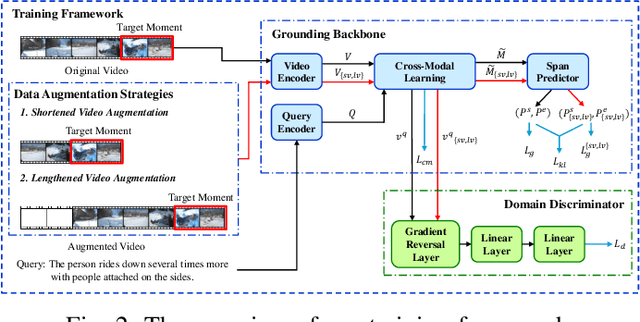
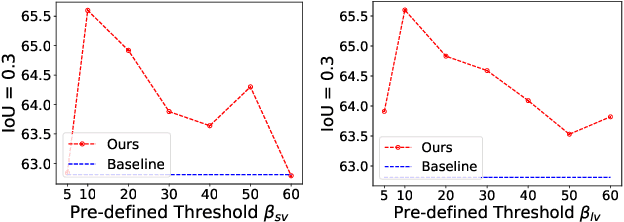
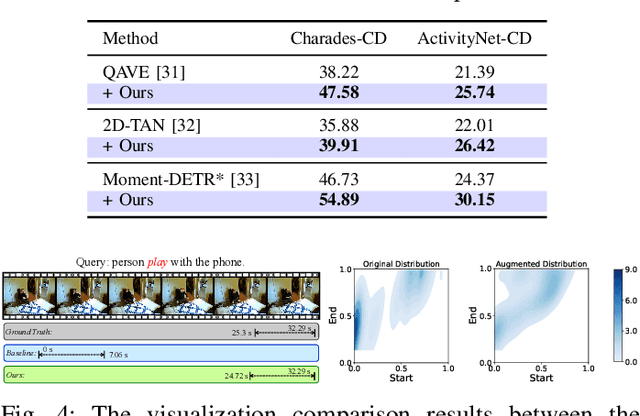
Temporal sentence grounding in videos (TSGV) faces challenges due to public TSGV datasets containing significant temporal biases, which are attributed to the uneven temporal distributions of target moments. Existing methods generate augmented videos, where target moments are forced to have varying temporal locations. However, since the video lengths of the given datasets have small variations, only changing the temporal locations results in poor generalization ability in videos with varying lengths. In this paper, we propose a novel training framework complemented by diversified data augmentation and a domain discriminator. The data augmentation generates videos with various lengths and target moment locations to diversify temporal distributions. However, augmented videos inevitably exhibit distinct feature distributions which may introduce noise. To address this, we design a domain adaptation auxiliary task to diminish feature discrepancies between original and augmented videos. We also encourage the model to produce distinct predictions for videos with the same text queries but different moment locations to promote debiased training. Experiments on Charades-CD and ActivityNet-CD datasets demonstrate the effectiveness and generalization abilities of our method in multiple grounding structures, achieving state-of-the-art results.
Multi-Pair Temporal Sentence Grounding via Multi-Thread Knowledge Transfer Network
Dec 20, 2024
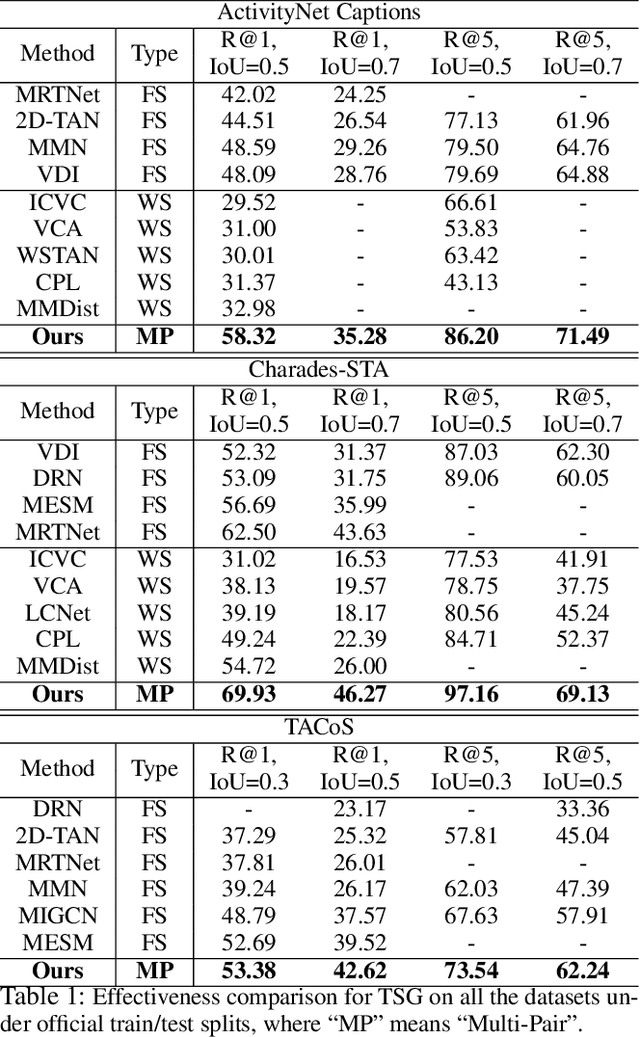


Given some video-query pairs with untrimmed videos and sentence queries, temporal sentence grounding (TSG) aims to locate query-relevant segments in these videos. Although previous respectable TSG methods have achieved remarkable success, they train each video-query pair separately and ignore the relationship between different pairs. We observe that the similar video/query content not only helps the TSG model better understand and generalize the cross-modal representation but also assists the model in locating some complex video-query pairs. Previous methods follow a single-thread framework that cannot co-train different pairs and usually spends much time re-obtaining redundant knowledge, limiting their real-world applications. To this end, in this paper, we pose a brand-new setting: Multi-Pair TSG, which aims to co-train these pairs. In particular, we propose a novel video-query co-training approach, Multi-Thread Knowledge Transfer Network, to locate a variety of video-query pairs effectively and efficiently. Firstly, we mine the spatial and temporal semantics across different queries to cooperate with each other. To learn intra- and inter-modal representations simultaneously, we design a cross-modal contrast module to explore the semantic consistency by a self-supervised strategy. To fully align visual and textual representations between different pairs, we design a prototype alignment strategy to 1) match object prototypes and phrase prototypes for spatial alignment, and 2) align activity prototypes and sentence prototypes for temporal alignment. Finally, we develop an adaptive negative selection module to adaptively generate a threshold for cross-modal matching. Extensive experiments show the effectiveness and efficiency of our proposed method.