 Add to Chrome
 Add to Firefox
 Add to Edge
Synthetic Rain Datasets
Papers and Code
UENR-600K: A Large-Scale Physically Grounded Dataset for Nighttime Video Deraining
Apr 06, 2026
Nighttime video deraining is uniquely challenging because raindrops interact with artificial lighting. Unlike daytime white rain, nighttime rain takes on various colors and appears locally illuminated. Existing small-scale synthetic datasets rely on 2D rain overlays and fail to capture these physical properties, causing models to generalize poorly to real-world night rain. Meanwhile, capturing real paired nighttime videos remains impractical because rain effects cannot be isolated from other degradations like sensor noise. To bridge this gap, we introduce UENR-600K, a large-scale, physically grounded dataset containing 600,000 1080p frame pairs. We utilize Unreal Engine to simulate rain as 3D particles within virtual environments. This approach guarantees photorealism and physically real raindrops, capturing correct details like color refractions, scene occlusions, rain curtains. Leveraging this high-quality data, we establish a new state-of-the-art baseline by adapting the Wan 2.2 video generation model. Our baseline treat deraining as a video-to-video generation task, exploiting strong generative priors to almost entirely bridge the sim-to-real gap. Extensive benchmarking demonstrates that models trained on our dataset generalize significantly better to real-world videos. Project page: https://showlab.github.io/UENR-600K/.

Cross-Scenario Deraining Adaptation with Unpaired Data: Superpixel Structural Priors and Multi-Stage Pseudo-Rain Synthesis
Mar 23, 2026Image deraining plays a pivotal role in low-level computer vision, serving as a prerequisite for robust outdoor surveillance and autonomous driving systems. While deep learning paradigms have achieved remarkable success in firmly aligned settings, they often suffer from severe performance degradation when generalized to unseen Out-of-Distribution (OOD) scenarios. This failure stems primarily from the significant domain discrepancy between synthetic training datasets and the complex physical dynamics of real-world rain. To address these challenges, this paper proposes a pioneering cross-scenario deraining adaptation framework. Diverging from conventional approaches, our method obviates the requirements for paired rainy observations in the target domain, leveraging exclusively rain-free background images. We design a Superpixel Generation (Sup-Gen) module to extract stable structural priors from the source domain using Simple Linear Iterative Clustering. Subsequently, a Resolution-adaptive Fusion strategy is introduced to align these source structures with target backgrounds through texture similarity, ensuring the synthesis of diverse and realistic pseudo-data. Finally, we implement a pseudo-label re-Synthesize mechanism that employs multi-stage noise generation to simulate realistic rain streaks. This framework functions as a versatile plug-and-play module capable of seamless integration into arbitrary deraining architectures. Extensive experiments on state-of-the-art models demonstrate that our approach yields remarkable PSNR gains of up to 32% to 59% in OOD domains while significantly accelerating training convergence.
WeatherReasonSeg: A Benchmark for Weather-Aware Reasoning Segmentation in Visual Language Models
Mar 18, 2026Existing vision-language models (VLMs) have demonstrated impressive performance in reasoning-based segmentation. However, current benchmarks are primarily constructed from high-quality images captured under idealized conditions. This raises a critical question: when visual cues are severely degraded by adverse weather conditions such as rain, snow, or fog, can VLMs sustain reliable reasoning segmentation capabilities? In response to this challenge, we introduce WeatherReasonSeg, a benchmark designed to evaluate VLM performance in reasoning-based segmentation under adverse weather conditions. It consists of two complementary components. First, we construct a controllable reasoning dataset by applying synthetic weather with varying severity levels to existing segmentation datasets, enabling fine-grained robustness analysis. Second, to capture real-world complexity, we curate a real-world adverse-weather reasoning segmentation dataset with semantically consistent queries generated via mask-guided LLM prompting. We further broaden the evaluation scope across five reasoning dimensions, including functionality, application scenarios, structural attributes, interactions, and requirement matching. Extensive experiments across diverse VLMs reveal two key findings: (1) VLM performance degrades monotonically with increasing weather severity, and (2) different weather types induce distinct vulnerability patterns. We hope WeatherReasonSeg will serve as a foundation for advancing robust, weather-aware reasoning.
The Diffusion Duet: Harmonizing Dual Channels with Wavelet Suppression for Image Separation
Feb 13, 2026Blind image separation (BIS) refers to the inverse problem of simultaneously estimating and restoring multiple independent source images from a single observation image under conditions of unknown mixing mode and without prior knowledge of the source images. Traditional methods relying on statistical independence assumptions or CNN/GAN variants struggle to characterize complex feature distributions in real scenes, leading to estimation bias, texture distortion, and artifact residue under strong noise and nonlinear mixing. This paper innovatively introduces diffusion models into dual-channel BIS, proposing an efficient Dual-Channel Diffusion Separation Model (DCDSM). DCDSM leverages diffusion models' powerful generative capability to learn source image feature distributions and reconstruct feature structures effectively. A novel Wavelet Suppression Module (WSM) is designed within the dual-branch reverse denoising process, forming an interactive separation network that enhances detail separation by exploiting the mutual coupling noise characteristic between source images. Extensive experiments on synthetic datasets containing rain/snow and complex mixtures demonstrate that DCDSM achieves state-of-the-art performance: 1) In image restoration tasks, it obtains PSNR/SSIM values of 35.0023 dB/0.9549 and 29.8108 dB/0.9243 for rain and snow removal respectively, outperforming Histoformer and LDRCNet by 1.2570 dB/0.9272 dB (PSNR) and 0.0262/0.0289 (SSIM) on average; 2) For complex mixture separation, the restored dual-source images achieve average PSNR and SSIM of 25.0049 dB and 0.7997, surpassing comparative methods by 4.1249 dB and 0.0926. Both subjective and objective evaluations confirm DCDSM's superiority in addressing rain/snow residue removal and detail preservation challenges.
A New Dataset and Framework for Robust Road Surface Classification via Camera-IMU Fusion
Jan 29, 2026Road surface classification (RSC) is a key enabler for environment-aware predictive maintenance systems. However, existing RSC techniques often fail to generalize beyond narrow operational conditions due to limited sensing modalities and datasets that lack environmental diversity. This work addresses these limitations by introducing a multimodal framework that fuses images and inertial measurements using a lightweight bidirectional cross-attention module followed by an adaptive gating layer that adjusts modality contributions under domain shifts. Given the limitations of current benchmarks, especially regarding lack of variability, we introduce ROAD, a new dataset composed of three complementary subsets: (i) real-world multimodal recordings with RGB-IMU streams synchronized using a gold-standard industry datalogger, captured across diverse lighting, weather, and surface conditions; (ii) a large vision-only subset designed to assess robustness under adverse illumination and heterogeneous capture setups; and (iii) a synthetic subset generated to study out-of-distribution generalization in scenarios difficult to obtain in practice. Experiments show that our method achieves a +1.4 pp improvement over the previous state-of-the-art on the PVS benchmark and an +11.6 pp improvement on our multimodal ROAD subset, with consistently higher F1-scores on minority classes. The framework also demonstrates stable performance across challenging visual conditions, including nighttime, heavy rain, and mixed-surface transitions. These findings indicate that combining affordable camera and IMU sensors with multimodal attention mechanisms provides a scalable, robust foundation for road surface understanding, particularly relevant for regions where environmental variability and cost constraints limit the adoption of high-end sensing suites.
PRE-Mamba: A 4D State Space Model for Ultra-High-Frequent Event Camera Deraining
May 08, 2025Event cameras excel in high temporal resolution and dynamic range but suffer from dense noise in rainy conditions. Existing event deraining methods face trade-offs between temporal precision, deraining effectiveness, and computational efficiency. In this paper, we propose PRE-Mamba, a novel point-based event camera deraining framework that fully exploits the spatiotemporal characteristics of raw event and rain. Our framework introduces a 4D event cloud representation that integrates dual temporal scales to preserve high temporal precision, a Spatio-Temporal Decoupling and Fusion module (STDF) that enhances deraining capability by enabling shallow decoupling and interaction of temporal and spatial information, and a Multi-Scale State Space Model (MS3M) that captures deeper rain dynamics across dual-temporal and multi-spatial scales with linear computational complexity. Enhanced by frequency-domain regularization, PRE-Mamba achieves superior performance (0.95 SR, 0.91 NR, and 0.4s/M events) with only 0.26M parameters on EventRain-27K, a comprehensive dataset with labeled synthetic and real-world sequences. Moreover, our method generalizes well across varying rain intensities, viewpoints, and even snowy conditions.
Iterative Optimal Attention and Local Model for Single Image Rain Streak Removal
Mar 20, 2025High-fidelity imaging is crucial for the successful safety supervision and intelligent deployment of vision-based measurement systems (VBMS). It ensures high-quality imaging in VBMS, which is fundamental for reliable visual measurement and analysis. However, imaging quality can be significantly impaired by adverse weather conditions, particularly rain, leading to blurred images and reduced contrast. Such impairments increase the risk of inaccurate evaluations and misinterpretations in VBMS. To address these limitations, we propose an Expectation Maximization Reconstruction Transformer (EMResformer) for single image rain streak removal. The EMResformer retains the key self-attention values for feature aggregation, enhancing local features to produce superior image reconstruction. Specifically, we propose an Expectation Maximization Block seamlessly integrated into the single image rain streak removal network, enhancing its ability to eliminate superfluous information and restore a cleaner background image. Additionally, to further enhance local information for improved detail rendition, we introduce a Local Model Residual Block, which integrates two local model blocks along with a sequence of convolutions and activation functions. This integration synergistically facilitates the extraction of more pertinent features for enhanced single image rain streak removal. Extensive experiments validate that our proposed EMResformer surpasses current state-of-the-art single image rain streak removal methods on both synthetic and real-world datasets, achieving an improved balance between model complexity and single image deraining performance. Furthermore, we evaluate the effectiveness of our method in VBMS scenarios, demonstrating that high-quality imaging significantly improves the accuracy and reliability of VBMS tasks.
Domain Generalization through Attenuation of Domain-Specific Information
Apr 09, 2025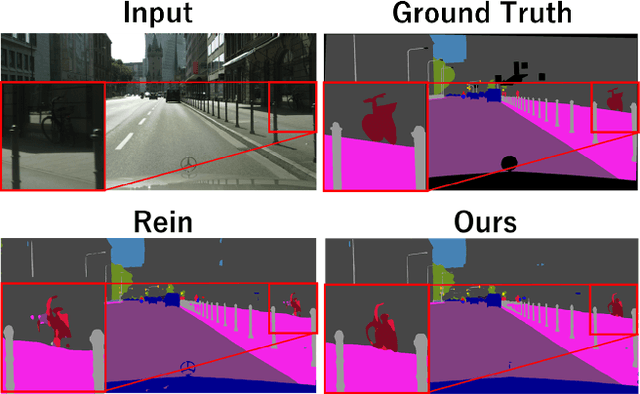
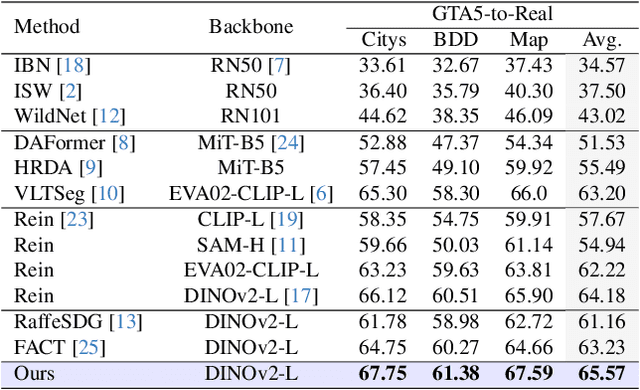
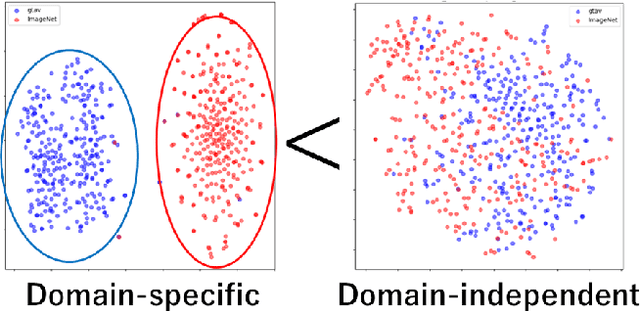

In this paper, we propose a new evaluation metric called Domain Independence (DI) and Attenuation of Domain-Specific Information (ADSI) which is specifically designed for domain-generalized semantic segmentation in automotive images. DI measures the presence of domain-specific information: a lower DI value indicates strong domain dependence, while a higher DI value suggests greater domain independence. This makes it roughly where domain-specific information exists and up to which frequency range it is present. As a result, it becomes possible to effectively suppress only the regions in the image that contain domain-specific information, enabling feature extraction independent of the domain. ADSI uses a Butterworth filter to remove the low-frequency components of images that contain inherent domain-specific information such as sensor characteristics and lighting conditions. However, since low-frequency components also contain important information such as color, we should not remove them completely. Thus, a scalar value (ranging from 0 to 1) is multiplied by the low-frequency components to retain essential information. This helps the model learn more domain-independent features. In experiments, GTA5 (synthetic dataset) was used as training images, and a real-world dataset was used for evaluation, and the proposed method outperformed conventional approaches. Similarly, in experiments that the Cityscapes (real-world dataset) was used for training and various environment datasets such as rain and nighttime were used for evaluation, the proposed method demonstrated its robustness under nighttime conditions.
SpikeDerain: Unveiling Clear Videos from Rainy Sequences Using Color Spike Streams
Mar 26, 2025Restoring clear frames from rainy videos presents a significant challenge due to the rapid motion of rain streaks. Traditional frame-based visual sensors, which capture scene content synchronously, struggle to capture the fast-moving details of rain accurately. In recent years, neuromorphic sensors have introduced a new paradigm for dynamic scene perception, offering microsecond temporal resolution and high dynamic range. However, existing multimodal methods that fuse event streams with RGB images face difficulties in handling the complex spatiotemporal interference of raindrops in real scenes, primarily due to hardware synchronization errors and computational redundancy. In this paper, we propose a Color Spike Stream Deraining Network (SpikeDerain), capable of reconstructing spike streams of dynamic scenes and accurately removing rain streaks. To address the challenges of data scarcity in real continuous rainfall scenes, we design a physically interpretable rain streak synthesis model that generates parameterized continuous rain patterns based on arbitrary background images. Experimental results demonstrate that the network, trained with this synthetic data, remains highly robust even under extreme rainfall conditions. These findings highlight the effectiveness and robustness of our method across varying rainfall levels and datasets, setting new standards for video deraining tasks. The code will be released soon.
Channel Consistency Prior and Self-Reconstruction Strategy Based Unsupervised Image Deraining
Mar 24, 2025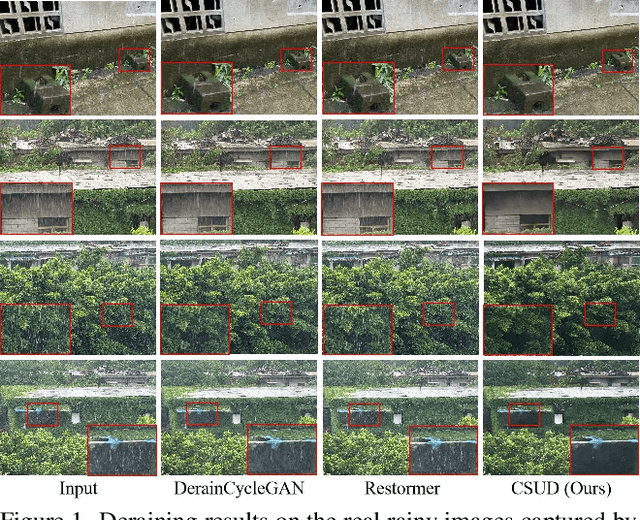
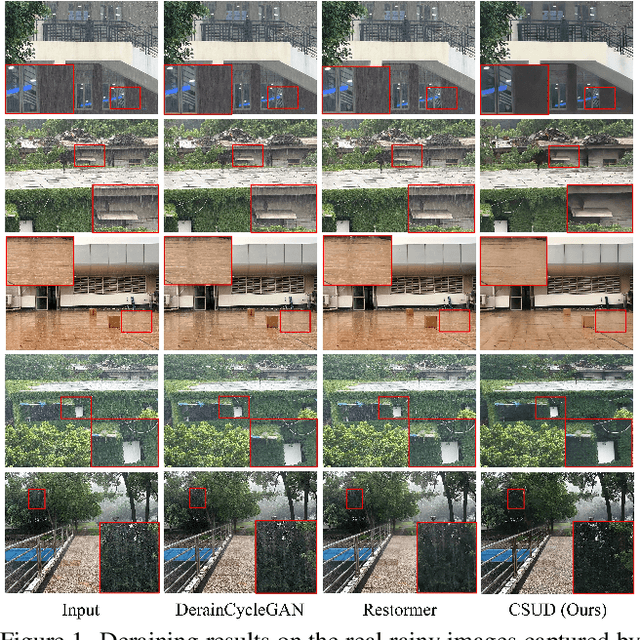
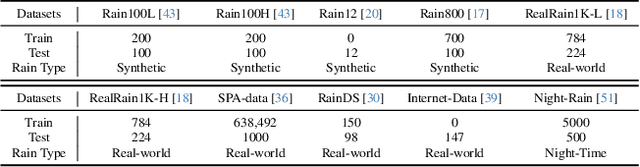
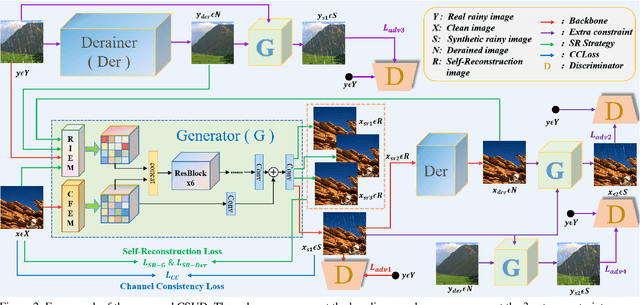
Recently, deep image deraining models based on paired datasets have made a series of remarkable progress. However, they cannot be well applied in real-world applications due to the difficulty of obtaining real paired datasets and the poor generalization performance. In this paper, we propose a novel Channel Consistency Prior and Self-Reconstruction Strategy Based Unsupervised Image Deraining framework, CSUD, to tackle the aforementioned challenges. During training with unpaired data, CSUD is capable of generating high-quality pseudo clean and rainy image pairs which are used to enhance the performance of deraining network. Specifically, to preserve more image background details while transferring rain streaks from rainy images to the unpaired clean images, we propose a novel Channel Consistency Loss (CCLoss) by introducing the Channel Consistency Prior (CCP) of rain streaks into training process, thereby ensuring that the generated pseudo rainy images closely resemble the real ones. Furthermore, we propose a novel Self-Reconstruction (SR) strategy to alleviate the redundant information transfer problem of the generator, further improving the deraining performance and the generalization capability of our method. Extensive experiments on multiple synthetic and real-world datasets demonstrate that the deraining performance of CSUD surpasses other state-of-the-art unsupervised methods and CSUD exhibits superior generalization capability.