 Add to Chrome
 Add to Firefox
 Add to Edge
Prompt-Free and Efficient SAM2 Adaptation for Biomedical Semantic Segmentation via Dual Adapters
May 07, 2026
Segment Anything Model 2 (SAM2) demonstrated impressive zero-shot capabilities on natural images but faces challenges in biomedical segmentation due to significant domain shifts and prompt dependency. To address these limitations, we propose a prompt-free, parameter-efficient fine-tuning framework designed for multi-class segmentation on variable-sized inputs. We introduce a convolutional Positional Encoding Generator to adapt effectively to arbitrary aspect ratios and present a dual-adapter strategy: High-Performance Adapter utilizing deformable convolutions for precise boundary modeling and Lightweight Adapter employing structural re-parameterization to minimize inference latency. Experiments on ISBI 2012, Kvasir-SEG, Synapse, and ACDC datasets demonstrate that our approach significantly outperforms strong adaptation baselines. Specifically, our method improved segmentation accuracy by up to 19.66\% over the vanilla SAM2, while reducing computational costs by approximately 87\% compared to heavyweight medical SAM adaptations, establishing a superior trade-off between accuracy and efficiency.

Dynamic Distillation and Gradient Consistency for Robust Long-Tailed Incremental Learning
May 05, 2026The task of Long-tailed Class Incremental Learning (LT-CIL) addresses the sequential learning of new classes from datasets with imbalanced class distributions. This scenario intensifies the fundamental problem of catastrophic forgetting, inherent to continual learning, with the dual challenges of under-learning minority classes and overfitting majority classes. To tackle these combined issues, this paper proposes two main techniques. First, we introduce gradient consistency regularization, which leverages the moving average of gradients to suppress abrupt fluctuations and stabilize the training process. Second, we dynamically adjust the weight of the distillation loss by measuring the degree of class imbalance with normalized entropy. This adaptive weighting establishes an optimal balance between retaining old knowledge and acquiring new information. Experiments on the CIFAR-100-LT, ImageNetSubset-LT, and Food101-LT benchmarks show that our method achieves consistent accuracy improvements of up to 5.0\%. Furthermore, we demonstrate dramatic gains in the challenging 'In-ordered' setting, where tasks progress from majority to minority classes, highlighting our method's robustness in mitigating forgetting under unfavorable learning dynamics. This enhanced performance is achieved without a significant increase in computational overhead, demonstrating the practicality of our framework.
Accuracy Improvement of Semi-Supervised Segmentation Using Supervised ClassMix and Sup-Unsup Feature Discriminator
Apr 08, 2026In semantic segmentation, the creation of pixel-level labels for training data incurs significant costs. To address this problem, semi-supervised learning, which utilizes a small number of labeled images alongside unlabeled images to enhance the performance, has gained attention. A conventional semi-supervised learning method, ClassMix, pastes class labels predicted from unlabeled images onto other images. However, since ClassMix performs operations using pseudo-labels obtained from unlabeled images, there is a risk of handling inaccurate labels. Additionally, there is a gap in data quality between labeled and unlabeled images, which can impact the feature maps. This study addresses these two issues. First, we propose a method where class labels from labeled images, along with the corresponding image regions, are pasted onto unlabeled images and their pseudo-labeled images. Second, we introduce a method that trains the model to make predictions on unlabeled images more similar to those on labeled images. Experiments on the Chase and COVID-19 datasets demonstrated an average improvement of 2.07% in mIoU compared to conventional semi-supervised learning methods.
Multiple Domain Generalization Using Category Information Independent of Domain Differences
Apr 08, 2026Domain generalization is a technique aimed at enabling models to maintain high accuracy when applied to new environments or datasets (unseen domains) that differ from the datasets used in training. Generally, the accuracy of models trained on a specific dataset (source domain) often decreases significantly when evaluated on different datasets (target domain). This issue arises due to differences in domains caused by varying environmental conditions such as imaging equipment and staining methods. Therefore, we undertook two initiatives to perform segmentation that does not depend on domain differences. We propose a method that separates category information independent of domain differences from the information specific to the source domain. By using information independent of domain differences, our method enables learning the segmentation targets (e.g., blood vessels and cell nuclei). Although we extract independent information of domain differences, this cannot completely bridge the domain gap between training and test data. Therefore, we absorb the domain gap using the quantum vectors in Stochastically Quantized Variational AutoEncoder (SQ-VAE). In experiments, we evaluated our method on datasets for vascular segmentation and cell nucleus segmentation. Our methods improved the accuracy compared to conventional methods.
Novel Anomaly Detection Scenarios and Evaluation Metrics to Address the Ambiguity in the Definition of Normal Samples
Apr 08, 2026In conventional anomaly detection, training data consist of only normal samples. However, in real-world scenarios, the definition of a normal sample is often ambiguous. For example, there are cases where a sample has small scratches or stains but is still acceptable for practical usage. On the other hand, higher precision is required when manufacturing equipment is upgraded. In such cases, normal samples may include small scratches, tiny dust particles, or a foreign object that we would prefer to classify as an anomaly. Such cases frequently occur in industrial settings, yet they have not been discussed until now. Thus, we propose novel scenarios and an evaluation metric to accommodate specification changes in real-world applications. Furthermore, to address the ambiguity of normal samples, we propose the RePaste, which enhances learning by re-pasting regions with high anomaly scores from the previous step into the input for the next step. On our scenarios using the MVTec AD benchmark, RePaste achieved the state-of-the-art performance with respect to the proposed evaluation metric, while maintaining high AUROC and PRO scores. Code: https://github.com/ReijiSoftmaxSaito/Scenario
Combining Boundary Supervision and Segment-Level Regularization for Fine-Grained Action Segmentation
Apr 02, 2026Recent progress in Temporal Action Segmentation (TAS) has increasingly relied on complex architectures, which can hinder practical deployment. We present a lightweight dual-loss training framework that improves fine-grained segmentation quality with only one additional output channel and two auxiliary loss terms, requiring minimal architectural modification. Our approach combines a boundary-regression loss that promotes accurate temporal localization via a single-channel boundary prediction and a CDF-based segment-level regularization loss that encourages coherent within-segment structure by matching cumulative distributions over predicted and ground-truth segments. The framework is architecture-agnostic and can be integrated into existing TAS models (e.g., MS-TCN, C2F-TCN, FACT) as a training-time loss function. Across three benchmark datasets, the proposed method improves segment-level consistency and boundary quality, yielding higher F1 and Edit scores across three different models. Frame-wise accuracy remains largely unchanged, highlighting that precise segmentation can be achieved through simple loss design rather than heavier architectures or inference-time refinements.
SVD-ViT: Does SVD Make Vision Transformers Attend More to the Foreground?
Feb 02, 2026Vision Transformers (ViT) have been established as large-scale foundation models. However, because self-attention operates globally, they lack an explicit mechanism to distinguish foreground from background. As a result, ViT may learn unnecessary background features and artifacts, leading to degraded classification performance. To address this issue, we propose SVD-ViT, which leverages singular value decomposition (SVD) to prioritize the learning of foreground features. SVD-ViT consists of three components-\textbf{SPC module}, \textbf{SSVA}, and \textbf{ID-RSVD}-and suppresses task-irrelevant factors such as background noise and artifacts by extracting and aggregating singular vectors that capture object foreground information. Experimental results demonstrate that our method improves classification accuracy and effectively learns informative foreground representations while reducing the impact of background noise.
Sparse BEV Fusion with Self-View Consistency for Multi-View Detection and Tracking
Sep 10, 2025Multi-View Multi-Object Tracking (MVMOT) is essential for applications such as surveillance, autonomous driving, and sports analytics. However, maintaining consistent object identities across multiple cameras remains challenging due to viewpoint changes, lighting variations, and occlusions, which often lead to tracking errors.Recent methods project features from multiple cameras into a unified Bird's-Eye-View (BEV) space to improve robustness against occlusion. However, this projection introduces feature distortion and non-uniform density caused by variations in object scale with distance. These issues degrade the quality of the fused representation and reduce detection and tracking accuracy.To address these problems, we propose SCFusion, a framework that combines three techniques to improve multi-view feature integration. First, it applies a sparse transformation to avoid unnatural interpolation during projection. Next, it performs density-aware weighting to adaptively fuse features based on spatial confidence and camera distance. Finally, it introduces a multi-view consistency loss that encourages each camera to learn discriminative features independently before fusion.Experiments show that SCFusion achieves state-of-the-art performance, reaching an IDF1 score of 95.9% on WildTrack and a MODP of 89.2% on MultiviewX, outperforming the baseline method TrackTacular. These results demonstrate that SCFusion effectively mitigates the limitations of conventional BEV projection and provides a robust and accurate solution for multi-view object detection and tracking.
Domain Generalization through Attenuation of Domain-Specific Information
Apr 09, 2025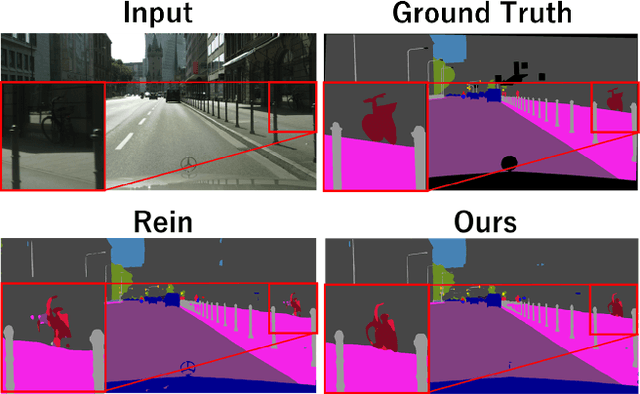
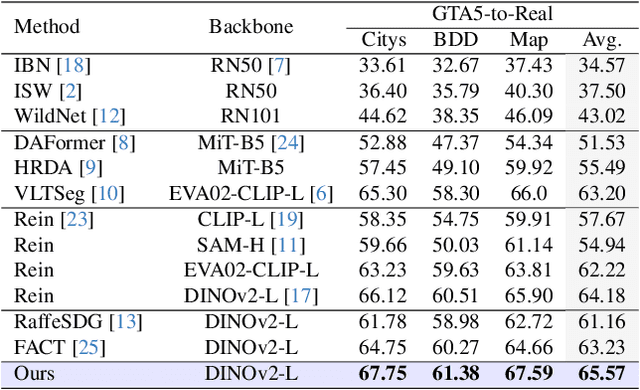
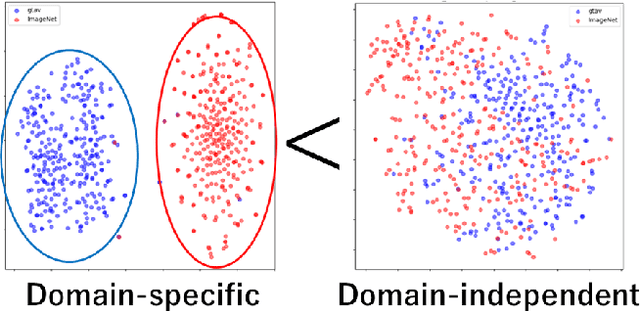

In this paper, we propose a new evaluation metric called Domain Independence (DI) and Attenuation of Domain-Specific Information (ADSI) which is specifically designed for domain-generalized semantic segmentation in automotive images. DI measures the presence of domain-specific information: a lower DI value indicates strong domain dependence, while a higher DI value suggests greater domain independence. This makes it roughly where domain-specific information exists and up to which frequency range it is present. As a result, it becomes possible to effectively suppress only the regions in the image that contain domain-specific information, enabling feature extraction independent of the domain. ADSI uses a Butterworth filter to remove the low-frequency components of images that contain inherent domain-specific information such as sensor characteristics and lighting conditions. However, since low-frequency components also contain important information such as color, we should not remove them completely. Thus, a scalar value (ranging from 0 to 1) is multiplied by the low-frequency components to retain essential information. This helps the model learn more domain-independent features. In experiments, GTA5 (synthetic dataset) was used as training images, and a real-world dataset was used for evaluation, and the proposed method outperformed conventional approaches. Similarly, in experiments that the Cityscapes (real-world dataset) was used for training and various environment datasets such as rain and nighttime were used for evaluation, the proposed method demonstrated its robustness under nighttime conditions.
Genetic Information Analysis of Age-Related Macular Degeneration Fellow Eye Using Multi-Modal Selective ViT
Sep 17, 2024In recent years, there has been significant development in the analysis of medical data using machine learning. It is believed that the onset of Age-related Macular Degeneration (AMD) is associated with genetic polymorphisms. However, genetic analysis is costly, and artificial intelligence may offer assistance. This paper presents a method that predict the presence of multiple susceptibility genes for AMD using fundus and Optical Coherence Tomography (OCT) images, as well as medical records. Experimental results demonstrate that integrating information from multiple modalities can effectively predict the presence of susceptibility genes with over 80$\%$ accuracy.