 Add to Chrome
 Add to Firefox
 Add to Edge
Multiple Domain Generalization Using Category Information Independent of Domain Differences
Apr 08, 2026
Domain generalization is a technique aimed at enabling models to maintain high accuracy when applied to new environments or datasets (unseen domains) that differ from the datasets used in training. Generally, the accuracy of models trained on a specific dataset (source domain) often decreases significantly when evaluated on different datasets (target domain). This issue arises due to differences in domains caused by varying environmental conditions such as imaging equipment and staining methods. Therefore, we undertook two initiatives to perform segmentation that does not depend on domain differences. We propose a method that separates category information independent of domain differences from the information specific to the source domain. By using information independent of domain differences, our method enables learning the segmentation targets (e.g., blood vessels and cell nuclei). Although we extract independent information of domain differences, this cannot completely bridge the domain gap between training and test data. Therefore, we absorb the domain gap using the quantum vectors in Stochastically Quantized Variational AutoEncoder (SQ-VAE). In experiments, we evaluated our method on datasets for vascular segmentation and cell nucleus segmentation. Our methods improved the accuracy compared to conventional methods.

Accuracy Improvement of Semi-Supervised Segmentation Using Supervised ClassMix and Sup-Unsup Feature Discriminator
Apr 08, 2026In semantic segmentation, the creation of pixel-level labels for training data incurs significant costs. To address this problem, semi-supervised learning, which utilizes a small number of labeled images alongside unlabeled images to enhance the performance, has gained attention. A conventional semi-supervised learning method, ClassMix, pastes class labels predicted from unlabeled images onto other images. However, since ClassMix performs operations using pseudo-labels obtained from unlabeled images, there is a risk of handling inaccurate labels. Additionally, there is a gap in data quality between labeled and unlabeled images, which can impact the feature maps. This study addresses these two issues. First, we propose a method where class labels from labeled images, along with the corresponding image regions, are pasted onto unlabeled images and their pseudo-labeled images. Second, we introduce a method that trains the model to make predictions on unlabeled images more similar to those on labeled images. Experiments on the Chase and COVID-19 datasets demonstrated an average improvement of 2.07% in mIoU compared to conventional semi-supervised learning methods.
Novel Anomaly Detection Scenarios and Evaluation Metrics to Address the Ambiguity in the Definition of Normal Samples
Apr 08, 2026In conventional anomaly detection, training data consist of only normal samples. However, in real-world scenarios, the definition of a normal sample is often ambiguous. For example, there are cases where a sample has small scratches or stains but is still acceptable for practical usage. On the other hand, higher precision is required when manufacturing equipment is upgraded. In such cases, normal samples may include small scratches, tiny dust particles, or a foreign object that we would prefer to classify as an anomaly. Such cases frequently occur in industrial settings, yet they have not been discussed until now. Thus, we propose novel scenarios and an evaluation metric to accommodate specification changes in real-world applications. Furthermore, to address the ambiguity of normal samples, we propose the RePaste, which enhances learning by re-pasting regions with high anomaly scores from the previous step into the input for the next step. On our scenarios using the MVTec AD benchmark, RePaste achieved the state-of-the-art performance with respect to the proposed evaluation metric, while maintaining high AUROC and PRO scores. Code: https://github.com/ReijiSoftmaxSaito/Scenario
Domain Generalization through Attenuation of Domain-Specific Information
Apr 09, 2025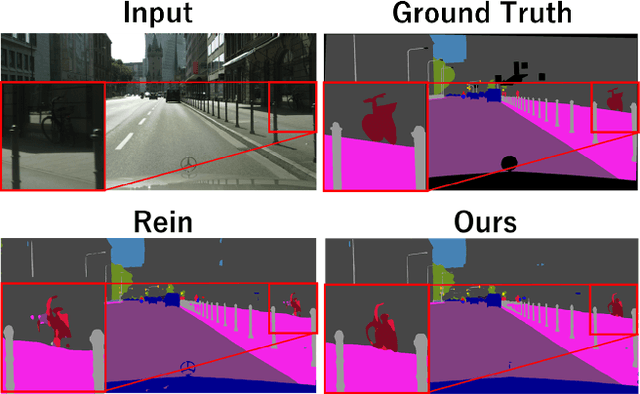
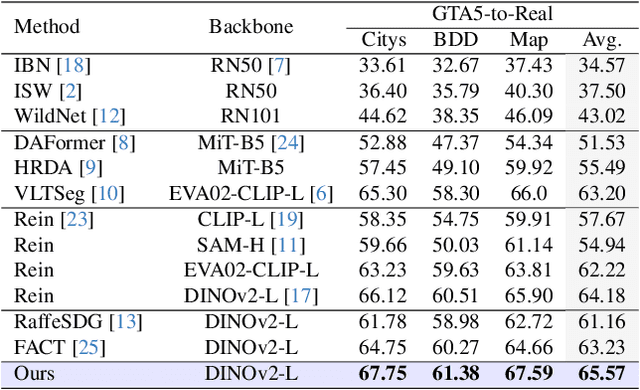
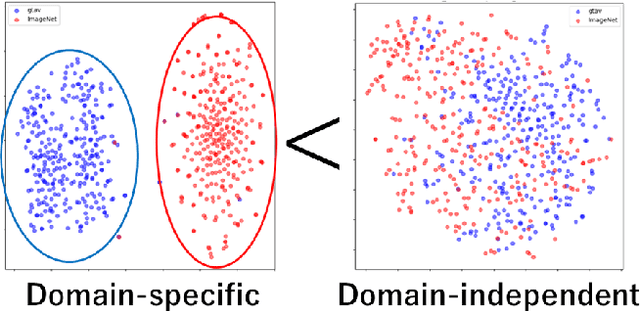

In this paper, we propose a new evaluation metric called Domain Independence (DI) and Attenuation of Domain-Specific Information (ADSI) which is specifically designed for domain-generalized semantic segmentation in automotive images. DI measures the presence of domain-specific information: a lower DI value indicates strong domain dependence, while a higher DI value suggests greater domain independence. This makes it roughly where domain-specific information exists and up to which frequency range it is present. As a result, it becomes possible to effectively suppress only the regions in the image that contain domain-specific information, enabling feature extraction independent of the domain. ADSI uses a Butterworth filter to remove the low-frequency components of images that contain inherent domain-specific information such as sensor characteristics and lighting conditions. However, since low-frequency components also contain important information such as color, we should not remove them completely. Thus, a scalar value (ranging from 0 to 1) is multiplied by the low-frequency components to retain essential information. This helps the model learn more domain-independent features. In experiments, GTA5 (synthetic dataset) was used as training images, and a real-world dataset was used for evaluation, and the proposed method outperformed conventional approaches. Similarly, in experiments that the Cityscapes (real-world dataset) was used for training and various environment datasets such as rain and nighttime were used for evaluation, the proposed method demonstrated its robustness under nighttime conditions.