 Add to Chrome
 Add to Firefox
 Add to Edge
Degradation-Aware Prompt Learning with Cross-Modal Compensation for Adverse Weather Removal
Aug 07, 2026
Adverse weather causes diverse and complex image degradations, severely compromising the reliability of computer vision systems. Existing all-in-one restoration models attempt to address multiple degradation types within a unified framework, but often lack explicit spatial and semantic modeling of degradation characteristics, limiting their adaptability to diverse weather conditions. To address this limitation, we propose a Degradation-Aware Cross-Modal Prompt Compensation Network (DCMPC-Net) that leverages cross-modal degradation cues from a pretrained vision-language model to condition restoration features within a unified backbone. Specifically, our DCMPC-Net mainly consists of the Cross-Modal Prompt Generator (CMPG), Prompt-Guided Attention Alignment Module (PGAAM), and Dual Feature Compensation Module (DFCM). The CMPG integrates textual embeddings with visual features to produce degradation-aware prompts that encode degradation-related semantic and contextual cues. These prompts are injected into the decoder via a PGAAM, which adaptively aligns semantic information with degraded regions to facilitate context-aware restoration. To further enhance structural fidelity, DFCM is introduced that disentangles degradation artifacts from scene structures, thereby improving the reconstruction of fine textures and detailed content. By integrating cross-modal semantic guidance with spatial alignment and structural enhancement, DCMPC-Net achieves robust and perceptually consistent restoration across diverse weather conditions. Extensive experiments show that DCMPC-Net outperforms state-of-the-art methods in both task-specific and unified settings, achieving superior accuracy and visual fidelity.

Medical world models in healthcare: foundations, applications, and challenges for trustworthy clinical translation
Jul 28, 2026Medical world models offer a framework for extending medical artificial intelligence beyond static prediction by representing evolving patient states and modelling how they change over time and in response to clinical interventions. This Review defines the conceptual boundaries, technical foundations, application domains, and evidence requirements of the field through a structured narrative synthesis with reproducible evidence mapping.We screened 1,455 unique records and assembled a corpus of 98 sources, including 14 studies that met a strict empirical definition of a medical world model. The field is organised around four capabilities: patient state representation, temporal dynamics modelling, intervention-conditioned simulation, and clinician-supervised planning. Evidence spans medical imaging, longitudinal electronic health records, treatment response modelling, physiological and multimodal state modelling, ultrasound and surgical interaction, and population and health-system simulation; clinical digital twins are treated as a cross-cutting integration framework.Current studies provide early evidence of technical feasibility for trajectory forecasting and comparison of candidate interventions, but most remain retrospective, task-specific, or preclinical. The evidence base is further limited by incomplete longitudinal intervention data, inconsistent action semantics, limited causal identifiability, long-horizon error accumulation, inadequate uncertainty estimation, and limited external validation. Clinical translation will therefore depend on precise intervention representations, robust causal and mechanistic grounding, calibrated trajectory-level uncertainty, safety-constrained planning, and prospective multicentre validation against clinically meaningful endpoints.
Agentic AI in medicine: architectures, applications, evaluation, and challenges for clinical translation
Jul 28, 2026Large language models and multimodal foundation models are enabling medical artificial intelligence (AI) systems to move beyond isolated prediction and undertake multistep clinical tasks that require planning, tool use, memory, iterative correction, and coordination among specialized agents. However, the scope of agentic AI in medicine remains unsettled, and current evaluation practices are not yet aligned with the requirements of clinical use. We conducted a scoping review with systematic evidence mapping across five electronic sources, screened 1,649 exportable records, and provisionally included 557 unique studies that met predefined criteria for goal-directed task execution, tool use, interaction with external resources, feedback-based refinement, or multi-agent collaboration. The included studies describe single agents that use external tools, workflows supported by retrieval and external knowledge, multimodal agents, and multi-agent systems applied to medical question answering, image interpretation, electronic health record analysis, drug safety, and clinical trial prediction. The evidence base remains dominated by public benchmarks, simulated settings, retrospective datasets, and small-scale expert evaluation. Process reliability, evidence traceability, uncertainty, safety, workflow impact, and external validity are evaluated less consistently. Clinical translation will depend on clearer definitions, reproducible evaluation, auditable oversight, interoperable system design, and prospective validation in real-world clinical workflows.
DDVT: Dynamic Dual-level Vision Transformer Fusion Network for Answer Grounding in Visual Question Answering
Jul 27, 2026Answer grounding in visual question answering aims to locate the region from a given natural language question associated with the visual content of an image, which has garnered significant attention due to its practical applications. In this paper, we introduce the Dynamic Dual-level Vision Transformer Fusion Network (DDVT) for answer grounding in visual question answering. Specifically, we propose a question-guided dynamic regional-level module (QGDR) that combines complementary image context through ROI Align and text content, enabling precise localization of text-related visual content. Moreover, we present a cross-modal multi-scale aggregation module (CMA) that enhances feature fusion between pixel-level and region-level features, facilitating the effective localization of visual content associated with grounded answers. Furthermore, we fuse the located visual content with text features to locate the region and provide answers to questions posed about the image. Experimental results demonstrate that our DDVT outperforms state-of-the-art methods on several widely-used benchmarks.
MambaLIE: Scene Light Intensity-Boosted Low-Light Image Enhancement with State Space Model
Jul 03, 2026Images captured by consumer electronic devices, such as mobile phones and digital cameras, often suffer from low-light degradation due to sensor limitations and imaging pipelines, which degrades visual quality and affects downstream vision tasks. Existing methods based on Convolutional Neural Networks (CNNs) and Transformers have dominated current low-light image enhancement (LIE) due to their excellent ability to model hierarchical features. However, CNNs operate in local receptive fields that cannot model long-range dependencies, while Transformers overcome this problem but incur substantial computational costs. To address these challenges, we propose MambaLIE, a Scene Light Intensity-Boosted Low-Light Image Enhancement method based on a State Space Model (SSM). We first introduce scene light intensity to improve the structural distribution of illumination, which is then gated with the low-light input to guide enhancement. To better model the illumination while maintaining computational efficiency, we propose the Locally Enhanced State Space Model (LESSM) for efficient light enhancement. Our LESSM contains two branches: an SSM branch and a Local Enhanced branch, where the former is used to model the long-range dependencies with linear time complexity, while the latter is used to enhance local feature representations. Extensive experiments demonstrate that MambaLIE outperforms state-of-the-art CNN-based and Transformer-based LIE methods on four widely used synthetic benchmarks and five publicly available real-world benchmarks in terms of accuracy, speed, and model size, making it suitable for practical deployment on resource-constrained devices.
Iterative Optimal Attention and Local Model for Single Image Rain Streak Removal
Mar 20, 2025High-fidelity imaging is crucial for the successful safety supervision and intelligent deployment of vision-based measurement systems (VBMS). It ensures high-quality imaging in VBMS, which is fundamental for reliable visual measurement and analysis. However, imaging quality can be significantly impaired by adverse weather conditions, particularly rain, leading to blurred images and reduced contrast. Such impairments increase the risk of inaccurate evaluations and misinterpretations in VBMS. To address these limitations, we propose an Expectation Maximization Reconstruction Transformer (EMResformer) for single image rain streak removal. The EMResformer retains the key self-attention values for feature aggregation, enhancing local features to produce superior image reconstruction. Specifically, we propose an Expectation Maximization Block seamlessly integrated into the single image rain streak removal network, enhancing its ability to eliminate superfluous information and restore a cleaner background image. Additionally, to further enhance local information for improved detail rendition, we introduce a Local Model Residual Block, which integrates two local model blocks along with a sequence of convolutions and activation functions. This integration synergistically facilitates the extraction of more pertinent features for enhanced single image rain streak removal. Extensive experiments validate that our proposed EMResformer surpasses current state-of-the-art single image rain streak removal methods on both synthetic and real-world datasets, achieving an improved balance between model complexity and single image deraining performance. Furthermore, we evaluate the effectiveness of our method in VBMS scenarios, demonstrating that high-quality imaging significantly improves the accuracy and reliability of VBMS tasks.
Semantic-Guided Global-Local Collaborative Networks for Lightweight Image Super-Resolution
Mar 20, 2025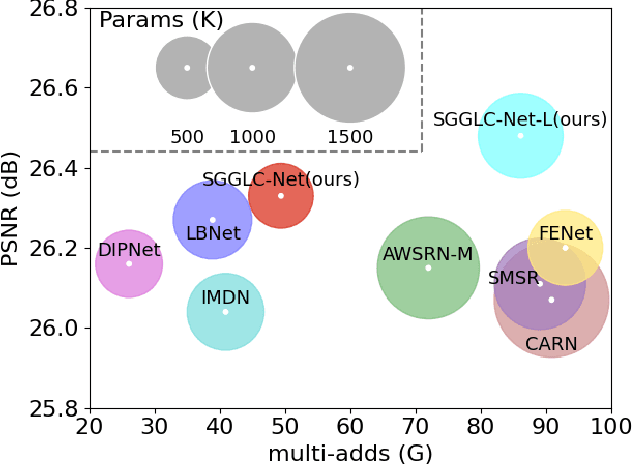
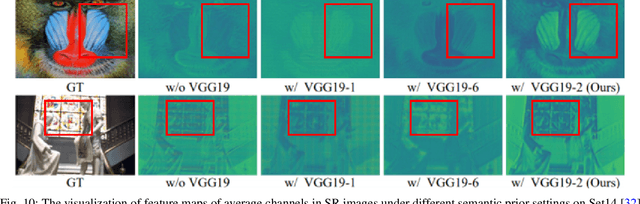
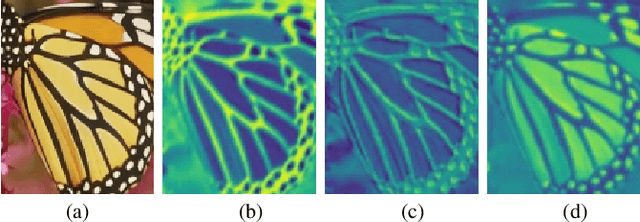
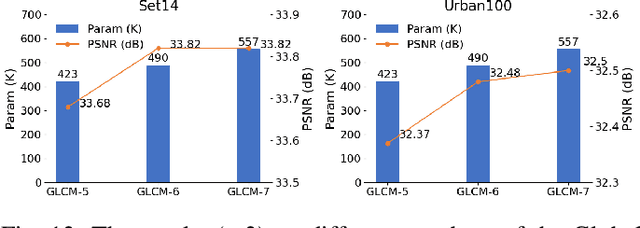
Single-Image Super-Resolution (SISR) plays a pivotal role in enhancing the accuracy and reliability of measurement systems, which are integral to various vision-based instrumentation and measurement applications. These systems often require clear and detailed images for precise object detection and recognition. However, images captured by visual measurement tools frequently suffer from degradation, including blurring and loss of detail, which can impede measurement accuracy.As a potential remedy, we in this paper propose a Semantic-Guided Global-Local Collaborative Network (SGGLC-Net) for lightweight SISR. Our SGGLC-Net leverages semantic priors extracted from a pre-trained model to guide the super-resolution process, enhancing image detail quality effectively. Specifically,we propose a Semantic Guidance Module that seamlessly integrates the semantic priors into the super-resolution network, enabling the network to more adeptly capture and utilize semantic priors, thereby enhancing image details. To further explore both local and non-local interactions for improved detail rendition,we propose a Global-Local Collaborative Module, which features three Global and Local Detail Enhancement Modules, as well as a Hybrid Attention Mechanism to work together to efficiently learn more useful features. Our extensive experiments show that SGGLC-Net achieves competitive PSNR and SSIM values across multiple benchmark datasets, demonstrating higher performance with the multi-adds reduction of 12.81G compared to state-of-the-art lightweight super-resolution approaches. These improvements underscore the potential of our approach to enhance the precision and effectiveness of visual measurement systems. Codes are at https://github.com/fanamber831/SGGLC-Net.
* 14 pages,13 figures, 9 tables