 Add to Chrome
 Add to Firefox
 Add to Edge
Stereo Lidar Fusion
Papers and Code
LiDAR Prompted Spatio-Temporal Multi-View Stereo for Autonomous Driving
Mar 04, 2026
Accurate metric depth is critical for autonomous driving perception and simulation, yet current approaches struggle to achieve high metric accuracy, multi-view and temporal consistency, and cross-domain generalization. To address these challenges, we present DriveMVS, a novel multi-view stereo framework that reconciles these competing objectives through two key insights: (1) Sparse but metrically accurate LiDAR observations can serve as geometric prompts to anchor depth estimation in absolute scale, and (2) deep fusion of diverse cues is essential for resolving ambiguities and enhancing robustness, while a spatio-temporal decoder ensures consistency across frames. Built upon these principles, DriveMVS embeds the LiDAR prompt in two ways: as a hard geometric prior that anchors the cost volume, and as soft feature-wise guidance fused by a triple-cue combiner. Regarding temporal consistency, DriveMVS employs a spatio-temporal decoder that jointly leverages geometric cues from the MVS cost volume and temporal context from neighboring frames. Experiments show that DriveMVS achieves state-of-the-art performance on multiple benchmarks, excelling in metric accuracy, temporal stability, and zero-shot cross-domain transfer, demonstrating its practical value for scalable, reliable autonomous driving systems.

CurriFlow: Curriculum-Guided Depth Fusion with Optical Flow-Based Temporal Alignment for 3D Semantic Scene Completion
Oct 14, 2025Semantic Scene Completion (SSC) aims to infer complete 3D geometry and semantics from monocular images, serving as a crucial capability for camera-based perception in autonomous driving. However, existing SSC methods relying on temporal stacking or depth projection often lack explicit motion reasoning and struggle with occlusions and noisy depth supervision. We propose CurriFlow, a novel semantic occupancy prediction framework that integrates optical flow-based temporal alignment with curriculum-guided depth fusion. CurriFlow employs a multi-level fusion strategy to align segmentation, visual, and depth features across frames using pre-trained optical flow, thereby improving temporal consistency and dynamic object understanding. To enhance geometric robustness, a curriculum learning mechanism progressively transitions from sparse yet accurate LiDAR depth to dense but noisy stereo depth during training, ensuring stable optimization and seamless adaptation to real-world deployment. Furthermore, semantic priors from the Segment Anything Model (SAM) provide category-agnostic supervision, strengthening voxel-level semantic learning and spatial consistency. Experiments on the SemanticKITTI benchmark demonstrate that CurriFlow achieves state-of-the-art performance with a mean IoU of 16.9, validating the effectiveness of our motion-guided and curriculum-aware design for camera-based 3D semantic scene completion.
Stereo-LiDAR Fusion by Semi-Global Matching With Discrete Disparity-Matching Cost and Semidensification
Apr 07, 2025We present a real-time, non-learning depth estimation method that fuses Light Detection and Ranging (LiDAR) data with stereo camera input. Our approach comprises three key techniques: Semi-Global Matching (SGM) stereo with Discrete Disparity-matching Cost (DDC), semidensification of LiDAR disparity, and a consistency check that combines stereo images and LiDAR data. Each of these components is designed for parallelization on a GPU to realize real-time performance. When it was evaluated on the KITTI dataset, the proposed method achieved an error rate of 2.79\%, outperforming the previous state-of-the-art real-time stereo-LiDAR fusion method, which had an error rate of 3.05\%. Furthermore, we tested the proposed method in various scenarios, including different LiDAR point densities, varying weather conditions, and indoor environments, to demonstrate its high adaptability. We believe that the real-time and non-learning nature of our method makes it highly practical for applications in robotics and automation.
* 8 pages, 8 figures, 7 tables
Experimental Analysis of Quadcopter Drone Hover Constraints for Localization Improvements
Apr 10, 2025In this work, we evaluate the use of aerial drone hover constraints in a multisensor fusion of ground robot and drone data to improve the localization performance of a drone. In particular, we build upon our prior work on cooperative localization between an aerial drone and ground robot that fuses data from LiDAR, inertial navigation, peer-to-peer ranging, altimeter, and stereo-vision and evaluate the incorporation knowledge from the autopilot regarding when the drone is hovering. This control command data is leveraged to add constraints on the velocity state. Hover constraints can be considered important dynamic model information, such as the exploitation of zero-velocity updates in pedestrian navigation. We analyze the benefits of these constraints using an incremental factor graph optimization. Experimental data collected in a motion capture faculty is used to provide performance insights and assess the benefits of hover constraints.
Distance Estimation in Outdoor Driving Environments Using Phase-only Correlation Method with Event Cameras
May 23, 2025With the growing adoption of autonomous driving, the advancement of sensor technology is crucial for ensuring safety and reliable operation. Sensor fusion techniques that combine multiple sensors such as LiDAR, radar, and cameras have proven effective, but the integration of multiple devices increases both hardware complexity and cost. Therefore, developing a single sensor capable of performing multiple roles is highly desirable for cost-efficient and scalable autonomous driving systems. Event cameras have emerged as a promising solution due to their unique characteristics, including high dynamic range, low latency, and high temporal resolution. These features enable them to perform well in challenging lighting conditions, such as low-light or backlit environments. Moreover, their ability to detect fine-grained motion events makes them suitable for applications like pedestrian detection and vehicle-to-infrastructure communication via visible light. In this study, we present a method for distance estimation using a monocular event camera and a roadside LED bar. By applying a phase-only correlation technique to the event data, we achieve sub-pixel precision in detecting the spatial shift between two light sources. This enables accurate triangulation-based distance estimation without requiring stereo vision. Field experiments conducted in outdoor driving scenarios demonstrated that the proposed approach achieves over 90% success rate with less than 0.5-meter error for distances ranging from 20 to 60 meters. Future work includes extending this method to full position estimation by leveraging infrastructure such as smart poles equipped with LEDs, enabling event-camera-based vehicles to determine their own position in real time. This advancement could significantly enhance navigation accuracy, route optimization, and integration into intelligent transportation systems.
An Accelerated Camera 3DMA Framework for Efficient Urban GNSS Multipath Estimation
Apr 23, 2025Robust GNSS positioning in urban environments is still plagued by multipath effects, particularly due to the complex signal propagation induced by ubiquitous surfaces with varied radio frequency reflectivities. Current 3D Mapping Aided (3DMA) GNSS techniques show great potentials in mitigating multipath but face a critical trade-off between computational efficiency and modeling accuracy. Most approaches often rely on offline outdated or oversimplified 3D maps, while real-time LiDAR-based reconstruction boasts high accuracy, it is problematic in low laser reflectivity conditions; camera 3DMA is a good candidate to balance accuracy and efficiency but current methods suffer from extremely low reconstruction speed, a far cry from real-time multipath-mitigated navigation. This paper proposes an accelerated framework incorporating camera multi-view stereo (MVS) reconstruction and ray tracing. By hypothesizing on surface textures, an orthogonal visual feature fusion framework is proposed, which robustly addresses both texture-rich and texture-poor surfaces, lifting off the reflectivity challenges in visual reconstruction. A polygonal surface modeling scheme is further integrated to accurately delineate complex building boundaries, enhancing the reconstruction granularity. To avoid excessively accurate reconstruction, reprojected point cloud multi-plane fitting and two complexity control strategies are proposed, thus improving upon multipath estimation speed. Experiments were conducted in Lujiazui, Shanghai, a typical multipath-prone district. The results show that the method achieves an average reconstruction accuracy of 2.4 meters in dense urban environments featuring glass curtain wall structures, a traditionally tough case for reconstruction, and achieves a ray-tracing-based multipath correction rate of 30 image frames per second, 10 times faster than the contemporary benchmarks.
The NavINST Dataset for Multi-Sensor Autonomous Navigation
Feb 19, 2025The NavINST Laboratory has developed a comprehensive multisensory dataset from various road-test trajectories in urban environments, featuring diverse lighting conditions, including indoor garage scenarios with dense 3D maps. This dataset includes multiple commercial-grade IMUs and a high-end tactical-grade IMU. Additionally, it contains a wide array of perception-based sensors, such as a solid-state LiDAR - making it one of the first datasets to do so - a mechanical LiDAR, four electronically scanning RADARs, a monocular camera, and two stereo cameras. The dataset also includes forward speed measurements derived from the vehicle's odometer, along with accurately post-processed high-end GNSS/IMU data, providing precise ground truth positioning and navigation information. The NavINST dataset is designed to support advanced research in high-precision positioning, navigation, mapping, computer vision, and multisensory fusion. It offers rich, multi-sensor data ideal for developing and validating robust algorithms for autonomous vehicles. Finally, it is fully integrated with the ROS, ensuring ease of use and accessibility for the research community. The complete dataset and development tools are available at https://navinst.github.io.
LiDAR-Event Stereo Fusion with Hallucinations
Aug 08, 2024Event stereo matching is an emerging technique to estimate depth from neuromorphic cameras; however, events are unlikely to trigger in the absence of motion or the presence of large, untextured regions, making the correspondence problem extremely challenging. Purposely, we propose integrating a stereo event camera with a fixed-frequency active sensor -- e.g., a LiDAR -- collecting sparse depth measurements, overcoming the aforementioned limitations. Such depth hints are used by hallucinating -- i.e., inserting fictitious events -- the stacks or raw input streams, compensating for the lack of information in the absence of brightness changes. Our techniques are general, can be adapted to any structured representation to stack events and outperform state-of-the-art fusion methods applied to event-based stereo.
Pixel-aligned RGB-NIR Stereo Imaging and Dataset for Robot Vision
Nov 27, 2024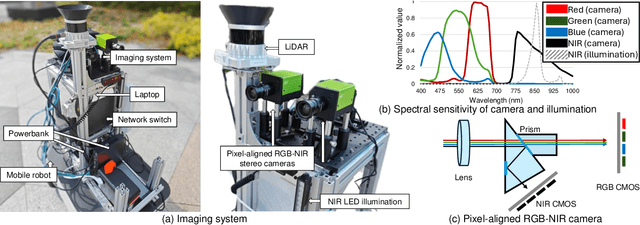
Integrating RGB and NIR stereo imaging provides complementary spectral information, potentially enhancing robotic 3D vision in challenging lighting conditions. However, existing datasets and imaging systems lack pixel-level alignment between RGB and NIR images, posing challenges for downstream vision tasks. In this paper, we introduce a robotic vision system equipped with pixel-aligned RGB-NIR stereo cameras and a LiDAR sensor mounted on a mobile robot. The system simultaneously captures pixel-aligned pairs of RGB stereo images, NIR stereo images, and temporally synchronized LiDAR points. Utilizing the mobility of the robot, we present a dataset containing continuous video frames under diverse lighting conditions. We then introduce two methods that utilize the pixel-aligned RGB-NIR images: an RGB-NIR image fusion method and a feature fusion method. The first approach enables existing RGB-pretrained vision models to directly utilize RGB-NIR information without fine-tuning. The second approach fine-tunes existing vision models to more effectively utilize RGB-NIR information. Experimental results demonstrate the effectiveness of using pixel-aligned RGB-NIR images across diverse lighting conditions.
CoSEC: A Coaxial Stereo Event Camera Dataset for Autonomous Driving
Aug 16, 2024
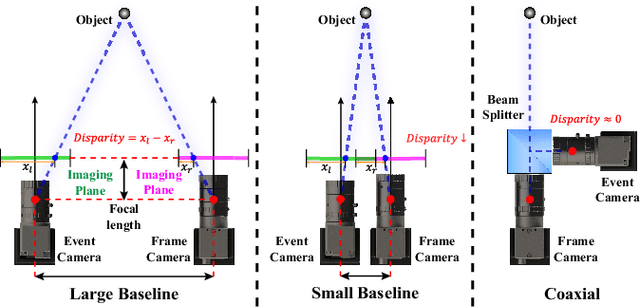


Conventional frame camera is the mainstream sensor of the autonomous driving scene perception, while it is limited in adverse conditions, such as low light. Event camera with high dynamic range has been applied in assisting frame camera for the multimodal fusion, which relies heavily on the pixel-level spatial alignment between various modalities. Typically, existing multimodal datasets mainly place event and frame cameras in parallel and directly align them spatially via warping operation. However, this parallel strategy is less effective for multimodal fusion, since the large disparity exacerbates spatial misalignment due to the large event-frame baseline. We argue that baseline minimization can reduce alignment error between event and frame cameras. In this work, we introduce hybrid coaxial event-frame devices to build the multimodal system, and propose a coaxial stereo event camera (CoSEC) dataset for autonomous driving. As for the multimodal system, we first utilize the microcontroller to achieve time synchronization, and then spatially calibrate different sensors, where we perform intra- and inter-calibration of stereo coaxial devices. As for the multimodal dataset, we filter LiDAR point clouds to generate depth and optical flow labels using reference depth, which is further improved by fusing aligned event and frame data in nighttime conditions. With the help of the coaxial device, the proposed dataset can promote the all-day pixel-level multimodal fusion. Moreover, we also conduct experiments to demonstrate that the proposed dataset can improve the performance and generalization of the multimodal fusion.