 Add to Chrome
 Add to Firefox
 Add to Edge
ZipDepth: Bringing Lightweight Zero-Shot Monocular Depth Anywhere, on Any Device
Jul 09, 2026
Monocular depth estimation has seen remarkable progress through foundation models achieving robust zero-shot generalization, yet their computational demands place them far beyond the reach of embedded and mobile platforms. Lightweight alternatives exist, but have been developed almost exclusively within single-domain, self-supervised paradigms, failing silently under domain shift. We present ZipDepth, a compact monocular depth network that bridges this gap by combining an efficient reparameterizable encoder-decoder with large-scale knowledge distillation from a foundation model over a large multi-domain training set. Comprising just 6.1M parameters, ZipDepth runs at real-time rates from server GPUs to power-constrained devices, achieving the best trade-off between zero-shot accuracy and deployment efficiency among lightweight models across five benchmarks, taking a significant step towards the accuracy of foundation models with 50x more parameters.

Bidirectional Cross-Modal Prompting for Event-Frame Asymmetric Stereo
Apr 16, 2026Conventional frame-based cameras capture rich contextual information but suffer from limited temporal resolution and motion blur in dynamic scenes. Event cameras offer an alternative visual representation with higher dynamic range free from such limitations. The complementary characteristics of the two modalities make event-frame asymmetric stereo promising for reliable 3D perception under fast motion and challenging illumination. However, the modality gap often leads to marginalization of domain-specific cues essential for cross-modal stereo matching. In this paper, we introduce Bi-CMPStereo, a novel bidirectional cross-modal prompting framework that fully exploits semantic and structural features from both domains for robust matching. Our approach learns finely aligned stereo representations within a target canonical space and integrates complementary representations by projecting each modality into both event and frame domains. Extensive experiments demonstrate that our approach significantly outperforms state-of-the-art methods in accuracy and generalization.
EventHub: Data Factory for Generalizable Event-Based Stereo Networks without Active Sensors
Apr 02, 2026We propose EventHub, a novel framework for training deep-event stereo networks without ground truth annotations from costly active sensors, relying instead on standard color images. From these images, we derive either proxy annotations and proxy events through state-of-the-art novel view synthesis techniques, or simply proxy annotations when images are already paired with event data. Using the training set generated by our data factory, we repurpose state-of-the-art stereo models from RGB literature to process event data, obtaining new event stereo models with unprecedented generalization capabilities. Experiments on widely used event stereo datasets support the effectiveness of EventHub and show how the same data distillation mechanism can improve the accuracy of RGB stereo foundation models in challenging conditions such as nighttime scenes.
Depth AnyEvent: A Cross-Modal Distillation Paradigm for Event-Based Monocular Depth Estimation
Sep 18, 2025Event cameras capture sparse, high-temporal-resolution visual information, making them particularly suitable for challenging environments with high-speed motion and strongly varying lighting conditions. However, the lack of large datasets with dense ground-truth depth annotations hinders learning-based monocular depth estimation from event data. To address this limitation, we propose a cross-modal distillation paradigm to generate dense proxy labels leveraging a Vision Foundation Model (VFM). Our strategy requires an event stream spatially aligned with RGB frames, a simple setup even available off-the-shelf, and exploits the robustness of large-scale VFMs. Additionally, we propose to adapt VFMs, either a vanilla one like Depth Anything v2 (DAv2), or deriving from it a novel recurrent architecture to infer depth from monocular event cameras. We evaluate our approach with synthetic and real-world datasets, demonstrating that i) our cross-modal paradigm achieves competitive performance compared to fully supervised methods without requiring expensive depth annotations, and ii) our VFM-based models achieve state-of-the-art performance.
Stereo Anywhere: Robust Zero-Shot Deep Stereo Matching Even Where Either Stereo or Mono Fail
Dec 05, 2024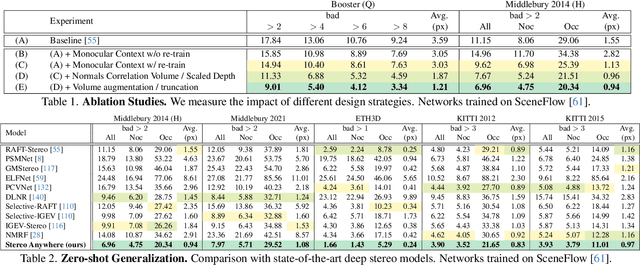
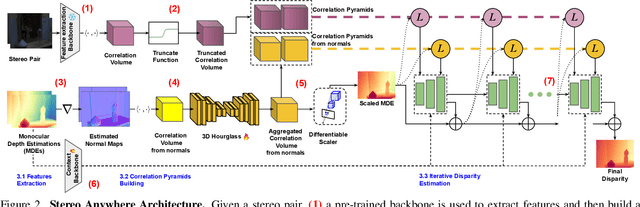

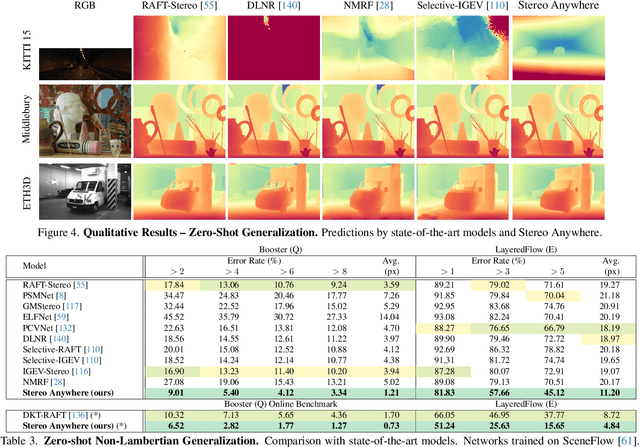
We introduce Stereo Anywhere, a novel stereo-matching framework that combines geometric constraints with robust priors from monocular depth Vision Foundation Models (VFMs). By elegantly coupling these complementary worlds through a dual-branch architecture, we seamlessly integrate stereo matching with learned contextual cues. Following this design, our framework introduces novel cost volume fusion mechanisms that effectively handle critical challenges such as textureless regions, occlusions, and non-Lambertian surfaces. Through our novel optical illusion dataset, MonoTrap, and extensive evaluation across multiple benchmarks, we demonstrate that our synthetic-only trained model achieves state-of-the-art results in zero-shot generalization, significantly outperforming existing solutions while showing remarkable robustness to challenging cases such as mirrors and transparencies.
LiDAR-Event Stereo Fusion with Hallucinations
Aug 08, 2024Event stereo matching is an emerging technique to estimate depth from neuromorphic cameras; however, events are unlikely to trigger in the absence of motion or the presence of large, untextured regions, making the correspondence problem extremely challenging. Purposely, we propose integrating a stereo event camera with a fixed-frequency active sensor -- e.g., a LiDAR -- collecting sparse depth measurements, overcoming the aforementioned limitations. Such depth hints are used by hallucinating -- i.e., inserting fictitious events -- the stacks or raw input streams, compensating for the lack of information in the absence of brightness changes. Our techniques are general, can be adapted to any structured representation to stack events and outperform state-of-the-art fusion methods applied to event-based stereo.
A Survey on Deep Stereo Matching in the Twenties
Jul 10, 2024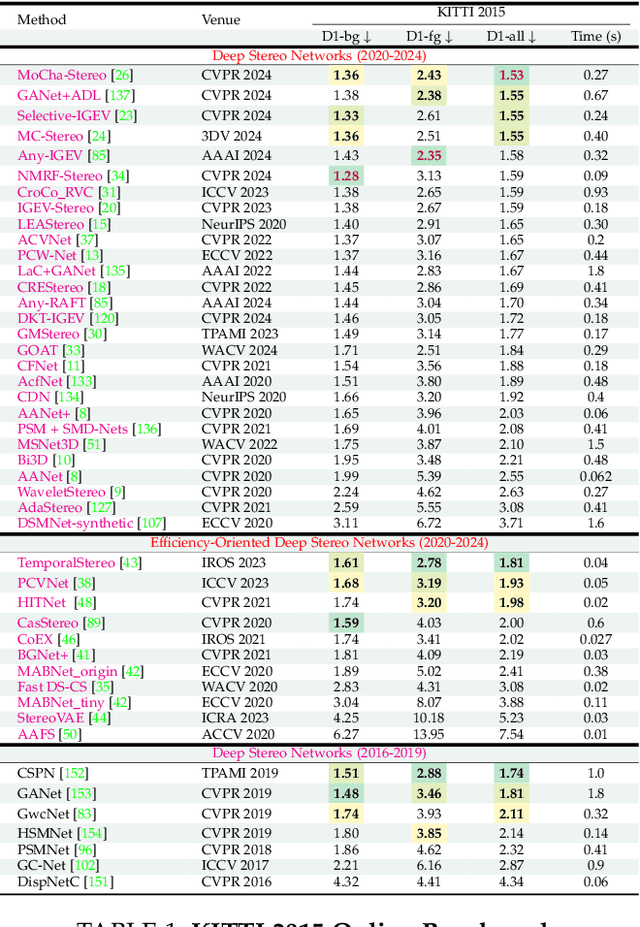
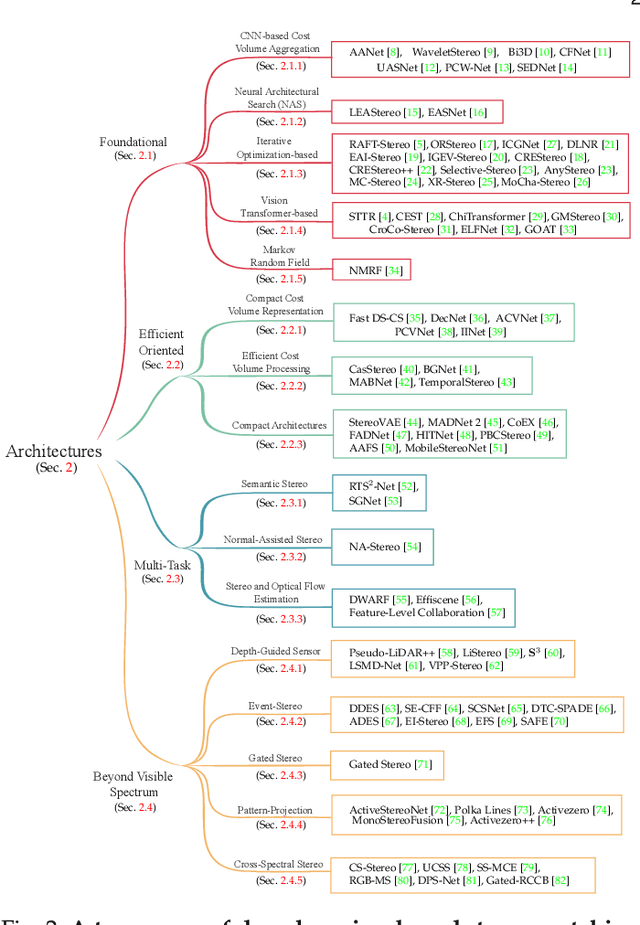
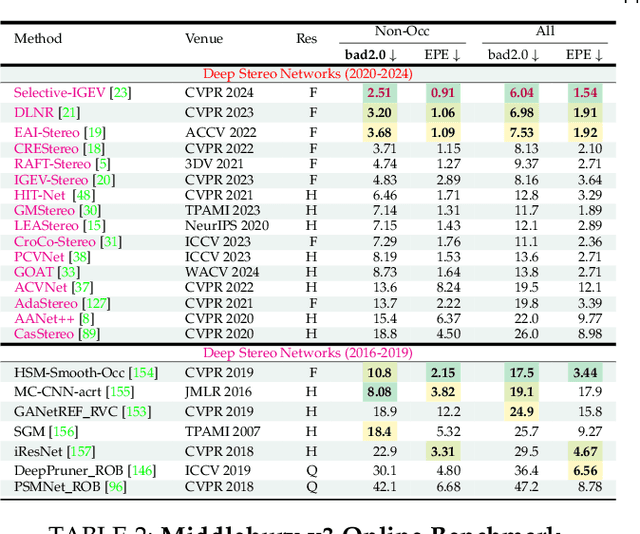
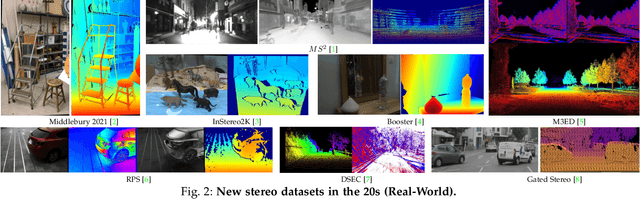
Stereo matching is close to hitting a half-century of history, yet witnessed a rapid evolution in the last decade thanks to deep learning. While previous surveys in the late 2010s covered the first stage of this revolution, the last five years of research brought further ground-breaking advancements to the field. This paper aims to fill this gap in a two-fold manner: first, we offer an in-depth examination of the latest developments in deep stereo matching, focusing on the pioneering architectural designs and groundbreaking paradigms that have redefined the field in the 2020s; second, we present a thorough analysis of the critical challenges that have emerged alongside these advances, providing a comprehensive taxonomy of these issues and exploring the state-of-the-art techniques proposed to address them. By reviewing both the architectural innovations and the key challenges, we offer a holistic view of deep stereo matching and highlight the specific areas that require further investigation. To accompany this survey, we maintain a regularly updated project page that catalogs papers on deep stereo matching in our Awesome-Deep-Stereo-Matching (https://github.com/fabiotosi92/Awesome-Deep-Stereo-Matching) repository.
Stereo-Depth Fusion through Virtual Pattern Projection
Jun 06, 2024This paper presents a novel general-purpose stereo and depth data fusion paradigm that mimics the active stereo principle by replacing the unreliable physical pattern projector with a depth sensor. It works by projecting virtual patterns consistent with the scene geometry onto the left and right images acquired by a conventional stereo camera, using the sparse hints obtained from a depth sensor, to facilitate the visual correspondence. Purposely, any depth sensing device can be seamlessly plugged into our framework, enabling the deployment of a virtual active stereo setup in any possible environment and overcoming the severe limitations of physical pattern projection, such as the limited working range and environmental conditions. Exhaustive experiments on indoor and outdoor datasets featuring both long and close range, including those providing raw, unfiltered depth hints from off-the-shelf depth sensors, highlight the effectiveness of our approach in notably boosting the robustness and accuracy of algorithms and deep stereo without any code modification and even without re-training. Additionally, we assess the performance of our strategy on active stereo evaluation datasets with conventional pattern projection. Indeed, in all these scenarios, our virtual pattern projection paradigm achieves state-of-the-art performance. The source code is available at: https://github.com/bartn8/vppstereo.
Revisiting Depth Completion from a Stereo Matching Perspective for Cross-domain Generalization
Dec 14, 2023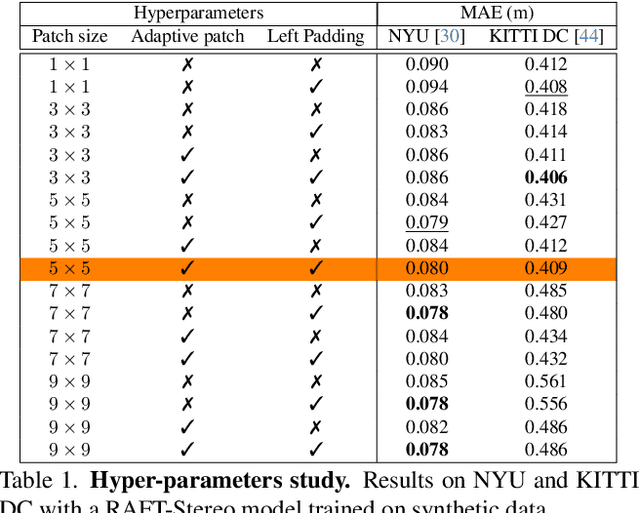
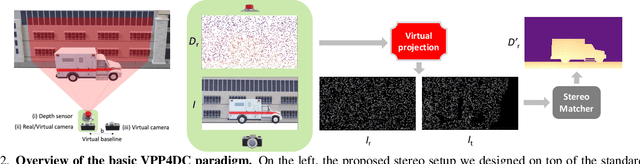

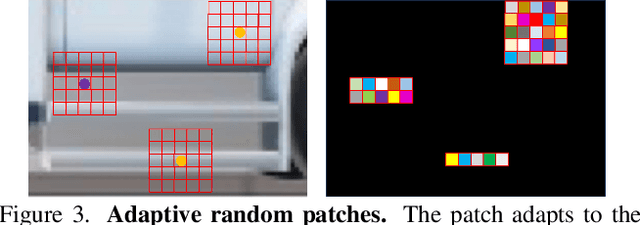
This paper proposes a new framework for depth completion robust against domain-shifting issues. It exploits the generalization capability of modern stereo networks to face depth completion, by processing fictitious stereo pairs obtained through a virtual pattern projection paradigm. Any stereo network or traditional stereo matcher can be seamlessly plugged into our framework, allowing for the deployment of a virtual stereo setup that is future-proof against advancement in the stereo field. Exhaustive experiments on cross-domain generalization support our claims. Hence, we argue that our framework can help depth completion to reach new deployment scenarios.
Active Stereo Without Pattern Projector
Sep 21, 2023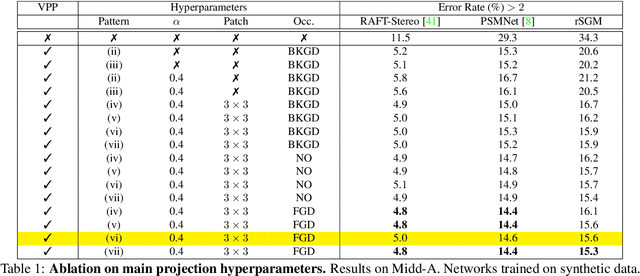
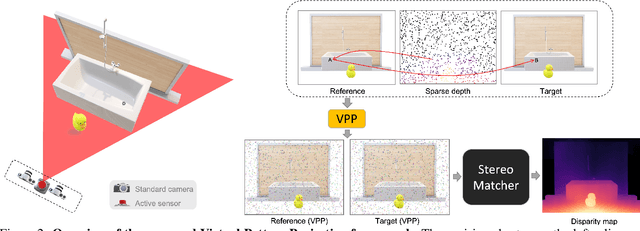
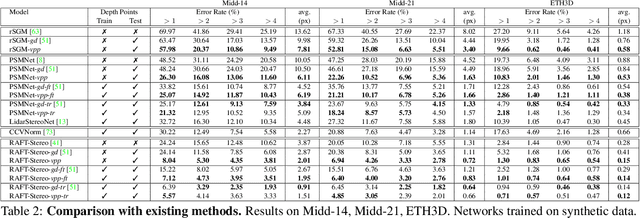
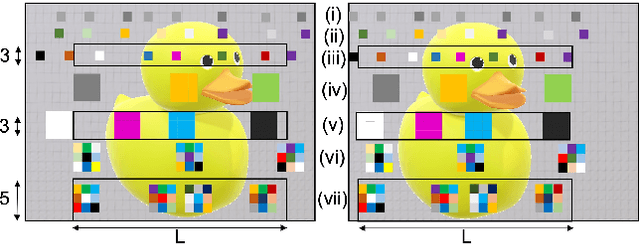
This paper proposes a novel framework integrating the principles of active stereo in standard passive camera systems without a physical pattern projector. We virtually project a pattern over the left and right images according to the sparse measurements obtained from a depth sensor. Any such devices can be seamlessly plugged into our framework, allowing for the deployment of a virtual active stereo setup in any possible environment, overcoming the limitation of pattern projectors, such as limited working range or environmental conditions. Experiments on indoor/outdoor datasets, featuring both long and close-range, support the seamless effectiveness of our approach, boosting the accuracy of both stereo algorithms and deep networks.