 Add to Chrome
 Add to Firefox
 Add to Edge
Ambient-robust Inverse Rendering using Active RGB-NIR Imaging
May 28, 2026
Inverse rendering aims to reconstruct geometry and reflectance of objects from images. Despite recent progress, existing methods often produces inaccurate reconstructions that are sensitive to ambient illumination conditions. Here we introduce an ambient-robust inverse rendering method enabled by active RGB-NIR imaging. Our key insight is to leverage near-infrared (NIR) flash illumination-imperceptible to human observers-to obtain stable point-light shading that is largely invariant to ambient illumination. By using multi-view RGB images illuminated by ambient light and NIR images acquired with active NIR flash illumination, we reconstruct accurate geometry and reflectance by exploiting the complementary benefits of RGB and NIR images via a three-stage inverse rendering method. To enable dense multi-view acquisition, we develop an active imaging system equipped with a RGB-NIR camera and a NIR flash mounted on a mobile base. Using this system, we collect the first multi-view RGB-NIR inverse rendering dataset captured under multiple ambient illumination conditions. Experiments demonstrate that our method outperforms prior approaches, achieving accurate geometry and reflectance estimation across multiple ambient lighting scenarios.

Broadband Hyperspectral 3D Imaging using Dispersed Structured Light
May 25, 2026Hyperspectral 3D imaging enables the capture of dense spectral information and scene geometry but has traditionally been confined to narrow spectral windows, typically the visible range. In this work, we introduce a broadband hyperspectral 3D imaging (BH3D) method to extend this capability across the full visible-near-infrared and short-wavelength infrared (SWIR) spectrum (450-1500 nm). This broad coverage is critical as it captures complementary physical cues: visible wavelengths reveal surface appearance, while SWIR bands provide insight into subsurface properties and material composition. However, realizing BH3D is challenging due to fundamental sensor constraints between visible-spectrum silicon and SWIR-spectrum InGaAs sensors, which necessitate complex multi-spectrograph designs. Here we propose a single-spectrograph BH3D system, using a stereo setup comprising visible and SWIR cameras, that reconstructs dense broadband hyperspectral reflectance together with accurate 3D geometry. Our key idea is to extend dispersed structured light to the broadband regime using a single spectrograph. We model the image formation of broadband dispersed structured light, and estimate hyperspectral reflectance and depth. We validate our approach on diverse real-world scenes, demonstrating accurate reconstruction with a mean spectral angle mapper of 0.13 rad, root mean square error of 0.03, and mean depth error of 4.5 mm. We further demonstrate identifying metameric materials, performing imaging through opaque layers, uncovering hidden features on banknotes, and revealing blood vessels.
Snapshot Polarimetric Display Inverse Rendering
May 24, 2026Inverse rendering remains a core challenge in graphics and vision, especially in the snapshot configurations required for lightweight desktop workflows, where the per-frame information budget is highly constrained. Previous inverse rendering work explores various available dimensions for enriching the per-shot information, including temporal modulation, spectral encoding, and polarization. In this work, we introduce polarimetric display inverse rendering, using an LCD to project a linearly polarized RGB binary pattern and an RGB polarization camera augmented with a quarter-wave plate to acquire spectro-polarimetric measurements in a single shot. A feed-forward transformer maps these measurements to per-pixel normal, albedo, roughness, and metallicity. To overcome training data scarcity, we expand a limited set of measured polarimetric bidirectional reflectance distribution functions via a generative manifold. Evaluations on a real desktop setup demonstrate accurate inverse rendering across diverse scenes, outperforming existing approaches.
DynaVid: Learning to Generate Highly Dynamic Videos using Synthetic Motion Data
Apr 02, 2026Despite recent progress, video diffusion models still struggle to synthesize realistic videos involving highly dynamic motions or requiring fine-grained motion controllability. A central limitation lies in the scarcity of such examples in commonly used training datasets. To address this, we introduce DynaVid, a video synthesis framework that leverages synthetic motion data in training, which is represented as optical flow and rendered using computer graphics pipelines. This approach offers two key advantages. First, synthetic motion offers diverse motion patterns and precise control signals that are difficult to obtain from real data. Second, unlike rendered videos with artificial appearances, rendered optical flow encodes only motion and is decoupled from appearance, thereby preventing models from reproducing the unnatural look of synthetic videos. Building on this idea, DynaVid adopts a two-stage generation framework: a motion generator first synthesizes motion, and then a motion-guided video generator produces video frames conditioned on that motion. This decoupled formulation enables the model to learn dynamic motion patterns from synthetic data while preserving visual realism from real-world videos. We validate our framework on two challenging scenarios, vigorous human motion generation and extreme camera motion control, where existing datasets are particularly limited. Extensive experiments demonstrate that DynaVid improves the realism and controllability in dynamic motion generation and camera motion control.
Learned split-spectrum metalens for obstruction-free broadband imaging in the visible
Jan 27, 2026Obstructions such as raindrops, fences, or dust degrade captured images, especially when mechanical cleaning is infeasible. Conventional solutions to obstructions rely on a bulky compound optics array or computational inpainting, which compromise compactness or fidelity. Metalenses composed of subwavelength meta-atoms promise compact imaging, but simultaneous achievement of broadband and obstruction-free imaging remains a challenge, since a metalens that images distant scenes across a broadband spectrum cannot properly defocus near-depth occlusions. Here, we introduce a learned split-spectrum metalens that enables broadband obstruction-free imaging. Our approach divides the spectrum of each RGB channel into pass and stop bands with multi-band spectral filtering and learns the metalens to focus light from far objects through pass bands, while filtering focused near-depth light through stop bands. This optical signal is further enhanced using a neural network. Our learned split-spectrum metalens achieves broadband and obstruction-free imaging with relative PSNR gains of 32.29% and improves object detection and semantic segmentation accuracies with absolute gains of +13.54% mAP, +48.45% IoU, and +20.35% mIoU over a conventional hyperbolic design. This promises robust obstruction-free sensing and vision for space-constrained systems, such as mobile robots, drones, and endoscopes.
A Real-world Display Inverse Rendering Dataset
Aug 20, 2025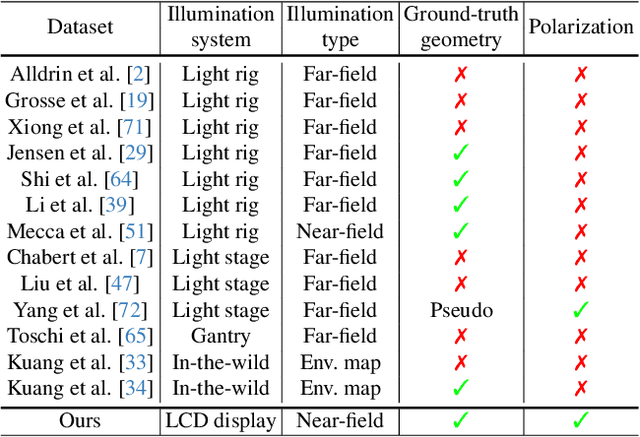
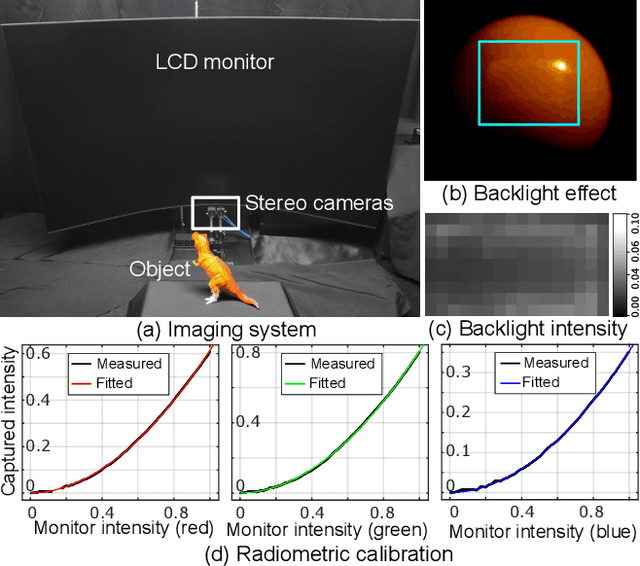
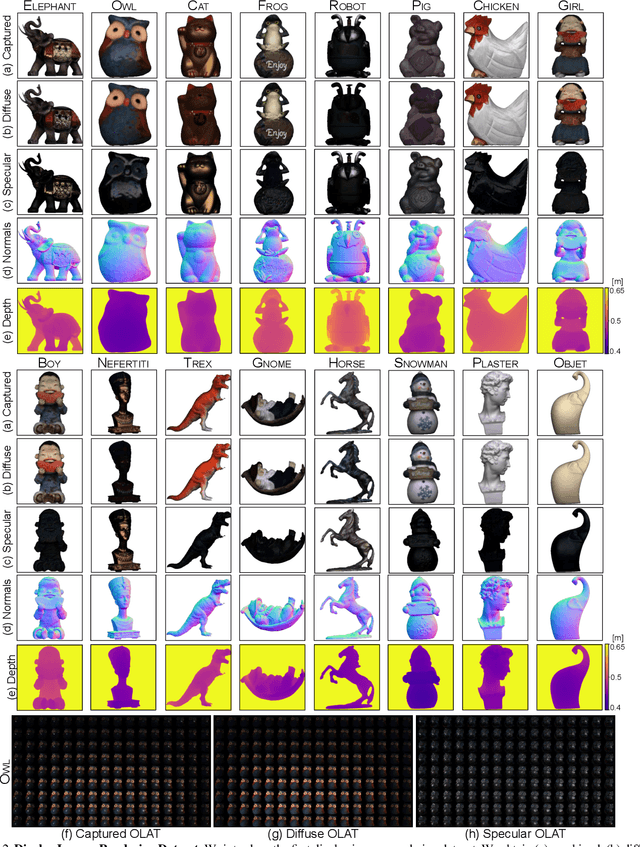

Inverse rendering aims to reconstruct geometry and reflectance from captured images. Display-camera imaging systems offer unique advantages for this task: each pixel can easily function as a programmable point light source, and the polarized light emitted by LCD displays facilitates diffuse-specular separation. Despite these benefits, there is currently no public real-world dataset captured using display-camera systems, unlike other setups such as light stages. This absence hinders the development and evaluation of display-based inverse rendering methods. In this paper, we introduce the first real-world dataset for display-based inverse rendering. To achieve this, we construct and calibrate an imaging system comprising an LCD display and stereo polarization cameras. We then capture a diverse set of objects with diverse geometry and reflectance under one-light-at-a-time (OLAT) display patterns. We also provide high-quality ground-truth geometry. Our dataset enables the synthesis of captured images under arbitrary display patterns and different noise levels. Using this dataset, we evaluate the performance of existing photometric stereo and inverse rendering methods, and provide a simple, yet effective baseline for display inverse rendering, outperforming state-of-the-art inverse rendering methods. Code and dataset are available on our project page at https://michaelcsj.github.io/DIR/
Complex-Valued Holographic Radiance Fields
Jun 10, 2025Modeling the full properties of light, including both amplitude and phase, in 3D representations is crucial for advancing physically plausible rendering, particularly in holographic displays. To support these features, we propose a novel representation that optimizes 3D scenes without relying on intensity-based intermediaries. We reformulate 3D Gaussian splatting with complex-valued Gaussian primitives, expanding support for rendering with light waves. By leveraging RGBD multi-view images, our method directly optimizes complex-valued Gaussians as a 3D holographic scene representation. This eliminates the need for computationally expensive hologram re-optimization. Compared with state-of-the-art methods, our method achieves 30x-10,000x speed improvements while maintaining on-par image quality, representing a first step towards geometrically aligned, physically plausible holographic scene representations.
FloVD: Optical Flow Meets Video Diffusion Model for Enhanced Camera-Controlled Video Synthesis
Feb 12, 2025This paper presents FloVD, a novel optical-flow-based video diffusion model for camera-controllable video generation. FloVD leverages optical flow maps to represent motions of the camera and moving objects. This approach offers two key benefits. Since optical flow can be directly estimated from videos, our approach allows for the use of arbitrary training videos without ground-truth camera parameters. Moreover, as background optical flow encodes 3D correlation across different viewpoints, our method enables detailed camera control by leveraging the background motion. To synthesize natural object motion while supporting detailed camera control, our framework adopts a two-stage video synthesis pipeline consisting of optical flow generation and flow-conditioned video synthesis. Extensive experiments demonstrate the superiority of our method over previous approaches in terms of accurate camera control and natural object motion synthesis.
Differentiable Mobile Display Photometric Stereo
Feb 07, 2025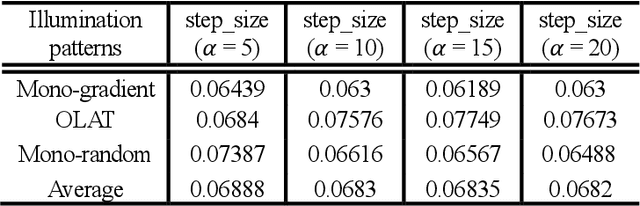
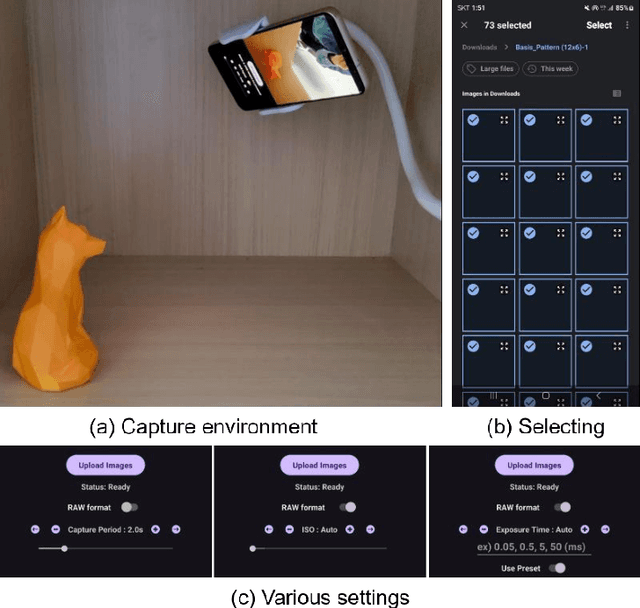
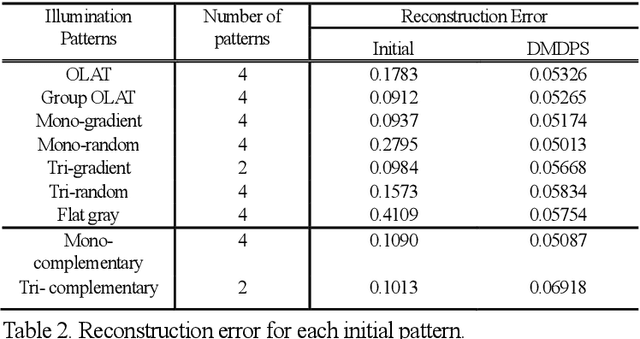
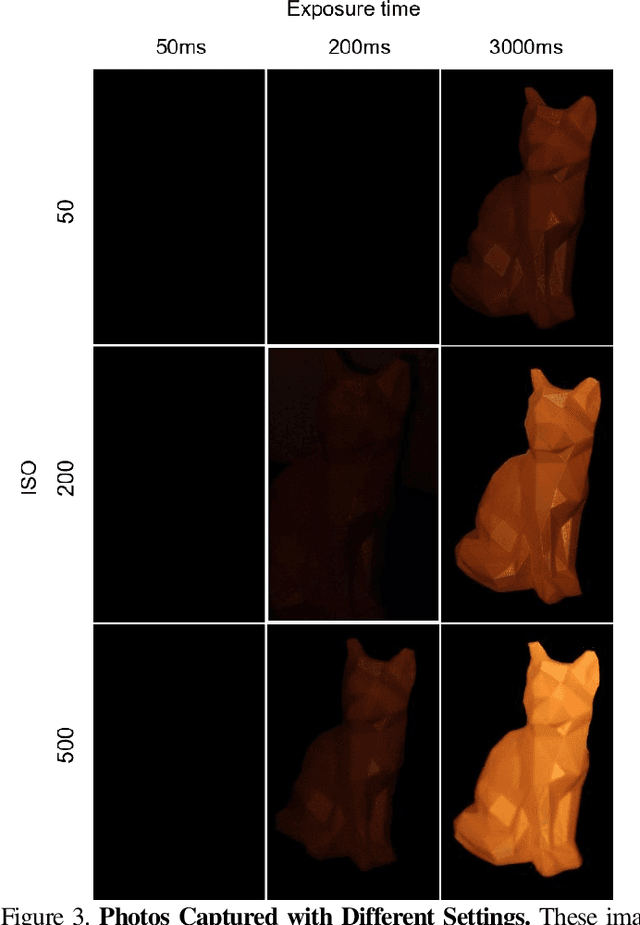
Display photometric stereo uses a display as a programmable light source to illuminate a scene with diverse illumination conditions. Recently, differentiable display photometric stereo (DDPS) demonstrated improved normal reconstruction accuracy by using learned display patterns. However, DDPS faced limitations in practicality, requiring a fixed desktop imaging setup using a polarization camera and a desktop-scale monitor. In this paper, we propose a more practical physics-based photometric stereo, differentiable mobile display photometric stereo (DMDPS), that leverages a mobile phone consisting of a display and a camera. We overcome the limitations of using a mobile device by developing a mobile app and method that simultaneously displays patterns and captures high-quality HDR images. Using this technique, we capture real-world 3D-printed objects and learn display patterns via a differentiable learning process. We demonstrate the effectiveness of DMDPS on both a 3D printed dataset and a first dataset of fallen leaves. The leaf dataset contains reconstructed surface normals and albedos of fallen leaves that may enable future research beyond computer graphics and vision. We believe that DMDPS takes a step forward for practical physics-based photometric stereo.
Polarimetric BSSRDF Acquisition of Dynamic Faces
Dec 29, 2024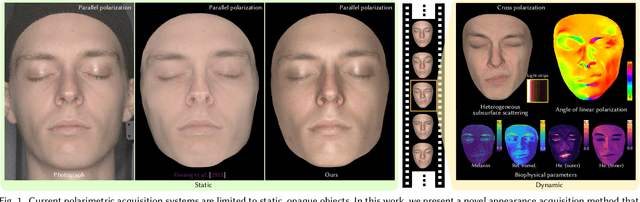
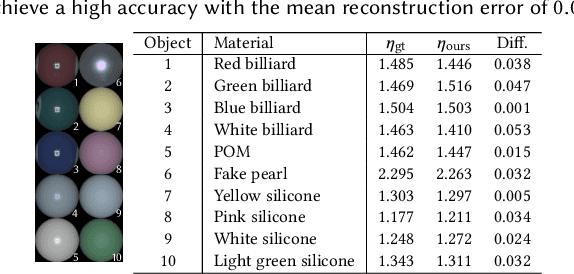
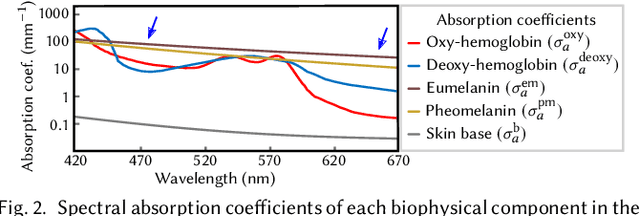
Acquisition and modeling of polarized light reflection and scattering help reveal the shape, structure, and physical characteristics of an object, which is increasingly important in computer graphics. However, current polarimetric acquisition systems are limited to static and opaque objects. Human faces, on the other hand, present a particularly difficult challenge, given their complex structure and reflectance properties, the strong presence of spatially-varying subsurface scattering, and their dynamic nature. We present a new polarimetric acquisition method for dynamic human faces, which focuses on capturing spatially varying appearance and precise geometry, across a wide spectrum of skin tones and facial expressions. It includes both single and heterogeneous subsurface scattering, index of refraction, and specular roughness and intensity, among other parameters, while revealing biophysically-based components such as inner- and outer-layer hemoglobin, eumelanin and pheomelanin. Our method leverages such components' unique multispectral absorption profiles to quantify their concentrations, which in turn inform our model about the complex interactions occurring within the skin layers. To our knowledge, our work is the first to simultaneously acquire polarimetric and spectral reflectance information alongside biophysically-based skin parameters and geometry of dynamic human faces. Moreover, our polarimetric skin model integrates seamlessly into various rendering pipelines.