 Add to Chrome
 Add to Firefox
 Add to Edge
Semantic Image Matting
Papers and Code
A$^2$-Edit: Precise Reference-Guided Image Editing of Arbitrary Objects and Ambiguous Masks
Mar 11, 2026
We propose \textbf{A$^2$-Edit}, a unified inpainting framework for arbitrary object categories, which allows users to replace any target region with a reference object using only a coarse mask. To address the issues of severe homogenization and limited category coverage in existing datasets, we construct a large-scale, multi-category dataset \textbf{UniEdit-500K}, which includes 8 major categories, 209 fine-grained subcategories, and a total of 500,104 image pairs. Such rich category diversity poses new challenges for the model, requiring it to automatically learn semantic relationships and distinctions across categories. To this end, we introduce the \textbf{Mixture of Transformer} module, which performs differentiated modeling of various object categories through dynamic expert selection, and further enhances cross-category semantic transfer and generalization through collaboration among experts. In addition, we propose a \textbf{Mask Annealing Training Strategy} (MATS) that progressively relaxes mask precision during training, reducing the model's reliance on accurate masks and improving robustness across diverse editing tasks. Extensive experiments on benchmarks such as VITON-HD and AnyInsertion demonstrate that A$^2$-Edit consistently outperforms existing approaches across all metrics, providing a new and efficient solution for arbitrary object editing.

MatAnyone 2: Scaling Video Matting via a Learned Quality Evaluator
Dec 12, 2025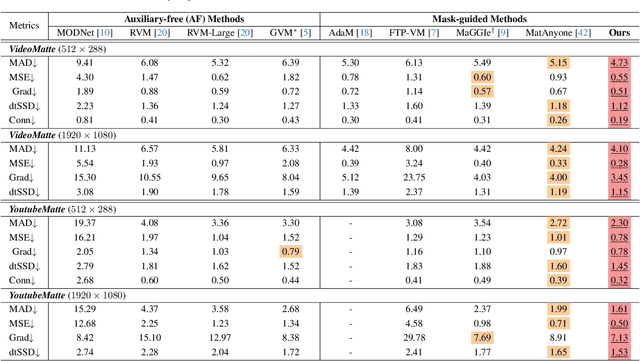
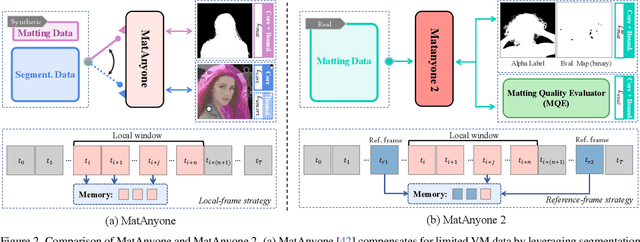
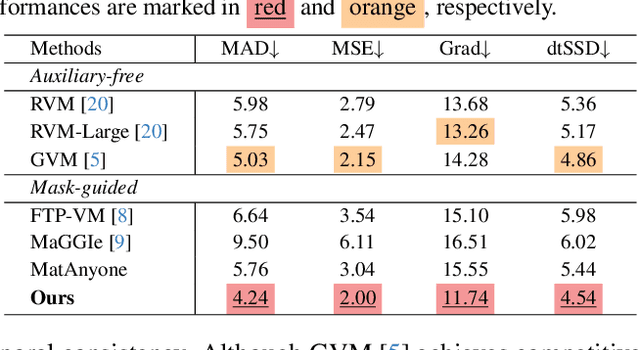
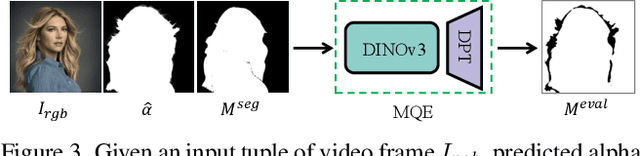
Video matting remains limited by the scale and realism of existing datasets. While leveraging segmentation data can enhance semantic stability, the lack of effective boundary supervision often leads to segmentation-like mattes lacking fine details. To this end, we introduce a learned Matting Quality Evaluator (MQE) that assesses semantic and boundary quality of alpha mattes without ground truth. It produces a pixel-wise evaluation map that identifies reliable and erroneous regions, enabling fine-grained quality assessment. The MQE scales up video matting in two ways: (1) as an online matting-quality feedback during training to suppress erroneous regions, providing comprehensive supervision, and (2) as an offline selection module for data curation, improving annotation quality by combining the strengths of leading video and image matting models. This process allows us to build a large-scale real-world video matting dataset, VMReal, containing 28K clips and 2.4M frames. To handle large appearance variations in long videos, we introduce a reference-frame training strategy that incorporates long-range frames beyond the local window for effective training. Our MatAnyone 2 achieves state-of-the-art performance on both synthetic and real-world benchmarks, surpassing prior methods across all metrics.
RePainter: Empowering E-commerce Object Removal via Spatial-matting Reinforcement Learning
Oct 09, 2025In web data, product images are central to boosting user engagement and advertising efficacy on e-commerce platforms, yet the intrusive elements such as watermarks and promotional text remain major obstacles to delivering clear and appealing product visuals. Although diffusion-based inpainting methods have advanced, they still face challenges in commercial settings due to unreliable object removal and limited domain-specific adaptation. To tackle these challenges, we propose Repainter, a reinforcement learning framework that integrates spatial-matting trajectory refinement with Group Relative Policy Optimization (GRPO). Our approach modulates attention mechanisms to emphasize background context, generating higher-reward samples and reducing unwanted object insertion. We also introduce a composite reward mechanism that balances global, local, and semantic constraints, effectively reducing visual artifacts and reward hacking. Additionally, we contribute EcomPaint-100K, a high-quality, large-scale e-commerce inpainting dataset, and a standardized benchmark EcomPaint-Bench for fair evaluation. Extensive experiments demonstrate that Repainter significantly outperforms state-of-the-art methods, especially in challenging scenes with intricate compositions. We will release our code and weights upon acceptance.
Enhancing Image Matting in Real-World Scenes with Mask-Guided Iterative Refinement
Feb 24, 2025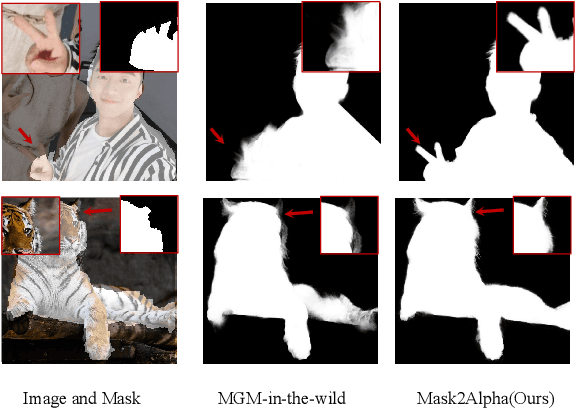
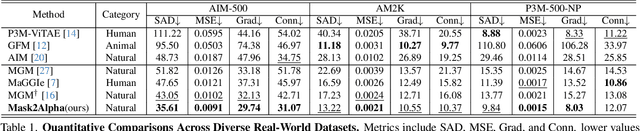
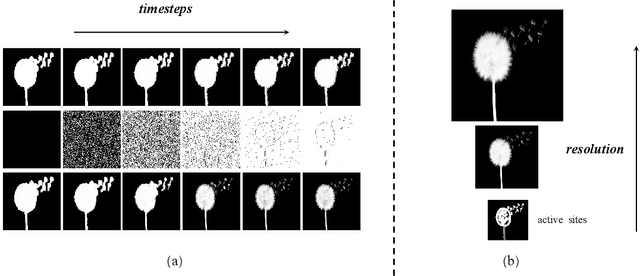
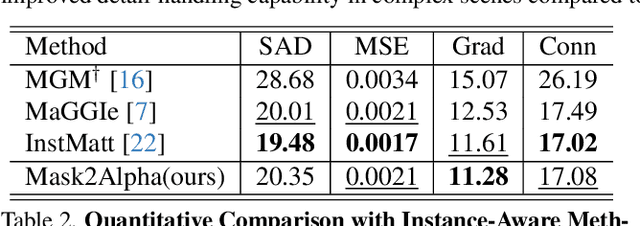
Real-world image matting is essential for applications in content creation and augmented reality. However, it remains challenging due to the complex nature of scenes and the scarcity of high-quality datasets. To address these limitations, we introduce Mask2Alpha, an iterative refinement framework designed to enhance semantic comprehension, instance awareness, and fine-detail recovery in image matting. Our framework leverages self-supervised Vision Transformer features as semantic priors, strengthening contextual understanding in complex scenarios. To further improve instance differentiation, we implement a mask-guided feature selection module, enabling precise targeting of objects in multi-instance settings. Additionally, a sparse convolution-based optimization scheme allows Mask2Alpha to recover high-resolution details through progressive refinement,from low-resolution semantic passes to high-resolution sparse reconstructions. Benchmarking across various real-world datasets, Mask2Alpha consistently achieves state-of-the-art results, showcasing its effectiveness in accurate and efficient image matting.
Towards Natural Image Matting in the Wild via Real-Scenario Prior
Oct 09, 2024


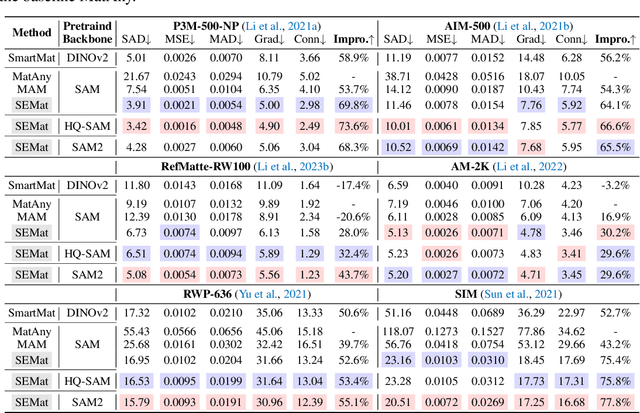
Recent approaches attempt to adapt powerful interactive segmentation models, such as SAM, to interactive matting and fine-tune the models based on synthetic matting datasets. However, models trained on synthetic data fail to generalize to complex and occlusion scenes. We address this challenge by proposing a new matting dataset based on the COCO dataset, namely COCO-Matting. Specifically, the construction of our COCO-Matting includes accessory fusion and mask-to-matte, which selects real-world complex images from COCO and converts semantic segmentation masks to matting labels. The built COCO-Matting comprises an extensive collection of 38,251 human instance-level alpha mattes in complex natural scenarios. Furthermore, existing SAM-based matting methods extract intermediate features and masks from a frozen SAM and only train a lightweight matting decoder by end-to-end matting losses, which do not fully exploit the potential of the pre-trained SAM. Thus, we propose SEMat which revamps the network architecture and training objectives. For network architecture, the proposed feature-aligned transformer learns to extract fine-grained edge and transparency features. The proposed matte-aligned decoder aims to segment matting-specific objects and convert coarse masks into high-precision mattes. For training objectives, the proposed regularization and trimap loss aim to retain the prior from the pre-trained model and push the matting logits extracted from the mask decoder to contain trimap-based semantic information. Extensive experiments across seven diverse datasets demonstrate the superior performance of our method, proving its efficacy in interactive natural image matting. We open-source our code, models, and dataset at https://github.com/XiaRho/SEMat.
Training Matting Models without Alpha Labels
Aug 20, 2024

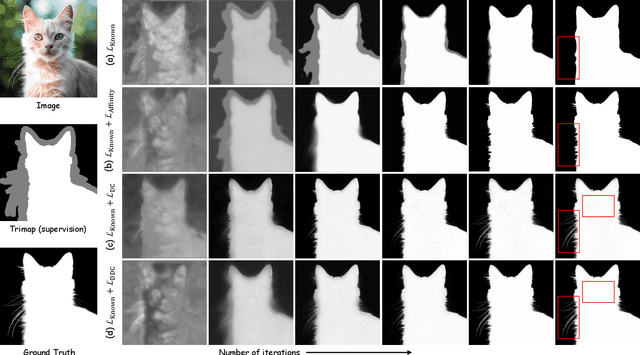
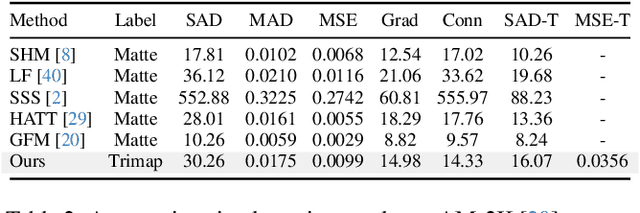
The labelling difficulty has been a longstanding problem in deep image matting. To escape from fine labels, this work explores using rough annotations such as trimaps coarsely indicating the foreground/background as supervision. We present that the cooperation between learned semantics from indicated known regions and proper assumed matting rules can help infer alpha values at transition areas. Inspired by the nonlocal principle in traditional image matting, we build a directional distance consistency loss (DDC loss) at each pixel neighborhood to constrain the alpha values conditioned on the input image. DDC loss forces the distance of similar pairs on the alpha matte and on its corresponding image to be consistent. In this way, the alpha values can be propagated from learned known regions to unknown transition areas. With only images and trimaps, a matting model can be trained under the supervision of a known loss and the proposed DDC loss. Experiments on AM-2K and P3M-10K dataset show that our paradigm achieves comparable performance with the fine-label-supervised baseline, while sometimes offers even more satisfying results than human-labelled ground truth. Code is available at \url{https://github.com/poppuppy/alpha-free-matting}.
FADE: A Task-Agnostic Upsampling Operator for Encoder-Decoder Architectures
Jul 18, 2024The goal of this work is to develop a task-agnostic feature upsampling operator for dense prediction where the operator is required to facilitate not only region-sensitive tasks like semantic segmentation but also detail-sensitive tasks such as image matting. Prior upsampling operators often can work well in either type of the tasks, but not both. We argue that task-agnostic upsampling should dynamically trade off between semantic preservation and detail delineation, instead of having a bias between the two properties. In this paper, we present FADE, a novel, plug-and-play, lightweight, and task-agnostic upsampling operator by fusing the assets of decoder and encoder features at three levels: i) considering both the encoder and decoder feature in upsampling kernel generation; ii) controlling the per-point contribution of the encoder/decoder feature in upsampling kernels with an efficient semi-shift convolutional operator; and iii) enabling the selective pass of encoder features with a decoder-dependent gating mechanism for compensating details. To improve the practicality of FADE, we additionally study parameter- and memory-efficient implementations of semi-shift convolution. We analyze the upsampling behavior of FADE on toy data and show through large-scale experiments that FADE is task-agnostic with consistent performance improvement on a number of dense prediction tasks with little extra cost. For the first time, we demonstrate robust feature upsampling on both region- and detail-sensitive tasks successfully. Code is made available at: https://github.com/poppinace/fade
DFIMat: Decoupled Flexible Interactive Matting in Multi-Person Scenarios
Oct 13, 2024Interactive portrait matting refers to extracting the soft portrait from a given image that best meets the user's intent through their inputs. Existing methods often underperform in complex scenarios, mainly due to three factors. (1) Most works apply a tightly coupled network that directly predicts matting results, lacking interpretability and resulting in inadequate modeling. (2) Existing works are limited to a single type of user input, which is ineffective for intention understanding and also inefficient for user operation. (3) The multi-round characteristics have been under-explored, which is crucial for user interaction. To alleviate these limitations, we propose DFIMat, a decoupled framework that enables flexible interactive matting. Specifically, we first decouple the task into 2 sub-ones: localizing target instances by understanding scene semantics and the flexible user inputs, and conducting refinement for instance-level matting. We observe a clear performance gain from decoupling, as it makes sub-tasks easier to learn, and the flexible multi-type input further enhances both effectiveness and efficiency. DFIMat also considers the multi-round interaction property, where a contrastive reasoning module is designed to enhance cross-round refinement. Another limitation for multi-person matting task is the lack of training data. We address this by introducing a new synthetic data generation pipeline that can generate much more realistic samples than previous arts. A new large-scale dataset SMPMat is subsequently established. Experiments verify the significant superiority of DFIMat. With it, we also investigate the roles of different input types, providing valuable principles for users. Our code and dataset can be found at https://github.com/JiaoSiyi/DFIMat.
End-to-End Human Instance Matting
Mar 03, 2024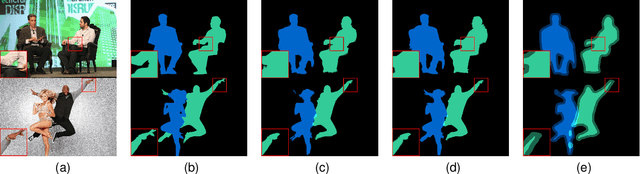
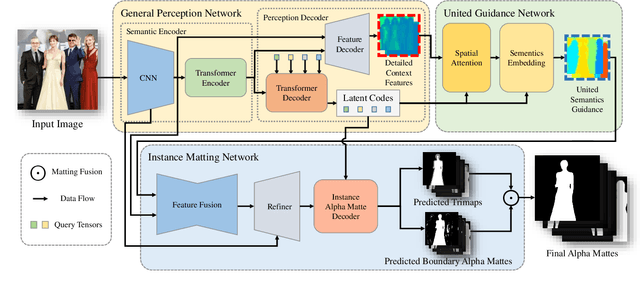
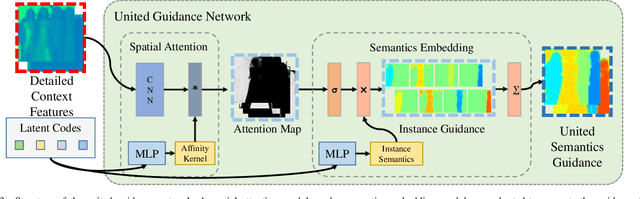
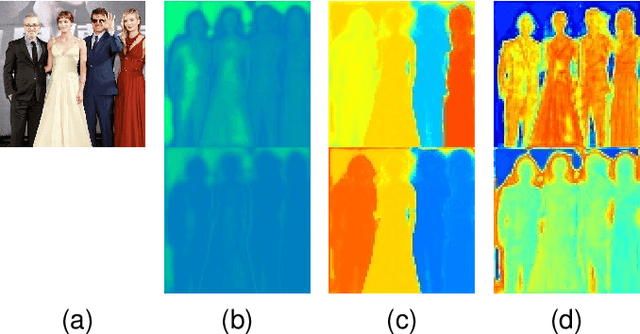
Human instance matting aims to estimate an alpha matte for each human instance in an image, which is extremely challenging and has rarely been studied so far. Despite some efforts to use instance segmentation to generate a trimap for each instance and apply trimap-based matting methods, the resulting alpha mattes are often inaccurate due to inaccurate segmentation. In addition, this approach is computationally inefficient due to multiple executions of the matting method. To address these problems, this paper proposes a novel End-to-End Human Instance Matting (E2E-HIM) framework for simultaneous multiple instance matting in a more efficient manner. Specifically, a general perception network first extracts image features and decodes instance contexts into latent codes. Then, a united guidance network exploits spatial attention and semantics embedding to generate united semantics guidance, which encodes the locations and semantic correspondences of all instances. Finally, an instance matting network decodes the image features and united semantics guidance to predict all instance-level alpha mattes. In addition, we construct a large-scale human instance matting dataset (HIM-100K) comprising over 100,000 human images with instance alpha matte labels. Experiments on HIM-100K demonstrate the proposed E2E-HIM outperforms the existing methods on human instance matting with 50% lower errors and 5X faster speed (6 instances in a 640X640 image). Experiments on the PPM-100, RWP-636, and P3M datasets demonstrate that E2E-HIM also achieves competitive performance on traditional human matting.
Dual-Context Aggregation for Universal Image Matting
Feb 28, 2024Natural image matting aims to estimate the alpha matte of the foreground from a given image. Various approaches have been explored to address this problem, such as interactive matting methods that use guidance such as click or trimap, and automatic matting methods tailored to specific objects. However, existing matting methods are designed for specific objects or guidance, neglecting the common requirement of aggregating global and local contexts in image matting. As a result, these methods often encounter challenges in accurately identifying the foreground and generating precise boundaries, which limits their effectiveness in unforeseen scenarios. In this paper, we propose a simple and universal matting framework, named Dual-Context Aggregation Matting (DCAM), which enables robust image matting with arbitrary guidance or without guidance. Specifically, DCAM first adopts a semantic backbone network to extract low-level features and context features from the input image and guidance. Then, we introduce a dual-context aggregation network that incorporates global object aggregators and local appearance aggregators to iteratively refine the extracted context features. By performing both global contour segmentation and local boundary refinement, DCAM exhibits robustness to diverse types of guidance and objects. Finally, we adopt a matting decoder network to fuse the low-level features and the refined context features for alpha matte estimation. Experimental results on five matting datasets demonstrate that the proposed DCAM outperforms state-of-the-art matting methods in both automatic matting and interactive matting tasks, which highlights the strong universality and high performance of DCAM. The source code is available at \url{https://github.com/Windaway/DCAM}.