 Add to Chrome
 Add to Firefox
 Add to Edge
Pdc
Papers and Code
The PARLO Dementia Corpus: A German Multi-Center Resource for Alzheimer's Disease
Mar 05, 2026
Early and accessible detection of Alzheimer's disease (AD) remains a major challenge, as current diagnostic methods often rely on costly and invasive biomarkers. Speech and language analysis has emerged as a promising non-invasive and scalable approach to detecting cognitive impairment, but research in this area is hindered by the lack of publicly available datasets, especially for languages other than English. This paper introduces the PARLO Dementia Corpus (PDC), a new multi-center, clinically validated German resource for AD collected across nine academic memory clinics in Germany. The dataset comprises speech recordings from individuals with AD-related mild cognitive impairment and mild to moderate dementia, as well as cognitively healthy controls. Speech was elicited using a standardized test battery of eight neuropsychological tasks, including confrontation naming, verbal fluency, word repetition, picture description, story reading, and recall tasks. In addition to audio recordings, the dataset includes manually verified transcriptions and detailed demographic, clinical, and biomarker metadata. Baseline experiments on ASR benchmarking, automated test evaluation, and LLM-based classification illustrate the feasibility of automatic, speech-based cognitive assessment and highlight the diagnostic value of recall-driven speech production. The PDC thus establishes the first publicly available German benchmark for multi-modal and cross-lingual research on neurodegenerative diseases.

ResponseRank: Data-Efficient Reward Modeling through Preference Strength Learning
Dec 31, 2025Binary choices, as often used for reinforcement learning from human feedback (RLHF), convey only the direction of a preference. A person may choose apples over oranges and bananas over grapes, but which preference is stronger? Strength is crucial for decision-making under uncertainty and generalization of preference models, but hard to measure reliably. Metadata such as response times and inter-annotator agreement can serve as proxies for strength, but are often noisy and confounded. We propose ResponseRank to address the challenge of learning from noisy strength signals. Our method uses relative differences in proxy signals to rank responses to pairwise comparisons by their inferred preference strength. To control for systemic variation, we compare signals only locally within carefully constructed strata. This enables robust learning of utility differences consistent with strength-derived rankings while making minimal assumptions about the strength signal. Our contributions are threefold: (1) ResponseRank, a novel method that robustly learns preference strength by leveraging locally valid relative strength signals; (2) empirical evidence of improved sample efficiency and robustness across diverse tasks: synthetic preference learning (with simulated response times), language modeling (with annotator agreement), and RL control tasks (with simulated episode returns); and (3) the Pearson Distance Correlation (PDC), a novel metric that isolates cardinal utility learning from ordinal accuracy.
Perceive and Calibrate: Analyzing and Enhancing Robustness of Medical Multi-Modal Large Language Models
Dec 26, 2025Medical Multi-modal Large Language Models (MLLMs) have shown promising clinical performance. However, their sensitivity to real-world input perturbations, such as imaging artifacts and textual errors, critically undermines their clinical applicability. Systematic analysis of such noise impact on medical MLLMs remains largely unexplored. Furthermore, while several works have investigated the MLLMs' robustness in general domains, they primarily focus on text modality and rely on costly fine-tuning. They are inadequate to address the complex noise patterns and fulfill the strict safety standards in medicine. To bridge this gap, this work systematically analyzes the impact of various perturbations on medical MLLMs across both visual and textual modalities. Building on our findings, we introduce a training-free Inherent-enhanced Multi-modal Calibration (IMC) framework that leverages MLLMs' inherent denoising capabilities following the perceive-and-calibrate principle for cross-modal robustness enhancement. For the visual modality, we propose a Perturbation-aware Denoising Calibration (PDC) which leverages MLLMs' own vision encoder to identify noise patterns and perform prototype-guided feature calibration. For text denoising, we design a Self-instantiated Multi-agent System (SMS) that exploits the MLLMs' self-assessment capabilities to refine noisy text through a cooperative hierarchy of agents. We construct a benchmark containing 11 types of noise across both image and text modalities on 2 datasets. Experimental results demonstrate our method achieves the state-of-the-art performance across multiple modalities, showing potential to enhance MLLMs' robustness in real clinical scenarios.
PDCNet: a benchmark and general deep learning framework for activity prediction of peptide-drug conjugates
Jun 15, 2025Peptide-drug conjugates (PDCs) represent a promising therapeutic avenue for human diseases, particularly in cancer treatment. Systematic elucidation of structure-activity relationships (SARs) and accurate prediction of the activity of PDCs are critical for the rational design and optimization of these conjugates. To this end, we carefully design and construct a benchmark PDCs dataset compiled from literature-derived collections and PDCdb database, and then develop PDCNet, the first unified deep learning framework for forecasting the activity of PDCs. The architecture systematically captures the complex factors underlying anticancer decisions of PDCs in real-word scenarios through a multi-level feature fusion framework that collaboratively characterizes and learns the features of peptides, linkers, and payloads. Leveraging a curated PDCs benchmark dataset, comprehensive evaluation results show that PDCNet demonstrates superior predictive capability, with the highest AUC, F1, MCC and BA scores of 0.9213, 0.7656, 0.7071 and 0.8388 for the test set, outperforming eight established traditional machine learning models. Multi-level validations, including 5-fold cross-validation, threshold testing, ablation studies, model interpretability analysis and external independent testing, further confirm the superiority, robustness, and usability of the PDCNet architecture. We anticipate that PDCNet represents a novel paradigm, incorporating both a benchmark dataset and advanced models, which can accelerate the design and discovery of new PDC-based therapeutic agents.
Emergent Active Perception and Dexterity of Simulated Humanoids from Visual Reinforcement Learning
May 18, 2025Human behavior is fundamentally shaped by visual perception -- our ability to interact with the world depends on actively gathering relevant information and adapting our movements accordingly. Behaviors like searching for objects, reaching, and hand-eye coordination naturally emerge from the structure of our sensory system. Inspired by these principles, we introduce Perceptive Dexterous Control (PDC), a framework for vision-driven dexterous whole-body control with simulated humanoids. PDC operates solely on egocentric vision for task specification, enabling object search, target placement, and skill selection through visual cues, without relying on privileged state information (e.g., 3D object positions and geometries). This perception-as-interface paradigm enables learning a single policy to perform multiple household tasks, including reaching, grasping, placing, and articulated object manipulation. We also show that training from scratch with reinforcement learning can produce emergent behaviors such as active search. These results demonstrate how vision-driven control and complex tasks induce human-like behaviors and can serve as the key ingredients in closing the perception-action loop for animation, robotics, and embodied AI.
Improving the quality of Web-mined Parallel Corpora of Low-Resource Languages using Debiasing Heuristics
Feb 26, 2025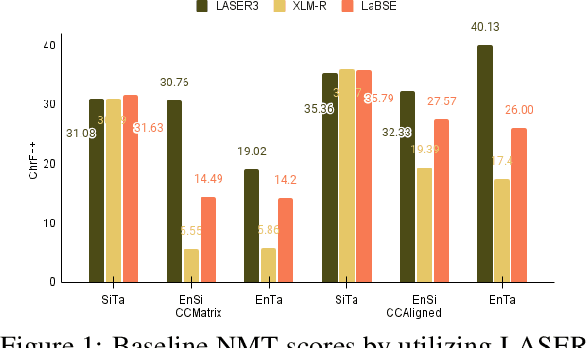
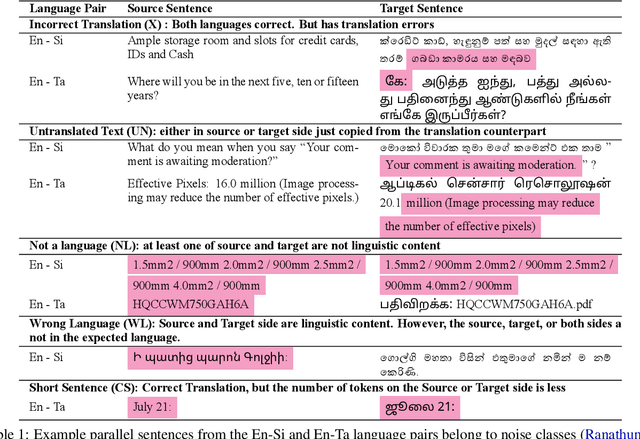
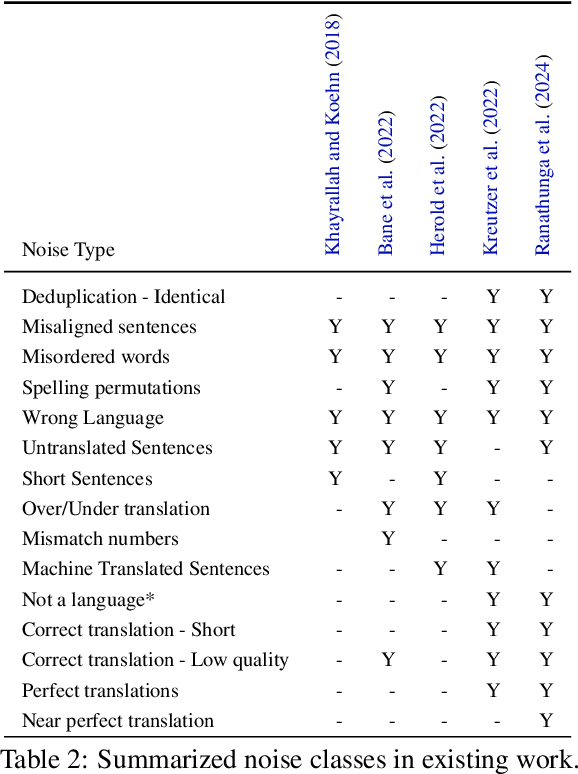
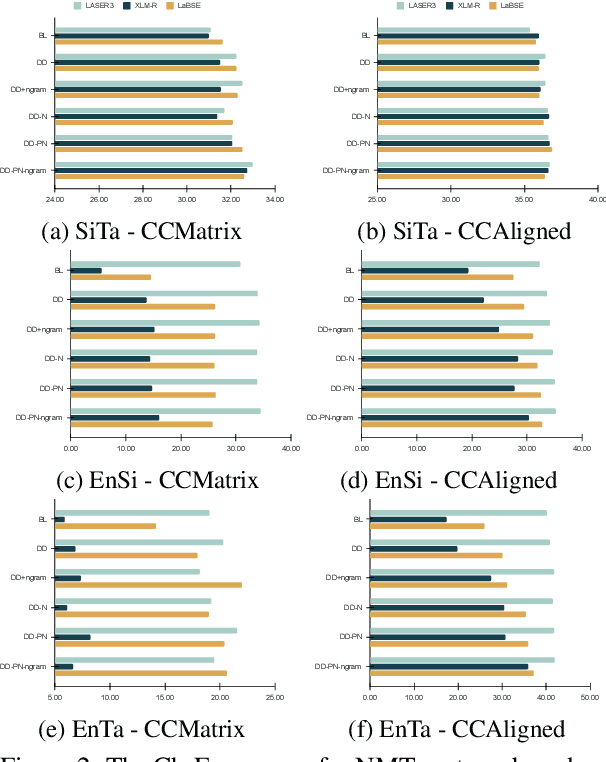
Parallel Data Curation (PDC) techniques aim to filter out noisy parallel sentences from the web-mined corpora. Prior research has demonstrated that ranking sentence pairs using similarity scores on sentence embeddings derived from Pre-trained Multilingual Language Models (multiPLMs) and training the NMT systems with the top-ranked samples, produces superior NMT performance than when trained using the full dataset. However, previous research has shown that the choice of multiPLM significantly impacts the ranking quality. This paper investigates the reasons behind this disparity across multiPLMs. Using the web-mined corpora CCMatrix and CCAligned for En$\rightarrow$Si, En$\rightarrow$Ta and Si$\rightarrow$Ta, we show that different multiPLMs (LASER3, XLM-R, and LaBSE) are biased towards certain types of sentences, which allows noisy sentences to creep into the top-ranked samples. We show that by employing a series of heuristics, this noise can be removed to a certain extent. This results in improving the results of NMT systems trained with web-mined corpora and reduces the disparity across multiPLMs.
PDC-ViT : Source Camera Identification using Pixel Difference Convolution and Vision Transformer
Jan 27, 2025Source camera identification has emerged as a vital solution to unlock incidents involving critical cases like terrorism, violence, and other criminal activities. The ability to trace the origin of an image/video can aid law enforcement agencies in gathering evidence and constructing the timeline of events. Moreover, identifying the owner of a certain device narrows down the area of search in a criminal investigation where smartphone devices are involved. This paper proposes a new pixel-based method for source camera identification, integrating Pixel Difference Convolution (PDC) with a Vision Transformer network (ViT), and named PDC-ViT. While the PDC acts as the backbone for feature extraction by exploiting Angular PDC (APDC) and Radial PDC (RPDC). These techniques enhance the capability to capture subtle variations in pixel information, which are crucial for distinguishing between different source cameras. The second part of the methodology focuses on classification, which is based on a Vision Transformer network. Unlike traditional methods that utilize image patches directly for training the classification network, the proposed approach uniquely inputs PDC features into the Vision Transformer network. To demonstrate the effectiveness of the PDC-ViT approach, it has been assessed on five different datasets, which include various image contents and video scenes. The method has also been compared with state-of-the-art source camera identification methods. Experimental results demonstrate the effectiveness and superiority of the proposed system in terms of accuracy and robustness when compared to its competitors. For example, our proposed PDC-ViT has achieved an accuracy of 94.30%, 84%, 94.22% and 92.29% using the Vision dataset, Daxing dataset, Socrates dataset and QUFVD dataset, respectively.
PDC & DM-SFT: A Road for LLM SQL Bug-Fix Enhancing
Nov 11, 2024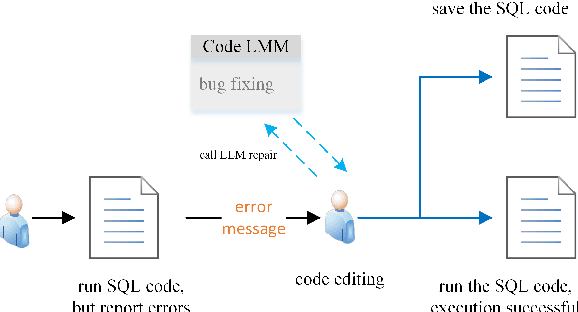
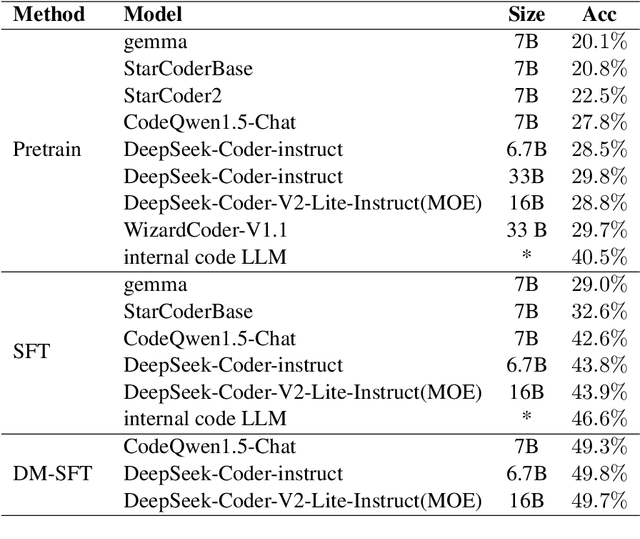

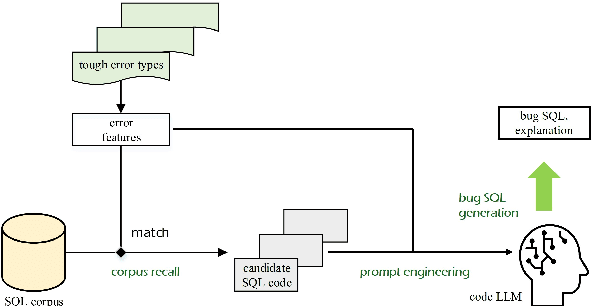
Code Large Language Models (Code LLMs), such as Code llama and DeepSeek-Coder, have demonstrated exceptional performance in the code generation tasks. However, most existing models focus on the abilities of generating correct code, but often struggle with bug repair. We introduce a suit of methods to enhance LLM's SQL bug-fixing abilities. The methods are mainly consisted of two parts: A Progressive Dataset Construction (PDC) from scratch and Dynamic Mask Supervised Fine-tuning (DM-SFT). PDC proposes two data expansion methods from the perspectives of breadth first and depth first respectively. DM-SFT introduces an efficient bug-fixing supervised learning approach, which effectively reduce the total training steps and mitigate the "disorientation" in SQL code bug-fixing training. In our evaluation, the code LLM models trained with two methods have exceeds all current best performing model which size is much larger.
PDCFNet: Enhancing Underwater Images through Pixel Difference Convolution
Sep 28, 2024Majority of deep learning methods utilize vanilla convolution for enhancing underwater images. While vanilla convolution excels in capturing local features and learning the spatial hierarchical structure of images, it tends to smooth input images, which can somewhat limit feature expression and modeling. A prominent characteristic of underwater degraded images is blur, and the goal of enhancement is to make the textures and details (high-frequency features) in the images more visible. Therefore, we believe that leveraging high-frequency features can improve enhancement performance. To address this, we introduce Pixel Difference Convolution (PDC), which focuses on gradient information with significant changes in the image, thereby improving the modeling of enhanced images. We propose an underwater image enhancement network, PDCFNet, based on PDC and cross-level feature fusion. Specifically, we design a detail enhancement module based on PDC that employs parallel PDCs to capture high-frequency features, leading to better detail and texture enhancement. The designed cross-level feature fusion module performs operations such as concatenation and multiplication on features from different levels, ensuring sufficient interaction and enhancement between diverse features. Our proposed PDCFNet achieves a PSNR of 27.37 and an SSIM of 92.02 on the UIEB dataset, attaining the best performance to date. Our code is available at https://github.com/zhangsong1213/PDCFNet.
PDC-FRS: Privacy-preserving Data Contribution for Federated Recommender System
Sep 12, 2024


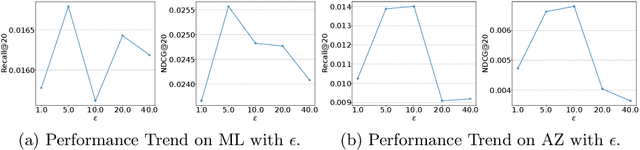
Federated recommender systems (FedRecs) have emerged as a popular research direction for protecting users' privacy in on-device recommendations. In FedRecs, users keep their data locally and only contribute their local collaborative information by uploading model parameters to a central server. While this rigid framework protects users' raw data during training, it severely compromises the recommendation model's performance due to the following reasons: (1) Due to the power law distribution nature of user behavior data, individual users have few data points to train a recommendation model, resulting in uploaded model updates that may be far from optimal; (2) As each user's uploaded parameters are learned from local data, which lacks global collaborative information, relying solely on parameter aggregation methods such as FedAvg to fuse global collaborative information may be suboptimal. To bridge this performance gap, we propose a novel federated recommendation framework, PDC-FRS. Specifically, we design a privacy-preserving data contribution mechanism that allows users to share their data with a differential privacy guarantee. Based on the shared but perturbed data, an auxiliary model is trained in parallel with the original federated recommendation process. This auxiliary model enhances FedRec by augmenting each user's local dataset and integrating global collaborative information. To demonstrate the effectiveness of PDC-FRS, we conduct extensive experiments on two widely used recommendation datasets. The empirical results showcase the superiority of PDC-FRS compared to baseline methods.