 Add to Chrome
 Add to Firefox
 Add to Edge
Beyond Text-to-SQL: Can LLMs Really Debug Enterprise ETL SQL?
Jan 26, 2026
SQL is central to enterprise data engineering, yet generating fully correct SQL code in a single attempt remains difficult, even for experienced developers and advanced text-to-SQL LLMs, often requiring multiple debugging iterations. We introduce OurBench, the first benchmark for enterprise-level SQL reasoning and debugging. Our benchmark is built on two key innovations: (1) an automated construction workflow that uses reverse engineering to systematically inject realistic bugs into large-scale SQL code, enabling scalable and diverse benchmark generation; and (2) an execution-free evaluation framework tailored to enterprise settings, providing fast, accurate, and resource-efficient assessment. OurBench comprises 469 OurBenchSyn queries featuring syntax errors with explicit error messages, and 516 OurBenchSem queries targeting semantic errors in which the code fails to meet user intent. The queries are highly complex, averaging over 140 lines and featuring deep and wide abstract syntax trees. Evaluation of nearly 30 LLMs reveals a substantial performance gap: the best-performing model, Claude-4-Sonnet, achieves only 36.46 percent accuracy on OurBenchSyn and 32.17 percent on OurBenchSem, while most models score below 20 percent. We further explore four solution strategies, identify key challenges, and outline promising directions for enterprise SQL debugging with LLMs.

PDC & DM-SFT: A Road for LLM SQL Bug-Fix Enhancing
Nov 11, 2024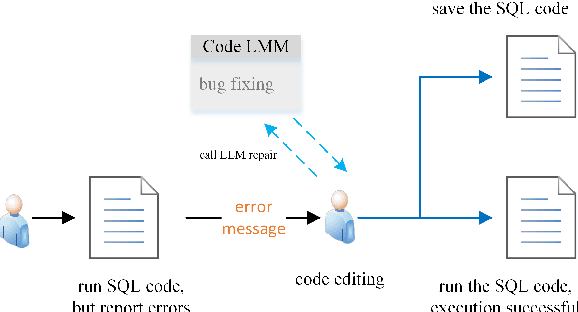
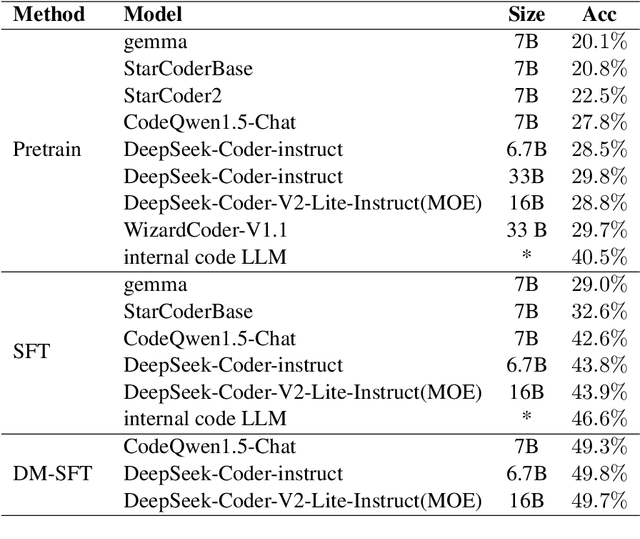

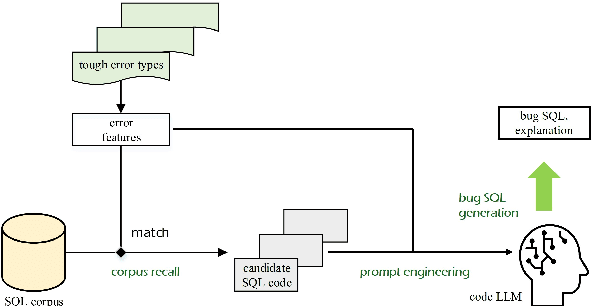
Code Large Language Models (Code LLMs), such as Code llama and DeepSeek-Coder, have demonstrated exceptional performance in the code generation tasks. However, most existing models focus on the abilities of generating correct code, but often struggle with bug repair. We introduce a suit of methods to enhance LLM's SQL bug-fixing abilities. The methods are mainly consisted of two parts: A Progressive Dataset Construction (PDC) from scratch and Dynamic Mask Supervised Fine-tuning (DM-SFT). PDC proposes two data expansion methods from the perspectives of breadth first and depth first respectively. DM-SFT introduces an efficient bug-fixing supervised learning approach, which effectively reduce the total training steps and mitigate the "disorientation" in SQL code bug-fixing training. In our evaluation, the code LLM models trained with two methods have exceeds all current best performing model which size is much larger.