 Add to Chrome
 Add to Firefox
 Add to Edge
Negotiation Dialogues Dataset
Papers and Code
STREAM: A Data-Centric Framework for Mining High-Value Task-Oriented Dialogues from Streaming Media
May 24, 2026
Large language models for vertical domains are bottlenecked by the scarcity of complex, domain-specific task-oriented dialogues. Existing data acquisition pipelines face a persistent trilemma: expert annotation is expensive, real-world service conversations are constrained by privacy and commercial restrictions, and static corpora quickly become temporally stale. We propose Stream, a data-centric framework that leverages publicly available streaming media (live streams and short videos) to synthesize high-value service dialogues at scale. Stream mines authentic interaction signals from noisy streams and synthesizes conversations by integrating role-grounded persona construction with Conversational Blueprint construction; it further adopts retrieval-augmented generation (RAG) to support knowledge-aware responses. Based on Stream, we release StreamDial, a large-scale multi-domain dataset covering Automotive, Restaurant, and Hotel. StreamDial contains 87,498 dialogue sessions and 1,497,320 turns in total, with an average of 17.11 turns per session and a comparable scale across domains. Each session is organized as a structured quadruplet $\langle P_u, P_a, B, H \rangle$ that pairs dialogue history with explicit user/agent personas and a Conversational Blueprint, capturing realistic service behaviors such as requirement mining, constraint conflicts, negotiation, and recovery. Evaluations with automatic judges and downstream tasks show that StreamDial improves intrinsic dialogue quality over strong baselines, and models trained with StreamDial improve Dialogue State Tracking across backbones; we further report a completed human-evaluation set and encouraging multilingual transfer on Qwen3-8B under a controlled training budget. The data is released in https://github.com/hitxueliang/DialogDataSetBySTREAM.

Distilling Bayesian Belief States into Language Models for Auditable Negotiation
May 06, 2026Negotiation agents must infer what their counterpart values, update those beliefs over dialogue turns, and choose actions under uncertainty. End-to-end large language models (LLMs) can imitate negotiation dialogue, but their opponent beliefs are usually implicit and difficult to inspect. We propose BOND (Bayesian Opponent-belief Negotiation Distillation), a framework for auditable negotiation. BOND consists of an LLM-based Bayesian teacher that scores dialogue contexts against the six possible opponent priority orderings, updates a posterior over those orderings, and uses the posterior for menu-based decision making, as well as a smaller 8B student language model that emits both negotiation actions and normalized posterior beliefs as tagged text. In the CaSiNo negotiation dataset, BOND outperforms the state-of-the-art and achieves mean Brier score 0.085 over opponent-priority posteriors. The distilled student preserves much of this belief signal, achieving Brier 0.114, below the uniform six-ordering reference of 5/36, approximately 0.139. Compared with a 70B structured-CoT baseline, the significantly smaller 8B student model yields substantially better elicited posterior calibration. We further showcase auditability through posterior trajectories, belief-versus-policy error decomposition, and posterior-prefix interventions. These diagnostics reveal that distillation preserves a scoreable belief report more strongly than causal belief-conditioned control, making weak belief-action coupling visible, not hidden.
Full-Duplex Interaction in Spoken Dialogue Systems: A Comprehensive Study from the ICASSP 2026 HumDial Challenge
Apr 23, 2026Full-duplex interaction, where speakers and listeners converse simultaneously, is a key element of human communication often missing from traditional spoken dialogue systems. These systems, based on rigid turn-taking paradigms, struggle to respond naturally in dynamic conversations. The Full-Duplex Interaction Track of ICASSP 2026 Human-like Spoken Dialogue Systems Challenge (HumDial Challenge) aims to advance the evaluation of full-duplex systems by offering a framework for handling real-time interruptions, speech overlap, and dynamic turn negotiation. We introduce a comprehensive benchmark for full-duplex spoken dialogue systems, built from the HumDial Challenge. We release a high-quality dual-channel dataset of real human-recorded conversations, capturing interruptions, overlapping speech, and feedback mechanisms. This dataset forms the basis for the HumDial-FDBench benchmark, which assesses a system's ability to handle interruptions while maintaining conversational flow. Additionally, we create a public leaderboard to compare the performance of open-source and proprietary models, promoting transparent, reproducible evaluation. These resources support the development of more responsive, adaptive, and human-like dialogue systems.
PRISMA: Preference-Reinforced Self-Training Approach for Interpretable Emotionally Intelligent Negotiation Dialogues
Apr 20, 2026Emotion plays a pivotal role in shaping negotiation outcomes, influencing trust, cooperation, and long-term relationships. Developing negotiation dialog systems that can recognize and respond strategically to emotions is, therefore, essential to create more effective human-centered interactions. Beyond generating emotionally appropriate responses, interpretability - understanding how a system generates a particular emotion-aware response, is critical for fostering reliability and building rapport. Driven by these aspects, in this work, we introduce PRISMA, an interpretable emotionally intelligent negotiation dialogue system targeting two application domains, viz. job interviews and resource allocation. To enable interpretability, we propose an Emotion-aware Negotiation Strategy-informed Chain-of-Thought (ENS-CoT) reasoning mechanism, which mimics human negotiation by perceiving, understanding, using, and managing emotions. Leveraging ENS-CoT, we curate two new datasets: JobNego (for job interview negotiation) and ResNego (for resource allocation negotiation). We then leverage these datasets to develop PRISMA by augmenting self-training with Direct Preference Optimization (DPO), guiding agents toward more accurate, interpretable, and emotionally appropriate negotiation responses. Automatic and human evaluation on JobNego and ResNego datasets demonstrate that PRISMA substantially enhances interpretability and generates appropriate emotion-aware responses, while improving overall negotiation effectiveness.
Listening Alone, Understanding Together: Collaborative Context Recovery for Privacy-Aware AI
Apr 14, 2026We introduce CONCORD, a privacy-aware asynchronous assistant-to-assistant (A2A) framework that leverages collaboration between proactive speech-based AI. As agents evolve from reactive to always-listening assistants, they face a core privacy risk (of capturing non-consenting speakers), which makes their social deployment a challenge. To overcome this, we implement CONCORD, which enforces owner-only speech capture via real-time speaker verification, producing a one-sided transcript that incurs missing context but preserves privacy. We demonstrate that CONCORD can safely recover necessary context through (1) spatio-temporal context resolution, (2) information gap detection, and (3) minimal A2A queries governed by a relationship-aware disclosure. Instead of hallucination-prone inferring, CONCORD treats context recovery as a negotiated safe exchange between assistants. Across a multi-domain dialogue dataset, CONCORD achieves 91.4% recall in gap detection, 96% relationship classification accuracy, and 97% true negative rate in privacy-sensitive disclosure decisions. By reframing always-listening AI as a coordination problem between privacy-preserving agents, CONCORD offers a practical path toward socially deployable proactive conversational agents.
Can LLMs Truly Embody Human Personality? Analyzing AI and Human Behavior Alignment in Dispute Resolution
Feb 07, 2026Large language models (LLMs) are increasingly used to simulate human behavior in social settings such as legal mediation, negotiation, and dispute resolution. However, it remains unclear whether these simulations reproduce the personality-behavior patterns observed in humans. Human personality, for instance, shapes how individuals navigate social interactions, including strategic choices and behaviors in emotionally charged interactions. This raises the question: Can LLMs, when prompted with personality traits, reproduce personality-driven differences in human conflict behavior? To explore this, we introduce an evaluation framework that enables direct comparison of human-human and LLM-LLM behaviors in dispute resolution dialogues with respect to Big Five Inventory (BFI) personality traits. This framework provides a set of interpretable metrics related to strategic behavior and conflict outcomes. We additionally contribute a novel dataset creation methodology for LLM dispute resolution dialogues with matched scenarios and personality traits with respect to human conversations. Finally, we demonstrate the use of our evaluation framework with three contemporary closed-source LLMs and show significant divergences in how personality manifests in conflict across different LLMs compared to human data, challenging the assumption that personality-prompted agents can serve as reliable behavioral proxies in socially impactful applications. Our work highlights the need for psychological grounding and validation in AI simulations before real-world use.
Measuring Fine-Grained Negotiation Tactics of Humans and LLMs in Diplomacy
Dec 20, 2025The study of negotiation styles dates back to Aristotle's ethos-pathos-logos rhetoric. Prior efforts primarily studied the success of negotiation agents. Here, we shift the focus towards the styles of negotiation strategies. Our focus is the strategic dialogue board game Diplomacy, which affords rich natural language negotiation and measures of game success. We used LLM-as-a-judge to annotate a large human-human set of Diplomacy games for fine-grained negotiation tactics from a sociologically-grounded taxonomy. Using a combination of the It Takes Two and WebDiplomacy datasets, we demonstrate the reliability of our LLM-as-a-Judge framework and show strong correlations between negotiation features and success in the Diplomacy setting. Lastly, we investigate the differences between LLM and human negotiation strategies and show that fine-tuning can steer LLM agents toward more human-like negotiation behaviors.
EQ-Negotiator: An Emotion-Reasoning LLM Agent in Credit Dialogues
Mar 27, 2025While large language model (LLM)-based chatbots have been applied for effective engagement in credit dialogues, their capacity for dynamic emotional expression remains limited. Current agents primarily rely on passive empathy rather than affective reasoning. For instance, when faced with persistent client negativity, the agent should employ strategic emotional adaptation by expressing measured anger to discourage counterproductive behavior and guide the conversation toward resolution. This context-aware emotional modulation is essential for imitating the nuanced decision-making of human negotiators. This paper introduces an EQ-negotiator that combines emotion sensing from pre-trained language models (PLMs) with emotional reasoning based on Game Theory and Hidden Markov Models. It takes into account both the current and historical emotions of the client to better manage and address negative emotions during interactions. By fine-tuning pre-trained language models (PLMs) on public emotion datasets and validating them on the credit dialogue datasets, our approach enables LLM-based agents to effectively capture shifts in client emotions and dynamically adjust their response tone based on our emotion decision policies in real-world financial negotiations. This EQ-negotiator can also help credit agencies foster positive client relationships, enhancing satisfaction in credit services.
SentiXRL: An advanced large language Model Framework for Multilingual Fine-Grained Emotion Classification in Complex Text Environment
Nov 27, 2024


With strong expressive capabilities in Large Language Models(LLMs), generative models effectively capture sentiment structures and deep semantics, however, challenges remain in fine-grained sentiment classification across multi-lingual and complex contexts. To address this, we propose the Sentiment Cross-Lingual Recognition and Logic Framework (SentiXRL), which incorporates two modules,an emotion retrieval enhancement module to improve sentiment classification accuracy in complex contexts through historical dialogue and logical reasoning,and a self-circulating analysis negotiation mechanism (SANM)to facilitates autonomous decision-making within a single model for classification tasks.We have validated SentiXRL's superiority on multiple standard datasets, outperforming existing models on CPED and CH-SIMS,and achieving overall better performance on MELD,Emorynlp and IEMOCAP. Notably, we unified labels across several fine-grained sentiment annotation datasets and conducted category confusion experiments, revealing challenges and impacts of class imbalance in standard datasets.
GNOME: Generating Negotiations through Open-Domain Mapping of Exchanges
Jun 16, 2024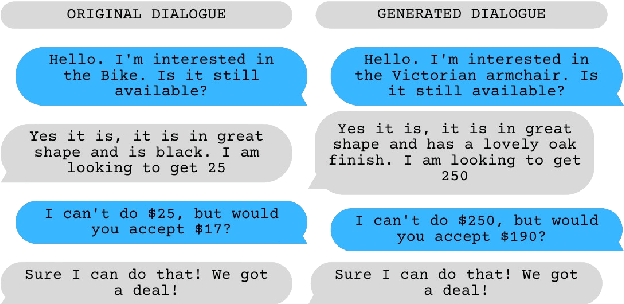
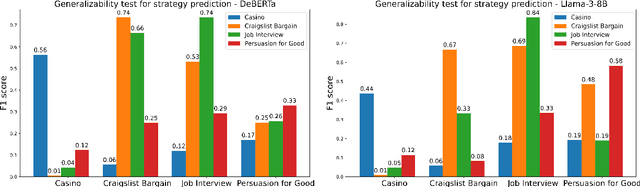
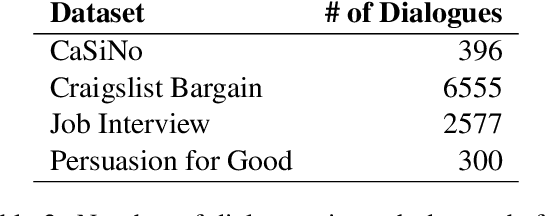
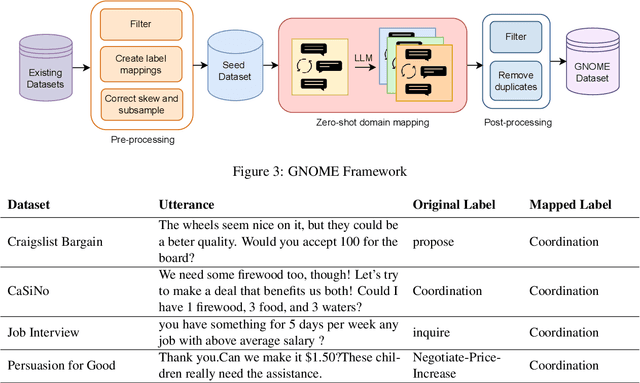
Language Models have previously shown strong negotiation capabilities in closed domains where the negotiation strategy prediction scope is constrained to a specific setup. In this paper, we first show that these models are not generalizable beyond their original training domain despite their wide-scale pretraining. Following this, we propose an automated framework called GNOME, which processes existing human-annotated, closed-domain datasets using Large Language Models and produces synthetic open-domain dialogues for negotiation. GNOME improves the generalizability of negotiation systems while reducing the expensive and subjective task of manual data curation. Through our experimental setup, we create a benchmark comparing encoder and decoder models trained on existing datasets against datasets created through GNOME. Our results show that models trained on our dataset not only perform better than previous state of the art models on domain specific strategy prediction, but also generalize better to previously unseen domains.