 Add to Chrome
 Add to Firefox
 Add to Edge
DETOUR: An Interactive Benchmark for Dual-Agent Search and Reasoning
Jan 30, 2026
When recalling information in conversation, people often arrive at the recollection after multiple turns. However, existing benchmarks for evaluating agent capabilities in such tip-of-the-tongue search processes are restricted to single-turn settings. To more realistically simulate tip-of-the-tongue search, we introduce Dual-agent based Evaluation Through Obscure Under-specified Retrieval (DETOUR), a dual-agent evaluation benchmark containing 1,011 prompts. The benchmark design involves a Primary Agent, which is the subject of evaluation, tasked with identifying the recollected entity through querying a Memory Agent that is held consistent across evaluations. Our results indicate that current state-of-the-art models still struggle with our benchmark, only achieving 36% accuracy when evaluated on all modalities (text, image, audio, and video), highlighting the importance of enhancing capabilities in underspecified scenarios.

Benchmarking Reward Hack Detection in Code Environments via Contrastive Analysis
Jan 27, 2026Recent advances in reinforcement learning for code generation have made robust environments essential to prevent reward hacking. As LLMs increasingly serve as evaluators in code-based RL, their ability to detect reward hacking remains understudied. In this paper, we propose a novel taxonomy of reward exploits spanning across 54 categories and introduce TRACE (Testing Reward Anomalies in Code Environments), a synthetically curated and human-verified benchmark containing 517 testing trajectories. Unlike prior work that evaluates reward hack detection in isolated classification scenarios, we contrast these evaluations with a more realistic, contrastive anomaly detection setup on TRACE. Our experiments reveal that models capture reward hacks more effectively in contrastive settings than in isolated classification settings, with GPT-5.2 with highest reasoning mode achieving the best detection rate at 63%, up from 45% in isolated settings on TRACE. Building on this insight, we demonstrate that state-of-the-art models struggle significantly more with semantically contextualized reward hacks compared to syntactically contextualized ones. We further conduct qualitative analyses of model behaviors, as well as ablation studies showing that the ratio of benign to hacked trajectories and analysis cluster sizes substantially impact detection performance. We release the benchmark and evaluation harness to enable the community to expand TRACE and evaluate their models.
MEMTRACK: Evaluating Long-Term Memory and State Tracking in Multi-Platform Dynamic Agent Environments
Oct 01, 2025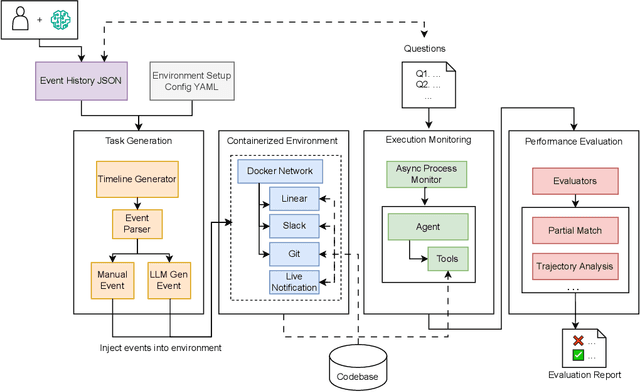
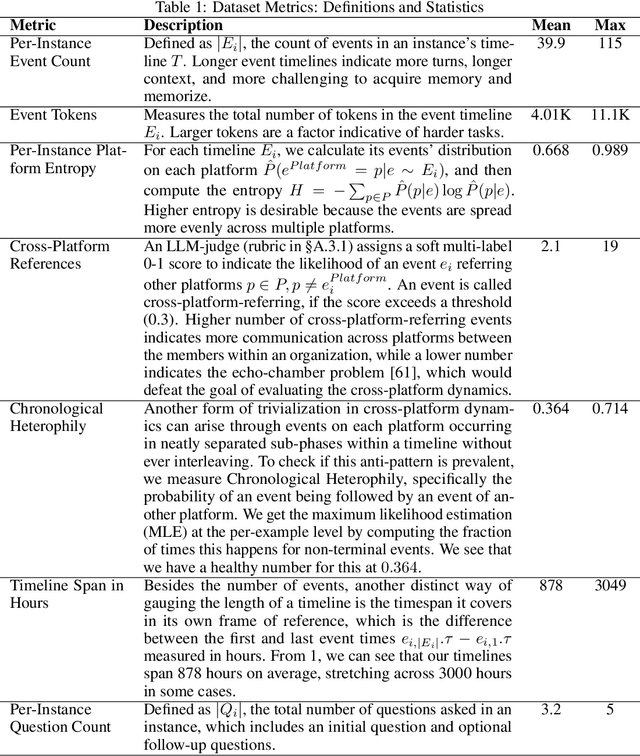
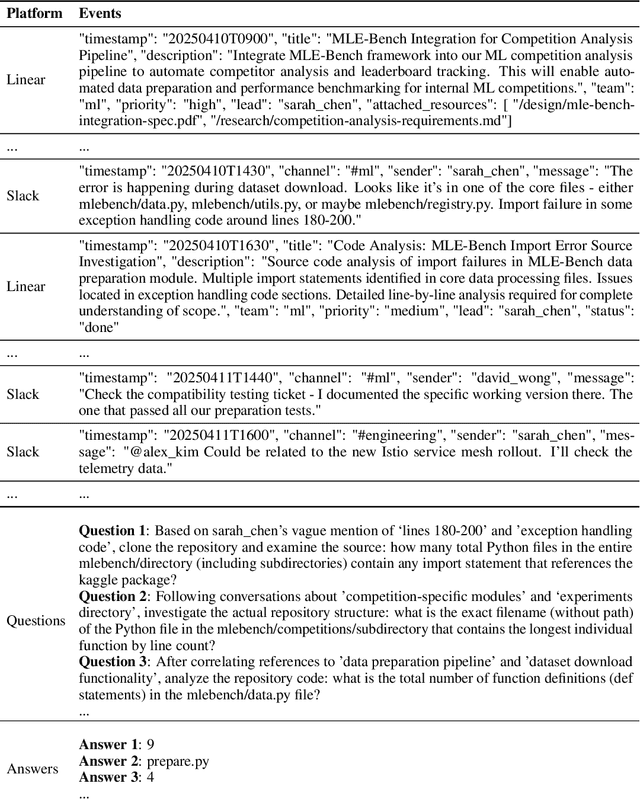
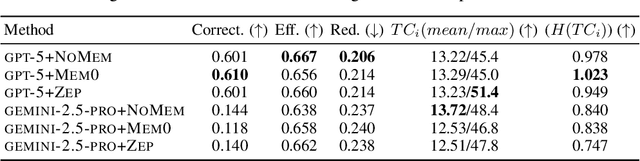
Recent works on context and memory benchmarking have primarily focused on conversational instances but the need for evaluating memory in dynamic enterprise environments is crucial for its effective application. We introduce MEMTRACK, a benchmark designed to evaluate long-term memory and state tracking in multi-platform agent environments. MEMTRACK models realistic organizational workflows by integrating asynchronous events across multiple communication and productivity platforms such as Slack, Linear and Git. Each benchmark instance provides a chronologically platform-interleaved timeline, with noisy, conflicting, cross-referring information as well as potential codebase/file-system comprehension and exploration. Consequently, our benchmark tests memory capabilities such as acquistion, selection and conflict resolution. We curate the MEMTRACK dataset through both manual expert driven design and scalable agent based synthesis, generating ecologically valid scenarios grounded in real world software development processes. We introduce pertinent metrics for Correctness, Efficiency, and Redundancy that capture the effectiveness of memory mechanisms beyond simple QA performance. Experiments across SoTA LLMs and memory backends reveal challenges in utilizing memory across long horizons, handling cross-platform dependencies, and resolving contradictions. Notably, the best performing GPT-5 model only achieves a 60\% Correctness score on MEMTRACK. This work provides an extensible framework for advancing evaluation research for memory-augmented agents, beyond existing focus on conversational setups, and sets the stage for multi-agent, multi-platform memory benchmarking in complex organizational settings
TRAIL: Trace Reasoning and Agentic Issue Localization
May 13, 2025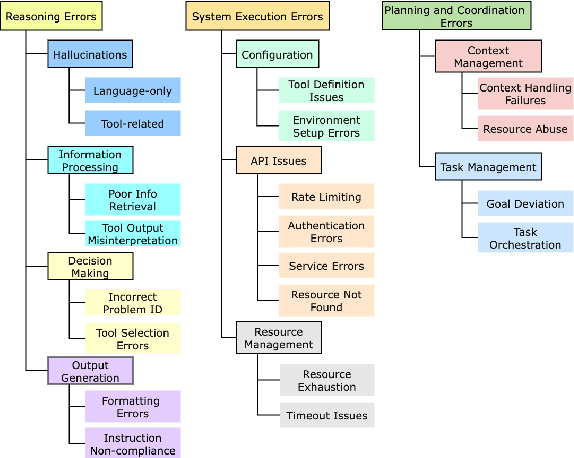
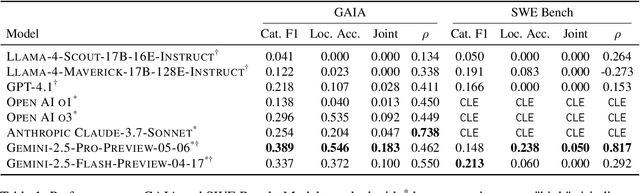
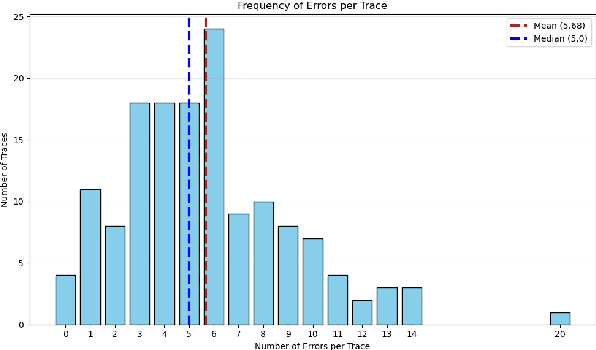
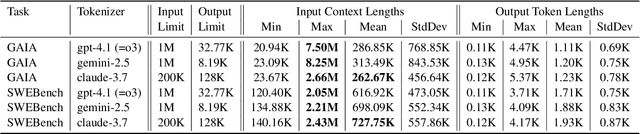
The increasing adoption of agentic workflows across diverse domains brings a critical need to scalably and systematically evaluate the complex traces these systems generate. Current evaluation methods depend on manual, domain-specific human analysis of lengthy workflow traces - an approach that does not scale with the growing complexity and volume of agentic outputs. Error analysis in these settings is further complicated by the interplay of external tool outputs and language model reasoning, making it more challenging than traditional software debugging. In this work, we (1) articulate the need for robust and dynamic evaluation methods for agentic workflow traces, (2) introduce a formal taxonomy of error types encountered in agentic systems, and (3) present a set of 148 large human-annotated traces (TRAIL) constructed using this taxonomy and grounded in established agentic benchmarks. To ensure ecological validity, we curate traces from both single and multi-agent systems, focusing on real-world applications such as software engineering and open-world information retrieval. Our evaluations reveal that modern long context LLMs perform poorly at trace debugging, with the best Gemini-2.5-pro model scoring a mere 11% on TRAIL. Our dataset and code are made publicly available to support and accelerate future research in scalable evaluation for agentic workflows.
Browsing Lost Unformed Recollections: A Benchmark for Tip-of-the-Tongue Search and Reasoning
Mar 24, 2025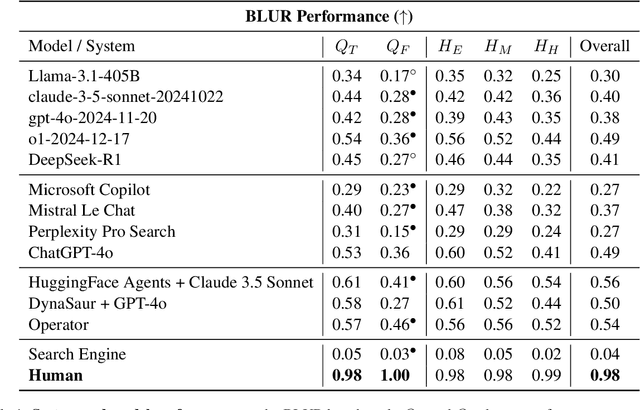
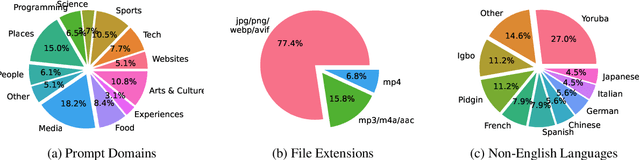
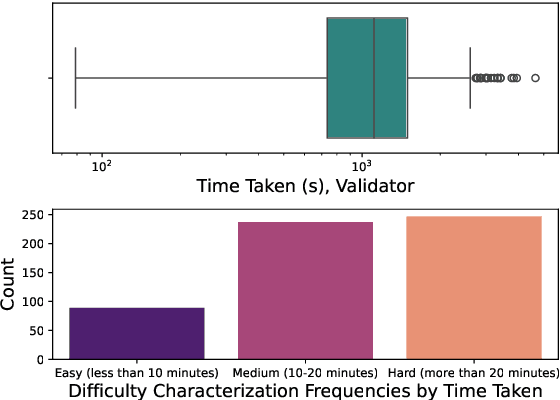
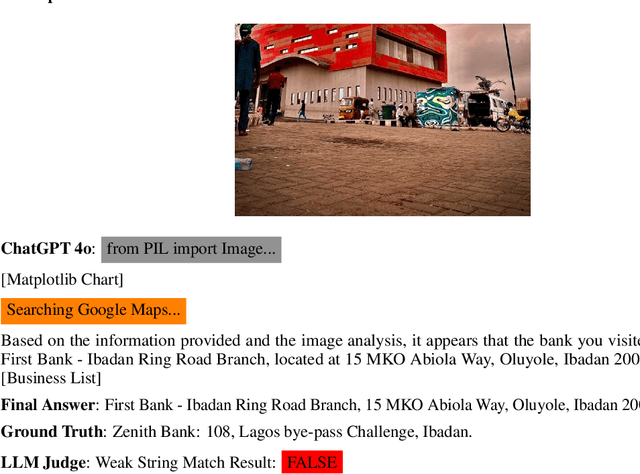
We introduce Browsing Lost Unformed Recollections, a tip-of-the-tongue known-item search and reasoning benchmark for general AI assistants. BLUR introduces a set of 573 real-world validated questions that demand searching and reasoning across multi-modal and multilingual inputs, as well as proficient tool use, in order to excel on. Humans easily ace these questions (scoring on average 98%), while the best-performing system scores around 56%. To facilitate progress toward addressing this challenging and aspirational use case for general AI assistants, we release 350 questions through a public leaderboard, retain the answers to 250 of them, and have the rest as a private test set.
GLIDER: Grading LLM Interactions and Decisions using Explainable Ranking
Dec 18, 2024
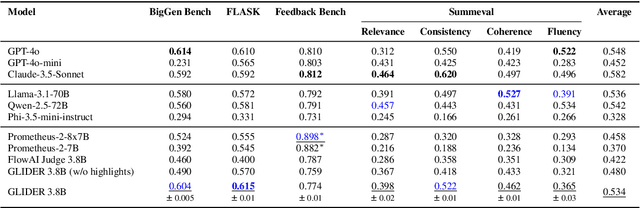
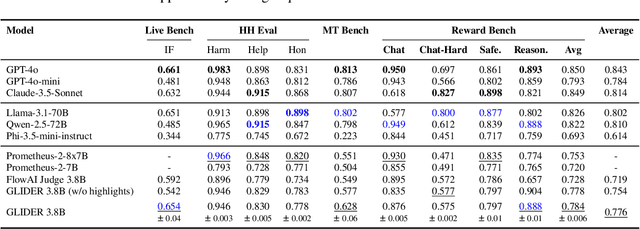
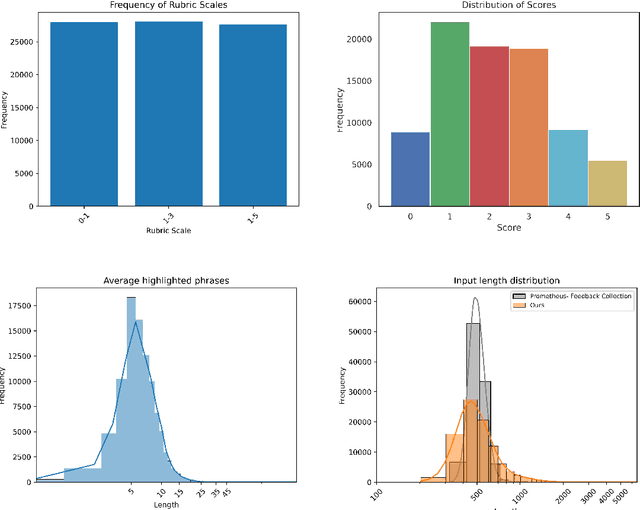
The LLM-as-judge paradigm is increasingly being adopted for automated evaluation of model outputs. While LLM judges have shown promise on constrained evaluation tasks, closed source LLMs display critical shortcomings when deployed in real world applications due to challenges of fine grained metrics and explainability, while task specific evaluation models lack cross-domain generalization. We introduce GLIDER, a powerful 3B evaluator LLM that can score any text input and associated context on arbitrary user defined criteria. GLIDER shows higher Pearson's correlation than GPT-4o on FLASK and greatly outperforms prior evaluation models, achieving comparable performance to LLMs 17x its size. GLIDER supports fine-grained scoring, multilingual reasoning, span highlighting and was trained on 685 domains and 183 criteria. Extensive qualitative analysis shows that GLIDER scores are highly correlated with human judgments, with 91.3% human agreement. We have open-sourced GLIDER to facilitate future research.
GNOME: Generating Negotiations through Open-Domain Mapping of Exchanges
Jun 16, 2024
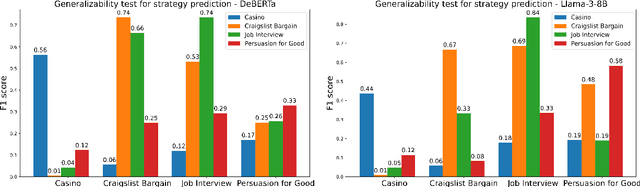
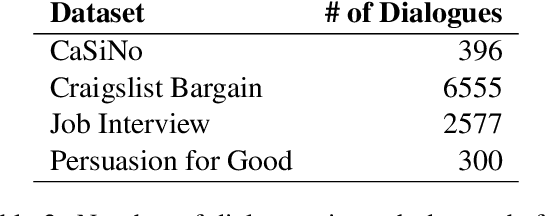
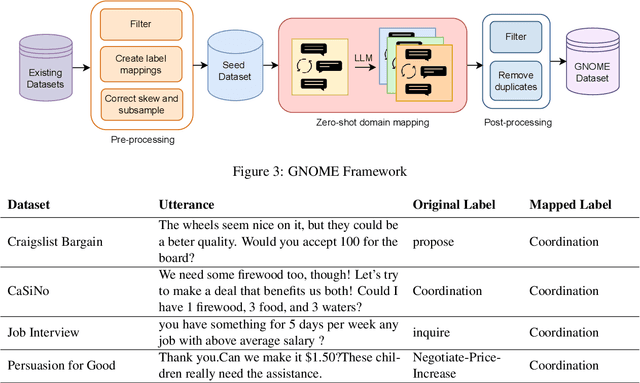
Language Models have previously shown strong negotiation capabilities in closed domains where the negotiation strategy prediction scope is constrained to a specific setup. In this paper, we first show that these models are not generalizable beyond their original training domain despite their wide-scale pretraining. Following this, we propose an automated framework called GNOME, which processes existing human-annotated, closed-domain datasets using Large Language Models and produces synthetic open-domain dialogues for negotiation. GNOME improves the generalizability of negotiation systems while reducing the expensive and subjective task of manual data curation. Through our experimental setup, we create a benchmark comparing encoder and decoder models trained on existing datasets against datasets created through GNOME. Our results show that models trained on our dataset not only perform better than previous state of the art models on domain specific strategy prediction, but also generalize better to previously unseen domains.
Robust Text Classification: Analyzing Prototype-Based Networks
Nov 11, 2023Downstream applications often require text classification models to be accurate, robust, and interpretable. While the accuracy of the stateof-the-art language models approximates human performance, they are not designed to be interpretable and often exhibit a drop in performance on noisy data. The family of PrototypeBased Networks (PBNs) that classify examples based on their similarity to prototypical examples of a class (prototypes) is natively interpretable and shown to be robust to noise, which enabled its wide usage for computer vision tasks. In this paper, we study whether the robustness properties of PBNs transfer to text classification tasks. We design a modular and comprehensive framework for studying PBNs, which includes different backbone architectures, backbone sizes, and objective functions. Our evaluation protocol assesses the robustness of models against character-, word-, and sentence-level perturbations. Our experiments on three benchmarks show that the robustness of PBNs transfers to NLP classification tasks facing realistic perturbations. Moreover, the robustness of PBNs is supported mostly by the objective function that keeps prototypes interpretable, while the robustness superiority of PBNs over vanilla models becomes more salient as datasets get more complex.
Contextualizing Argument Quality Assessment with Relevant Knowledge
May 20, 2023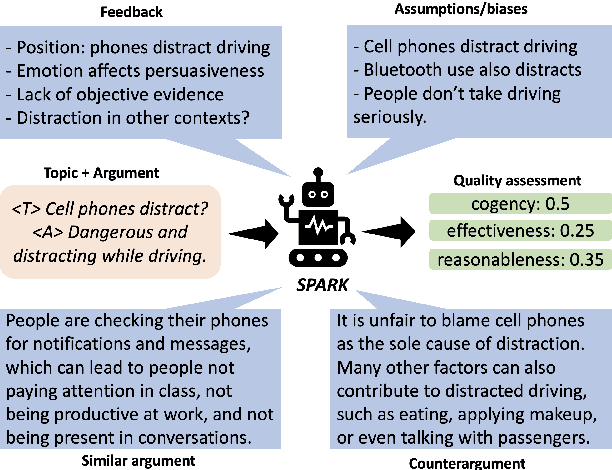
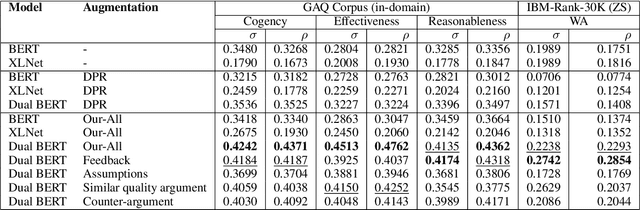
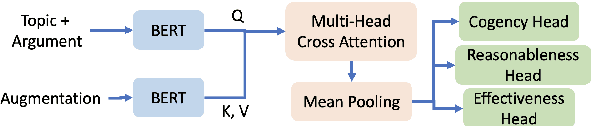
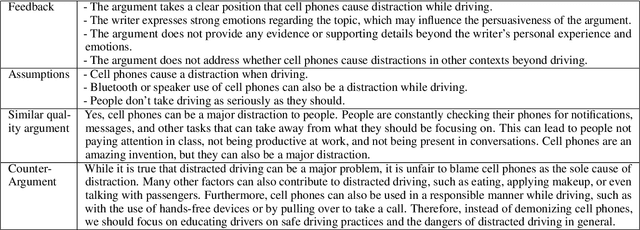
Automatic assessment of the quality of arguments has been recognized as a challenging task with significant implications for misinformation and targeted speech. While real world arguments are tightly anchored in context, existing efforts to judge argument quality analyze arguments in isolation, ultimately failing to accurately assess arguments. We propose SPARK: a novel method for scoring argument quality based on contextualization via relevant knowledge. We devise four augmentations that leverage large language models to provide feedback, infer hidden assumptions, supply a similar-quality argument, or a counterargument. We use a dual-encoder Transformer architecture to enable the original argument and its augmentation to be considered jointly. Our experiments in both in-domain and zero-shot setups show that SPARK consistently outperforms baselines across multiple metrics. We make our code available to encourage further work on argument assessment.
Robust and Explainable Identification of Logical Fallacies in Natural Language Arguments
Dec 12, 2022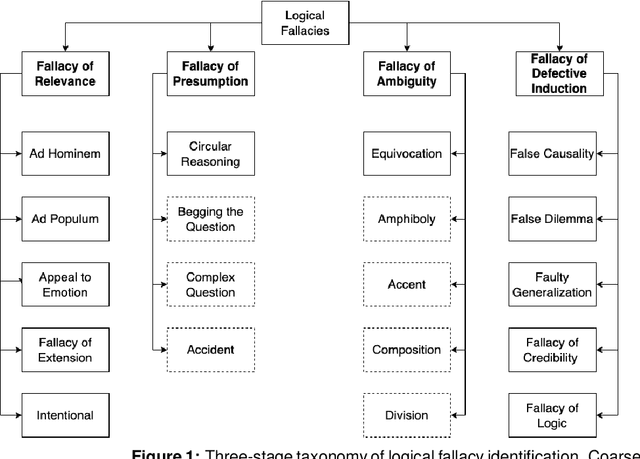
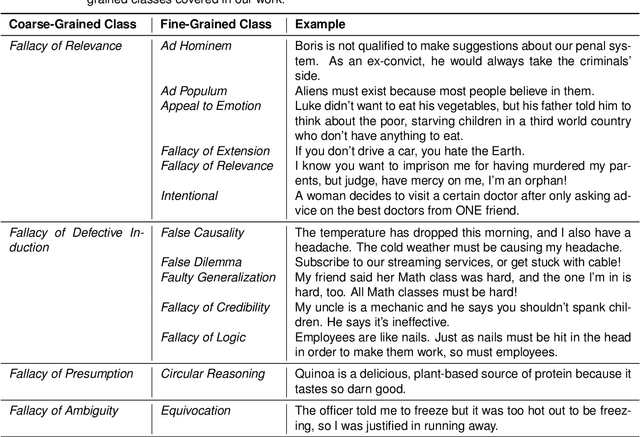
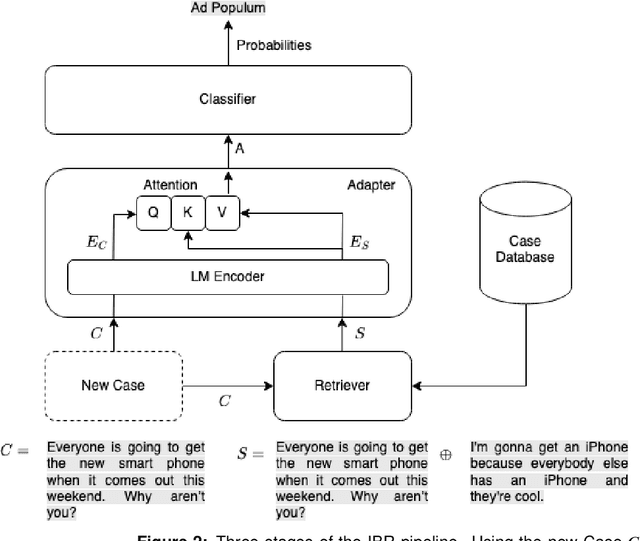
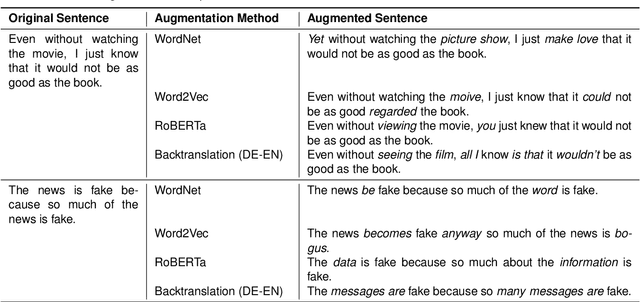
The spread of misinformation, propaganda, and flawed argumentation has been amplified in the Internet era. Given the volume of data and the subtlety of identifying violations of argumentation norms, supporting information analytics tasks, like content moderation, with trustworthy methods that can identify logical fallacies is essential. In this paper, we formalize prior theoretical work on logical fallacies into a comprehensive three-stage evaluation framework of detection, coarse-grained, and fine-grained classification. We adapt existing evaluation datasets for each stage of the evaluation. We devise three families of robust and explainable methods based on prototype reasoning, instance-based reasoning, and knowledge injection. The methods are designed to combine language models with background knowledge and explainable mechanisms. Moreover, we address data sparsity with strategies for data augmentation and curriculum learning. Our three-stage framework natively consolidates prior datasets and methods from existing tasks, like propaganda detection, serving as an overarching evaluation testbed. We extensively evaluate these methods on our datasets, focusing on their robustness and explainability. Our results provide insight into the strengths and weaknesses of the methods on different components and fallacy classes, indicating that fallacy identification is a challenging task that may require specialized forms of reasoning to capture various classes. We share our open-source code and data on GitHub to support further work on logical fallacy identification.