 Add to Chrome
 Add to Firefox
 Add to Edge
Anthropogenic Regional Adaptation in Multimodal Vision-Language Model
Apr 13, 2026
While the field of vision-language (VL) has achieved remarkable success in integrating visual and textual information across multiple languages and domains, there is still no dedicated framework for assessing human-centric alignment in vision-language systems. We offer two contributions to address this gap. First, we introduce Anthropogenic Regional Adaptation: a novel paradigm that aims to optimize model relevance to specific regional contexts while ensuring the retention of global generalization capabilities. Second, we present a simple, but effective adaptation method named Geographical-generalization-made-easy (GG-EZ), which utilizes regional data filtering and model merging. Through comprehensive experiments on 3 VL architectures: large vision-language models, text-to-image diffusion models, and vision-language embedding models, and a case study in Southeast Asia (SEA) regional adaptation, we demonstrate the importance of Anthropogenic Regional Adaptation and the effectiveness of GG-EZ, showing 5-15% gains in cultural relevance metrics across SEA while maintaining over 98% of global performance and even occasionally surpassing it. Our findings establish Anthropogenic Regional Alignment as a foundational paradigm towards applicability of multimodal vision-language models in diverse regions and demonstrate a simple-yet-effective baseline method that optimizes regional value alignment while preserving global generalization.

Temporal Narrative Monitoring in Dynamic Information Environments
Mar 18, 2026Comprehending the information environment (IE) during crisis events is challenging due to the rapid change and abstract nature of the domain. Many approaches focus on snapshots via classification methods or network approaches to describe the IE in crisis, ignoring the temporal nature of how information changed over time. This work presents a system-oriented framework for modeling emerging narratives as temporally evolving semantic structures without requiring prior label specification. By integrating semantic embeddings, density-based clustering, and rolling temporal linkage, the framework represents narratives as persistent yet adaptive entities within a shared semantic space. We apply the methodology to a real-world crisis event and evaluate system behavior through stratified cluster validation and temporal lifecycle analysis. Results demonstrate high cluster coherence and reveal heterogeneous narrative lifecycles characterized by both transient fragments and stable narrative anchors. We ground our approach in situational awareness theory, supporting perception and comprehension of the IE by transforming unstructured social media streams into interpretable, temporally structured representations. The resulting system provides a methodology for monitoring and decision support in dynamic information environments.
Stylistic Evolution and LLM Neutrality in Singlish Language
Jan 10, 2026Singlish is a creole rooted in Singapore's multilingual environment and continues to evolve alongside social and technological change. This study investigates the evolution of Singlish over a decade of informal digital text messages. We propose a stylistic similarity framework that compares lexico-structural, pragmatic, psycholinguistic, and encoder-derived features across years to quantify temporal variation. Our analysis reveals notable diachronic changes in tone, expressivity and sentence construction over the years. Conversely, while some LLMs were able to generate superficially realistic Singlish messages, they do not produce temporally neutral outputs, and residual temporal signals remain detectable despite prompting and fine-tuning. Our findings highlight the dynamic evolution of Singlish, as well as the capabilities and limitations of current LLMs in modeling sociolectal and temporal variations in the colloquial language.
Measuring Fine-Grained Negotiation Tactics of Humans and LLMs in Diplomacy
Dec 20, 2025The study of negotiation styles dates back to Aristotle's ethos-pathos-logos rhetoric. Prior efforts primarily studied the success of negotiation agents. Here, we shift the focus towards the styles of negotiation strategies. Our focus is the strategic dialogue board game Diplomacy, which affords rich natural language negotiation and measures of game success. We used LLM-as-a-judge to annotate a large human-human set of Diplomacy games for fine-grained negotiation tactics from a sociologically-grounded taxonomy. Using a combination of the It Takes Two and WebDiplomacy datasets, we demonstrate the reliability of our LLM-as-a-Judge framework and show strong correlations between negotiation features and success in the Diplomacy setting. Lastly, we investigate the differences between LLM and human negotiation strategies and show that fine-tuning can steer LLM agents toward more human-like negotiation behaviors.
Humanizing Machines: Rethinking LLM Anthropomorphism Through a Multi-Level Framework of Design
Aug 25, 2025Large Language Models (LLMs) increasingly exhibit \textbf{anthropomorphism} characteristics -- human-like qualities portrayed across their outlook, language, behavior, and reasoning functions. Such characteristics enable more intuitive and engaging human-AI interactions. However, current research on anthropomorphism remains predominantly risk-focused, emphasizing over-trust and user deception while offering limited design guidance. We argue that anthropomorphism should instead be treated as a \emph{concept of design} that can be intentionally tuned to support user goals. Drawing from multiple disciplines, we propose that the anthropomorphism of an LLM-based artifact should reflect the interaction between artifact designers and interpreters. This interaction is facilitated by cues embedded in the artifact by the designers and the (cognitive) responses of the interpreters to the cues. Cues are categorized into four dimensions: \textit{perceptive, linguistic, behavioral}, and \textit{cognitive}. By analyzing the manifestation and effectiveness of each cue, we provide a unified taxonomy with actionable levers for practitioners. Consequently, we advocate for function-oriented evaluations of anthropomorphic design.
Improving User Behavior Prediction: Leveraging Annotator Metadata in Supervised Machine Learning Models
Mar 26, 2025Supervised machine-learning models often underperform in predicting user behaviors from conversational text, hindered by poor crowdsourced label quality and low NLP task accuracy. We introduce the Metadata-Sensitive Weighted-Encoding Ensemble Model (MSWEEM), which integrates annotator meta-features like fatigue and speeding. First, our results show MSWEEM outperforms standard ensembles by 14\% on held-out data and 12\% on an alternative dataset. Second, we find that incorporating signals of annotator behavior, such as speed and fatigue, significantly boosts model performance. Third, we find that annotators with higher qualifications, such as Master's, deliver more consistent and faster annotations. Given the increasing uncertainty over annotation quality, our experiments show that understanding annotator patterns is crucial for enhancing model accuracy in user behavior prediction.
Crowdsource, Crawl, or Generate? Creating SEA-VL, a Multicultural Vision-Language Dataset for Southeast Asia
Mar 10, 2025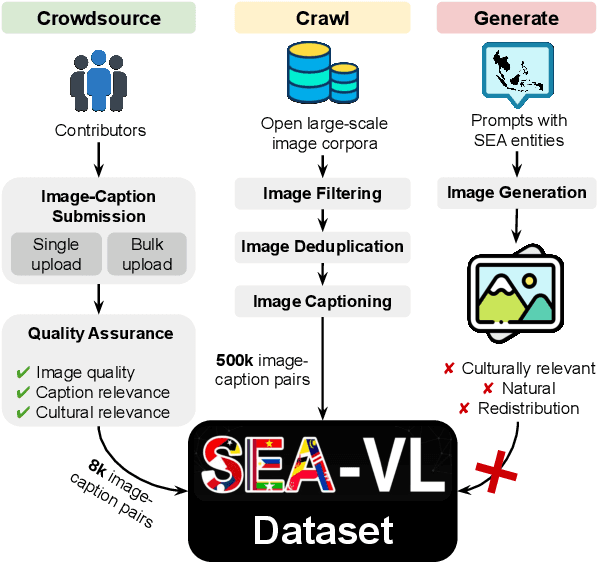
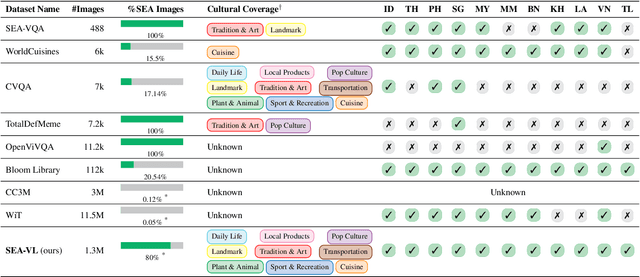
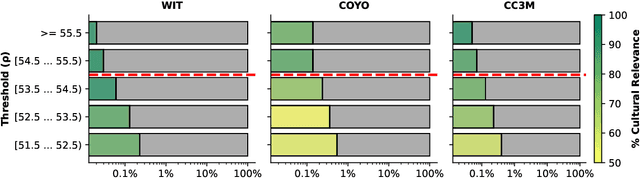
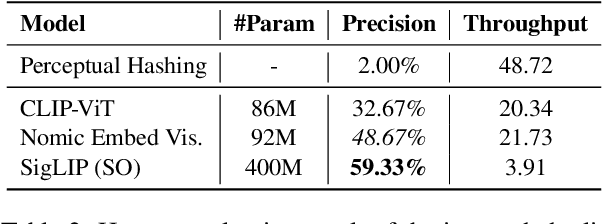
Southeast Asia (SEA) is a region of extraordinary linguistic and cultural diversity, yet it remains significantly underrepresented in vision-language (VL) research. This often results in artificial intelligence (AI) models that fail to capture SEA cultural nuances. To fill this gap, we present SEA-VL, an open-source initiative dedicated to developing high-quality, culturally relevant data for SEA languages. By involving contributors from SEA countries, SEA-VL aims to ensure better cultural relevance and diversity, fostering greater inclusivity of underrepresented languages in VL research. Beyond crowdsourcing, our initiative goes one step further in the exploration of the automatic collection of culturally relevant images through crawling and image generation. First, we find that image crawling achieves approximately ~85% cultural relevance while being more cost- and time-efficient than crowdsourcing. Second, despite the substantial progress in generative vision models, synthetic images remain unreliable in accurately reflecting SEA cultures. The generated images often fail to reflect the nuanced traditions and cultural contexts of the region. Collectively, we gather 1.28M SEA culturally-relevant images, more than 50 times larger than other existing datasets. Through SEA-VL, we aim to bridge the representation gap in SEA, fostering the development of more inclusive AI systems that authentically represent diverse cultures across SEA.
What is a Social Media Bot? A Global Comparison of Bot and Human Characteristics
Jan 01, 2025Chatter on social media is 20% bots and 80% humans. Chatter by bots and humans is consistently different: bots tend to use linguistic cues that can be easily automated while humans use cues that require dialogue understanding. Bots use words that match the identities they choose to present, while humans may send messages that are not related to the identities they present. Bots and humans differ in their communication structure: sampled bots have a star interaction structure, while sampled humans have a hierarchical structure. These conclusions are based on a large-scale analysis of social media tweets across ~200mil users across 7 events. Social media bots took the world by storm when social-cybersecurity researchers realized that social media users not only consisted of humans but also of artificial agents called bots. These bots wreck havoc online by spreading disinformation and manipulating narratives. Most research on bots are based on special-purposed definitions, mostly predicated on the event studied. This article first begins by asking, "What is a bot?", and we study the underlying principles of how bots are different from humans. We develop a first-principle definition of a social media bot. With this definition as a premise, we systematically compare characteristics between bots and humans across global events, and reflect on how the software-programmed bot is an Artificial Intelligent algorithm, and its potential for evolution as technology advances. Based on our results, we provide recommendations for the use and regulation of bots. Finally, we discuss open challenges and future directions: Detect, to systematically identify these automated and potentially evolving bots; Differentiate, to evaluate the goodness of the bot in terms of their content postings and relationship interactions; Disrupt, to moderate the impact of malicious bots.
What talking you?: Translating Code-Mixed Messaging Texts to English
Nov 08, 2024

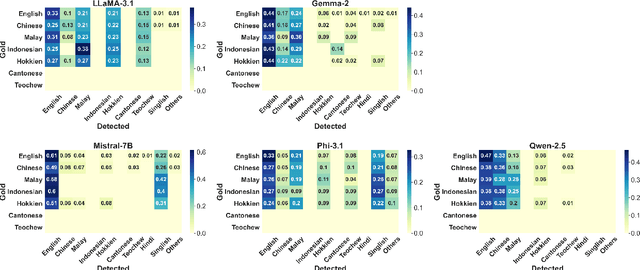
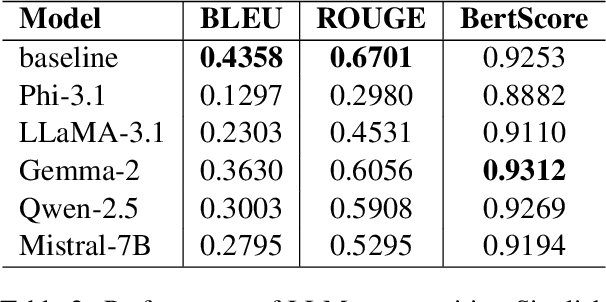
Translation of code-mixed texts to formal English allow a wider audience to understand these code-mixed languages, and facilitate downstream analysis applications such as sentiment analysis. In this work, we look at translating Singlish, which is colloquial Singaporean English, to formal standard English. Singlish is formed through the code-mixing of multiple Asian languages and dialects. We analysed the presence of other Asian languages and variants which can facilitate translation. Our dataset is short message texts, written as informal communication between Singlish speakers. We use a multi-step prompting scheme on five Large Language Models (LLMs) for language detection and translation. Our analysis show that LLMs do not perform well in this task, and we describe the challenges involved in translation of code-mixed languages. We also release our dataset in this link https://github.com/luoqichan/singlish.
$\textit{Who Speaks Matters}$: Analysing the Influence of the Speaker's Ethnicity on Hate Classification
Oct 27, 2024Large Language Models (LLMs) offer a lucrative promise for scalable content moderation, including hate speech detection. However, they are also known to be brittle and biased against marginalised communities and dialects. This requires their applications to high-stakes tasks like hate speech detection to be critically scrutinized. In this work, we investigate the robustness of hate speech classification using LLMs, particularly when explicit and implicit markers of the speaker's ethnicity are injected into the input. For the explicit markers, we inject a phrase that mentions the speaker's identity. For the implicit markers, we inject dialectal features. By analysing how frequently model outputs flip in the presence of these markers, we reveal varying degrees of brittleness across 4 popular LLMs and 5 ethnicities. We find that the presence of implicit dialect markers in inputs causes model outputs to flip more than the presence of explicit markers. Further, the percentage of flips varies across ethnicities. Finally, we find that larger models are more robust. Our findings indicate the need for exercising caution in deploying LLMs for high-stakes tasks like hate speech detection.