 Add to Chrome
 Add to Firefox
 Add to Edge
Activity Recognition In Videos
Papers and Code
WS-IMUBench: Can Weakly Supervised Methods from Audio, Image, and Video Be Adapted for IMU-based Temporal Action Localization?
Feb 02, 2026
IMU-based Human Activity Recognition (HAR) has enabled a wide range of ubiquitous computing applications, yet its dominant clip classification paradigm cannot capture the rich temporal structure of real-world behaviors. This motivates a shift toward IMU Temporal Action Localization (IMU-TAL), which predicts both action categories and their start/end times in continuous streams. However, current progress is strongly bottlenecked by the need for dense, frame-level boundary annotations, which are costly and difficult to scale. To address this bottleneck, we introduce WS-IMUBench, a systematic benchmark study of weakly supervised IMU-TAL (WS-IMU-TAL) under only sequence-level labels. Rather than proposing a new localization algorithm, we evaluate how well established weakly supervised localization paradigms from audio, image, and video transfer to IMU-TAL under only sequence-level labels. We benchmark seven representative weakly supervised methods on seven public IMU datasets, resulting in over 3,540 model training runs and 7,080 inference evaluations. Guided by three research questions on transferability, effectiveness, and insights, our findings show that (i) transfer is modality-dependent, with temporal-domain methods generally more stable than image-derived proposal-based approaches; (ii) weak supervision can be competitive on favorable datasets (e.g., with longer actions and higher-dimensional sensing); and (iii) dominant failure modes arise from short actions, temporal ambiguity, and proposal quality. Finally, we outline concrete directions for advancing WS-IMU-TAL (e.g., IMU-specific proposal generation, boundary-aware objectives, and stronger temporal reasoning). Beyond individual results, WS-IMUBench establishes a reproducible benchmarking template, datasets, protocols, and analyses, to accelerate community-wide progress toward scalable WS-IMU-TAL.

A Unified XAI-LLM Approach for EndotrachealSuctioning Activity Recognition
Jan 29, 2026Endotracheal suctioning (ES) is an invasive yet essential clinical procedure that requires a high degree of skill to minimize patient risk - particularly in home care and educational settings, where consistent supervision may be limited. Despite its critical importance, automated recognition and feedback systems for ES training remain underexplored. To address this gap, this study proposes a unified, LLM-centered framework for video-based activity recognition benchmarked against conventional machine learning and deep learning approaches, and a pilot study on feedback generation. Within this framework, the Large Language Model (LLM) serves as the central reasoning module, performing both spatiotemporal activity recognition and explainable decision analysis from video data. Furthermore, the LLM is capable of verbalizing feedback in natural language, thereby translating complex technical insights into accessible, human-understandable guidance for trainees. Experimental results demonstrate that the proposed LLM-based approach outperforms baseline models, achieving an improvement of approximately 15-20\% in both accuracy and F1 score. Beyond recognition, the framework incorporates a pilot student-support module built upon anomaly detection and explainable AI (XAI) principles, which provides automated, interpretable feedback highlighting correct actions and suggesting targeted improvements. Collectively, these contributions establish a scalable, interpretable, and data-driven foundation for advancing nursing education, enhancing training efficiency, and ultimately improving patient safety.
Fire on Motion: Optimizing Video Pass-bands for Efficient Spiking Action Recognition
Jan 30, 2026Spiking neural networks (SNNs) have gained traction in vision due to their energy efficiency, bio-plausibility, and inherent temporal processing. Yet, despite this temporal capacity, most progress concentrates on static image benchmarks, and SNNs still underperform on dynamic video tasks compared to artificial neural networks (ANNs). In this work, we diagnose a fundamental pass-band mismatch: Standard spiking dynamics behave as a temporal low pass that emphasizes static content while attenuating motion bearing bands, where task relevant information concentrates in dynamic tasks. This phenomenon explains why SNNs can approach ANNs on static tasks yet fall behind on tasks that demand richer temporal understanding.To remedy this, we propose the Pass-Bands Optimizer (PBO), a plug-and-play module that optimizes the temporal pass-band toward task-relevant motion bands. PBO introduces only two learnable parameters, and a lightweight consistency constraint that preserves semantics and boundaries, incurring negligible computational overhead and requires no architectural changes. PBO deliberately suppresses static components that contribute little to discrimination, effectively high passing the stream so that spiking activity concentrates on motion bearing content. On UCF101, PBO yields over ten percentage points improvement. On more complex multi-modal action recognition and weakly supervised video anomaly detection, PBO delivers consistent and significant gains, offering a new perspective for SNN based video processing and understanding.
Summary of the Unusual Activity Recognition Challenge for Developmental Disability Support
Jan 21, 2026This paper presents an overview of the Recognize the Unseen: Unusual Behavior Recognition from Pose Data Challenge, hosted at ISAS 2025. The challenge aims to address the critical need for automated recognition of unusual behaviors in facilities for individuals with developmental disabilities using non-invasive pose estimation data. Participating teams were tasked with distinguishing between normal and unusual activities based on skeleton keypoints extracted from video recordings of simulated scenarios. The dataset reflects real-world imbalance and temporal irregularities in behavior, and the evaluation adopted a Leave-One-Subject-Out (LOSO) strategy to ensure subject-agnostic generalization. The challenge attracted broad participation from 40 teams applying diverse approaches ranging from classical machine learning to deep learning architectures. Submissions were assessed primarily using macro-averaged F1 scores to account for class imbalance. The results highlight the difficulty of modeling rare, abrupt actions in noisy, low-dimensional data, and emphasize the importance of capturing both temporal and contextual nuances in behavior modeling. Insights from this challenge may contribute to future developments in socially responsible AI applications for healthcare and behavior monitoring.
Two-Stream temporal transformer for video action classification
Jan 20, 2026Motion representation plays an important role in video understanding and has many applications including action recognition, robot and autonomous guidance or others. Lately, transformer networks, through their self-attention mechanism capabilities, have proved their efficiency in many applications. In this study, we introduce a new two-stream transformer video classifier, which extracts spatio-temporal information from content and optical flow representing movement information. The proposed model identifies self-attention features across the joint optical flow and temporal frame domain and represents their relationships within the transformer encoder mechanism. The experimental results show that our proposed methodology provides excellent classification results on three well-known video datasets of human activities.
Enhancing Vision Language Models with Logic Reasoning for Situational Awareness
Jan 16, 2026Vision-Language Models (VLMs) offer the ability to generate high-level, interpretable descriptions of complex activities from images and videos, making them valuable for situational awareness (SA) applications. In such settings, the focus is on identifying infrequent but significant events with high reliability and accuracy, while also extracting fine-grained details and assessing recognition quality. In this paper, we propose an approach that integrates VLMs with traditional computer vision methods through explicit logic reasoning to enhance SA in three key ways: (a) extracting fine-grained event details, (b) employing an intelligent fine-tuning (FT) strategy that achieves substantially higher accuracy than uninformed selection, and (c) generating justifications for VLM outputs during inference. We demonstrate that our intelligent FT mechanism improves the accuracy and provides a valuable means, during inferencing, to either confirm the validity of the VLM output or indicate why it may be questionable.
DAOS: A Multimodal In-cabin Behavior Monitoring with Driver Action-Object Synergy Dataset
Jan 17, 2026In driver activity monitoring, movements are mostly limited to the upper body, which makes many actions look similar. To tell these actions apart, human often rely on the objects the driver is using, such as holding a phone compared with gripping the steering wheel. However, most existing driver-monitoring datasets lack accurate object-location annotations or do not link objects to their associated actions, leaving a critical gap for reliable action recognition. To address this, we introduce the Driver Action with Object Synergy (DAOS) dataset, comprising 9,787 video clips annotated with 36 fine-grained driver actions and 15 object classes, totaling more than 2.5 million corresponding object instances. DAOS offers multi-modal, multi-view data (RGB, IR, and depth) from front, face, left, and right perspectives. Although DAOS captures a wide range of cabin objects, only a few are directly relevant to each action for prediction, so focusing on task-specific human-object relations is essential. To tackle this challenge, we propose the Action-Object-Relation Network (AOR-Net). AOR-Net comprehends complex driver actions through multi-level reasoning and a chain-of-action prompting mechanism that models the logical relationships among actions, objects, and their relations. Additionally, the Mixture of Thoughts module is introduced to dynamically select essential knowledge at each stage, enhancing robustness in object-rich and object-scarce conditions. Extensive experiments demonstrate that our model outperforms other state-of-the-art methods on various datasets.
Motion Focus Recognition in Fast-Moving Egocentric Video
Jan 12, 2026From Vision-Language-Action (VLA) systems to robotics, existing egocentric datasets primarily focus on action recognition tasks, while largely overlooking the inherent role of motion analysis in sports and other fast-movement scenarios. To bridge this gap, we propose a real-time motion focus recognition method that estimates the subject's locomotion intention from any egocentric video. Our approach leverages the foundation model for camera pose estimation and introduces system-level optimizations to enable efficient and scalable inference. Evaluated on a collected egocentric action dataset, our method achieves real-time performance with manageable memory consumption through a sliding batch inference strategy. This work makes motion-centric analysis practical for edge deployment and offers a complementary perspective to existing egocentric studies on sports and fast-movement activities.
Better, But Not Sufficient: Testing Video ANNs Against Macaque IT Dynamics
Jan 06, 2026Feedforward artificial neural networks (ANNs) trained on static images remain the dominant models of the the primate ventral visual stream, yet they are intrinsically limited to static computations. The primate world is dynamic, and the macaque ventral visual pathways, specifically the inferior temporal (IT) cortex not only supports object recognition but also encodes object motion velocity during naturalistic video viewing. Does IT's temporal responses reflect nothing more than time-unfolded feedforward transformations, framewise features with shallow temporal pooling, or do they embody richer dynamic computations? We tested this by comparing macaque IT responses during naturalistic videos against static, recurrent, and video-based ANN models. Video models provided modest improvements in neural predictivity, particularly at later response stages, raising the question of what kind of dynamics they capture. To probe this, we applied a stress test: decoders trained on naturalistic videos were evaluated on "appearance-free" variants that preserve motion but remove shape and texture. IT population activity generalized across this manipulation, but all ANN classes failed. Thus, current video models better capture appearance-bound dynamics rather than the appearance-invariant temporal computations expressed in IT, underscoring the need for new objectives that encode biological temporal statistics and invariances.
Commercial Vehicle Braking Optimization: A Robust SIFT-Trajectory Approach
Dec 21, 2025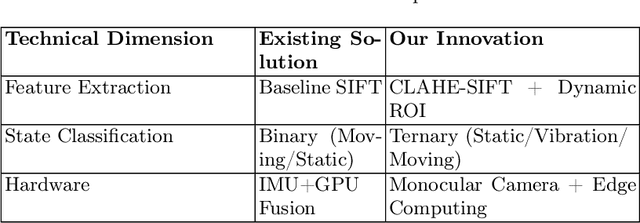
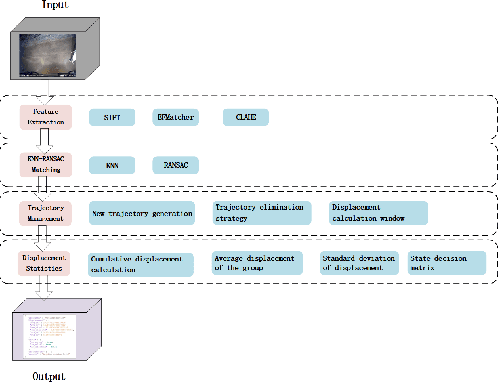
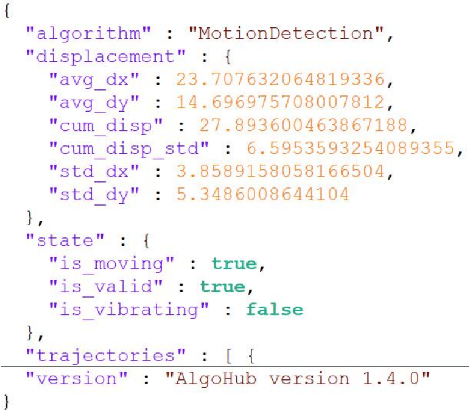
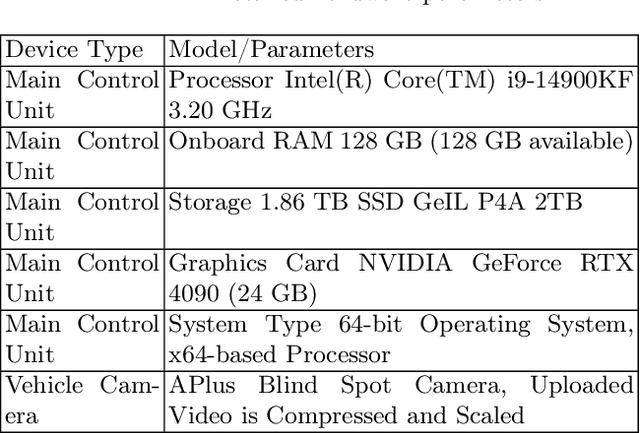
A vision-based trajectory analysis solution is proposed to address the "zero-speed braking" issue caused by inaccurate Controller Area Network (CAN) signals in commercial vehicle Automatic Emergency Braking (AEB) systems during low-speed operation. The algorithm utilizes the NVIDIA Jetson AGX Xavier platform to process sequential video frames from a blind spot camera, employing self-adaptive Contrast Limited Adaptive Histogram Equalization (CLAHE)-enhanced Scale-Invariant Feature Transform (SIFT) feature extraction and K-Nearest Neighbors (KNN)-Random Sample Consensus (RANSAC) matching. This allows for precise classification of the vehicle's motion state (static, vibration, moving). Key innovations include 1) multiframe trajectory displacement statistics (5-frame sliding window), 2) a dual-threshold state decision matrix, and 3) OBD-II driven dynamic Region of Interest (ROI) configuration. The system effectively suppresses environmental interference and false detection of dynamic objects, directly addressing the challenge of low-speed false activation in commercial vehicle safety systems. Evaluation in a real-world dataset (32,454 video segments from 1,852 vehicles) demonstrates an F1-score of 99.96% for static detection, 97.78% for moving state recognition, and a processing delay of 14.2 milliseconds (resolution 704x576). The deployment on-site shows an 89% reduction in false braking events, a 100% success rate in emergency braking, and a fault rate below 5%.