 Add to Chrome
 Add to Firefox
 Add to Edge
XClipGS: Exact Half-Space Clipping for Medical Volume Gaussian Splatting
Aug 07, 2026
Gaussian-splatting proxies enable interactive rendering of volumetric medical scans, but a clipping plane exposes anatomy not constrained by external-view training and intersects primitives that conventional splatting can only keep or drop whole. We present XClipGS (eXact Clipping), which treats these as two separate problems: the render-time clip operator and supervision of the hidden interior. Under the local affine model used by EWA splatting, the ray integral of a half-space-restricted Gaussian factorizes exactly into its ordinary 2D footprint and a conditional Gaussian CDF whose argument is affine in pixel coordinates. The resulting closed-form per-pixel operator introduces no learned clipping parameters or auxiliary network and remains differentiable with respect to the primitive and plane. We use multi-distance reference views with varied clipping-plane axes and offsets to supervise the interior through the same operator. We also introduce a paired clipped/unclipped cut-face protocol with difference-referenced cut error (CDE) and culled-side leakage (Leak), because global image metrics dilute errors near the plane. On eight CT and MRI volumes with plane offsets not used for training, XClipGS attains the highest PSNR on every volume (33.56 versus 32.34 dB for ClipGS) while rendering at over 650 FPS, far above real time, versus 278 FPS. On voxel-axis cut-face views, it raises average band SSIM from 0.809 to 0.860 and leaks roughly 40 times less. Without retraining, it also achieves the best average across all four metrics on arbitrary-normal planes; on a fixed interior, it matches RaRa's face fidelity with about 16 times less leakage. Project page: https://gaozhongpai.github.io/XClipGS/

Adversarial Prompts for Acceptance Collapse in Speculative Decoding
Jul 23, 2026Lossless acceleration schemes, such as speculative decoding, promise significant inference speedups by relying on dynamic token-level alignment between a draft and a target model. However, this guarantee of semantic equivalence masks a severe operational vulnerability: draft-target alignment can be systematically attacked. In this paper, we introduce ADSD, which, to the best of our knowledge, is the first prompt-suffix attack that collapses verifier acceptance by pushing draft probability mass toward tokens the target is unlikely to accept. ADSD uses Soft-Collapse, a verifier-aligned surrogate derived from the asymmetric speculative acceptance rule, together with a target-preservation objective that discourages obvious task corruption. ADSD successfully generates highly effective adversarial suffixes. On the GSM8K dataset, our attack increases the mean sample time by 62.3% while preserving the task quality. We further show that this vulnerability exists across different domains, speculative decoding strategies, and model architectures.
Digital measurement of droplet flame diameter in microgravity combustion images using Segment Anything Model 2 with automatic prompt selection
Jul 18, 2026Flame diameter is a key measurable parameter in microgravity droplet combustion, but its extraction from self-illuminated frames remains difficult because soot tails, blurred luminous boundaries, chamber reflections, and droplet drift introduce substantial measurement bias and operator dependence. This work presents an AI-enabled digital measurement workflow for automated flame diameter from combustion images. The workflow integrates automatic prompt-point generation into Segment Anything Model 2, employing Random Sample Consensus (RANSAC)-based circle fitting. The automatic prompt strategy removes subjective manual point selection, while the video memory mechanism maintains temporal consistency for drifting droplets, and the RANSAC fitting rejects soot-tail pixels as geometric outliers. The method is validated by 19,537 flame images of n-heptane, n-decane, and n-octane droplets with varying initial diameters. Compared with manual-reference measurements, the proposed workflow achieves a mean relative agreement of 96.9%, a mean absolute percentage error of 3.1%, and substantially outperforms conventional Hough circle detection, which performed worse under the same evaluation conditions. The results also show that the measurement accuracy improves with increasing droplet size. The proposed workflow has a combined standard uncertainty of 8.54% and achieves approximately a 229-fold improvement in efficiency over manual measurement. These results demonstrate that the proposed SAM2-based workflow provides a reproducible, fully automated, and metrologically characterized digital measurement system for extracting flame diameter from challenging combustion images. The approach supports high-throughput combustion diagnostics and illustrates that AI-based segmentation can be integrated into quantitative measurement workflows for digitalized image-based metrology.
FF3R: Feedforward Feature 3D Reconstruction from Unconstrained views
Apr 10, 2026Recent advances in vision foundation models have revolutionized geometry reconstruction and semantic understanding. Yet, most of the existing approaches treat these capabilities in isolation, leading to redundant pipelines and compounded errors. This paper introduces FF3R, a fully annotation-free feed-forward framework that unifies geometric and semantic reasoning from unconstrained multi-view image sequences. Unlike previous methods, FF3R does not require camera poses, depth maps, or semantic labels, relying solely on rendering supervision for RGB and feature maps, establishing a scalable paradigm for unified 3D reasoning. In addition, we address two critical challenges in feedforward feature reconstruction pipelines, namely global semantic inconsistency and local structural inconsistency, through two key innovations: (i) a Token-wise Fusion Module that enriches geometry tokens with semantic context via cross-attention, and (ii) a Semantic-Geometry Mutual Boosting mechanism combining geometry-guided feature warping for global consistency with semantic-aware voxelization for local coherence. Extensive experiments on ScanNet and DL3DV-10K demonstrate FF3R's superior performance in novel-view synthesis, open-vocabulary semantic segmentation, and depth estimation, with strong generalization to in-the-wild scenarios, paving the way for embodied intelligence systems that demand both spatial and semantic understanding.
Fine-Tuning a Large Vision-Language Model for Artwork's Scoring and Critique
Feb 09, 2026Assessing artistic creativity is foundational to creativity research and arts education, yet manual scoring (e.g., Torrance Tests of Creative Thinking) is labor-intensive at scale. Prior machine-learning approaches show promise for visual creativity scoring, but many rely mainly on image features and provide limited or no explanatory feedback. We propose a framework for automated creativity assessment of human paintings by fine-tuning the vision-language model Qwen2-VL-7B with multi-task learning. Our dataset contains 1000 human-created paintings scored on a 1-100 scale and paired with a short human-written description (content or artist explanation). Two expert raters evaluated each work using a five-dimension rubric (originality, color, texture, composition, content) and provided written critiques; we use an 80/20 train-test split. We add a lightweight regression head on the visual encoder output so the model can predict a numerical score and generate rubric-aligned feedback in a single forward pass. By embedding the structured rubric and the artwork description in the system prompt, we constrain the generated text to match the quantitative prediction. Experiments show strong accuracy, achieving Pearson r > 0.97 and MAE about 3.95 on the 100-point scale. Qualitative evaluation indicates the generated feedback is semantically close to expert critiques (average SBERT cosine similarity = 0.798). The proposed approach bridges computer vision and art assessment and offers a scalable tool for creativity research and classroom feedback.
FlexMap: Generalized HD Map Construction from Flexible Camera Configurations
Jan 29, 2026High-definition (HD) maps provide essential semantic information of road structures for autonomous driving systems, yet current HD map construction methods require calibrated multi-camera setups and either implicit or explicit 2D-to-BEV transformations, making them fragile when sensors fail or camera configurations vary across vehicle fleets. We introduce FlexMap, unlike prior methods that are fixed to a specific N-camera rig, our approach adapts to variable camera configurations without any architectural changes or per-configuration retraining. Our key innovation eliminates explicit geometric projections by using a geometry-aware foundation model with cross-frame attention to implicitly encode 3D scene understanding in feature space. FlexMap features two core components: a spatial-temporal enhancement module that separates cross-view spatial reasoning from temporal dynamics, and a camera-aware decoder with latent camera tokens, enabling view-adaptive attention without the need for projection matrices. Experiments demonstrate that FlexMap outperforms existing methods across multiple configurations while maintaining robustness to missing views and sensor variations, enabling more practical real-world deployment.
Spatial-Conditioned Reasoning in Long-Egocentric Videos
Jan 26, 2026Long-horizon egocentric video presents significant challenges for visual navigation due to viewpoint drift and the absence of persistent geometric context. Although recent vision-language models perform well on image and short-video reasoning, their spatial reasoning capability in long egocentric sequences remains limited. In this work, we study how explicit spatial signals influence VLM-based video understanding without modifying model architectures or inference procedures. We introduce Sanpo-D, a fine-grained re-annotation of the Google Sanpo dataset, and benchmark multiple VLMs on navigation-oriented spatial queries. To examine input-level inductive bias, we further fuse depth maps with RGB frames and evaluate their impact on spatial reasoning. Our results reveal a trade-off between general-purpose accuracy and spatial specialization, showing that depth-aware and spatially grounded representations can improve performance on safety-critical tasks such as pedestrian and obstruction detection.
Motion Focus Recognition in Fast-Moving Egocentric Video
Jan 12, 2026From Vision-Language-Action (VLA) systems to robotics, existing egocentric datasets primarily focus on action recognition tasks, while largely overlooking the inherent role of motion analysis in sports and other fast-movement scenarios. To bridge this gap, we propose a real-time motion focus recognition method that estimates the subject's locomotion intention from any egocentric video. Our approach leverages the foundation model for camera pose estimation and introduces system-level optimizations to enable efficient and scalable inference. Evaluated on a collected egocentric action dataset, our method achieves real-time performance with manageable memory consumption through a sliding batch inference strategy. This work makes motion-centric analysis practical for edge deployment and offers a complementary perspective to existing egocentric studies on sports and fast-movement activities.
Fast 2DGS: Efficient Image Representation with Deep Gaussian Prior
Dec 14, 2025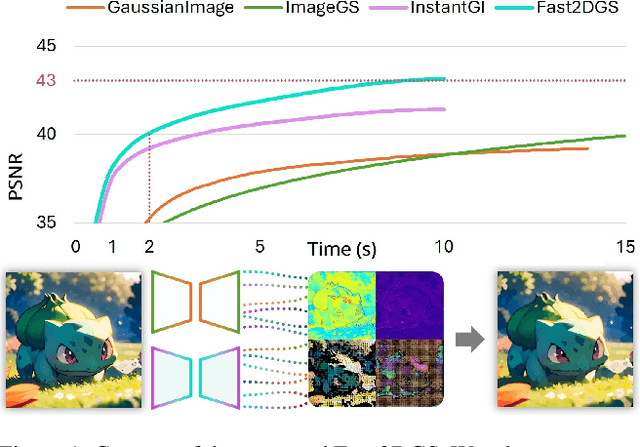

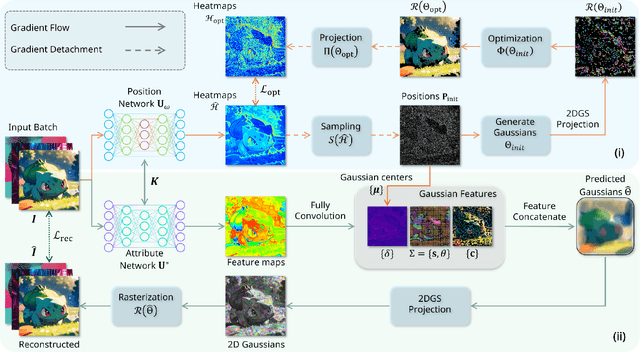
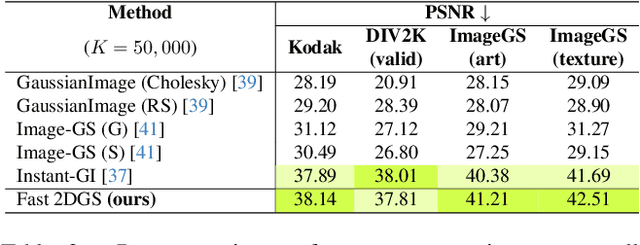
As generative models become increasingly capable of producing high-fidelity visual content, the demand for efficient, interpretable, and editable image representations has grown substantially. Recent advances in 2D Gaussian Splatting (2DGS) have emerged as a promising solution, offering explicit control, high interpretability, and real-time rendering capabilities (>1000 FPS). However, high-quality 2DGS typically requires post-optimization. Existing methods adopt random or heuristics (e.g., gradient maps), which are often insensitive to image complexity and lead to slow convergence (>10s). More recent approaches introduce learnable networks to predict initial Gaussian configurations, but at the cost of increased computational and architectural complexity. To bridge this gap, we present Fast-2DGS, a lightweight framework for efficient Gaussian image representation. Specifically, we introduce Deep Gaussian Prior, implemented as a conditional network to capture the spatial distribution of Gaussian primitives under different complexities. In addition, we propose an attribute regression network to predict dense Gaussian properties. Experiments demonstrate that this disentangled architecture achieves high-quality reconstruction in a single forward pass, followed by minimal fine-tuning. More importantly, our approach significantly reduces computational cost without compromising visual quality, bringing 2DGS closer to industry-ready deployment.
Bézier Splatting for Fast and Differentiable Vector Graphics
Mar 20, 2025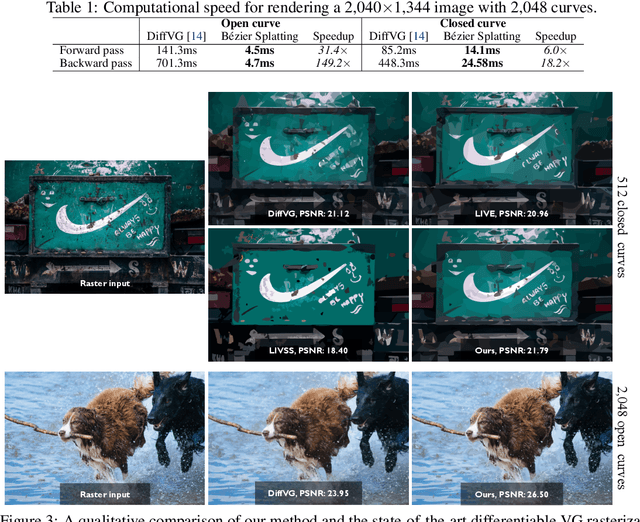


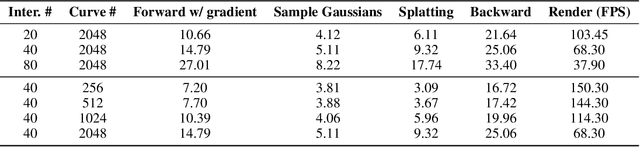
Differentiable vector graphics (VGs) are widely used in image vectorization and vector synthesis, while existing representations are costly to optimize and struggle to achieve high-quality rendering results for high-resolution images. This work introduces a new differentiable VG representation, dubbed B\'ezier splatting, that enables fast yet high-fidelity VG rasterization. B\'ezier splatting samples 2D Gaussians along B\'ezier curves, which naturally provide positional gradients at object boundaries. Thanks to the efficient splatting-based differentiable rasterizer, B\'ezier splatting achieves over 20x and 150x faster per forward and backward rasterization step for open curves compared to DiffVG. Additionally, we introduce an adaptive pruning and densification strategy that dynamically adjusts the spatial distribution of curves to escape local minima, further improving VG quality. Experimental results show that B\'ezier splatting significantly outperforms existing methods with better visual fidelity and 10x faster optimization speed.