 Add to Chrome
 Add to Firefox
 Add to Edge
3D Shape Retrieval
Papers and Code
Using Shadows in Circular Synthetic Aperture Sonar Imaging for Target Analysis
Jan 23, 2026
Circular Synthetic Aperture Sonar (CSAS) provides a 360° azimuth view of the seabed, surpassing the limited aperture and mono-view image of conventional side-scan SAS. This makes CSAS a valuable tool for target recognition in mine warfare where the diversity of point of view is essential for reducing false alarms. CSAS processing typically produces a very high-resolution two-dimensional image. However, the parallax introduced by the circular displacement of the illuminator fill-in the shadow regions, and the shadow cast by an object on the seafloor is lost in favor of azimuth coverage and resolution. Yet the shadows provide complementary information on target shape useful for target recognition. In this paper, we explore a way to retrieve shadow information from CSAS data to improve target analysis and carry 3D reconstruction. Sub-aperture filtering is used to get a collection of images at various points of view along the circular trajectory and fixed focus shadow enhancement (FFSE) is applied to obtain sharp shadows. An interactive interface is also proposed to allow human operators to visualize these shadows along the circular trajectory. A space-carving reconstruction method is applied to infer the 3D shape of the object from the segmented shadows. The results demonstrate the potential of shadows in circular SAS for improving target analysis and 3D reconstruction.

Class-Partitioned VQ-VAE and Latent Flow Matching for Point Cloud Scene Generation
Jan 18, 2026Most 3D scene generation methods are limited to only generating object bounding box parameters while newer diffusion methods also generate class labels and latent features. Using object size or latent feature, they then retrieve objects from a predefined database. For complex scenes of varied, multi-categorical objects, diffusion-based latents cannot be effectively decoded by current autoencoders into the correct point cloud objects which agree with target classes. We introduce a Class-Partitioned Vector Quantized Variational Autoencoder (CPVQ-VAE) that is trained to effectively decode object latent features, by employing a pioneering $\textit{class-partitioned codebook}$ where codevectors are labeled by class. To address the problem of $\textit{codebook collapse}$, we propose a $\textit{class-aware}$ running average update which reinitializes dead codevectors within each partition. During inference, object features and class labels, both generated by a Latent-space Flow Matching Model (LFMM) designed specifically for scene generation, are consumed by the CPVQ-VAE. The CPVQ-VAE's class-aware inverse look-up then maps generated latents to codebook entries that are decoded to class-specific point cloud shapes. Thereby, we achieve pure point cloud generation without relying on an external objects database for retrieval. Extensive experiments reveal that our method reliably recovers plausible point cloud scenes, with up to 70.4% and 72.3% reduction in Chamfer and Point2Mesh errors on complex living room scenes.
PatchAlign3D: Local Feature Alignment for Dense 3D Shape understanding
Jan 05, 2026Current foundation models for 3D shapes excel at global tasks (retrieval, classification) but transfer poorly to local part-level reasoning. Recent approaches leverage vision and language foundation models to directly solve dense tasks through multi-view renderings and text queries. While promising, these pipelines require expensive inference over multiple renderings, depend heavily on large language-model (LLM) prompt engineering for captions, and fail to exploit the inherent 3D geometry of shapes. We address this gap by introducing an encoder-only 3D model that produces language-aligned patch-level features directly from point clouds. Our pre-training approach builds on existing data engines that generate part-annotated 3D shapes by pairing multi-view SAM regions with VLM captioning. Using this data, we train a point cloud transformer encoder in two stages: (1) distillation of dense 2D features from visual encoders such as DINOv2 into 3D patches, and (2) alignment of these patch embeddings with part-level text embeddings through a multi-positive contrastive objective. Our 3D encoder achieves zero-shot 3D part segmentation with fast single-pass inference without any test-time multi-view rendering, while significantly outperforming previous rendering-based and feed-forward approaches across several 3D part segmentation benchmarks. Project website: https://souhail-hadgi.github.io/patchalign3dsite/
CSCBench: A PVC Diagnostic Benchmark for Commodity Supply Chain Reasoning
Jan 05, 2026Large Language Models (LLMs) have achieved remarkable success in general benchmarks, yet their competence in commodity supply chains (CSCs) -- a domain governed by institutional rule systems and feasibility constraints -- remains under-explored. CSC decisions are shaped jointly by process stages (e.g., planning, procurement, delivery), variety-specific rules (e.g., contract specifications and delivery grades), and reasoning depth (from retrieval to multi-step analysis and decision selection). We introduce CSCBench, a 2.3K+ single-choice benchmark for CSC reasoning, instantiated through our PVC 3D Evaluation Framework (Process, Variety, and Cognition). The Process axis aligns tasks with SCOR+Enable; the Variety axis operationalizes commodity-specific rule systems under coupled material-information-financial constraints, grounded in authoritative exchange guidebooks/rulebooks and industry reports; and the Cognition axis follows Bloom's revised taxonomy. Evaluating representative LLMs under a direct prompting setting, we observe strong performance on the Process and Cognition axes but substantial degradation on the Variety axis, especially on Freight Agreements. CSCBench provides a diagnostic yardstick for measuring and improving LLM capabilities in this high-stakes domain.
Name That Part: 3D Part Segmentation and Naming
Dec 19, 2025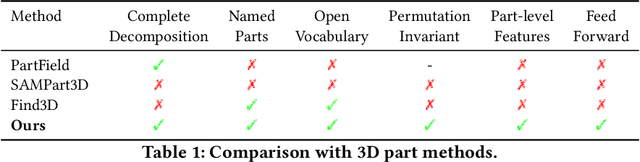
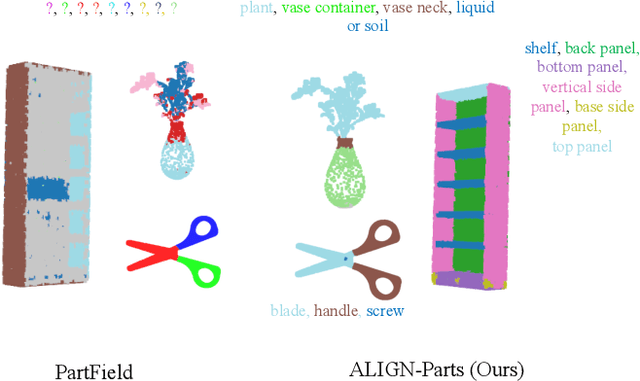

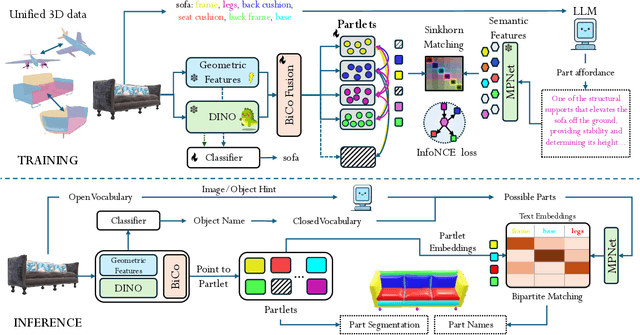
We address semantic 3D part segmentation: decomposing objects into parts with meaningful names. While datasets exist with part annotations, their definitions are inconsistent across datasets, limiting robust training. Previous methods produce unlabeled decompositions or retrieve single parts without complete shape annotations. We propose ALIGN-Parts, which formulates part naming as a direct set alignment task. Our method decomposes shapes into partlets - implicit 3D part representations - matched to part descriptions via bipartite assignment. We combine geometric cues from 3D part fields, appearance from multi-view vision features, and semantic knowledge from language-model-generated affordance descriptions. Text-alignment loss ensures partlets share embedding space with text, enabling a theoretically open-vocabulary matching setup, given sufficient data. Our efficient and novel, one-shot, 3D part segmentation and naming method finds applications in several downstream tasks, including serving as a scalable annotation engine. As our model supports zero-shot matching to arbitrary descriptions and confidence-calibrated predictions for known categories, with human verification, we create a unified ontology that aligns PartNet, 3DCoMPaT++, and Find3D, consisting of 1,794 unique 3D parts. We also show examples from our newly created Tex-Parts dataset. We also introduce 2 novel metrics appropriate for the named 3D part segmentation task.
ScaleADFG: Affordance-based Dexterous Functional Grasping via Scalable Dataset
Nov 12, 2025Dexterous functional tool-use grasping is essential for effective robotic manipulation of tools. However, existing approaches face significant challenges in efficiently constructing large-scale datasets and ensuring generalizability to everyday object scales. These issues primarily arise from size mismatches between robotic and human hands, and the diversity in real-world object scales. To address these limitations, we propose the ScaleADFG framework, which consists of a fully automated dataset construction pipeline and a lightweight grasp generation network. Our dataset introduce an affordance-based algorithm to synthesize diverse tool-use grasp configurations without expert demonstrations, allowing flexible object-hand size ratios and enabling large robotic hands (compared to human hands) to grasp everyday objects effectively. Additionally, we leverage pre-trained models to generate extensive 3D assets and facilitate efficient retrieval of object affordances. Our dataset comprising five object categories, each containing over 1,000 unique shapes with 15 scale variations. After filtering, the dataset includes over 60,000 grasps for each 2 dexterous robotic hands. On top of this dataset, we train a lightweight, single-stage grasp generation network with a notably simple loss design, eliminating the need for post-refinement. This demonstrates the critical importance of large-scale datasets and multi-scale object variant for effective training. Extensive experiments in simulation and on real robot confirm that the ScaleADFG framework exhibits strong adaptability to objects of varying scales, enhancing functional grasp stability, diversity, and generalizability. Moreover, our network exhibits effective zero-shot transfer to real-world objects. Project page is available at https://sizhe-wang.github.io/ScaleADFG_webpage
SCENEFORGE: Enhancing 3D-text alignment with Structured Scene Compositions
Sep 19, 2025The whole is greater than the sum of its parts-even in 3D-text contrastive learning. We introduce SceneForge, a novel framework that enhances contrastive alignment between 3D point clouds and text through structured multi-object scene compositions. SceneForge leverages individual 3D shapes to construct multi-object scenes with explicit spatial relations, pairing them with coherent multi-object descriptions refined by a large language model. By augmenting contrastive training with these structured, compositional samples, SceneForge effectively addresses the scarcity of large-scale 3D-text datasets, significantly enriching data complexity and diversity. We systematically investigate critical design elements, such as the optimal number of objects per scene, the proportion of compositional samples in training batches, and scene construction strategies. Extensive experiments demonstrate that SceneForge delivers substantial performance gains across multiple tasks, including zero-shot classification on ModelNet, ScanObjNN, Objaverse-LVIS, and ScanNet, as well as few-shot part segmentation on ShapeNetPart. SceneForge's compositional augmentations are model-agnostic, consistently improving performance across multiple encoder architectures. Moreover, SceneForge improves 3D visual question answering on ScanQA, generalizes robustly to retrieval scenarios with increasing scene complexity, and showcases spatial reasoning capabilities by adapting spatial configurations to align precisely with textual instructions.
LL3M: Large Language 3D Modelers
Aug 11, 2025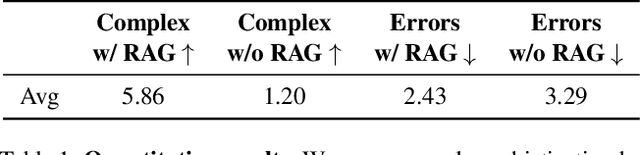
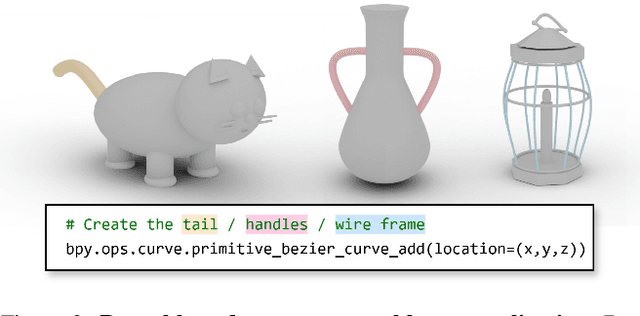
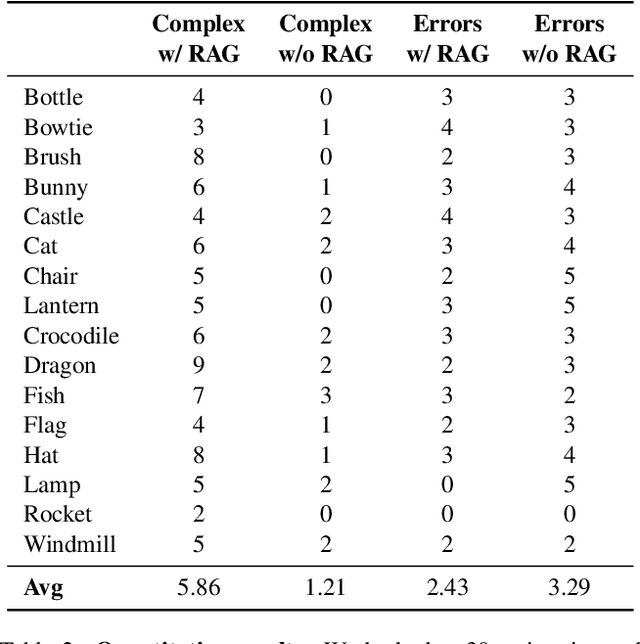
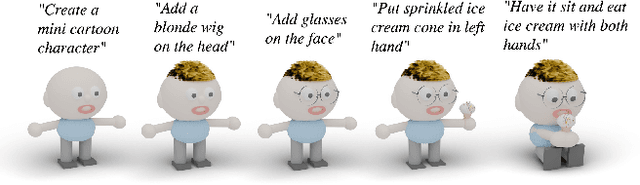
We present LL3M, a multi-agent system that leverages pretrained large language models (LLMs) to generate 3D assets by writing interpretable Python code in Blender. We break away from the typical generative approach that learns from a collection of 3D data. Instead, we reformulate shape generation as a code-writing task, enabling greater modularity, editability, and integration with artist workflows. Given a text prompt, LL3M coordinates a team of specialized LLM agents to plan, retrieve, write, debug, and refine Blender scripts that generate and edit geometry and appearance. The generated code works as a high-level, interpretable, human-readable, well-documented representation of scenes and objects, making full use of sophisticated Blender constructs (e.g. B-meshes, geometry modifiers, shader nodes) for diverse, unconstrained shapes, materials, and scenes. This code presents many avenues for further agent and human editing and experimentation via code tweaks or procedural parameters. This medium naturally enables a co-creative loop in our system: agents can automatically self-critique using code and visuals, while iterative user instructions provide an intuitive way to refine assets. A shared code context across agents enables awareness of previous attempts, and a retrieval-augmented generation knowledge base built from Blender API documentation, BlenderRAG, equips agents with examples, types, and functions empowering advanced modeling operations and code correctness. We demonstrate the effectiveness of LL3M across diverse shape categories, style and material edits, and user-driven refinements. Our experiments showcase the power of code as a generative and interpretable medium for 3D asset creation. Our project page is at https://threedle.github.io/ll3m.
ViewCraft3D: High-Fidelity and View-Consistent 3D Vector Graphics Synthesis
May 26, 20253D vector graphics play a crucial role in various applications including 3D shape retrieval, conceptual design, and virtual reality interactions due to their ability to capture essential structural information with minimal representation. While recent approaches have shown promise in generating 3D vector graphics, they often suffer from lengthy processing times and struggle to maintain view consistency. To address these limitations, we propose ViewCraft3D (VC3D), an efficient method that leverages 3D priors to generate 3D vector graphics. Specifically, our approach begins with 3D object analysis, employs a geometric extraction algorithm to fit 3D vector graphics to the underlying structure, and applies view-consistent refinement process to enhance visual quality. Our comprehensive experiments demonstrate that VC3D outperforms previous methods in both qualitative and quantitative evaluations, while significantly reducing computational overhead. The resulting 3D sketches maintain view consistency and effectively capture the essential characteristics of the original objects.
AI Agents in Engineering Design: A Multi-Agent Framework for Aesthetic and Aerodynamic Car Design
Mar 30, 2025We introduce the concept of "Design Agents" for engineering applications, particularly focusing on the automotive design process, while emphasizing that our approach can be readily extended to other engineering and design domains. Our framework integrates AI-driven design agents into the traditional engineering workflow, demonstrating how these specialized computational agents interact seamlessly with engineers and designers to augment creativity, enhance efficiency, and significantly accelerate the overall design cycle. By automating and streamlining tasks traditionally performed manually, such as conceptual sketching, styling enhancements, 3D shape retrieval and generative modeling, computational fluid dynamics (CFD) meshing, and aerodynamic simulations, our approach reduces certain aspects of the conventional workflow from weeks and days down to minutes. These agents leverage state-of-the-art vision-language models (VLMs), large language models (LLMs), and geometric deep learning techniques, providing rapid iteration and comprehensive design exploration capabilities. We ground our methodology in industry-standard benchmarks, encompassing a wide variety of conventional automotive designs, and utilize high-fidelity aerodynamic simulations to ensure practical and applicable outcomes. Furthermore, we present design agents that can swiftly and accurately predict simulation outcomes, empowering engineers and designers to engage in more informed design optimization and exploration. This research underscores the transformative potential of integrating advanced generative AI techniques into complex engineering tasks, paving the way for broader adoption and innovation across multiple engineering disciplines.