 Add to Chrome
 Add to Firefox
 Add to Edge
Using Shadows in Circular Synthetic Aperture Sonar Imaging for Target Analysis
Jan 23, 2026
Circular Synthetic Aperture Sonar (CSAS) provides a 360° azimuth view of the seabed, surpassing the limited aperture and mono-view image of conventional side-scan SAS. This makes CSAS a valuable tool for target recognition in mine warfare where the diversity of point of view is essential for reducing false alarms. CSAS processing typically produces a very high-resolution two-dimensional image. However, the parallax introduced by the circular displacement of the illuminator fill-in the shadow regions, and the shadow cast by an object on the seafloor is lost in favor of azimuth coverage and resolution. Yet the shadows provide complementary information on target shape useful for target recognition. In this paper, we explore a way to retrieve shadow information from CSAS data to improve target analysis and carry 3D reconstruction. Sub-aperture filtering is used to get a collection of images at various points of view along the circular trajectory and fixed focus shadow enhancement (FFSE) is applied to obtain sharp shadows. An interactive interface is also proposed to allow human operators to visualize these shadows along the circular trajectory. A space-carving reconstruction method is applied to infer the 3D shape of the object from the segmented shadows. The results demonstrate the potential of shadows in circular SAS for improving target analysis and 3D reconstruction.

Semantic Classification of 3D Point Clouds with Multiscale Spherical Neighborhoods
Aug 01, 2018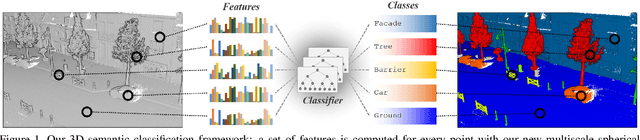
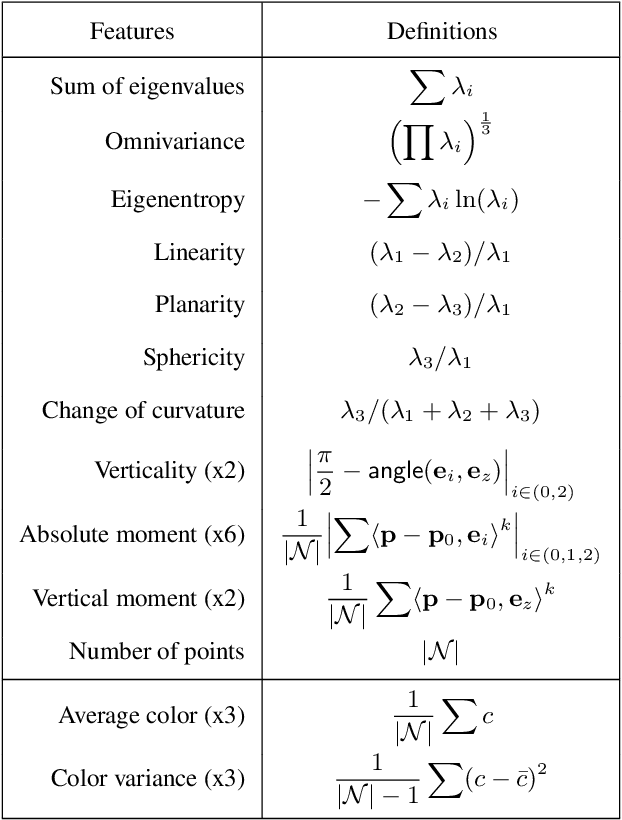
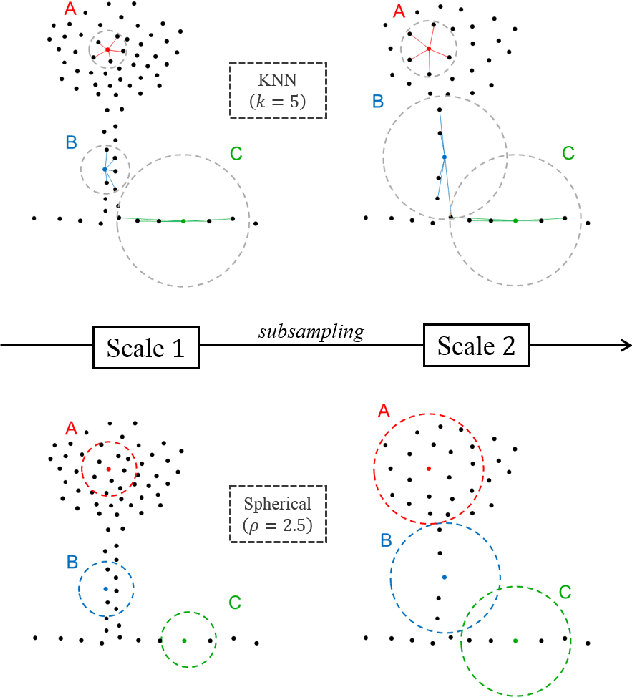
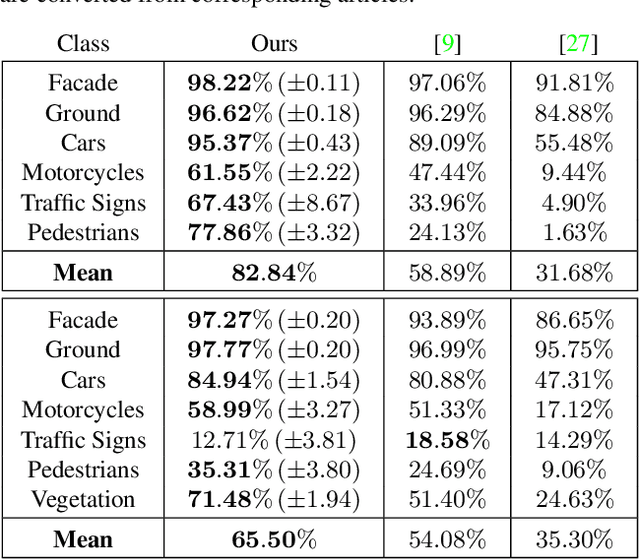
This paper introduces a new definition of multiscale neighborhoods in 3D point clouds. This definition, based on spherical neighborhoods and proportional subsampling, allows the computation of features with a consistent geometrical meaning, which is not the case when using k-nearest neighbors. With an appropriate learning strategy, the proposed features can be used in a random forest to classify 3D points. In this semantic classification task, we show that our multiscale features outperform state-of-the-art features using the same experimental conditions. Furthermore, their classification power competes with more elaborate classification approaches including Deep Learning methods.