 Add to Chrome
 Add to Firefox
 Add to Edge
3D Absolute Human Pose Estimation
Papers and Code
OpenCap Monocular: 3D Human Kinematics and Musculoskeletal Dynamics from a Single Smartphone Video
Mar 25, 2026
Quantifying human movement (kinematics) and musculoskeletal forces (kinetics) at scale, such as estimating quadriceps force during a sit-to-stand movement, could transform prediction, treatment, and monitoring of mobility-related conditions. However, quantifying kinematics and kinetics traditionally requires costly, time-intensive analysis in specialized laboratories, limiting clinical translation. Scalable, accurate tools for biomechanical assessment are needed. We introduce OpenCap Monocular, an algorithm that estimates 3D skeletal kinematics and kinetics from a single smartphone video. The method refines 3D human pose estimates from a monocular pose estimation model (WHAM) via optimization, computes kinematics of a biomechanically constrained skeletal model, and estimates kinetics via physics-based simulation and machine learning. We validated OpenCap Monocular against marker-based motion capture and force plate data for walking, squatting, and sit-to-stand tasks. OpenCap Monocular achieved low kinematic error (4.8° mean absolute error for rotational degrees of freedom; 3.4 cm for pelvis translations), outperforming a regression-only computer vision baseline by 48% in rotational accuracy (p = 0.036) and 69% in translational accuracy (p < 0.001). OpenCap Monocular also estimated ground reaction forces during walking with accuracy comparable to, or better than, our prior two-camera OpenCap system. We demonstrate that the algorithm estimates important kinetic outcomes with clinically meaningful accuracy in applications related to frailty and knee osteoarthritis, including estimating knee extension moment during sit-to-stand transitions and knee adduction moment during walking. OpenCap Monocular is deployed via a smartphone app, web app, and secure cloud computing (https://opencap.ai), enabling free, accessible single-smartphone biomechanical assessments.

Group Inertial Poser: Multi-Person Pose and Global Translation from Sparse Inertial Sensors and Ultra-Wideband Ranging
Oct 24, 2025Tracking human full-body motion using sparse wearable inertial measurement units (IMUs) overcomes the limitations of occlusion and instrumentation of the environment inherent in vision-based approaches. However, purely IMU-based tracking compromises translation estimates and accurate relative positioning between individuals, as inertial cues are inherently self-referential and provide no direct spatial reference for others. In this paper, we present a novel approach for robustly estimating body poses and global translation for multiple individuals by leveraging the distances between sparse wearable sensors - both on each individual and across multiple individuals. Our method Group Inertial Poser estimates these absolute distances between pairs of sensors from ultra-wideband ranging (UWB) and fuses them with inertial observations as input into structured state-space models to integrate temporal motion patterns for precise 3D pose estimation. Our novel two-step optimization further leverages the estimated distances for accurately tracking people's global trajectories through the world. We also introduce GIP-DB, the first IMU+UWB dataset for two-person tracking, which comprises 200 minutes of motion recordings from 14 participants. In our evaluation, Group Inertial Poser outperforms previous state-of-the-art methods in accuracy and robustness across synthetic and real-world data, showing the promise of IMU+UWB-based multi-human motion capture in the wild. Code, models, dataset: https://github.com/eth-siplab/GroupInertialPoser
Systematic Comparison of Projection Methods for Monocular 3D Human Pose Estimation on Fisheye Images
Jun 24, 2025Fisheye cameras offer robots the ability to capture human movements across a wider field of view (FOV) than standard pinhole cameras, making them particularly useful for applications in human-robot interaction and automotive contexts. However, accurately detecting human poses in fisheye images is challenging due to the curved distortions inherent to fisheye optics. While various methods for undistorting fisheye images have been proposed, their effectiveness and limitations for poses that cover a wide FOV has not been systematically evaluated in the context of absolute human pose estimation from monocular fisheye images. To address this gap, we evaluate the impact of pinhole, equidistant and double sphere camera models, as well as cylindrical projection methods, on 3D human pose estimation accuracy. We find that in close-up scenarios, pinhole projection is inadequate, and the optimal projection method varies with the FOV covered by the human pose. The usage of advanced fisheye models like the double sphere model significantly enhances 3D human pose estimation accuracy. We propose a heuristic for selecting the appropriate projection model based on the detection bounding box to enhance prediction quality. Additionally, we introduce and evaluate on our novel dataset FISHnCHIPS, which features 3D human skeleton annotations in fisheye images, including images from unconventional angles, such as extreme close-ups, ground-mounted cameras, and wide-FOV poses, available at: https://www.vision.rwth-aachen.de/fishnchips
Sixth-Sense: Self-Supervised Learning of Spatial Awareness of Humans from a Planar Lidar
Feb 28, 2025Localizing humans is a key prerequisite for any service robot operating in proximity to people. In these scenarios, robots rely on a multitude of state-of-the-art detectors usually designed to operate with RGB-D cameras or expensive 3D LiDARs. However, most commercially available service robots are equipped with cameras with a narrow field of view, making them blind when a user is approaching from other directions, or inexpensive 1D LiDARs whose readings are difficult to interpret. To address these limitations, we propose a self-supervised approach to detect humans and estimate their 2D pose from 1D LiDAR data, using detections from an RGB-D camera as a supervision source. Our approach aims to provide service robots with spatial awareness of nearby humans. After training on 70 minutes of data autonomously collected in two environments, our model is capable of detecting humans omnidirectionally from 1D LiDAR data in a novel environment, with 71% precision and 80% recall, while retaining an average absolute error of 13 cm in distance and 44{\deg} in orientation.
Mocap-2-to-3: Lifting 2D Diffusion-Based Pretrained Models for 3D Motion Capture
Mar 05, 2025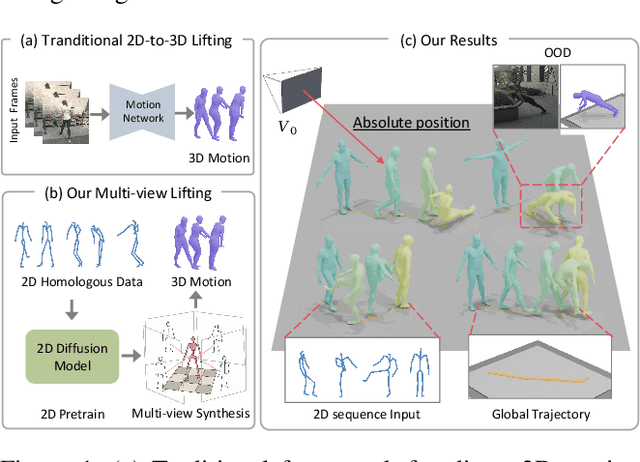
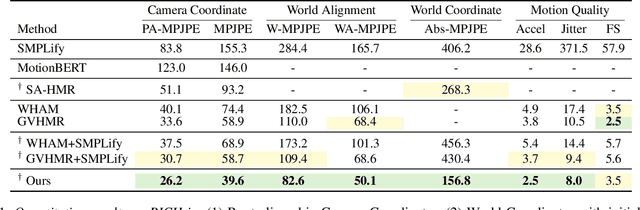
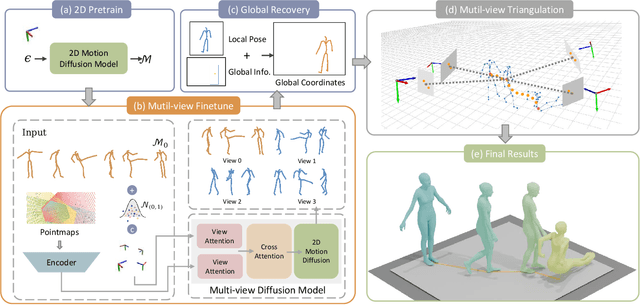
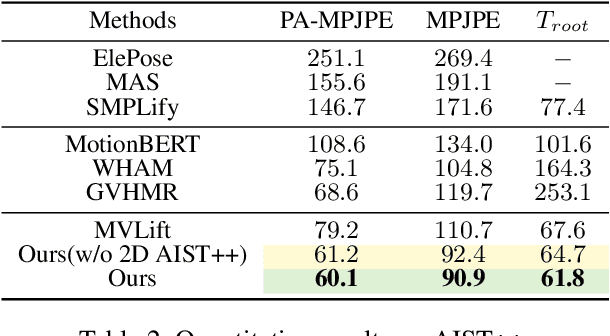
Recovering absolute poses in the world coordinate system from monocular views presents significant challenges. Two primary issues arise in this context. Firstly, existing methods rely on 3D motion data for training, which requires collection in limited environments. Acquiring such 3D labels for new actions in a timely manner is impractical, severely restricting the model's generalization capabilities. In contrast, 2D poses are far more accessible and easier to obtain. Secondly, estimating a person's absolute position in metric space from a single viewpoint is inherently more complex. To address these challenges, we introduce Mocap-2-to-3, a novel framework that decomposes intricate 3D motions into 2D poses, leveraging 2D data to enhance 3D motion reconstruction in diverse scenarios and accurately predict absolute positions in the world coordinate system. We initially pretrain a single-view diffusion model with extensive 2D data, followed by fine-tuning a multi-view diffusion model for view consistency using publicly available 3D data. This strategy facilitates the effective use of large-scale 2D data. Additionally, we propose an innovative human motion representation that decouples local actions from global movements and encodes geometric priors of the ground, ensuring the generative model learns accurate motion priors from 2D data. During inference, this allows for the gradual recovery of global movements, resulting in more plausible positioning. We evaluate our model's performance on real-world datasets, demonstrating superior accuracy in motion and absolute human positioning compared to state-of-the-art methods, along with enhanced generalization and scalability. Our code will be made publicly available.
SurgPose: a Dataset for Articulated Robotic Surgical Tool Pose Estimation and Tracking
Feb 17, 2025Accurate and efficient surgical robotic tool pose estimation is of fundamental significance to downstream applications such as augmented reality (AR) in surgical training and learning-based autonomous manipulation. While significant advancements have been made in pose estimation for humans and animals, it is still a challenge in surgical robotics due to the scarcity of published data. The relatively large absolute error of the da Vinci end effector kinematics and arduous calibration procedure make calibrated kinematics data collection expensive. Driven by this limitation, we collected a dataset, dubbed SurgPose, providing instance-aware semantic keypoints and skeletons for visual surgical tool pose estimation and tracking. By marking keypoints using ultraviolet (UV) reactive paint, which is invisible under white light and fluorescent under UV light, we execute the same trajectory under different lighting conditions to collect raw videos and keypoint annotations, respectively. The SurgPose dataset consists of approximately 120k surgical instrument instances (80k for training and 40k for validation) of 6 categories. Each instrument instance is labeled with 7 semantic keypoints. Since the videos are collected in stereo pairs, the 2D pose can be lifted to 3D based on stereo-matching depth. In addition to releasing the dataset, we test a few baseline approaches to surgical instrument tracking to demonstrate the utility of SurgPose. More details can be found at surgpose.github.io.
Multi-view Pose Fusion for Occlusion-Aware 3D Human Pose Estimation
Aug 28, 2024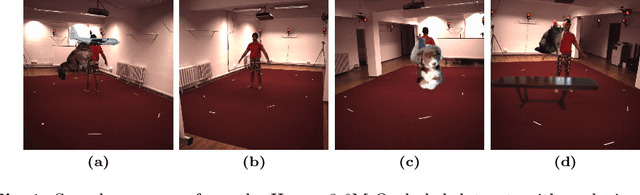

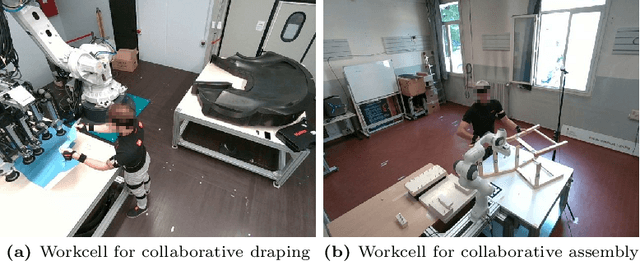
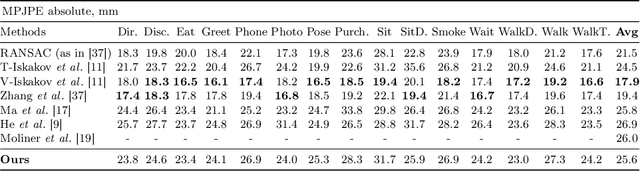
Robust 3D human pose estimation is crucial to ensure safe and effective human-robot collaboration. Accurate human perception,however, is particularly challenging in these scenarios due to strong occlusions and limited camera viewpoints. Current 3D human pose estimation approaches are rather vulnerable in such conditions. In this work we present a novel approach for robust 3D human pose estimation in the context of human-robot collaboration. Instead of relying on noisy 2D features triangulation, we perform multi-view fusion on 3D skeletons provided by absolute monocular methods. Accurate 3D pose estimation is then obtained via reprojection error optimization, introducing limbs length symmetry constraints. We evaluate our approach on the public dataset Human3.6M and on a novel version Human3.6M-Occluded, derived adding synthetic occlusions on the camera views with the purpose of testing pose estimation algorithms under severe occlusions. We further validate our method on real human-robot collaboration workcells, in which we strongly surpass current 3D human pose estimation methods. Our approach outperforms state-of-the-art multi-view human pose estimation techniques and demonstrates superior capabilities in handling challenging scenarios with strong occlusions, representing a reliable and effective solution for real human-robot collaboration setups.
CasCalib: Cascaded Calibration for Motion Capture from Sparse Unsynchronized Cameras
May 10, 2024


It is now possible to estimate 3D human pose from monocular images with off-the-shelf 3D pose estimators. However, many practical applications require fine-grained absolute pose information for which multi-view cues and camera calibration are necessary. Such multi-view recordings are laborious because they require manual calibration, and are expensive when using dedicated hardware. Our goal is full automation, which includes temporal synchronization, as well as intrinsic and extrinsic camera calibration. This is done by using persons in the scene as the calibration objects. Existing methods either address only synchronization or calibration, assume one of the former as input, or have significant limitations. A common limitation is that they only consider single persons, which eases correspondence finding. We attain this generality by partitioning the high-dimensional time and calibration space into a cascade of subspaces and introduce tailored algorithms to optimize each efficiently and robustly. The outcome is an easy-to-use, flexible, and robust motion capture toolbox that we release to enable scientific applications, which we demonstrate on diverse multi-view benchmarks. Project website: https://github.com/jamestang1998/CasCalib.
Your Turn: Real-World Turning Angle Estimation for Parkinson's Disease Severity Assessment
Aug 15, 2024People with Parkinson's Disease (PD) often experience progressively worsening gait, including changes in how they turn around, as the disease progresses. Existing clinical rating tools are not capable of capturing hour-by-hour variations of PD symptoms, as they are confined to brief assessments within clinic settings. Measuring real-world gait turning angles continuously and passively is a component step towards using gait characteristics as sensitive indicators of disease progression in PD. This paper presents a deep learning-based approach to automatically quantify turning angles by extracting 3D skeletons from videos and calculating the rotation of hip and knee joints. We utilise state-of-the-art human pose estimation models, Fastpose and Strided Transformer, on a total of 1386 turning video clips from 24 subjects (12 people with PD and 12 healthy control volunteers), trimmed from a PD dataset of unscripted free-living videos in a home-like setting (Turn-REMAP). We also curate a turning video dataset, Turn-H3.6M, from the public Human3.6M human pose benchmark with 3D ground truth, to further validate our method. Previous gait research has primarily taken place in clinics or laboratories evaluating scripted gait outcomes, but this work focuses on real-world settings where complexities exist, such as baggy clothing and poor lighting. Due to difficulties in obtaining accurate ground truth data in a free-living setting, we quantise the angle into the nearest bin $45^\circ$ based on the manual labelling of expert clinicians. Our method achieves a turning calculation accuracy of 41.6%, a Mean Absolute Error (MAE) of 34.7{\deg}, and a weighted precision WPrec of 68.3% for Turn-REMAP. This is the first work to explore the use of single monocular camera data to quantify turns by PD patients in a home setting.
HPE-CogVLM: New Head Pose Grounding Task Exploration on Vision Language Model
Jun 04, 2024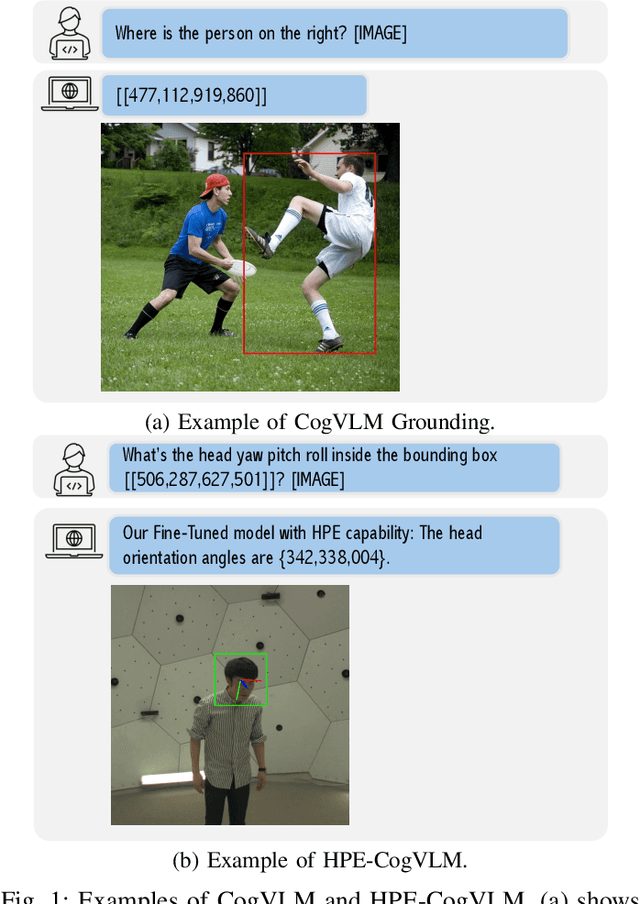
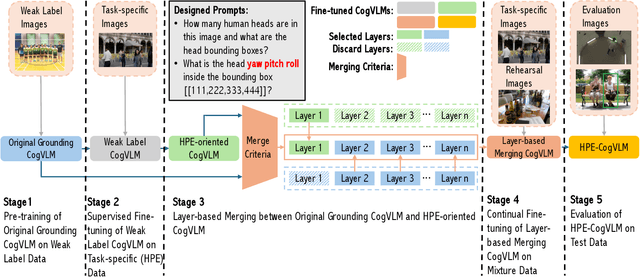
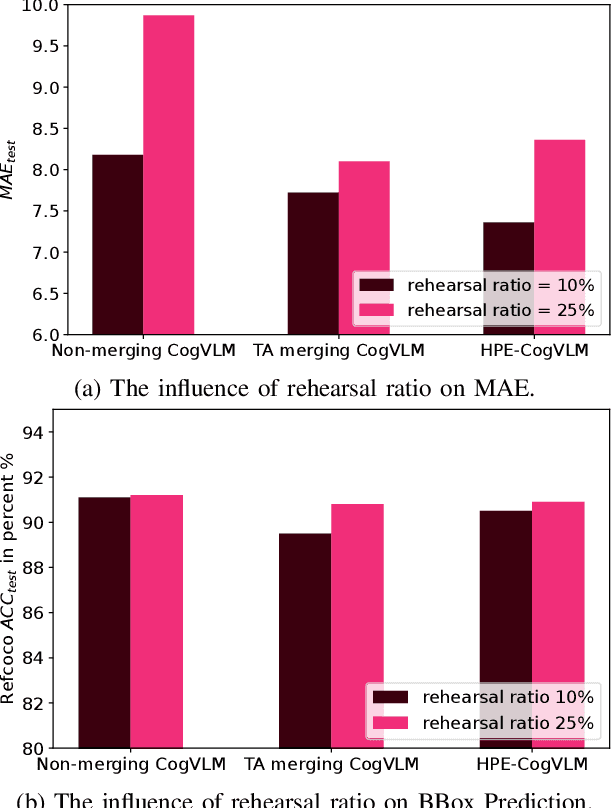
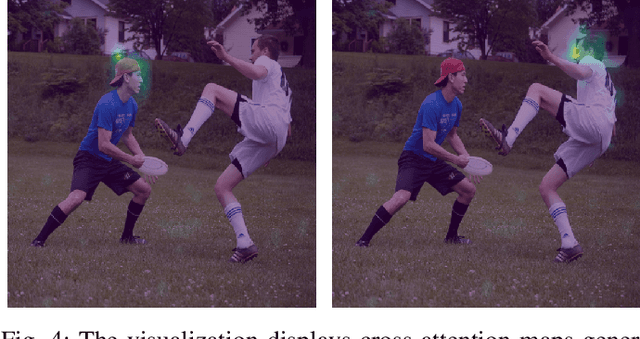
Head pose estimation (HPE) task requires a sophisticated understanding of 3D spatial relationships and precise numerical output of yaw, pitch, and roll Euler angles. Previous HPE studies are mainly based on Non-large language models (Non-LLMs), which rely on close-up human heads cropped from the full image as inputs and lack robustness in real-world scenario. In this paper, we present a novel framework to enhance the HPE prediction task by leveraging the visual grounding capability of CogVLM. CogVLM is a vision language model (VLM) with grounding capability of predicting object bounding boxes (BBoxes), which enables HPE training and prediction using full image information input. To integrate the HPE task into the VLM, we first cop with the catastrophic forgetting problem in large language models (LLMs) by investigating the rehearsal ratio in the data rehearsal method. Then, we propose and validate a LoRA layer-based model merging method, which keeps the integrity of parameters, to enhance the HPE performance in the framework. The results show our HPE-CogVLM achieves a 31.5\% reduction in Mean Absolute Error for HPE prediction over the current Non-LLM based state-of-the-art in cross-dataset evaluation. Furthermore, we compare our LoRA layer-based model merging method with LoRA fine-tuning only and other merging methods in CogVLM. The results demonstrate our framework outperforms them in all HPE metrics.