 Add to Chrome
 Add to Firefox
 Add to Edge
SkelSplat: Robust Multi-view 3D Human Pose Estimation with Differentiable Gaussian Rendering
Nov 11, 2025
Accurate 3D human pose estimation is fundamental for applications such as augmented reality and human-robot interaction. State-of-the-art multi-view methods learn to fuse predictions across views by training on large annotated datasets, leading to poor generalization when the test scenario differs. To overcome these limitations, we propose SkelSplat, a novel framework for multi-view 3D human pose estimation based on differentiable Gaussian rendering. Human pose is modeled as a skeleton of 3D Gaussians, one per joint, optimized via differentiable rendering to enable seamless fusion of arbitrary camera views without 3D ground-truth supervision. Since Gaussian Splatting was originally designed for dense scene reconstruction, we propose a novel one-hot encoding scheme that enables independent optimization of human joints. SkelSplat outperforms approaches that do not rely on 3D ground truth in Human3.6M and CMU, while reducing the cross-dataset error up to 47.8% compared to learning-based methods. Experiments on Human3.6M-Occ and Occlusion-Person demonstrate robustness to occlusions, without scenario-specific fine-tuning. Our project page is available here: https://skelsplat.github.io.

Multi-view Pose Fusion for Occlusion-Aware 3D Human Pose Estimation
Aug 28, 2024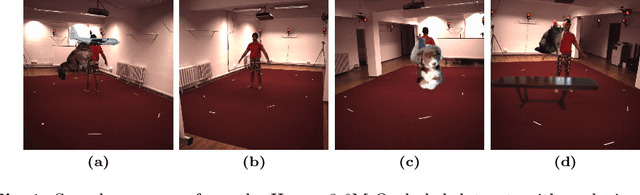

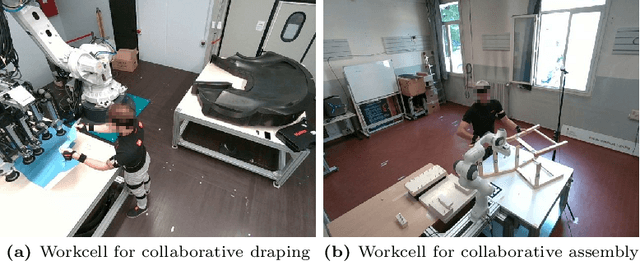
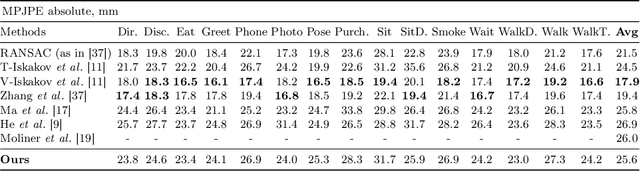
Robust 3D human pose estimation is crucial to ensure safe and effective human-robot collaboration. Accurate human perception,however, is particularly challenging in these scenarios due to strong occlusions and limited camera viewpoints. Current 3D human pose estimation approaches are rather vulnerable in such conditions. In this work we present a novel approach for robust 3D human pose estimation in the context of human-robot collaboration. Instead of relying on noisy 2D features triangulation, we perform multi-view fusion on 3D skeletons provided by absolute monocular methods. Accurate 3D pose estimation is then obtained via reprojection error optimization, introducing limbs length symmetry constraints. We evaluate our approach on the public dataset Human3.6M and on a novel version Human3.6M-Occluded, derived adding synthetic occlusions on the camera views with the purpose of testing pose estimation algorithms under severe occlusions. We further validate our method on real human-robot collaboration workcells, in which we strongly surpass current 3D human pose estimation methods. Our approach outperforms state-of-the-art multi-view human pose estimation techniques and demonstrates superior capabilities in handling challenging scenarios with strong occlusions, representing a reliable and effective solution for real human-robot collaboration setups.