 Add to Chrome
 Add to Firefox
 Add to Edge
Learning What to Remember: Test-Time Training via Context Distillation
Aug 03, 2026
Effective long-context modeling is not merely about retaining more of the past, but about preserving the information that may prove relevant later. Test-time training (TTT) is an appealing approach that performs online parameter updates for long-context modeling, yet existing TTT methods only optimize either reconstruction or online adaptation objectives without considering the future utility of retained information. In this work, we propose \textbf{T}est-\textbf{T}ime \textbf{C}ontext \textbf{D}istillation (TTCD), a TTT framework that introduces a self-supervised objective for allocating limited memory capacity for future use. Specifically, TTCD uses a long-window teacher to supervise the fast weights of a short-window student, where the hidden-state discrepancy between them offers a dense, self-supervised signal guiding the model to memorize the contextual information crucial for future token predictions. We focus on an in-place variant: In-Place TTCD (IP-TTCD), which uses the existing MLP parameters as the fast weights. Experiments on long-context language modeling tasks show IP-TTCD consistently outperforms DeltaNet, Gated DeltaNet, sliding-window attention, and TTT when pre-trained from scratch. Furthermore, IP-TTCD allows pre-trained transformer models to adapt their parameters during inference through continual pre-training, gaining long-context capabilities with only a lightweight architectural augmentation. Our results position TTCD as a step toward architectural continual learning.

EdgeBench: Unveiling Scaling Laws of Learning from Real-World Environments
Jul 06, 2026Pretraining scaling laws reveal that model capability improves predictably with data and compute. But learning from real world environments after deployment remains far less understood. Analyzing roughly 38,000 hours of agent interaction with the environment across 134 real world tasks, we find, to the best of our knowledge, the first evidence that overall performance during environment learning follows a log-sigmoid scaling law with remarkably high precision, reaching R^2 = 0.998. Across model generations, we also find that agent learning speed roughly doubles every three months. This discovery stems from EdgeBench, a suite of 134 real world tasks with ultra-long horizons, spanning scientific discovery, software engineering, combinatorial optimization, professional knowledge work, formal mathematics, and interactive games. Each task sustains at least 12 hours of continuous agent operation under rich, multilevel feedback, and is built through substantial expert effort. We publicly release 51 tasks and our full evaluation framework to accelerate the study of how agents learn from real world experience.
Feynman: Knowledge-Infused Diagramming Agent for Scalable Visual Designs
Mar 13, 2026Visual design is an essential application of state-of-the-art multi-modal AI systems. Improving these systems requires high-quality vision-language data at scale. Despite the abundance of internet image and text data, knowledge-rich and well-aligned image-text pairs are rare. In this paper, we present a scalable diagram generation pipeline built with our agent, Feynman. To create diagrams, Feynman first enumerates domain-specific knowledge components (''ideas'') and performs code planning based on the ideas. Given the plan, Feynman translates ideas into simple declarative programs and iterates to receives feedback and visually refine diagrams. Finally, the declarative programs are rendered by the Penrose diagramming system. The optimization-based rendering of Penrose preserves the visual semantics while injecting fresh randomness into the layout, thereby producing diagrams with visual consistency and diversity. As a result, Feynman can author diagrams along with grounded captions with very little cost and time. Using Feynman, we synthesized a dataset with more than 100k well-aligned diagram-caption pairs. We also curate a visual-language benchmark, Diagramma, from freshly generated data. Diagramma can be used for evaluating the visual reasoning capabilities of vision-language models. We plan to release the dataset, benchmark, and the full agent pipeline as an open-source project.
Learn Hard Problems During RL with Reference Guided Fine-tuning
Mar 05, 2026Reinforcement learning (RL) for mathematical reasoning can suffer from reward sparsity: for challenging problems, LLM fails to sample any correct trajectories, preventing RL from receiving meaningful positive feedback. At the same time, there often exist human-written reference solutions along with the problem (e.g., problems from AoPS), but directly fine-tuning on these solutions offers no benefit because models often cannot imitate human proofs that lie outside their own reasoning distribution. We introduce Reference-Guided Fine-Tuning (ReGFT), a simple and effective method that utilizes human-written reference solutions to synthesize positive trajectories on hard problems and train on them before RL. For each problem, we provide the model with a partial reference solution and let it generate its own reasoning trace, ensuring the resulting trajectories remain in the model's reasoning space while still benefiting from reference guidance. Fine-tuning on these reference-guided trajectories increases the number of solvable problems and produces a checkpoint that receives more positive rewards during RL. Across three benchmarks (AIME24, AIME25, BeyondAIME), ReGFT consistently improves supervised accuracy, accelerates DAPO training, and raises the final performance plateau of RL. Our results show that ReGFT effectively overcomes reward sparsity and unlocks stronger RL-based mathematical reasoning.
On the Learning Dynamics of RLVR at the Edge of Competence
Feb 16, 2026Reinforcement learning with verifiable rewards (RLVR) has been a main driver of recent breakthroughs in large reasoning models. Yet it remains a mystery how rewards based solely on final outcomes can help overcome the long-horizon barrier to extended reasoning. To understand this, we develop a theory of the training dynamics of RL for transformers on compositional reasoning tasks. Our theory characterizes how the effectiveness of RLVR is governed by the smoothness of the difficulty spectrum. When data contains abrupt discontinuities in difficulty, learning undergoes grokking-type phase transitions, producing prolonged plateaus before progress recurs. In contrast, a smooth difficulty spectrum leads to a relay effect: persistent gradient signals on easier problems elevate the model's capabilities to the point where harder ones become tractable, resulting in steady and continuous improvement. Our theory explains how RLVR can improve performance at the edge of competence, and suggests that appropriately designed data mixtures can yield scalable gains. As a technical contribution, our analysis develops and adapts tools from Fourier analysis on finite groups to our setting. We validate the predicted mechanisms empirically via synthetic experiments.
Transformers Provably Learn Chain-of-Thought Reasoning with Length Generalization
Nov 10, 2025The ability to reason lies at the core of artificial intelligence (AI), and challenging problems usually call for deeper and longer reasoning to tackle. A crucial question about AI reasoning is whether models can extrapolate learned reasoning patterns to solve harder tasks with longer chain-of-thought (CoT). In this work, we present a theoretical analysis of transformers learning on synthetic state-tracking tasks with gradient descent. We mathematically prove how the algebraic structure of state-tracking problems governs the degree of extrapolation of the learned CoT. Specifically, our theory characterizes the length generalization of transformers through the mechanism of attention concentration, linking the retrieval robustness of the attention layer to the state-tracking task structure of long-context reasoning. Moreover, for transformers with limited reasoning length, we prove that a recursive self-training scheme can progressively extend the range of solvable problem lengths. To our knowledge, we provide the first optimization guarantee that constant-depth transformers provably learn $\mathsf{NC}^1$-complete problems with CoT, significantly going beyond prior art confined in $\mathsf{TC}^0$, unless the widely held conjecture $\mathsf{TC}^0 \neq \mathsf{NC}^1$ fails. Finally, we present a broad set of experiments supporting our theoretical results, confirming the length generalization behaviors and the mechanism of attention concentration.
Scaling Latent Reasoning via Looped Language Models
Oct 29, 2025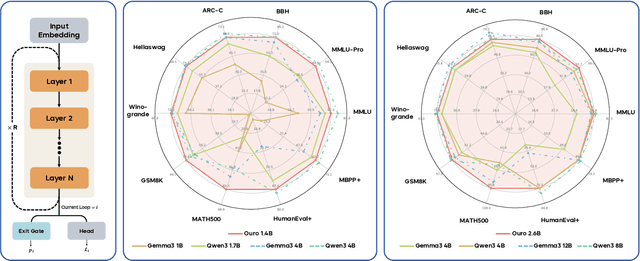
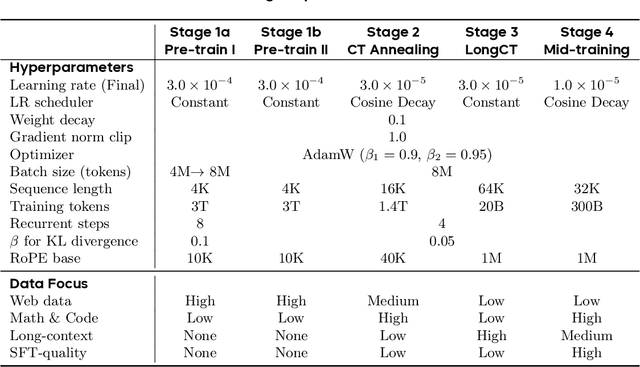
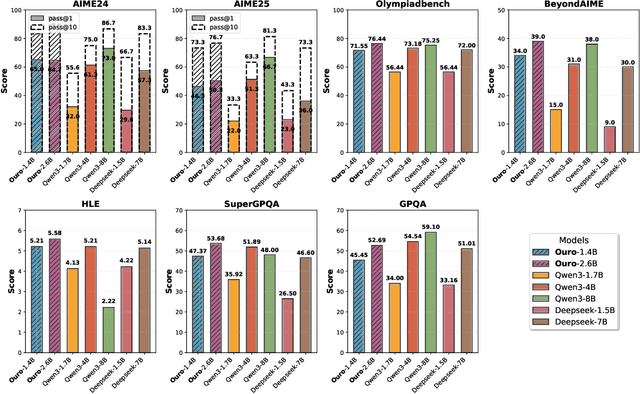

Modern LLMs are trained to "think" primarily via explicit text generation, such as chain-of-thought (CoT), which defers reasoning to post-training and under-leverages pre-training data. We present and open-source Ouro, named after the recursive Ouroboros, a family of pre-trained Looped Language Models (LoopLM) that instead build reasoning into the pre-training phase through (i) iterative computation in latent space, (ii) an entropy-regularized objective for learned depth allocation, and (iii) scaling to 7.7T tokens. Ouro 1.4B and 2.6B models enjoy superior performance that match the results of up to 12B SOTA LLMs across a wide range of benchmarks. Through controlled experiments, we show this advantage stems not from increased knowledge capacity, but from superior knowledge manipulation capabilities. We also show that LoopLM yields reasoning traces more aligned with final outputs than explicit CoT. We hope our results show the potential of LoopLM as a novel scaling direction in the reasoning era. Our model could be found in: http://ouro-llm.github.io.
Faster WIND: Accelerating Iterative Best-of-$N$ Distillation for LLM Alignment
Oct 28, 2024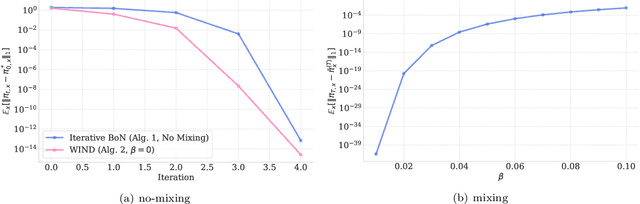
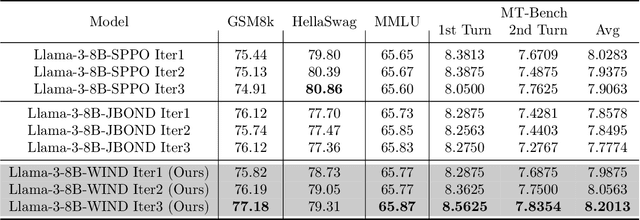
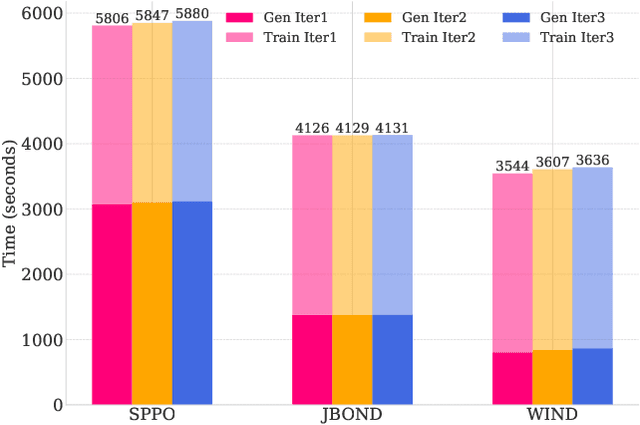
Recent advances in aligning large language models with human preferences have corroborated the growing importance of best-of-N distillation (BOND). However, the iterative BOND algorithm is prohibitively expensive in practice due to the sample and computation inefficiency. This paper addresses the problem by revealing a unified game-theoretic connection between iterative BOND and self-play alignment, which unifies seemingly disparate algorithmic paradigms. Based on the connection, we establish a novel framework, WIN rate Dominance (WIND), with a series of efficient algorithms for regularized win rate dominance optimization that approximates iterative BOND in the parameter space. We provides provable sample efficiency guarantee for one of the WIND variant with the square loss objective. The experimental results confirm that our algorithm not only accelerates the computation, but also achieves superior sample efficiency compared to existing methods.
Transformers Provably Learn Feature-Position Correlations in Masked Image Modeling
Mar 04, 2024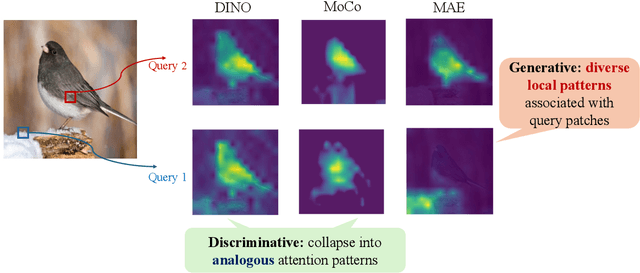
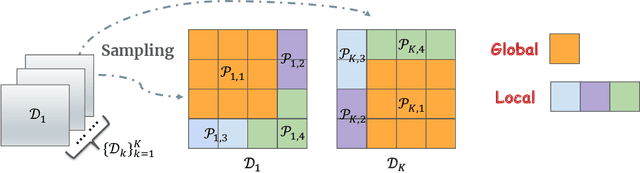
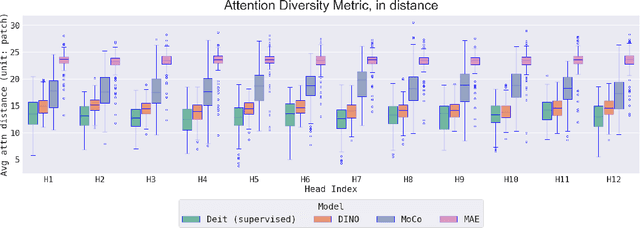
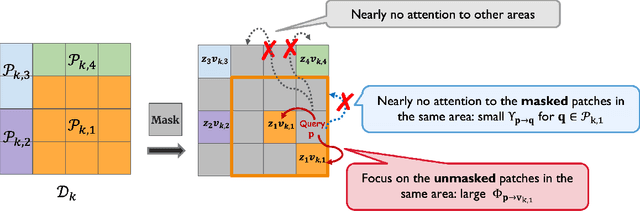
Masked image modeling (MIM), which predicts randomly masked patches from unmasked ones, has emerged as a promising approach in self-supervised vision pretraining. However, the theoretical understanding of MIM is rather limited, especially with the foundational architecture of transformers. In this paper, to the best of our knowledge, we provide the first end-to-end theory of learning one-layer transformers with softmax attention in MIM self-supervised pretraining. On the conceptual side, we posit a theoretical mechanism of how transformers, pretrained with MIM, produce empirically observed local and diverse attention patterns on data distributions with spatial structures that highlight feature-position correlations. On the technical side, our end-to-end analysis of the training dynamics of softmax-based transformers accommodates both input and position embeddings simultaneously, which is developed based on a novel approach to track the interplay between the attention of feature-position and position-wise correlations.
Revisiting Disentanglement in Downstream Tasks: A Study on Its Necessity for Abstract Visual Reasoning
Mar 01, 2024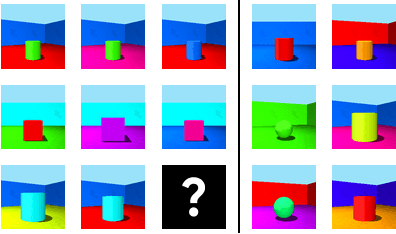
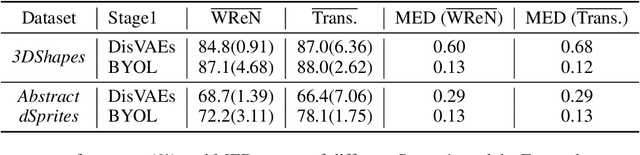
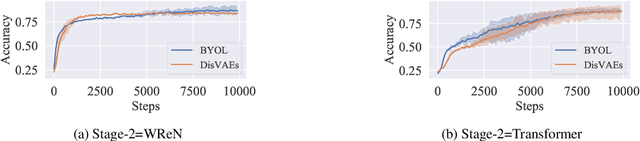
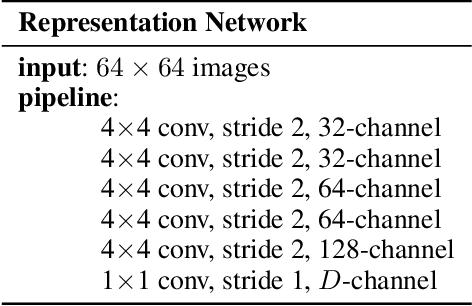
In representation learning, a disentangled representation is highly desirable as it encodes generative factors of data in a separable and compact pattern. Researchers have advocated leveraging disentangled representations to complete downstream tasks with encouraging empirical evidence. This paper further investigates the necessity of disentangled representation in downstream applications. Specifically, we show that dimension-wise disentangled representations are unnecessary on a fundamental downstream task, abstract visual reasoning. We provide extensive empirical evidence against the necessity of disentanglement, covering multiple datasets, representation learning methods, and downstream network architectures. Furthermore, our findings suggest that the informativeness of representations is a better indicator of downstream performance than disentanglement. Finally, the positive correlation between informativeness and disentanglement explains the claimed usefulness of disentangled representations in previous works. The source code is available at https://github.com/Richard-coder-Nai/disentanglement-lib-necessity.git.