 Add to Chrome
 Add to Firefox
 Add to Edge
Stochastic Sparse Attention for Memory-Bound Inference
May 03, 2026
Autoregressive decoding becomes bandwidth-limited at long contexts, as generating each token requires reading all $n_k$ key and value vectors from KV cache. We present Stochastic Additive No-mulT Attention (SANTA), a method that sparsifies value-cache access by sampling $S \ll n_k$ indices from the post-softmax distribution and aggregates only those value rows. This yields an unbiased estimator of the post-softmax value aggregation while replacing value-stage multiply-accumulates with gather-and-add. We introduce stratified sampling to design variance-reduced, GPU-friendly variants, demonstrating $1.5\times$ decode-step attention kernel speedup over FlashInfer and FlashDecoding on an NVIDIA RTX 6000 Ada while matching baseline accuracy at 32k-token contexts. Finally, we propose Bernoulli $qK^\mathsf{T}$ sampling as a complementary technique to sparsify the score stage, reducing key-feature access through stochastic ternary queries. Both methods are orthogonal to upstream techniques such as ternary quantization, low-rank projections, and KV-cache compression. Together, they point toward sparse, multiplier-free, and energy-efficient inference. We open-source our kernels at: https://github.com/OPUSLab/SANTA.git

Feynman: Knowledge-Infused Diagramming Agent for Scalable Visual Designs
Mar 13, 2026Visual design is an essential application of state-of-the-art multi-modal AI systems. Improving these systems requires high-quality vision-language data at scale. Despite the abundance of internet image and text data, knowledge-rich and well-aligned image-text pairs are rare. In this paper, we present a scalable diagram generation pipeline built with our agent, Feynman. To create diagrams, Feynman first enumerates domain-specific knowledge components (''ideas'') and performs code planning based on the ideas. Given the plan, Feynman translates ideas into simple declarative programs and iterates to receives feedback and visually refine diagrams. Finally, the declarative programs are rendered by the Penrose diagramming system. The optimization-based rendering of Penrose preserves the visual semantics while injecting fresh randomness into the layout, thereby producing diagrams with visual consistency and diversity. As a result, Feynman can author diagrams along with grounded captions with very little cost and time. Using Feynman, we synthesized a dataset with more than 100k well-aligned diagram-caption pairs. We also curate a visual-language benchmark, Diagramma, from freshly generated data. Diagramma can be used for evaluating the visual reasoning capabilities of vision-language models. We plan to release the dataset, benchmark, and the full agent pipeline as an open-source project.
Latent Chain-of-Thought? Decoding the Depth-Recurrent Transformer
Jul 02, 2025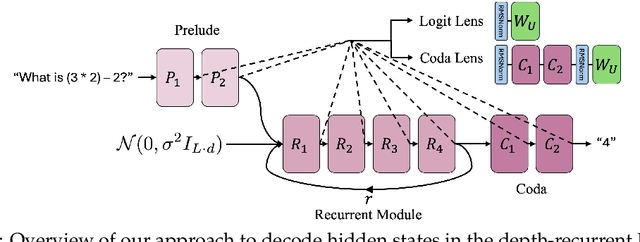
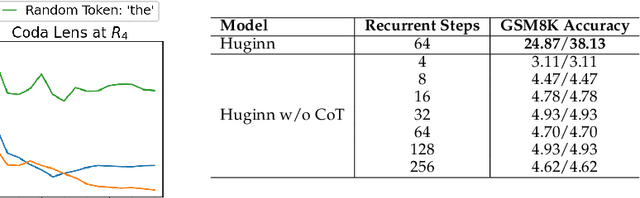
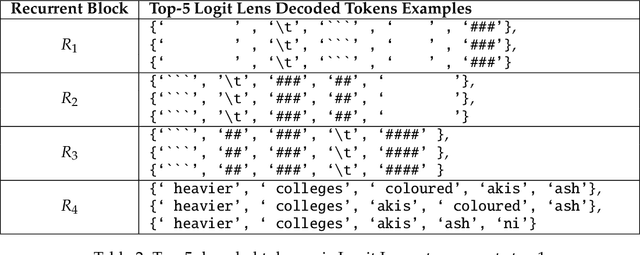
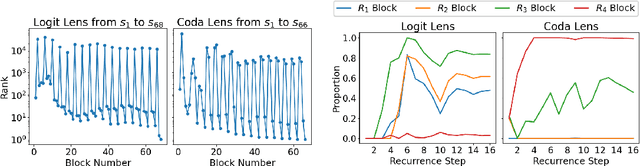
Chain-of-thought (CoT) reasoning has enabled transformer-based language models to excel at complex mathematics and multi-step planning. However, in standard decoder-only architectures, these reasoning steps are externalized in natural language, improving interpretability at the cost of efficiency. To capture reasoning that is not easily represented in words, many works have explored recurrent architectures that aim to internalize reasoning in latent space, potentially supporting latent CoT. In this paper, we investigate whether such reasoning structures emerge in Huginn-3.5B, a depth-recurrent Transformer that reuses layers at inference time without increasing parameter count. We examine the model's internal behavior on arithmetic tasks using a suite of probing techniques including the Logit Lens and Coda Lens. Our findings reveal limited evidence of interpretable latent CoT by tracking rank trajectories of final and intermediate result tokens. Furthermore, we uncover significant probing inconsistencies across recurrent blocks, where the interpretability of hidden states depends heavily on both the layer index and the decoding method. Finally, we empirically show that increasing recurrence depth yields only marginal gains and falls well short of models that explicitly externalize reasoning steps. The code is available at https://github.com/wenquanlu/huginn-latent-cot.