 Add to Chrome
 Add to Firefox
 Add to Edge
Developing and evaluating a chatbot to support maternal health care
Mar 13, 2026
The ability to provide trustworthy maternal health information using phone-based chatbots can have a significant impact, particularly in low-resource settings where users have low health literacy and limited access to care. However, deploying such systems is technically challenging: user queries are short, underspecified, and code-mixed across languages, answers require regional context-specific grounding, and partial or missing symptom context makes safe routing decisions difficult. We present a chatbot for maternal health in India developed through a partnership between academic researchers, a health tech company, a public health nonprofit, and a hospital. The system combines (1) stage-aware triage, routing high-risk queries to expert templates, (2) hybrid retrieval over curated maternal/newborn guidelines, and (3) evidence-conditioned generation from an LLM. Our core contribution is an evaluation workflow for high-stakes deployment under limited expert supervision. Targeting both component-level and end-to-end testing, we introduce: (i) a labeled triage benchmark (N=150) achieving 86.7% emergency recall, explicitly reporting the missed-emergency vs. over-escalation trade-off; (ii) a synthetic multi-evidence retrieval benchmark (N=100) with chunk-level evidence labels; (iii) LLM-as-judge comparison on real queries (N=781) using clinician-codesigned criteria; and (iv) expert validation. Our findings show that trustworthy medical assistants in multilingual, noisy settings require defense-in-depth design paired with multi-method evaluation, rather than any single model and evaluation method choice.

Feynman: Knowledge-Infused Diagramming Agent for Scalable Visual Designs
Mar 13, 2026Visual design is an essential application of state-of-the-art multi-modal AI systems. Improving these systems requires high-quality vision-language data at scale. Despite the abundance of internet image and text data, knowledge-rich and well-aligned image-text pairs are rare. In this paper, we present a scalable diagram generation pipeline built with our agent, Feynman. To create diagrams, Feynman first enumerates domain-specific knowledge components (''ideas'') and performs code planning based on the ideas. Given the plan, Feynman translates ideas into simple declarative programs and iterates to receives feedback and visually refine diagrams. Finally, the declarative programs are rendered by the Penrose diagramming system. The optimization-based rendering of Penrose preserves the visual semantics while injecting fresh randomness into the layout, thereby producing diagrams with visual consistency and diversity. As a result, Feynman can author diagrams along with grounded captions with very little cost and time. Using Feynman, we synthesized a dataset with more than 100k well-aligned diagram-caption pairs. We also curate a visual-language benchmark, Diagramma, from freshly generated data. Diagramma can be used for evaluating the visual reasoning capabilities of vision-language models. We plan to release the dataset, benchmark, and the full agent pipeline as an open-source project.
AI+HW 2035: Shaping the Next Decade
Mar 05, 2026Artificial intelligence (AI) and hardware (HW) are advancing at unprecedented rates, yet their trajectories have become inseparably intertwined. The global research community lacks a cohesive, long-term vision to strategically coordinate the development of AI and HW. This fragmentation constrains progress toward holistic, sustainable, and adaptive AI systems capable of learning, reasoning, and operating efficiently across cloud, edge, and physical environments. The future of AI depends not only on scaling intelligence, but on scaling efficiency, achieving exponential gains in intelligence per joule, rather than unbounded compute consumption. Addressing this grand challenge requires rethinking the entire computing stack. This vision paper lays out a 10-year roadmap for AI+HW co-design and co-development, spanning algorithms, architectures, systems, and sustainability. We articulate key insights that redefine scaling around energy efficiency, system-level integration, and cross-layer optimization. We identify key challenges and opportunities, candidly assess potential obstacles and pitfalls, and propose integrated solutions grounded in algorithmic innovation, hardware advances, and software abstraction. Looking ahead, we define what success means in 10 years: achieving a 1000x improvement in efficiency for AI training and inference; enabling energy-aware, self-optimizing systems that seamlessly span cloud, edge, and physical AI; democratizing access to advanced AI infrastructure; and embedding human-centric principles into the design of intelligent systems. Finally, we outline concrete action items for academia, industry, government, and the broader community, calling for coordinated national initiatives, shared infrastructure, workforce development, cross-agency collaboration, and sustained public-private partnerships to ensure that AI+HW co-design becomes a unifying long-term mission.
On the Learning Dynamics of RLVR at the Edge of Competence
Feb 16, 2026Reinforcement learning with verifiable rewards (RLVR) has been a main driver of recent breakthroughs in large reasoning models. Yet it remains a mystery how rewards based solely on final outcomes can help overcome the long-horizon barrier to extended reasoning. To understand this, we develop a theory of the training dynamics of RL for transformers on compositional reasoning tasks. Our theory characterizes how the effectiveness of RLVR is governed by the smoothness of the difficulty spectrum. When data contains abrupt discontinuities in difficulty, learning undergoes grokking-type phase transitions, producing prolonged plateaus before progress recurs. In contrast, a smooth difficulty spectrum leads to a relay effect: persistent gradient signals on easier problems elevate the model's capabilities to the point where harder ones become tractable, resulting in steady and continuous improvement. Our theory explains how RLVR can improve performance at the edge of competence, and suggests that appropriately designed data mixtures can yield scalable gains. As a technical contribution, our analysis develops and adapts tools from Fourier analysis on finite groups to our setting. We validate the predicted mechanisms empirically via synthetic experiments.
Expanding the Capabilities of Reinforcement Learning via Text Feedback
Feb 02, 2026The success of RL for LLM post-training stems from an unreasonably uninformative source: a single bit of information per rollout as binary reward or preference label. At the other extreme, distillation offers dense supervision but requires demonstrations, which are costly and difficult to scale. We study text feedback as an intermediate signal: richer than scalar rewards, yet cheaper than complete demonstrations. Textual feedback is a natural mode of human interaction and is already abundant in many real-world settings, where users, annotators, and automated judges routinely critique LLM outputs. Towards leveraging text feedback at scale, we formalize a multi-turn RL setup, RL from Text Feedback (RLTF), where text feedback is available during training but not at inference. Therefore, models must learn to internalize the feedback in order to improve their test-time single-turn performance. To do this, we propose two methods: Self Distillation (RLTF-SD), which trains the single-turn policy to match its own feedback-conditioned second-turn generations; and Feedback Modeling (RLTF-FM), which predicts the feedback as an auxiliary objective. We provide theoretical analysis on both methods, and empirically evaluate on reasoning puzzles, competition math, and creative writing tasks. Our results show that both methods consistently outperform strong baselines across benchmarks, highlighting the potential of RL with an additional source of rich supervision at scale.
Online Social Welfare Function-based Resource Allocation
Feb 01, 2026In many real-world settings, a centralized decision-maker must repeatedly allocate finite resources to a population over multiple time steps. Individuals who receive a resource derive some stochastic utility; to characterize the population-level effects of an allocation, the expected individual utilities are then aggregated using a social welfare function (SWF). We formalize this setting and present a general confidence sequence framework for SWF-based online learning and inference, valid for any monotonic, concave, and Lipschitz-continuous SWF. Our key insight is that monotonicity alone suffices to lift confidence sequences from individual utilities to anytime-valid bounds on optimal welfare. Building on this foundation, we propose SWF-UCB, a SWF-agnostic online learning algorithm that achieves near-optimal $\tilde{O}(n+\sqrt{nkT})$ regret (for $k$ resources distributed among $n$ individuals at each of $T$ time steps). We instantiate our framework on three normatively distinct SWF families: Weighted Power Mean, Kolm, and Gini, providing bespoke oracle algorithms for each. Experiments confirm $\sqrt{T}$ scaling and reveal rich interactions between $k$ and SWF parameters. This framework naturally supports inference applications such as sequential hypothesis testing, optimal stopping, and policy evaluation.
Cooperative Multi-agent RL with Communication Constraints
Jan 18, 2026Cooperative MARL often assumes frequent access to global information in a data buffer, such as team rewards or other agents' actions, which is typically unrealistic in decentralized MARL systems due to high communication costs. When communication is limited, agents must rely on outdated information to estimate gradients and update their policies. A common approach to handle missing data is called importance sampling, in which we reweigh old data from a base policy to estimate gradients for the current policy. However, it quickly becomes unstable when the communication is limited (i.e. missing data probability is high), so that the base policy in importance sampling is outdated. To address this issue, we propose a technique called base policy prediction, which utilizes old gradients to predict the policy update and collect samples for a sequence of base policies, which reduces the gap between the base policy and the current policy. This approach enables effective learning with significantly fewer communication rounds, since the samples of predicted base policies could be collected within one communication round. Theoretically, we show that our algorithm converges to an $\varepsilon$-Nash equilibrium in potential games with only $O(\varepsilon^{-3/4})$ communication rounds and $O(poly(\max_i |A_i|)\varepsilon^{-11/4})$ samples, improving existing state-of-the-art results in communication cost, as well as sample complexity without the exponential dependence on the joint action space size. We also extend these results to general Markov Cooperative Games to find an agent-wise local maximum. Empirically, we test the base policy prediction algorithm in both simulated games and MAPPO for complex environments.
Transformers Provably Learn Chain-of-Thought Reasoning with Length Generalization
Nov 10, 2025The ability to reason lies at the core of artificial intelligence (AI), and challenging problems usually call for deeper and longer reasoning to tackle. A crucial question about AI reasoning is whether models can extrapolate learned reasoning patterns to solve harder tasks with longer chain-of-thought (CoT). In this work, we present a theoretical analysis of transformers learning on synthetic state-tracking tasks with gradient descent. We mathematically prove how the algebraic structure of state-tracking problems governs the degree of extrapolation of the learned CoT. Specifically, our theory characterizes the length generalization of transformers through the mechanism of attention concentration, linking the retrieval robustness of the attention layer to the state-tracking task structure of long-context reasoning. Moreover, for transformers with limited reasoning length, we prove that a recursive self-training scheme can progressively extend the range of solvable problem lengths. To our knowledge, we provide the first optimization guarantee that constant-depth transformers provably learn $\mathsf{NC}^1$-complete problems with CoT, significantly going beyond prior art confined in $\mathsf{TC}^0$, unless the widely held conjecture $\mathsf{TC}^0 \neq \mathsf{NC}^1$ fails. Finally, we present a broad set of experiments supporting our theoretical results, confirming the length generalization behaviors and the mechanism of attention concentration.
OEUVRE: OnlinE Unbiased Variance-Reduced loss Estimation
Oct 26, 2025Online learning algorithms continually update their models as data arrive, making it essential to accurately estimate the expected loss at the current time step. The prequential method is an effective estimation approach which can be practically deployed in various ways. However, theoretical guarantees have previously been established under strong conditions on the algorithm, and practical algorithms have hyperparameters which require careful tuning. We introduce OEUVRE, an estimator that evaluates each incoming sample on the function learned at the current and previous time steps, recursively updating the loss estimate in constant time and memory. We use algorithmic stability, a property satisfied by many popular online learners, for optimal updates and prove consistency, convergence rates, and concentration bounds for our estimator. We design a method to adaptively tune OEUVRE's hyperparameters and test it across diverse online and stochastic tasks. We observe that OEUVRE matches or outperforms other estimators even when their hyperparameters are tuned with oracle access to ground truth.
Projection Optimization: A General Framework for Multi-Objective and Multi-Group RLHF
Feb 24, 2025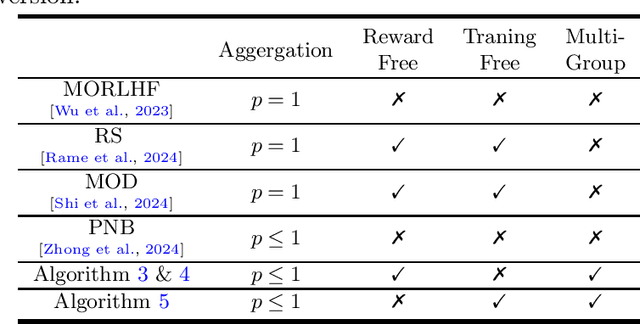
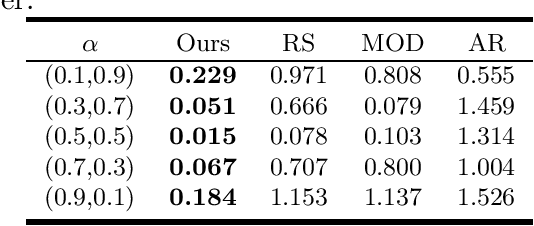
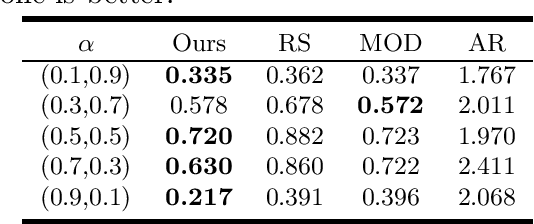

Reinforcement Learning with Human Feedback (RLHF) is a widely used fine-tuning approach that aligns machine learning model, particularly Language Model (LM) with human preferences. There are typically multiple objectives driving the preference, hence humans find it easier to express per-objective comparisons rather than a global preference between two choices. Multi-Objective RLHF (MORLHF) aims to use per-objective preference feedback and achieve Pareto optimality among these objectives by aggregating them into a single unified objective for optimization. However, nearly all prior works rely on linear aggregation, which rules out policies that favor specific objectives such as the worst one. The only existing approach using non-linear aggregation is computationally expensive due to its reward-based nature and the need for retraining whenever the aggregation parameters change. In this work, we address this limitation by transforming the non-linear aggregation maximization problem into a series of sub-problems. Each sub-problem involves only linear aggregation, making it computationally efficient to solve. We further extend our framework to handle multi-group scenarios, where each group has distinct weights for the objectives. Our method enables achieving consensus or maximizing the aggregated objective across all groups. Theoretically, we demonstrate that our algorithmic framework achieves sublinear regret and can be easily adapted to a reward-free algorithm. Empirically, leveraging our theoretical insights, we propose a nearly training-free algorithm once the optimal policies for individual objectives are obtained.