 Add to Chrome
 Add to Firefox
 Add to Edge
Towards Generalist Game Players: An Investigation of Foundation Models in the Game Multiverse
May 11, 2026
The real world unfolds along a single set of physics laws, yet human intelligence demonstrates a remarkable capacity to generalize experiences from this singular physical existence into a multiverse of games, each governed by entirely different rules, aesthetics, physics, and objectives. This omni-reality adaptability is a hallmark of general intelligence. As Artificial Intelligence progresses towards Artificial General Intelligence, the multiverse of games has evolved from mere entertainment into the ultimate ground for training and evaluating AGI. The pursuit of this generality has unfolded across four eras: from environment-specific symbolic and reinforcement learning agents, to current large foundation models acting as generalist players, and toward a future creator stage where agent both creates new game worlds and continually evolves within them. We trace the full lifecycle of a generalist game player along four interdependent pillars: Dataset, Model, Harness, and Benchmark. Every advance across these pillars can be read as an attempt to break one of five fundamental trade-offs that currently bound the whole system. Building on this end-to-end view, we chart a five-level roadmap, progressing from single-game mastery to the ultimate creator stage in which the agent simultaneously creates and evolves within theoretical game multiverse. Taken together, our work offers a unified lens onto a rapidly shifting field,and a principled path toward the omnipotent generalist agent capable of seamlessly mastering any challenge within the multiverse of games, thereby paving the way for AGI.

PACE: A Personalized Adaptive Curriculum Engine for 9-1-1 Call-taker Training
Mar 05, 20269-1-1 call-taking training requires mastery of over a thousand interdependent skills, covering diverse incident types and protocol-specific nuances. A nationwide labor shortage is already straining training capacity, but effective instruction still demands that trainers tailor objectives to each trainee's evolving competencies. This personalization burden is one that current practice cannot scale. Partnering with Metro Nashville Department of Emergency Communications (MNDEC), we propose PACE (Personalized Adaptive Curriculum Engine), a co-pilot system that augments trainer decision-making by (1) maintaining probabilistic beliefs over trainee skill states, (2) modeling individual learning and forgetting dynamics, and (3) recommending training scenarios that balance acquisition of new competencies with retention of existing ones. PACE propagates evidence over a structured skill graph to accelerate diagnostic coverage and applies contextual bandits to select scenarios that target gaps the trainee is prepared to address. Empirical results show that PACE achieves 19.50% faster time-to-competence and 10.95% higher terminal mastery compared to state-of-the-art frameworks. Co-pilot studies with practicing training officers further demonstrate a 95.45% alignment rate between PACE's and experts' pedagogical judgments on real-world cases. Under estimation, PACE cuts turnaround time to merely 34 seconds from 11.58 minutes, up to 95.08% reduction.
Patch the Distribution Mismatch: RL Rewriting Agent for Stable Off-Policy SFT
Feb 11, 2026Large language models (LLMs) have made rapid progress, yet adapting them to downstream scenarios still commonly relies on supervised fine-tuning (SFT). When downstream data exhibit a substantial distribution shift from the model's prior training distribution, SFT can induce catastrophic forgetting. To narrow this gap, data rewriting has been proposed as a data-centric approach that rewrites downstream training data prior to SFT. However, existing methods typically sample rewrites from a prompt-induced conditional distribution, so the resulting targets are not necessarily aligned with the model's natural QA-style generation distribution. Moreover, reliance on fixed templates can lead to diversity collapse. To address these issues, we cast data rewriting as a policy learning problem and learn a rewriting policy that better matches the backbone's QA-style generation distribution while preserving diversity. Since distributional alignment, diversity and task consistency are automatically evaluable but difficult to optimize end-to-end with differentiable objectives, we leverage reinforcement learning to optimize the rewrite distribution under reward feedback and propose an RL-based data-rewriting agent. The agent jointly optimizes QA-style distributional alignment and diversity under a hard task-consistency gate, thereby constructing a higher-quality rewritten dataset for downstream SFT. Extensive experiments show that our method achieves downstream gains comparable to standard SFT while reducing forgetting on non-downstream benchmarks by 12.34% on average. Our code is available at https://anonymous.4open.science/r/Patch-the-Prompt-Gap-4112 .
What Should I Cite? A RAG Benchmark for Academic Citation Prediction
Jan 21, 2026With the rapid growth of Web-based academic publications, more and more papers are being published annually, making it increasingly difficult to find relevant prior work. Citation prediction aims to automatically suggest appropriate references, helping scholars navigate the expanding scientific literature. Here we present \textbf{CiteRAG}, the first comprehensive retrieval-augmented generation (RAG)-integrated benchmark for evaluating large language models on academic citation prediction, featuring a multi-level retrieval strategy, specialized retrievers, and generators. Our benchmark makes four core contributions: (1) We establish two instances of the citation prediction task with different granularity. Task 1 focuses on coarse-grained list-specific citation prediction, while Task 2 targets fine-grained position-specific citation prediction. To enhance these two tasks, we build a dataset containing 7,267 instances for Task 1 and 8,541 instances for Task 2, enabling comprehensive evaluation of both retrieval and generation. (2) We construct a three-level large-scale corpus with 554k papers spanning many major subfields, using an incremental pipeline. (3) We propose a multi-level hybrid RAG approach for citation prediction, fine-tuning embedding models with contrastive learning to capture complex citation relationships, paired with specialized generation models. (4) We conduct extensive experiments across state-of-the-art language models, including closed-source APIs, open-source models, and our fine-tuned generators, demonstrating the effectiveness of our framework. Our open-source toolkit enables reproducible evaluation and focuses on academic literature, providing the first comprehensive evaluation framework for citation prediction and serving as a methodological template for other scientific domains. Our source code and data are released at https://github.com/LQgdwind/CiteRAG.
Learning with Preserving for Continual Multitask Learning
Nov 11, 2025Artificial intelligence systems in critical fields like autonomous driving and medical imaging analysis often continually learn new tasks using a shared stream of input data. For instance, after learning to detect traffic signs, a model may later need to learn to classify traffic lights or different types of vehicles using the same camera feed. This scenario introduces a challenging setting we term Continual Multitask Learning (CMTL), where a model sequentially learns new tasks on an underlying data distribution without forgetting previously learned abilities. Existing continual learning methods often fail in this setting because they learn fragmented, task-specific features that interfere with one another. To address this, we introduce Learning with Preserving (LwP), a novel framework that shifts the focus from preserving task outputs to maintaining the geometric structure of the shared representation space. The core of LwP is a Dynamically Weighted Distance Preservation (DWDP) loss that prevents representation drift by regularizing the pairwise distances between latent data representations. This mechanism of preserving the underlying geometric structure allows the model to retain implicit knowledge and support diverse tasks without requiring a replay buffer, making it suitable for privacy-conscious applications. Extensive evaluations on time-series and image benchmarks show that LwP not only mitigates catastrophic forgetting but also consistently outperforms state-of-the-art baselines in CMTL tasks. Notably, our method shows superior robustness to distribution shifts and is the only approach to surpass the strong single-task learning baseline, underscoring its effectiveness for real-world dynamic environments.
LogicPuzzleRL: Cultivating Robust Mathematical Reasoning in LLMs via Reinforcement Learning
Jun 05, 2025Large language models (LLMs) excel at many supervised tasks but often struggle with structured reasoning in unfamiliar settings. This discrepancy suggests that standard fine-tuning pipelines may instill narrow, domain-specific heuristics rather than fostering general-purpose thinking strategies. In this work, we propose a "play to learn" framework that fine-tunes LLMs through reinforcement learning on a suite of seven custom logic puzzles, each designed to cultivate distinct reasoning skills such as constraint propagation, spatial consistency, and symbolic deduction. Using a reinforcement learning setup with verifiable rewards, models receive binary feedback based on puzzle correctness, encouraging iterative, hypothesis-driven problem solving. We demonstrate that this training approach significantly improves out-of-distribution performance on a range of mathematical benchmarks, especially for mid-difficulty problems that require multi-step reasoning. Analyses across problem categories and difficulty levels reveal that puzzle training promotes transferable reasoning routines, strengthening algebraic manipulation, geometric inference, and combinatorial logic, while offering limited gains on rote or highly specialized tasks. These findings show that reinforcement learning over logic puzzles reshapes the internal reasoning of LLMs, enabling more robust and compositional generalization without relying on task-specific symbolic tools.
LogiDebrief: A Signal-Temporal Logic based Automated Debriefing Approach with Large Language Models Integration
May 06, 2025Emergency response services are critical to public safety, with 9-1-1 call-takers playing a key role in ensuring timely and effective emergency operations. To ensure call-taking performance consistency, quality assurance is implemented to evaluate and refine call-takers' skillsets. However, traditional human-led evaluations struggle with high call volumes, leading to low coverage and delayed assessments. We introduce LogiDebrief, an AI-driven framework that automates traditional 9-1-1 call debriefing by integrating Signal-Temporal Logic (STL) with Large Language Models (LLMs) for fully-covered rigorous performance evaluation. LogiDebrief formalizes call-taking requirements as logical specifications, enabling systematic assessment of 9-1-1 calls against procedural guidelines. It employs a three-step verification process: (1) contextual understanding to identify responder types, incident classifications, and critical conditions; (2) STL-based runtime checking with LLM integration to ensure compliance; and (3) automated aggregation of results into quality assurance reports. Beyond its technical contributions, LogiDebrief has demonstrated real-world impact. Successfully deployed at Metro Nashville Department of Emergency Communications, it has assisted in debriefing 1,701 real-world calls, saving 311.85 hours of active engagement. Empirical evaluation with real-world data confirms its accuracy, while a case study and extensive user study highlight its effectiveness in enhancing call-taking performance.
Combining LLMs with Logic-Based Framework to Explain MCTS
May 01, 2025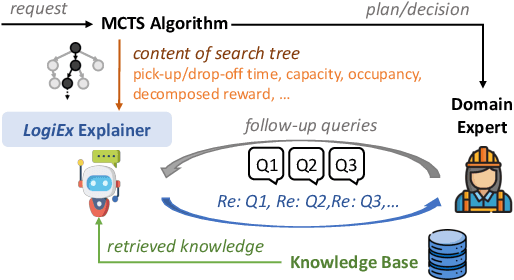
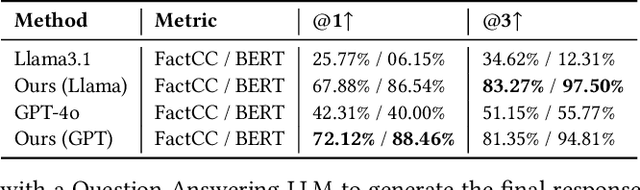
In response to the lack of trust in Artificial Intelligence (AI) for sequential planning, we design a Computational Tree Logic-guided large language model (LLM)-based natural language explanation framework designed for the Monte Carlo Tree Search (MCTS) algorithm. MCTS is often considered challenging to interpret due to the complexity of its search trees, but our framework is flexible enough to handle a wide range of free-form post-hoc queries and knowledge-based inquiries centered around MCTS and the Markov Decision Process (MDP) of the application domain. By transforming user queries into logic and variable statements, our framework ensures that the evidence obtained from the search tree remains factually consistent with the underlying environmental dynamics and any constraints in the actual stochastic control process. We evaluate the framework rigorously through quantitative assessments, where it demonstrates strong performance in terms of accuracy and factual consistency.
Sim911: Towards Effective and Equitable 9-1-1 Dispatcher Training with an LLM-Enabled Simulation
Dec 24, 2024Emergency response services are vital for enhancing public safety by safeguarding the environment, property, and human lives. As frontline members of these services, 9-1-1 dispatchers have a direct impact on response times and the overall effectiveness of emergency operations. However, traditional dispatcher training methods, which rely on role-playing by experienced personnel, are labor-intensive, time-consuming, and often neglect the specific needs of underserved communities. To address these challenges, we introduce Sim911, the first training simulation for 9-1-1 dispatchers powered by Large Language Models (LLMs). Sim911 enhances training through three key technical innovations: (1) knowledge construction, which utilizes archived 9-1-1 call data to generate simulations that closely mirror real-world scenarios; (2) context-aware controlled generation, which employs dynamic prompts and vector bases to ensure that LLM behavior aligns with training objectives; and (3) validation with looped correction, which filters out low-quality responses and refines the system performance.
EVQAScore: Efficient Video Question Answering Data Evaluation
Nov 11, 2024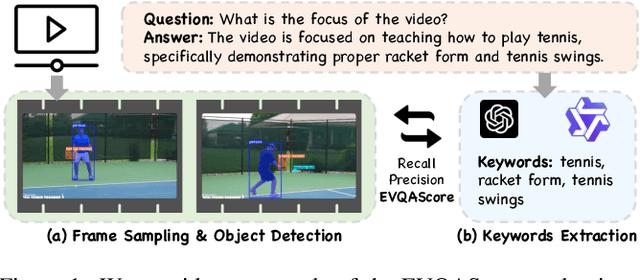
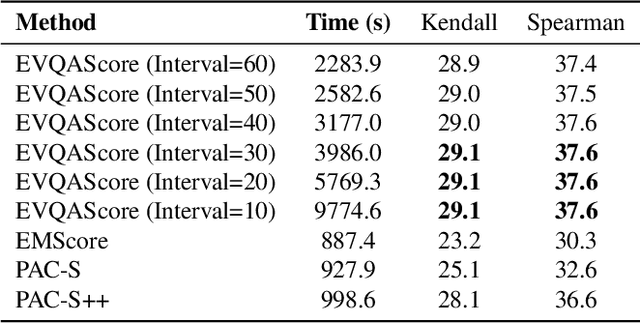
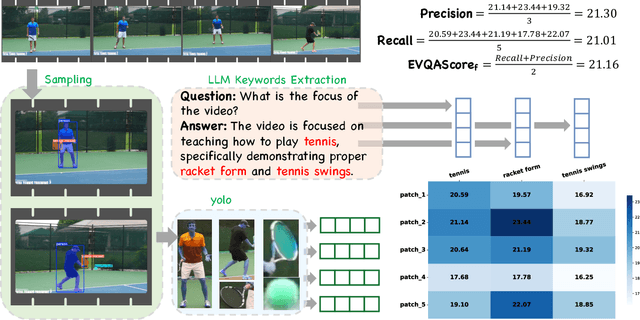
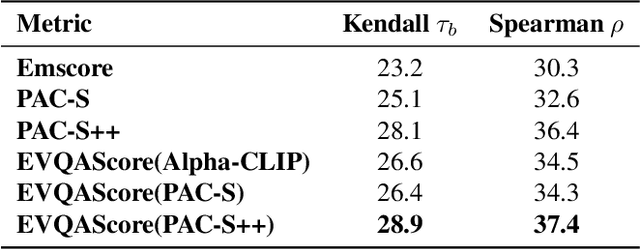
Video question-answering (QA) is a core task in video understanding. Evaluating the quality of video QA and video caption data quality for training video large language models (VideoLLMs) is an essential challenge. Although various methods have been proposed for assessing video caption quality, there remains a lack of dedicated evaluation methods for Video QA. To address this gap, we introduce EVQAScore, a reference-free method that leverages keyword extraction to assess both video caption and video QA data quality. Additionally, we incorporate frame sampling and rescaling techniques to enhance the efficiency and robustness of our evaluation, this enables our score to evaluate the quality of extremely long videos. Our approach achieves state-of-the-art (SOTA) performance (32.8 for Kendall correlation and 42.3 for Spearman correlation, 4.7 and 5.9 higher than the previous method PAC-S++) on the VATEX-EVAL benchmark for video caption evaluation. Furthermore, by using EVQAScore for data selection, we achieved SOTA results with only 12.5\% of the original data volume, outperforming the previous SOTA method PAC-S and 100\% of data.