 Add to Chrome
 Add to Firefox
 Add to Edge
CLAIM: Leading Open-domain Active Clarification of Large Language Models with Uncertainty Measurement
Aug 12, 2026
In open-domain human-computer interaction scenarios, large language models (LLMs) frequently encounter user queries that are ambiguous or incomplete. In such cases, directly producing an answer often leads to overgeneralized, erroneous, or low-information responses. In contrast, asking clarifying questions can substantially improve interaction quality. However, existing approaches still rely heavily on manually annotated data or preference alignment to address two fundamental challenges: when clarification is necessary, and which aspect of the query should be clarified. This reliance incurs high annotation costs and limits generalization. To address these challenges, we propose CLAIM, an uncertainty-driven framework for active clarification learning in open-domain settings. CLAIM eliminates the need for explicit human preference annotations by quantifying query uncertainty through the entropy induced by answer disagreements across multiple models. This uncertainty signal is then used to construct high-quality synthetic data, enabling the training of a unified clarification decision model through a combination of supervised learning and reinforcement learning. Specifically, we propose an entropy-driven synthetic data generation pipeline that integrates entropy-based uncertainty estimation with semantic clustering and reasoning-based judgments, enabling reliable automatic annotation of clarification requirements. To train CLAIM, we formulate the clarification process as a structured decision generation problem and adopt a training paradigm that combines supervised fine-tuning (SFT) with group-relative policy optimization (GRPO). Experimental results demonstrate that CLAIM can learn stable and generalizable clarification strategies without relying on manually labeled data, offering a low-cost and robust solution for proactive understanding in real-world open-domain interactions with LLMs.

Memory Layer: Train the In-Model Cache for Recommendation Models
Jul 27, 2026Early ranking stages in recommendation systems precompute item embeddings and cache them in-model for scoring within strict latency constraints. Because this cache exists only at serving time, outside the training loop, training and serving use different item representations, a structural discrepancy that limits quality and adds operational fragility. We show that co-designing the training and serving paths removes this representation discrepancy at its source. We introduce the memory layer, an in-model key-value embedding cache co-trained with the model: the item tower writes embeddings during training and the model reads them at serving, one source of truth for item representations by construction. Always-on embeddings cover items not yet cached, so every item receives a prediction, and the design consolidates three separate trainer-to-predictor update paths into a single self-contained pipeline. Deployed in production on Instagram Reels, the memory layer raises prediction coverage from 96% to 100%, improves embedding freshness from $O(5\text{ min})$ to $O(20\text{ s})$, and narrows the training-serving Normalized Entropy (NE) gap by up to 86%, yielding over $2\times$ recall for the freshest content and a 5-6% cold start engagement lift. Because embeddings are produced during training, the system needs no separate bulk-evaluation or publish-time recomputation, cutting training-and-publish computational cost by 30% at neutral serving computational cost.
SAM: State-Adaptive Memory for Long-Horizon Reasoning Agent
May 23, 2026Long-horizon agentic reasoning requires large language models to act over long interaction histories containing thoughts, tool calls, observations, and partial conclusions. The challenge is not merely that these histories grow long, but that information needed for the current decision may be scattered across distant steps and only become relevant later. Existing approaches address this difficulty by truncating the interaction history, compressing it into shorter surrogates, or retrieving selected parts of it for reuse, but they do not explicitly model how access to past interaction should adapt to the agent's evolving state. We instead cast long-horizon reasoning as a problem of state-adaptive memory. To this end, we propose State-Adaptive Memory~(SAM), a standalone framework that consolidates ongoing interaction into compact memory cues while preserving raw trajectory pages for intent-driven recall. These cues are not treated as replacements for history; rather, they serve as lightweight handles that allow the agent to reconstruct temporally distant information according to its current needs, without retraining the underlying backbone. We further optimize the memory module through expert-guided supervision and reinforcement learning, aligning it with trajectory-level utility. Across BrowseComp, BrowseComp-ZH, WideSearch, and HLE, SAM consistently outperforms strong baselines over diverse agent backbones. Our results suggest that explicit memory modeling provides a simple and effective foundation for long-horizon agentic reasoning.
PlanningBench: Generating Scalable and Verifiable Planning Data for Evaluating and Training Large Language Models
May 20, 2026Planning is a fundamental capability for large language models (LLMs) because such complex tasks require models to coordinate goals, constraints, resources, and long-term consequences into executable and verifiable solutions. Existing planning benchmarks, however, usually treat planning data as fixed collections of instances rather than controllable generation targets. This limits scenario coverage, ties difficulty to surface-level proxies rather than structural sources, and offers limited support for scalable generation, automatic verification, or planning-oriented training. We introduce PlanningBench, a framework for generating scalable, diverse, and verifiable planning data for both evaluation and training. PlanningBench starts from real planning scenarios and abstracts practical workflows into a structured taxonomy of more than 30 task types, subtasks, constraint families, and difficulty factors. Guided by this taxonomy, a constraint-driven synthesis pipeline instantiates self-contained planning problems with adaptive difficulty control, quality filtering, and instance-level verification checklists. This shifts planning data construction from fixed benchmark collection to controllable generation while preserving realistic task grounding. We use PlanningBench to evaluate open-source and closed-source frontier LLMs, and find that current models still struggle to produce complete solutions under coupled constraints. Beyond evaluation, reinforcement learning on verified PlanningBench data improves performance on unseen planning benchmarks and broader instruction-following tasks. Further analysis suggests that determinate or well-specified optimal solutions provide clearer reward signals and more stable training dynamics. Overall, PlanningBench provides a controllable source of planning data for diagnosing and improving generalizable planning abilities in LLMs.
Multi-Probe Zero Collision Hash (MPZCH): Mitigating Embedding Collisions and Enhancing Model Freshness in Large-Scale Recommenders
Feb 19, 2026Embedding tables are critical components of large-scale recommendation systems, facilitating the efficient mapping of high-cardinality categorical features into dense vector representations. However, as the volume of unique IDs expands, traditional hash-based indexing methods suffer from collisions that degrade model performance and personalization quality. We present Multi-Probe Zero Collision Hash (MPZCH), a novel indexing mechanism based on linear probing that effectively mitigates embedding collisions. With reasonable table sizing, it often eliminates these collisions entirely while maintaining production-scale efficiency. MPZCH utilizes auxiliary tensors and high-performance CUDA kernels to implement configurable probing and active eviction policies. By retiring obsolete IDs and resetting reassigned slots, MPZCH prevents the stale embedding inheritance typical of hash-based methods, ensuring new features learn effectively from scratch. Despite its collision-mitigation overhead, the system maintains training QPS and inference latency comparable to existing methods. Rigorous online experiments demonstrate that MPZCH achieves zero collisions for user embeddings and significantly improves item embedding freshness and quality. The solution has been released within the open-source TorchRec library for the broader community.
ProRAG: Process-Supervised Reinforcement Learning for Retrieval-Augmented Generation
Jan 29, 2026Reinforcement learning (RL) has become a promising paradigm for optimizing Retrieval-Augmented Generation (RAG) in complex reasoning tasks. However, traditional outcome-based RL approaches often suffer from reward sparsity and inefficient credit assignment, as coarse-grained scalar rewards fail to identify specific erroneous steps within long-horizon trajectories. This ambiguity frequently leads to "process hallucinations", where models reach correct answers through flawed logic or redundant retrieval steps. Although recent process-aware approaches attempt to mitigate this via static preference learning or heuristic reward shaping, they often lack the on-policy exploration capabilities required to decouple step-level credit from global outcomes. To address these challenges, we propose ProRAG, a process-supervised reinforcement learning framework designed to integrate learned step-level supervision into the online optimization loop. Our framework consists of four stages: (1) Supervised Policy Warmup to initialize the model with a structured reasoning format; (2) construction of an MCTS-based Process Reward Model (PRM) to quantify intermediate reasoning quality; (3) PRM-Guided Reasoning Refinement to align the policy with fine-grained process preferences; and (4) Process-Supervised Reinforcement Learning with a dual-granularity advantage mechanism. By aggregating step-level process rewards with global outcome signals, ProRAG provides precise feedback for every action. Extensive experiments on five multi-hop reasoning benchmarks demonstrate that ProRAG achieves superior overall performance compared to strong outcome-based and process-aware RL baselines, particularly on complex long-horizon tasks, validating the effectiveness of fine-grained process supervision. The code and model are available at https://github.com/lilinwz/ProRAG.
mmE5: Improving Multimodal Multilingual Embeddings via High-quality Synthetic Data
Feb 12, 2025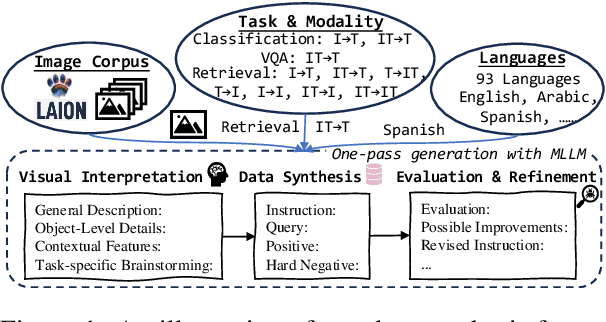
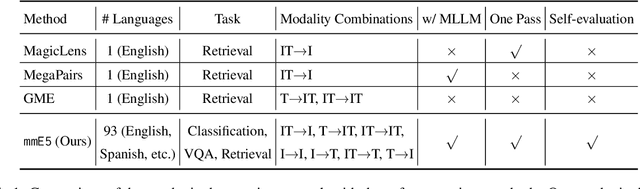
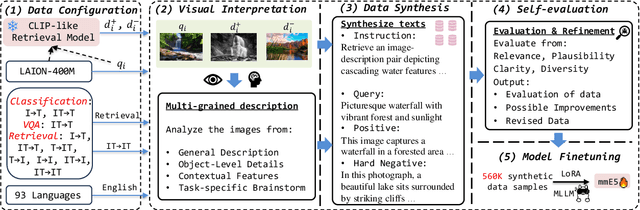
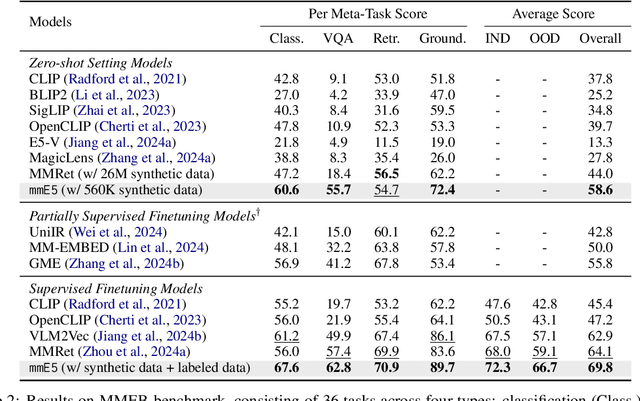
Multimodal embedding models have gained significant attention for their ability to map data from different modalities, such as text and images, into a unified representation space. However, the limited labeled multimodal data often hinders embedding performance. Recent approaches have leveraged data synthesis to address this problem, yet the quality of synthetic data remains a critical bottleneck. In this work, we identify three criteria for high-quality synthetic multimodal data. First, broad scope ensures that the generated data covers diverse tasks and modalities, making it applicable to various downstream scenarios. Second, robust cross-modal alignment makes different modalities semantically consistent. Third, high fidelity ensures that the synthetic data maintains realistic details to enhance its reliability. Guided by these principles, we synthesize datasets that: (1) cover a wide range of tasks, modality combinations, and languages, (2) are generated via a deep thinking process within a single pass of a multimodal large language model, and (3) incorporate real-world images with accurate and relevant texts, ensuring fidelity through self-evaluation and refinement. Leveraging these high-quality synthetic and labeled datasets, we train a multimodal multilingual E5 model mmE5. Extensive experiments demonstrate that mmE5 achieves state-of-the-art performance on the MMEB Benchmark and superior multilingual performance on the XTD benchmark. Our codes, datasets and models are released in https://github.com/haon-chen/mmE5.
Sliding Windows Are Not the End: Exploring Full Ranking with Long-Context Large Language Models
Dec 19, 2024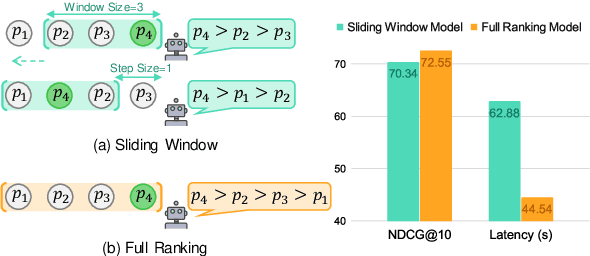
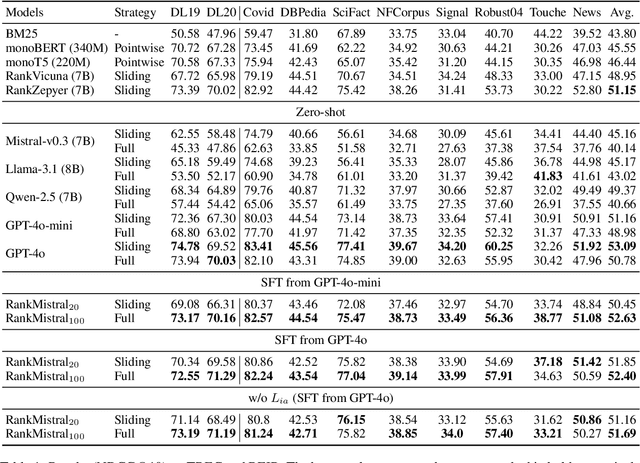
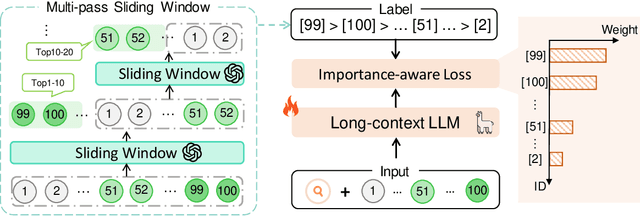
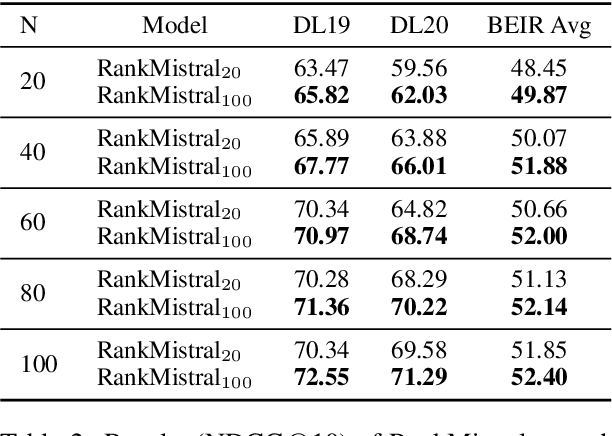
Large Language Models (LLMs) have shown exciting performance in listwise passage ranking. Due to the limited input length, existing methods often adopt the sliding window strategy. Such a strategy, though effective, is inefficient as it involves repetitive and serialized processing, which usually re-evaluates relevant passages multiple times. As a result, it incurs redundant API costs, which are proportional to the number of inference tokens. The development of long-context LLMs enables the full ranking of all passages within a single inference, avoiding redundant API costs. In this paper, we conduct a comprehensive study of long-context LLMs for ranking tasks in terms of efficiency and effectiveness. Surprisingly, our experiments reveal that full ranking with long-context LLMs can deliver superior performance in the supervised fine-tuning setting with a huge efficiency improvement. Furthermore, we identify two limitations of fine-tuning the full ranking model based on existing methods: (1) sliding window strategy fails to produce a full ranking list as a training label, and (2) the language modeling loss cannot emphasize top-ranked passage IDs in the label. To alleviate these issues, we propose a new complete listwise label construction approach and a novel importance-aware learning objective for full ranking. Experiments show the superior performance of our method over baselines. Our codes are available at \url{https://github.com/8421BCD/fullrank}.
CORAL: Benchmarking Multi-turn Conversational Retrieval-Augmentation Generation
Oct 30, 2024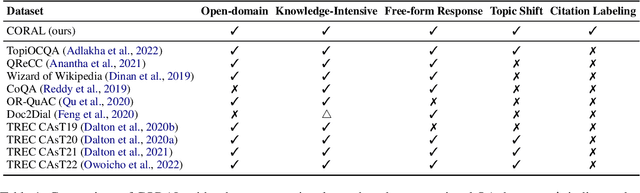
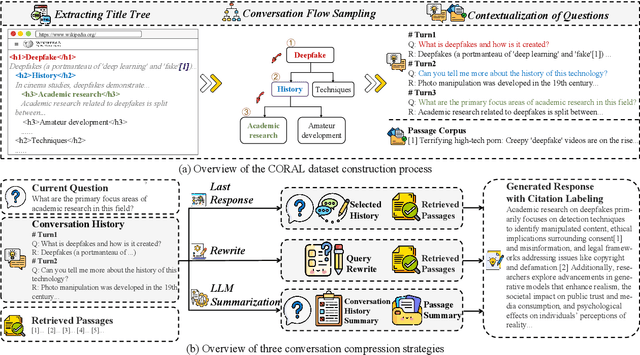
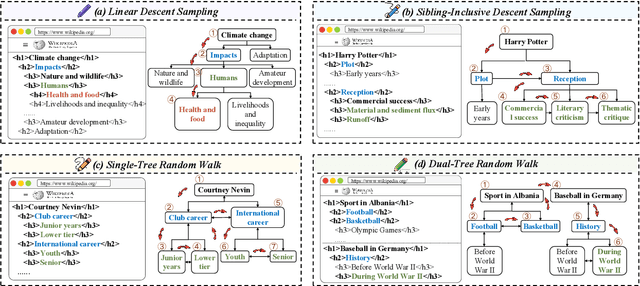
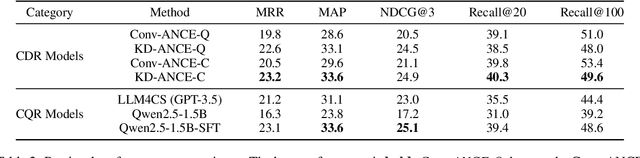
Retrieval-Augmented Generation (RAG) has become a powerful paradigm for enhancing large language models (LLMs) through external knowledge retrieval. Despite its widespread attention, existing academic research predominantly focuses on single-turn RAG, leaving a significant gap in addressing the complexities of multi-turn conversations found in real-world applications. To bridge this gap, we introduce CORAL, a large-scale benchmark designed to assess RAG systems in realistic multi-turn conversational settings. CORAL includes diverse information-seeking conversations automatically derived from Wikipedia and tackles key challenges such as open-domain coverage, knowledge intensity, free-form responses, and topic shifts. It supports three core tasks of conversational RAG: passage retrieval, response generation, and citation labeling. We propose a unified framework to standardize various conversational RAG methods and conduct a comprehensive evaluation of these methods on CORAL, demonstrating substantial opportunities for improving existing approaches.
Little Giants: Synthesizing High-Quality Embedding Data at Scale
Oct 24, 2024Synthetic data generation has become an increasingly popular way of training models without the need for large, manually labeled datasets. For tasks like text embedding, synthetic data offers diverse and scalable training examples, significantly reducing the cost of human annotation. However, most current approaches rely heavily on proprietary models like GPT-4, which are expensive and inefficient for generating large-scale embedding data. In this paper, we introduce SPEED, a framework that aligns open-source small models (8B) to efficiently generate large-scale synthetic embedding data. Through supervised fine-tuning, preference optimization, and self-improvement, SPEED enables small open-source models to produce high-quality data. Remarkably, SPEED uses only less than 1/10 of the GPT API calls, outperforming the state-of-the-art embedding model E5_mistral when both are trained solely on their synthetic data. Using this efficient generator, we conduct a comprehensive study on how various factors within the alignment pipeline impact data quality and reveal the scaling law for synthetic embedding data.