 Add to Chrome
 Add to Firefox
 Add to Edge
From Prompt Injection to Persistent Control: Defending Agentic Harness Against Trojan Backdoors
May 29, 2026
LLM agents are evolving from conversational chatbots to operational tools in real-world workspaces. In local agentic harnesses, an LLM can read and write files, call tools, and reuse workspace state across sessions. While such capabilities enhance utility, they also expose a new attack surface for attackers. Attackers can embed a prompt injection within a file or tool output. Agents may read this hidden instruction, store it, and execute it later. In this multi-step trojan attack paradigm, no individual step appears malicious on its own, but these steps can collectively turn untrusted text into persistent control content. However, existing defenses often inspect each step in isolation. As a result, they can block a clear harmful action, but fail to detect the earlier write operation that plants the backdoor. To reveal this threat, we introduce ClawTrojan, a benchmark designed to identify multi-step trojan attacks in local agentic harnesses. In an OpenClaw-style simulated workspace with GPT-5.4, ClawTrojan reaches a 95.5% attack success rate (ASR), while existing single-turn prompt-injection attacks produce near-zero ASR on the same model. To address this threat, we propose DASGuard, which scans control-like text in sensitive local files, traces its origin, and removes control content that does not originate from a trusted source. Our results show that DASGuard achieves strong dynamic defense by combining runtime attack blocking with sanitized commits to the workspace.

MemSifter: Offloading LLM Memory Retrieval via Outcome-Driven Proxy Reasoning
Mar 03, 2026As Large Language Models (LLMs) are increasingly used for long-duration tasks, maintaining effective long-term memory has become a critical challenge. Current methods often face a trade-off between cost and accuracy. Simple storage methods often fail to retrieve relevant information, while complex indexing methods (such as memory graphs) require heavy computation and can cause information loss. Furthermore, relying on the working LLM to process all memories is computationally expensive and slow. To address these limitations, we propose MemSifter, a novel framework that offloads the memory retrieval process to a small-scale proxy model. Instead of increasing the burden on the primary working LLM, MemSifter uses a smaller model to reason about the task before retrieving the necessary information. This approach requires no heavy computation during the indexing phase and adds minimal overhead during inference. To optimize the proxy model, we introduce a memory-specific Reinforcement Learning (RL) training paradigm. We design a task-outcome-oriented reward based on the working LLM's actual performance in completing the task. The reward measures the actual contribution of retrieved memories by mutiple interactions with the working LLM, and discriminates retrieved rankings by stepped decreasing contributions. Additionally, we employ training techniques such as Curriculum Learning and Model Merging to improve performance. We evaluated MemSifter on eight LLM memory benchmarks, including Deep Research tasks. The results demonstrate that our method meets or exceeds the performance of existing state-of-the-art approaches in both retrieval accuracy and final task completion. MemSifter offers an efficient and scalable solution for long-term LLM memory. We have open-sourced the model weights, code, and training data to support further research.
CORAL: Benchmarking Multi-turn Conversational Retrieval-Augmentation Generation
Oct 30, 2024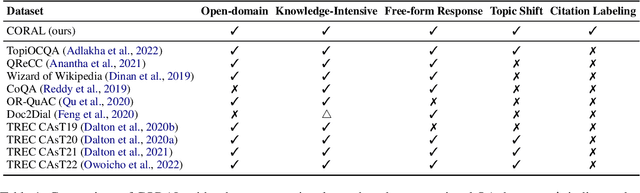
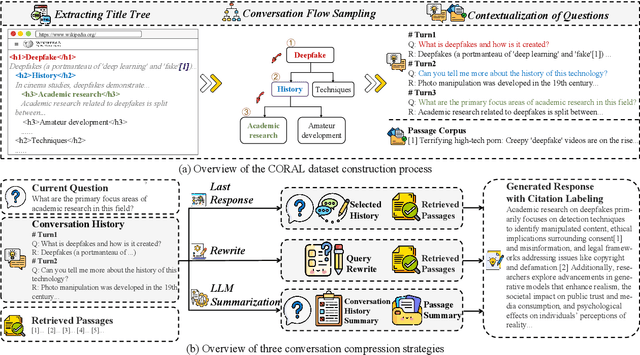
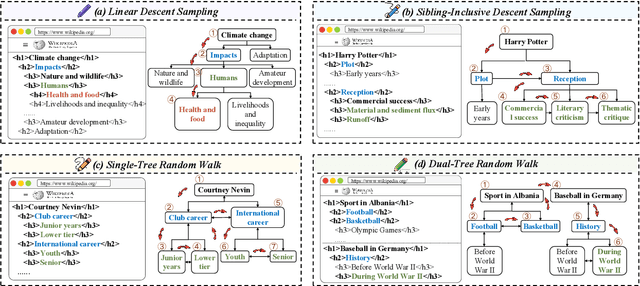
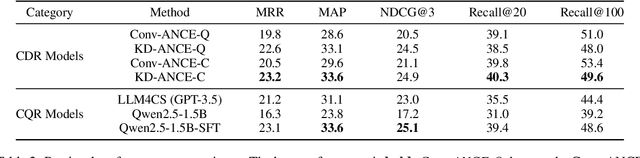
Retrieval-Augmented Generation (RAG) has become a powerful paradigm for enhancing large language models (LLMs) through external knowledge retrieval. Despite its widespread attention, existing academic research predominantly focuses on single-turn RAG, leaving a significant gap in addressing the complexities of multi-turn conversations found in real-world applications. To bridge this gap, we introduce CORAL, a large-scale benchmark designed to assess RAG systems in realistic multi-turn conversational settings. CORAL includes diverse information-seeking conversations automatically derived from Wikipedia and tackles key challenges such as open-domain coverage, knowledge intensity, free-form responses, and topic shifts. It supports three core tasks of conversational RAG: passage retrieval, response generation, and citation labeling. We propose a unified framework to standardize various conversational RAG methods and conduct a comprehensive evaluation of these methods on CORAL, demonstrating substantial opportunities for improving existing approaches.
A Survey of Conversational Search
Oct 21, 2024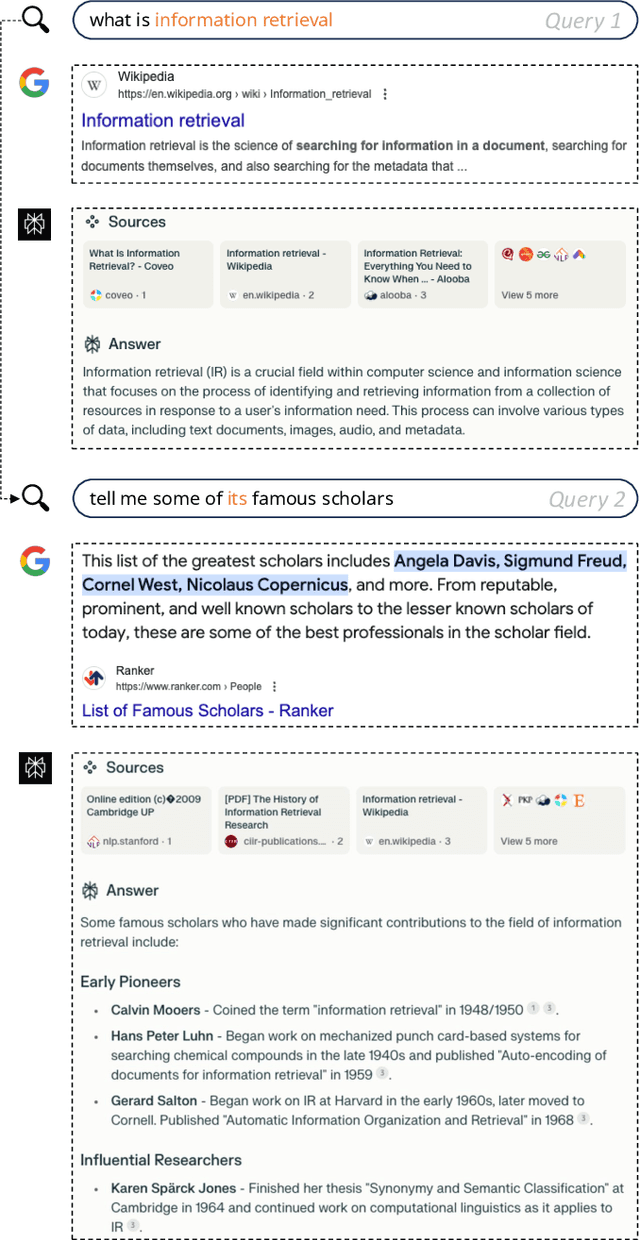
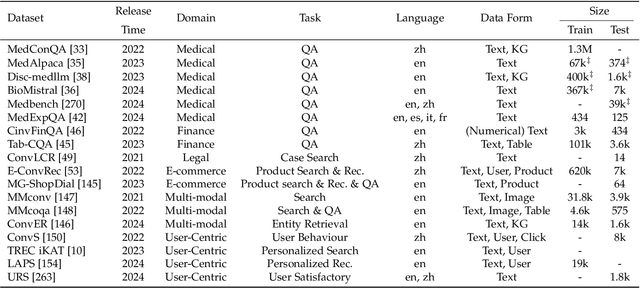
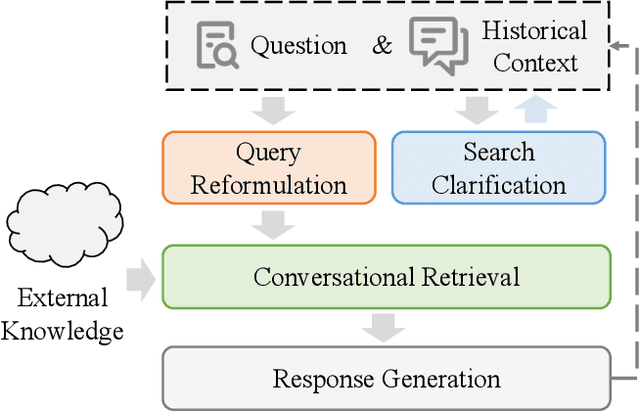
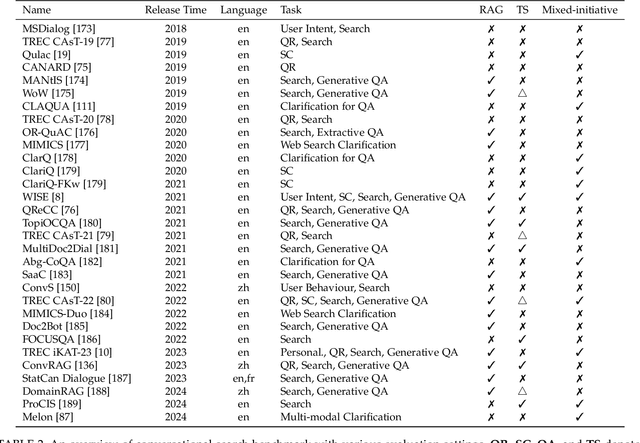
As a cornerstone of modern information access, search engines have become indispensable in everyday life. With the rapid advancements in AI and natural language processing (NLP) technologies, particularly large language models (LLMs), search engines have evolved to support more intuitive and intelligent interactions between users and systems. Conversational search, an emerging paradigm for next-generation search engines, leverages natural language dialogue to facilitate complex and precise information retrieval, thus attracting significant attention. Unlike traditional keyword-based search engines, conversational search systems enhance user experience by supporting intricate queries, maintaining context over multi-turn interactions, and providing robust information integration and processing capabilities. Key components such as query reformulation, search clarification, conversational retrieval, and response generation work in unison to enable these sophisticated interactions. In this survey, we explore the recent advancements and potential future directions in conversational search, examining the critical modules that constitute a conversational search system. We highlight the integration of LLMs in enhancing these systems and discuss the challenges and opportunities that lie ahead in this dynamic field. Additionally, we provide insights into real-world applications and robust evaluations of current conversational search systems, aiming to guide future research and development in conversational search.
Interpreting Conversational Dense Retrieval by Rewriting-Enhanced Inversion of Session Embedding
Feb 20, 2024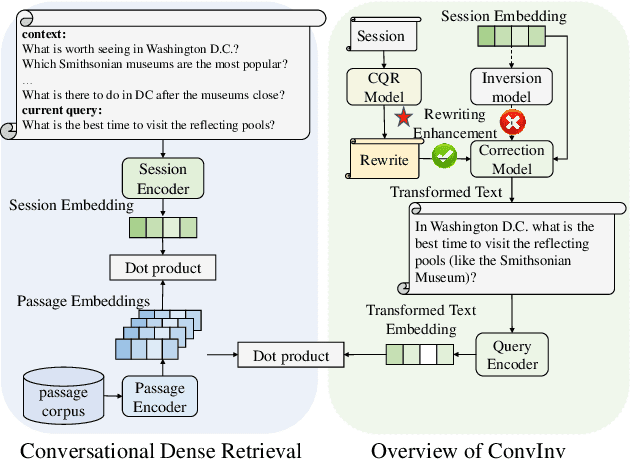
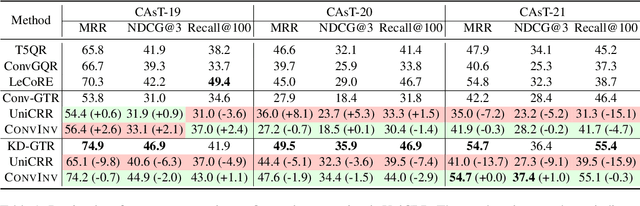

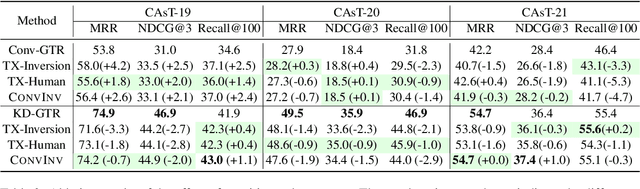
Conversational dense retrieval has shown to be effective in conversational search. However, a major limitation of conversational dense retrieval is their lack of interpretability, hindering intuitive understanding of model behaviors for targeted improvements. This paper presents CONVINV, a simple yet effective approach to shed light on interpretable conversational dense retrieval models. CONVINV transforms opaque conversational session embeddings into explicitly interpretable text while faithfully maintaining their original retrieval performance as much as possible. Such transformation is achieved by training a recently proposed Vec2Text model based on the ad-hoc query encoder, leveraging the fact that the session and query embeddings share the same space in existing conversational dense retrieval. To further enhance interpretability, we propose to incorporate external interpretable query rewrites into the transformation process. Extensive evaluations on three conversational search benchmarks demonstrate that CONVINV can yield more interpretable text and faithfully preserve original retrieval performance than baselines. Our work connects opaque session embeddings with transparent query rewriting, paving the way toward trustworthy conversational search.