 Add to Chrome
 Add to Firefox
 Add to Edge
MAP-Graph: Provenance-Aware Shared Memory for Multi-Agent Workflows
Aug 11, 2026
Shared memory helps language-model agents reuse information across long workflows, yet relevant evidence may not be admissible for a particular agent or action. Because restrictions propagate through derivations, summaries can conceal private, poisoned, untrusted, or revoked sources, enabling unauthorized reads or unsafe actions. Existing approaches provide semantic retrieval, scoped access, or lineage tracking, but do not clearly separate hard authorization from graded trust or adapt evidence requirements to action risk. We introduce MAP-Graph, a provenance-aware memory layer that represents agents, sources, memories, claims, and actions in a typed execution graph. It traces ancestry, excludes permission-ineligible records, reranks eligible memories by semantic similarity and multiplicative path trust, and applies a risk-sensitive gate before action execution while retaining affected lineage for audit. On a controlled benchmark of 2,700 synthetic tasks per method across three domains, MAP-Graph achieves 94.96\% overall task success, 72.70\% exact decision accuracy, and 90.22\% in the clean setting, where success requires a correct \textsc{Allow} rather than a safe intervention. Ablations isolate the roles of permission filtering, path trust, and action gating, while transfer tests with two additional backbones preserve the exact-decision and access-control advantages. These results support provenance as an operational control signal, rather than only post-hoc audit metadata, within the evaluated setting.

CRISP: Critical Step Perception for Training Efficient Deep Search Agents
Aug 03, 2026Large language models (LLMs) are increasingly extended into deep search agents that solve complex questions through multi-step interaction with external search and browsing tools. However, existing agents often incur substantial computational and interaction costs, generating lengthy trajectories that contain redundant queries, inefficient exploration, and irrelevant observations. Existing efficiency-oriented methods usually encourage agents to use tools less frequently, but treating all tool interactions uniformly may also suppress steps that gather necessary evidence. In this paper, we propose CRISP, a framework for training efficient deep search agents through critical step perception. Unlike prior efficiency methods that uniformly penalize tool use, CRISP distinguishes interactions that gather necessary evidence from redundant ones and shapes the training reward to preserve the former while pruning the latter, improving efficiency without sacrificing the evidence needed for correct answers. Specifically, CRISP first constructs critical-step labels with Backward Evidence Induction: starting from the final answer, a strong model traverses a completed search trajectory backward and judges whether each tool-interaction step provides or preserves evidence for the final answer. We then distill these step-wise judgments into a smaller critical-step recognizer, enabling full-trajectory analysis in a single pass. During policy optimization, an efficiency-aware reward is applied only to successful rollouts. Experiments on BrowseComp and HLE-Verified show that CRISP maintains competitive final-answer accuracy while reducing average interaction turns by 15.1% and 33.2%, respectively, demonstrating substantial improvements in interaction efficiency.
GRE-Diff: Gaussian Room Embeddings for Structured Layout Diffusion
Jul 09, 2026Designing functional and aesthetically coherent floor plans requires exploring a vast space of possible room arrangements, a task that quickly becomes overwhelming for human designers. In this paper, we propose GRE-Diff, a controllable and interactive diffusion-based framework that automates the creation and editing of apartment floor plans under user-specified constraints. By combining AI-generated suggestions with real-time, human-in-the-loop editing, the system enables users to specify room types, room counts, boundary shapes, and editing operations through LLM-parsed instructions or GUI-based interaction. It then generates a diverse set of plausible and well-structured designs for refinement. At the core of our approach is Gaussian Room Embedding (GRE), a continuous latent representation that models each room as a spatial Gaussian distribution capturing its location and extent. Extensive experiments on the RPLAN dataset show that GRE-Diff produces high-quality, constraint-aware, and editable polygonal layouts, offering a practical step toward bridging AI-driven automation and human creativity in spatial design.
CoVStream: Edge-Cloud Collaboration for Understanding of Long Video Streams
Jun 25, 2026Long, continuous video streams are an increasingly critical driver of multimedia intelligence. Existing efforts often handle long videos with a sample-encode-reason approach using large models. However, they overlook a crucial deployment fact: the stream is often produced by computationally constrained devices. This forces an untenable compromise: cloud offloading unlocks strong reasoning but incurs prohibitive bandwidth overhead, while on-device processing remains limited by edge hardware capacity. Therefore, we propose CoVStream, the first edge-cloud collaborative framework for understanding long video streams. The edge node distills raw video streams into compact visual features and semantic captions for transmission to the cloud, minimizing bandwidth costs, while the cloud server integrates this data into an entity graph and global visual context, activating the heavy reasoning model only when a user query arrives. Experiments on VideoMME-Long, LVBench, and RTV-Bench show that CoVStream reduces bandwidth usage by 87.6% while retaining 99.2% of the cloud baseline accuracy on LVBench.
Learning Generalizable Language-Conditioned Cloth Manipulation from Long Demonstrations
Mar 06, 2025Multi-step cloth manipulation is a challenging problem for robots due to the high-dimensional state spaces and the dynamics of cloth. Despite recent significant advances in end-to-end imitation learning for multi-step cloth manipulation skills, these methods fail to generalize to unseen tasks. Our insight in tackling the challenge of generalizable multi-step cloth manipulation is decomposition. We propose a novel pipeline that autonomously learns basic skills from long demonstrations and composes learned basic skills to generalize to unseen tasks. Specifically, our method first discovers and learns basic skills from the existing long demonstration benchmark with the commonsense knowledge of a large language model (LLM). Then, leveraging a high-level LLM-based task planner, these basic skills can be composed to complete unseen tasks. Experimental results demonstrate that our method outperforms baseline methods in learning multi-step cloth manipulation skills for both seen and unseen tasks.
Interaction-Driven Active 3D Reconstruction with Object Interiors
Oct 23, 2023We introduce an active 3D reconstruction method which integrates visual perception, robot-object interaction, and 3D scanning to recover both the exterior and interior, i.e., unexposed, geometries of a target 3D object. Unlike other works in active vision which focus on optimizing camera viewpoints to better investigate the environment, the primary feature of our reconstruction is an analysis of the interactability of various parts of the target object and the ensuing part manipulation by a robot to enable scanning of occluded regions. As a result, an understanding of part articulations of the target object is obtained on top of complete geometry acquisition. Our method operates fully automatically by a Fetch robot with built-in RGBD sensors. It iterates between interaction analysis and interaction-driven reconstruction, scanning and reconstructing detected moveable parts one at a time, where both the articulated part detection and mesh reconstruction are carried out by neural networks. In the final step, all the remaining, non-articulated parts, including all the interior structures that had been exposed by prior part manipulations and subsequently scanned, are reconstructed to complete the acquisition. We demonstrate the performance of our method via qualitative and quantitative evaluation, ablation studies, comparisons to alternatives, as well as experiments in a real environment.
Consistent Two-Flow Network for Tele-Registration of Point Clouds
Jun 01, 2021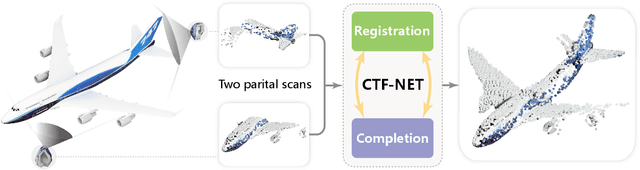

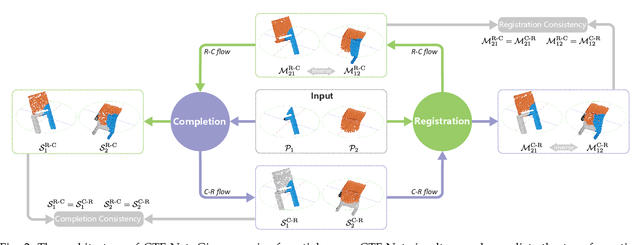

Rigid registration of partial observations is a fundamental problem in various applied fields. In computer graphics, special attention has been given to the registration between two partial point clouds generated by scanning devices. State-of-the-art registration techniques still struggle when the overlap region between the two point clouds is small, and completely fail if there is no overlap between the scan pairs. In this paper, we present a learning-based technique that alleviates this problem, and allows registration between point clouds, presented in arbitrary poses, and having little or even no overlap, a setting that has been referred to as tele-registration. Our technique is based on a novel neural network design that learns a prior of a class of shapes and can complete a partial shape. The key idea is combining the registration and completion tasks in a way that reinforces each other. In particular, we simultaneously train the registration network and completion network using two coupled flows, one that register-and-complete, and one that complete-and-register, and encourage the two flows to produce a consistent result. We show that, compared with each separate flow, this two-flow training leads to robust and reliable tele-registration, and hence to a better point cloud prediction that completes the registered scans. It is also worth mentioning that each of the components in our neural network outperforms state-of-the-art methods in both completion and registration. We further analyze our network with several ablation studies and demonstrate its performance on a large number of partial point clouds, both synthetic and real-world, that have only small or no overlap.
Predictive and Generative Neural Networks for Object Functionality
Jun 28, 2020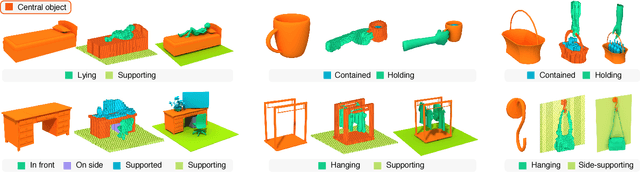

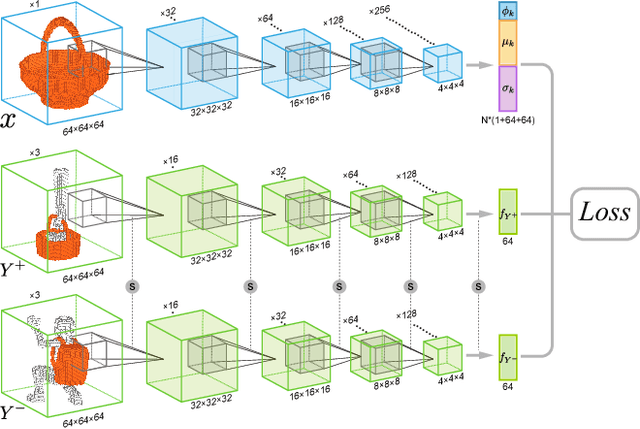
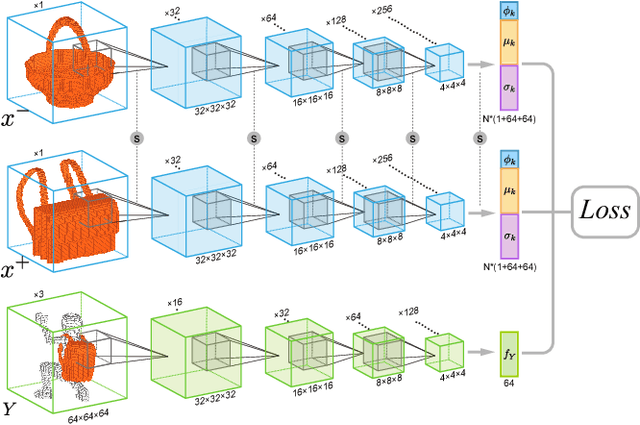
Humans can predict the functionality of an object even without any surroundings, since their knowledge and experience would allow them to "hallucinate" the interaction or usage scenarios involving the object. We develop predictive and generative deep convolutional neural networks to replicate this feat. Specifically, our work focuses on functionalities of man-made 3D objects characterized by human-object or object-object interactions. Our networks are trained on a database of scene contexts, called interaction contexts, each consisting of a central object and one or more surrounding objects, that represent object functionalities. Given a 3D object in isolation, our functional similarity network (fSIM-NET), a variation of the triplet network, is trained to predict the functionality of the object by inferring functionality-revealing interaction contexts. fSIM-NET is complemented by a generative network (iGEN-NET) and a segmentation network (iSEG-NET). iGEN-NET takes a single voxelized 3D object with a functionality label and synthesizes a voxelized surround, i.e., the interaction context which visually demonstrates the corresponding functionality. iSEG-NET further separates the interacting objects into different groups according to their interaction types.
* Accepted to SIGGRAPH 2018, project page at https://vcc.tech/research/2018/ICON4
RPM-Net: Recurrent Prediction of Motion and Parts from Point Cloud
Jun 26, 2020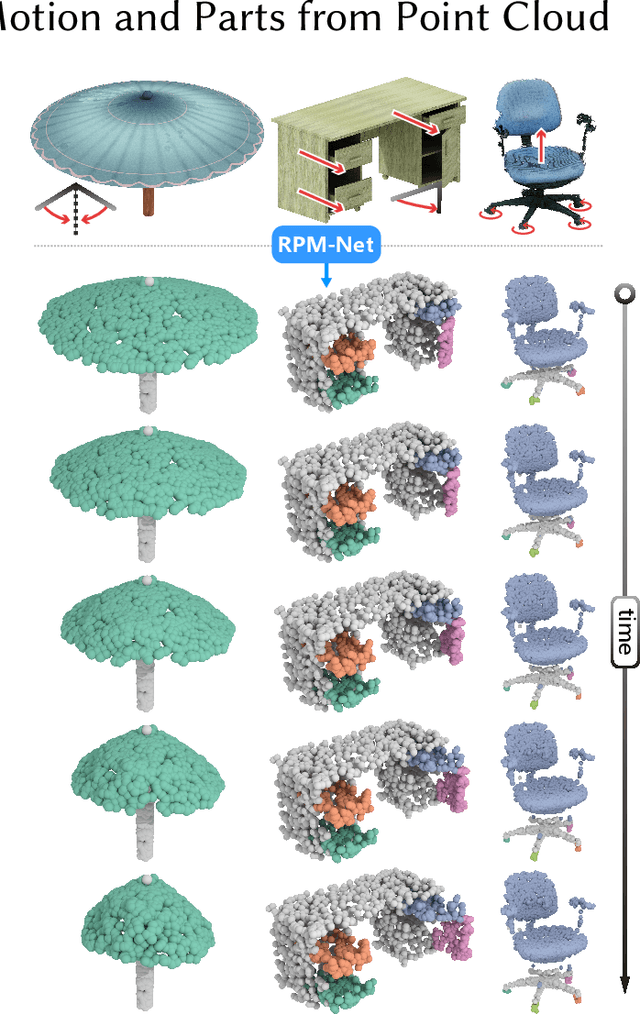
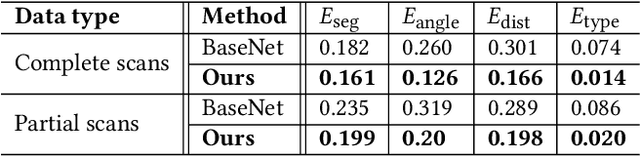
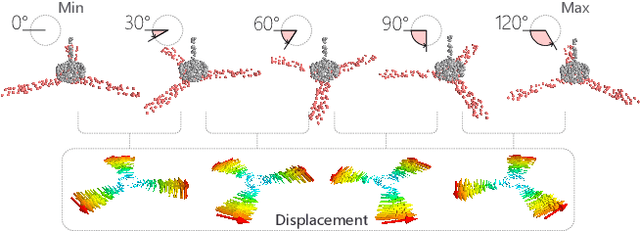
We introduce RPM-Net, a deep learning-based approach which simultaneously infers movable parts and hallucinates their motions from a single, un-segmented, and possibly partial, 3D point cloud shape. RPM-Net is a novel Recurrent Neural Network (RNN), composed of an encoder-decoder pair with interleaved Long Short-Term Memory (LSTM) components, which together predict a temporal sequence of pointwise displacements for the input point cloud. At the same time, the displacements allow the network to learn movable parts, resulting in a motion-based shape segmentation. Recursive applications of RPM-Net on the obtained parts can predict finer-level part motions, resulting in a hierarchical object segmentation. Furthermore, we develop a separate network to estimate part mobilities, e.g., per-part motion parameters, from the segmented motion sequence. Both networks learn deep predictive models from a training set that exemplifies a variety of mobilities for diverse objects. We show results of simultaneous motion and part predictions from synthetic and real scans of 3D objects exhibiting a variety of part mobilities, possibly involving multiple movable parts.
* Accepted to SIGGRAPH Asia 2019, project page at https://vcc.tech/research/2019/RPMNet