 Add to Chrome
 Add to Firefox
 Add to Edge
QuanTA: Efficient High-Rank Fine-Tuning of LLMs with Quantum-Informed Tensor Adaptation
May 31, 2024
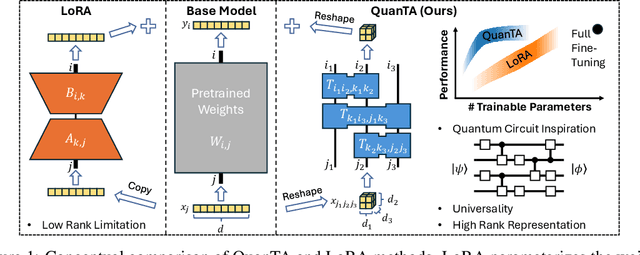
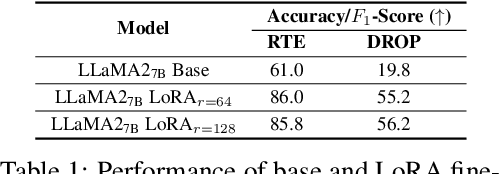
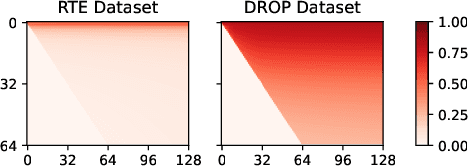
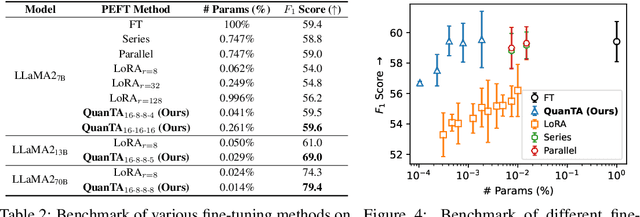
We propose Quantum-informed Tensor Adaptation (QuanTA), a novel, easy-to-implement, fine-tuning method with no inference overhead for large-scale pre-trained language models. By leveraging quantum-inspired methods derived from quantum circuit structures, QuanTA enables efficient high-rank fine-tuning, surpassing the limitations of Low-Rank Adaptation (LoRA)--low-rank approximation may fail for complicated downstream tasks. Our approach is theoretically supported by the universality theorem and the rank representation theorem to achieve efficient high-rank adaptations. Experiments demonstrate that QuanTA significantly enhances commonsense reasoning, arithmetic reasoning, and scalability compared to traditional methods. Furthermore, QuanTA shows superior performance with fewer trainable parameters compared to other approaches and can be designed to integrate with existing fine-tuning algorithms for further improvement, providing a scalable and efficient solution for fine-tuning large language models and advancing state-of-the-art in natural language processing.

Mixture of Modality Knowledge Experts for Robust Multi-modal Knowledge Graph Completion
May 27, 2024Multi-modal knowledge graph completion (MMKGC) aims to automatically discover new knowledge triples in the given multi-modal knowledge graphs (MMKGs), which is achieved by collaborative modeling the structural information concealed in massive triples and the multi-modal features of the entities. Existing methods tend to focus on crafting elegant entity-wise multi-modal fusion strategies, yet they overlook the utilization of multi-perspective features concealed within the modalities under diverse relational contexts. To address this issue, we introduce a novel MMKGC framework with Mixture of Modality Knowledge experts (MoMoK for short) to learn adaptive multi-modal embedding under intricate relational contexts. We design relation-guided modality knowledge experts to acquire relation-aware modality embeddings and integrate the predictions from multi-modalities to achieve comprehensive decisions. Additionally, we disentangle the experts by minimizing their mutual information. Experiments on four public MMKG benchmarks demonstrate the outstanding performance of MoMoK under complex scenarios.
Multi-domain Knowledge Graph Collaborative Pre-training and Prompt Tuning for Diverse Downstream Tasks
May 21, 2024
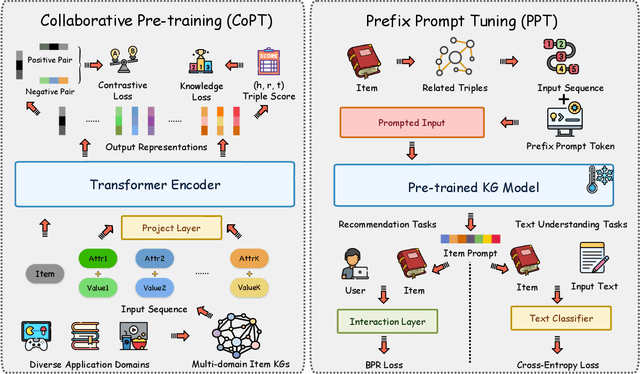

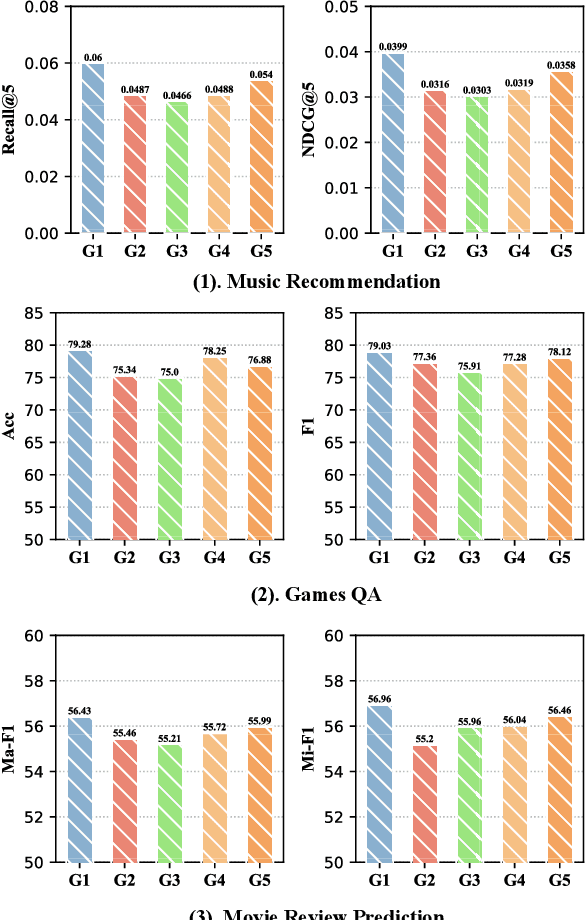
Knowledge graphs (KGs) provide reliable external knowledge for a wide variety of AI tasks in the form of structured triples. Knowledge graph pre-training (KGP) aims to pre-train neural networks on large-scale KGs and provide unified interfaces to enhance different downstream tasks, which is a key direction for KG management, maintenance, and applications. Existing works often focus on purely research questions in open domains, or they are not open source due to data security and privacy in real scenarios. Meanwhile, existing studies have not explored the training efficiency and transferability of KGP models in depth. To address these problems, We propose a framework MuDoK to achieve multi-domain collaborative pre-training and efficient prefix prompt tuning to serve diverse downstream tasks like recommendation and text understanding. Our design is a plug-and-play prompt learning approach that can be flexibly adapted to different downstream task backbones. In response to the lack of open-source benchmarks, we constructed a new multi-domain KGP benchmark called KPI with two large-scale KGs and six different sub-domain tasks to evaluate our method and open-sourced it for subsequent research. We evaluated our approach based on constructed KPI benchmarks using diverse backbone models in heterogeneous downstream tasks. The experimental results show that our framework brings significant performance gains, along with its generality, efficiency, and transferability.
T-CLAP: Temporal-Enhanced Contrastive Language-Audio Pretraining
Apr 27, 2024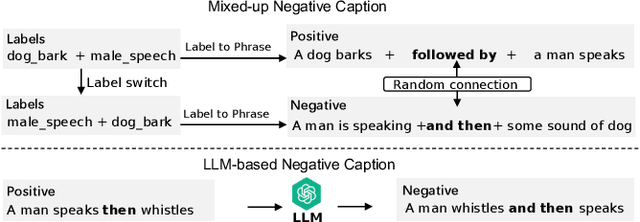
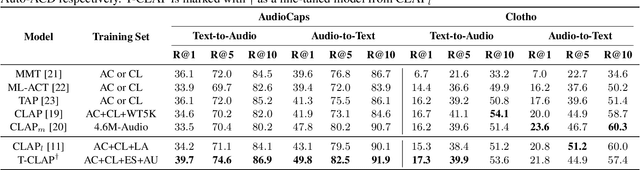
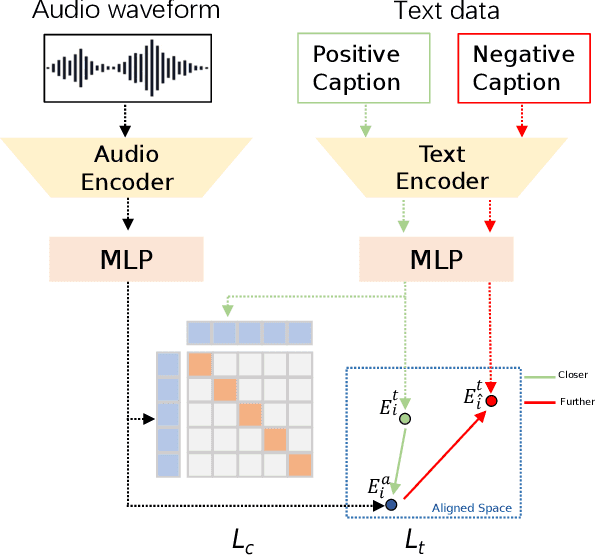
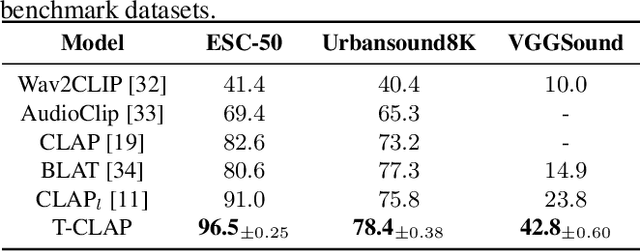
Contrastive language-audio pretraining~(CLAP) has been developed to align the representations of audio and language, achieving remarkable performance in retrieval and classification tasks. However, current CLAP struggles to capture temporal information within audio and text features, presenting substantial limitations for tasks such as audio retrieval and generation. To address this gap, we introduce T-CLAP, a temporal-enhanced CLAP model. We use Large Language Models~(LLMs) and mixed-up strategies to generate temporal-contrastive captions for audio clips from extensive audio-text datasets. Subsequently, a new temporal-focused contrastive loss is designed to fine-tune the CLAP model by incorporating these synthetic data. We conduct comprehensive experiments and analysis in multiple downstream tasks. T-CLAP shows improved capability in capturing the temporal relationship of sound events and outperforms state-of-the-art models by a significant margin.
Infusion: Preventing Customized Text-to-Image Diffusion from Overfitting
Apr 22, 2024Text-to-image (T2I) customization aims to create images that embody specific visual concepts delineated in textual descriptions. However, existing works still face a main challenge, concept overfitting. To tackle this challenge, we first analyze overfitting, categorizing it into concept-agnostic overfitting, which undermines non-customized concept knowledge, and concept-specific overfitting, which is confined to customize on limited modalities, i.e, backgrounds, layouts, styles. To evaluate the overfitting degree, we further introduce two metrics, i.e, Latent Fisher divergence and Wasserstein metric to measure the distribution changes of non-customized and customized concept respectively. Drawing from the analysis, we propose Infusion, a T2I customization method that enables the learning of target concepts to avoid being constrained by limited training modalities, while preserving non-customized knowledge. Remarkably, Infusion achieves this feat with remarkable efficiency, requiring a mere 11KB of trained parameters. Extensive experiments also demonstrate that our approach outperforms state-of-the-art methods in both single and multi-concept customized generation.
TENG: Time-Evolving Natural Gradient for Solving PDEs with Deep Neural Net
Apr 16, 2024Partial differential equations (PDEs) are instrumental for modeling dynamical systems in science and engineering. The advent of neural networks has initiated a significant shift in tackling these complexities though challenges in accuracy persist, especially for initial value problems. In this paper, we introduce the $\textit{Time-Evolving Natural Gradient (TENG)}$, generalizing time-dependent variational principles and optimization-based time integration, leveraging natural gradient optimization to obtain high accuracy in neural-network-based PDE solutions. Our comprehensive development includes algorithms like TENG-Euler and its high-order variants, such as TENG-Heun, tailored for enhanced precision and efficiency. TENG's effectiveness is further validated through its performance, surpassing current leading methods and achieving machine precision in step-by-step optimizations across a spectrum of PDEs, including the heat equation, Allen-Cahn equation, and Burgers' equation.
MyGO: Discrete Modality Information as Fine-Grained Tokens for Multi-modal Knowledge Graph Completion
Apr 15, 2024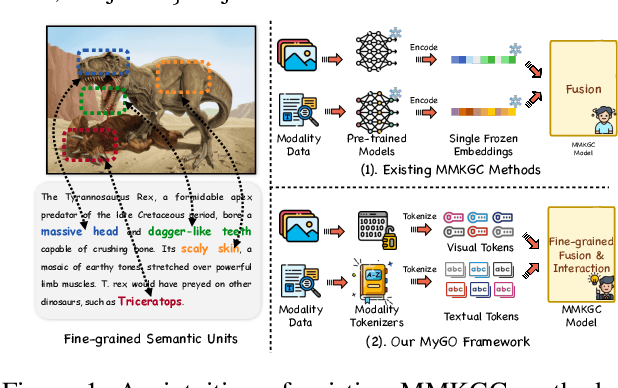
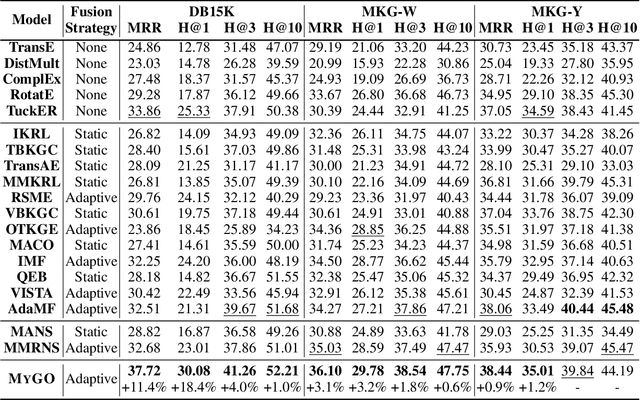
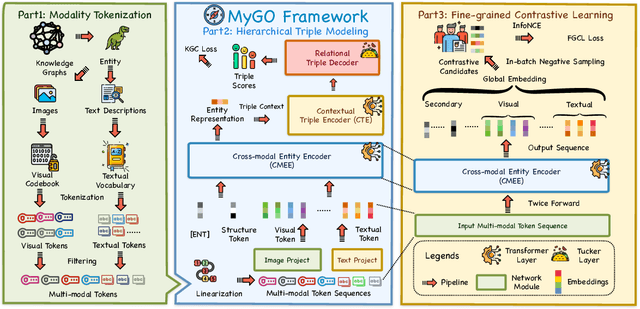
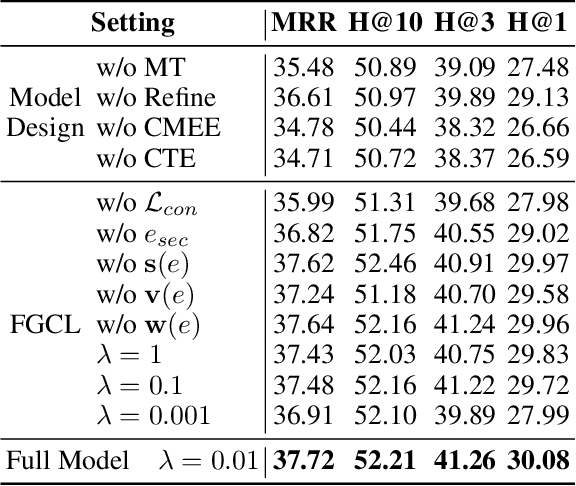
Multi-modal knowledge graphs (MMKG) store structured world knowledge containing rich multi-modal descriptive information. To overcome their inherent incompleteness, multi-modal knowledge graph completion (MMKGC) aims to discover unobserved knowledge from given MMKGs, leveraging both structural information from the triples and multi-modal information of the entities. Existing MMKGC methods usually extract multi-modal features with pre-trained models and employ a fusion module to integrate multi-modal features with triple prediction. However, this often results in a coarse handling of multi-modal data, overlooking the nuanced, fine-grained semantic details and their interactions. To tackle this shortfall, we introduce a novel framework MyGO to process, fuse, and augment the fine-grained modality information from MMKGs. MyGO tokenizes multi-modal raw data as fine-grained discrete tokens and learns entity representations with a cross-modal entity encoder. To further augment the multi-modal representations, MyGO incorporates fine-grained contrastive learning to highlight the specificity of the entity representations. Experiments on standard MMKGC benchmarks reveal that our method surpasses 20 of the latest models, underlining its superior performance. Code and data are available at https://github.com/zjukg/MyGO
CREST: Cross-modal Resonance through Evidential Deep Learning for Enhanced Zero-Shot Learning
Apr 15, 2024
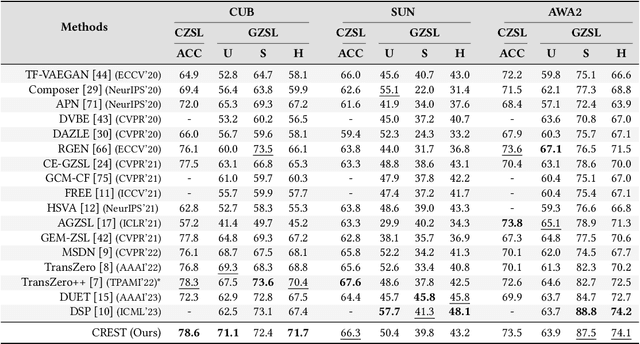
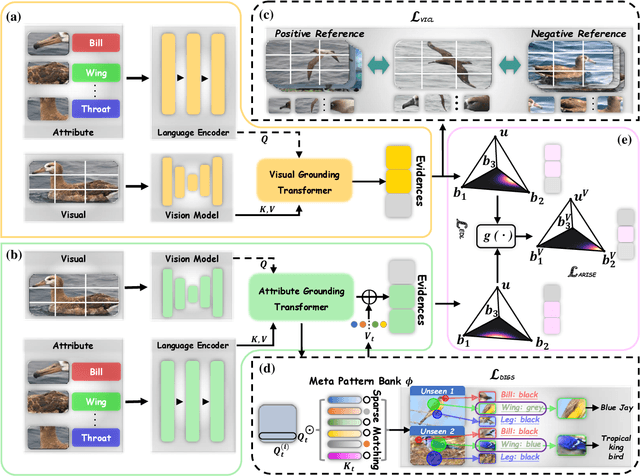

Zero-shot learning (ZSL) enables the recognition of novel classes by leveraging semantic knowledge transfer from known to unknown categories. This knowledge, typically encapsulated in attribute descriptions, aids in identifying class-specific visual features, thus facilitating visual-semantic alignment and improving ZSL performance. However, real-world challenges such as distribution imbalances and attribute co-occurrence among instances often hinder the discernment of local variances in images, a problem exacerbated by the scarcity of fine-grained, region-specific attribute annotations. Moreover, the variability in visual presentation within categories can also skew attribute-category associations. In response, we propose a bidirectional cross-modal ZSL approach CREST. It begins by extracting representations for attribute and visual localization and employs Evidential Deep Learning (EDL) to measure underlying epistemic uncertainty, thereby enhancing the model's resilience against hard negatives. CREST incorporates dual learning pathways, focusing on both visual-category and attribute-category alignments, to ensure robust correlation between latent and observable spaces. Moreover, we introduce an uncertainty-informed cross-modal fusion technique to refine visual-attribute inference. Extensive experiments demonstrate our model's effectiveness and unique explainability across multiple datasets. Our code and data are available at: Comments: Ongoing work; 10 pages, 2 Tables, 9 Figures; Repo is available at https://github.com/JethroJames/CREST.
UniMix: Towards Domain Adaptive and Generalizable LiDAR Semantic Segmentation in Adverse Weather
Apr 08, 2024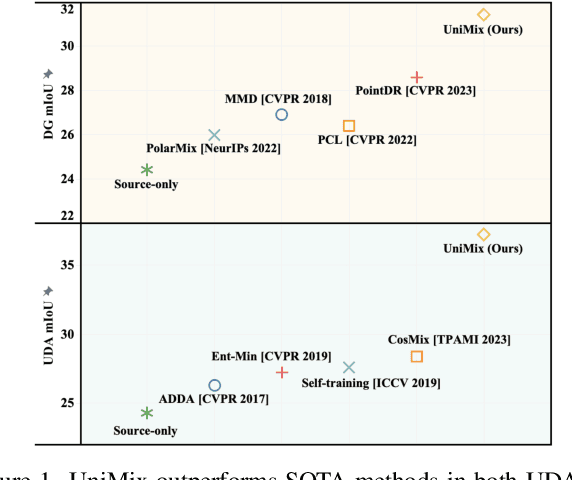
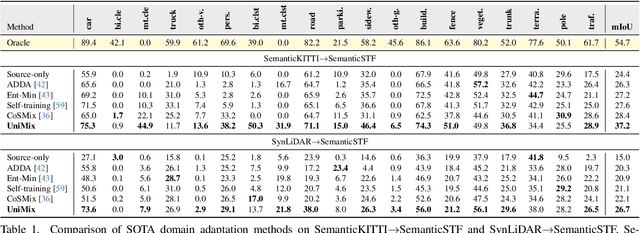
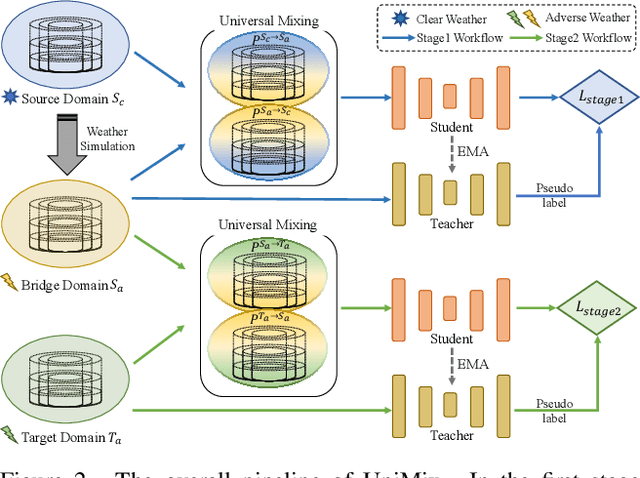
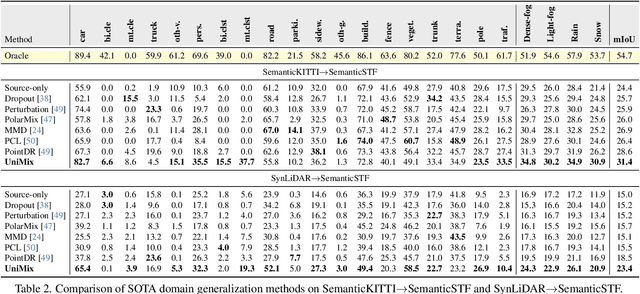
LiDAR semantic segmentation (LSS) is a critical task in autonomous driving and has achieved promising progress. However, prior LSS methods are conventionally investigated and evaluated on datasets within the same domain in clear weather. The robustness of LSS models in unseen scenes and all weather conditions is crucial for ensuring safety and reliability in real applications. To this end, we propose UniMix, a universal method that enhances the adaptability and generalizability of LSS models. UniMix first leverages physically valid adverse weather simulation to construct a Bridge Domain, which serves to bridge the domain gap between the clear weather scenes and the adverse weather scenes. Then, a Universal Mixing operator is defined regarding spatial, intensity, and semantic distributions to create the intermediate domain with mixed samples from given domains. Integrating the proposed two techniques into a teacher-student framework, UniMix efficiently mitigates the domain gap and enables LSS models to learn weather-robust and domain-invariant representations. We devote UniMix to two main setups: 1) unsupervised domain adaption, adapting the model from the clear weather source domain to the adverse weather target domain; 2) domain generalization, learning a model that generalizes well to unseen scenes in adverse weather. Extensive experiments validate the effectiveness of UniMix across different tasks and datasets, all achieving superior performance over state-of-the-art methods. The code will be released.
Using Interpretation Methods for Model Enhancement
Apr 02, 2024In the age of neural natural language processing, there are plenty of works trying to derive interpretations of neural models. Intuitively, when gold rationales exist during training, one can additionally train the model to match its interpretation with the rationales. However, this intuitive idea has not been fully explored. In this paper, we propose a framework of utilizing interpretation methods and gold rationales to enhance models. Our framework is very general in the sense that it can incorporate various interpretation methods. Previously proposed gradient-based methods can be shown as an instance of our framework. We also propose two novel instances utilizing two other types of interpretation methods, erasure/replace-based and extractor-based methods, for model enhancement. We conduct comprehensive experiments on a variety of tasks. Experimental results show that our framework is effective especially in low-resource settings in enhancing models with various interpretation methods, and our two newly-proposed methods outperform gradient-based methods in most settings. Code is available at https://github.com/Chord-Chen-30/UIMER.
* EMNLP 2023