 Add to Chrome
 Add to Firefox
 Add to Edge
Can AI Follow In Einstein's Footsteps?
Jul 30, 2026
AI is accelerating physics discovery, but perhaps away from Einstein-level theory building. To understand this gap, we must recognize a striking trend: while being very successful, the most visible AI contributions to physics discovery appear to mirror the historical development of physics, but in reverse. Human discovery in physics progressed, in broad strokes, from ancient pattern prediction, through phenomenological laws such as Kepler's, to principle-based universal theories such as relativity and the Standard Model. On the AI side, prominent contributions to physics discovery point in the opposite direction: early milestones emphasized explicit equation-discovery methods, such as symbolic regression, whereas more recent frontier contributions are powerful predictors such as AlphaFold and GraphCast, which can be remarkably accurate yet do not provide clear theoretical understanding. If this trend continues, AI would become extraordinarily good at prediction but may struggle to ever propose its first serious contender to quantum gravity or other paradigm-level theories. We review the current landscape of AI for physics discovery and highlight a critical missing skill: the ability to pose the right questions or invent the right principles to guide the development of new theories and the tests to falsify them. This mode of discovery has driven many of the deepest advances since the 17th century, where symmetry, simplicity, and new mathematical frameworks guided theory construction before experimental tests. Equipping AI systems with such skills could move them from predicting within known frameworks to proposing the next paradigm-level discovery in physics.

End-to-End Optimization of Incoherent Imaging for Classification Under Detector-Limited Readout
Jun 08, 2026End-to-end co-optimization of optical front-ends (e.g. metasurfaces) and neural network back-ends has been widely applied to imaging tasks, yet a formalism characterizing when and why such systems outperform conventional lens-based imaging is largely lacking. This paper focuses on object classification, a central imaging task, and asks when end-to-end optimization of a phase mask for incoherent imaging improves performance over a conventional focusing lens. We find that these gains arise primarily under constrained detector readout and are limited under full detector readout. In the latter setting, we prove that no incoherent phase mask exceeds the ideal-channel mutual information between detector measurements and class labels; a conventional focusing lens approaches this ceiling, and joint optimization yields no empirical gain. When detector readout is constrained -- by coarse spatial sampling or a limited number of measurements -- optimized optics can substantially improve classification by increasing class separability in the detector measurements. These gains are largest under low detector noise and shrink as noise grows, because the optics shape the signal before it reaches the detector but cannot remove noise added afterward. The advantage also depends on the spectral structure of the task: co-design helps most when class-discriminative content is concentrated at lower spatial frequencies than within-class variation. We develop a theoretical framework formalizing these distinctions and test its predictions on synthetic data and standard benchmarks (MNIST, FashionMNIST, SVHN).
Everything at Every Scale: Scale-Invariant Diffusion with Continuous Super-Resolution
May 25, 2026Creating images from noise is image generation; reconstructing fine details from coarse inputs is super-resolution. Despite their practical differences, both can be understood as reversing information loss across scales. We introduce $\textbf{SKILD}$, a $\textbf{S}$cale-invariant $\textbf{K}$-Space $\textbf{I}$mage $\textbf{L}$earning $\textbf{D}$iffusion model that unifies generation and continuous super-resolution within a single unconditional framework. Both natural images and critical physical systems exhibit scale invariance, and we leverage it to design a forward process that attenuates image content from fine to coarse scales while injecting spectrum-matched Gaussian noise, making scale an explicit coordinate of the diffusion dynamics. The same trained reverse process performs generation and continuous super-resolution by varying only the starting timestep: $\textit{no task-specific architecture, no conditioning branch, no classifier-free guidance, no retraining per scale factor}$. Empirically, SKILD reaches FID $2.65$ and Inception Score $9.63$ on unconditional CIFAR-10, performs $2\times$--$8\times$ super-resolution on ImageNet from a single unconditional checkpoint while outperforming conditional models across perceptual metrics, and reconstructs critical Ising models whose connected four-point correlations closely track the ground truth.
TraversalBench: Challenging Paths to Follow for Vision Language Models
Apr 13, 2026Vision-language models (VLMs) perform strongly on many multimodal benchmarks. However, the ability to follow complex visual paths -- a task that human observers typically find straightforward -- remains under-tested. We introduce TraversalBench, a controlled benchmark for exact visual path traversal. Each instance contains a single continuous polyline, a unique start marker, and markers placed at path vertices; the task is to recover the exact ordered sequence encountered when traversing the path from start to finish. The benchmark explicitly balances key path-structural factors including self-intersection count, tortuosity, vertex count, and nearby confounding lines, while minimizing reliance on OCR, world knowledge, and open-ended planning. We find that self-intersections are the dominant source of difficulty. A first-crossing analysis shows that errors are sharply localized: performance is relatively stable immediately before the first crossing, then drops steeply when the model must resolve the correct continuation. By contrast, nearby confounding lines produce a weaker persistent degradation that compounds with repeated exposure. These analyses make TraversalBench a useful diagnostic for identifying whether models suffer from human-like failures or other breakdowns in sustained visual processing. An auxiliary reading-order benchmark further reveals a consistent preference for layouts compatible with left-to-right serialization, while not explaining away the main effects of path complexity. Together, these results position TraversalBench as a controlled diagnostic of path-faithful visual reasoning and as a useful testbed for studying multimodal spatial reasoning under ambiguity, clutter, and distractor structure. More broadly, we position TraversalBench as a contribution to the still-limited area of sustained visual grounding benchmarks for VLMs.
A Framework for Closed-Loop Robotic Assembly, Alignment and Self-Recovery of Precision Optical Systems
Mar 23, 2026Robotic automation has transformed scientific workflows in domains such as chemistry and materials science, yet free-space optics, which is a high precision domain, remains largely manual. Optical systems impose strict spatial and angular tolerances, and their performance is governed by tightly coupled physical parameters, making generalizable automation particularly challenging. In this work, we present a robotics framework for the autonomous construction, alignment, and maintenance of precision optical systems. Our approach integrates hierarchical computer vision systems, optimization routines, and custom-built tools to achieve this functionality. As a representative demonstration, we perform the fully autonomous construction of a tabletop laser cavity from randomly distributed components. The system performs several tasks such as laser beam centering, spatial alignment of multiple beams, resonator alignment, laser mode selection, and self-recovery from induced misalignment and disturbances. By achieving closed-loop autonomy for highly sensitive optical systems, this work establishes a foundation for autonomous optical experiments for applications across technical domains.
Unsupervised Decomposition and Recombination with Discriminator-Driven Diffusion Models
Jan 29, 2026Decomposing complex data into factorized representations can reveal reusable components and enable synthesizing new samples via component recombination. We investigate this in the context of diffusion-based models that learn factorized latent spaces without factor-level supervision. In images, factors can capture background, illumination, and object attributes; in robotic videos, they can capture reusable motion components. To improve both latent factor discovery and quality of compositional generation, we introduce an adversarial training signal via a discriminator trained to distinguish between single-source samples and those generated by recombining factors across sources. By optimizing the generator to fool this discriminator, we encourage physical and semantic consistency in the resulting recombinations. Our method outperforms implementations of prior baselines on CelebA-HQ, Virtual KITTI, CLEVR, and Falcor3D, achieving lower FID scores and better disentanglement as measured by MIG and MCC. Furthermore, we demonstrate a novel application to robotic video trajectories: by recombining learned action components, we generate diverse sequences that significantly increase state-space coverage for exploration on the LIBERO benchmark.
Active learning for photonics
Jan 22, 2026Active learning for photonic crystals explores the integration of analytic approximate Bayesian last layer neural networks (LL-BNNs) with uncertainty-driven sample selection to accelerate photonic band gap prediction. We employ an analytic LL-BNN formulation, corresponding to the infinite Monte Carlo sample limit, to obtain uncertainty estimates that are strongly correlated with the true predictive error on unlabeled candidate structures. These uncertainty scores drive an active learning strategy that prioritizes the most informative simulations during training. Applied to the task of predicting band gap sizes in two-dimensional, two-tone photonic crystals, our approach achieves up to a 2.6x reduction in required training data compared to a random sampling baseline while maintaining predictive accuracy. The efficiency gains arise from concentrating computational resources on high uncertainty regions of the design space rather than sampling uniformly. Given the substantial cost of full band structure simulations, especially in three dimensions, this data efficiency enables rapid and scalable surrogate modeling. Our results suggest that analytic LL-BNN based active learning can substantially accelerate topological optimization and inverse design workflows for photonic crystals, and more broadly, offers a general framework for data efficient regression across scientific machine learning domains.
Learning simple heuristic rules for classifying materials based on chemical composition
May 05, 2025In the past decade, there has been a significant interest in the use of machine learning approaches in materials science research. Conventional deep learning approaches that rely on complex, nonlinear models have become increasingly important in computational materials science due to their high predictive accuracy. In contrast to these approaches, we have shown in a recent work that a remarkably simple learned heuristic rule -- based on the concept of topogivity -- can classify whether a material is topological using only its chemical composition. In this paper, we go beyond the topology classification scenario by also studying the use of machine learning to develop simple heuristic rules for classifying whether a material is a metal based on chemical composition. Moreover, we present a framework for incorporating chemistry-informed inductive bias based on the structure of the periodic table. For both the topology classification and the metallicity classification tasks, we empirically characterize the performance of simple heuristic rules fit with and without chemistry-informed inductive bias across a wide range of training set sizes. We find evidence that incorporating chemistry-informed inductive bias can reduce the amount of training data required to reach a given level of test accuracy.
L$^2$M: Mutual Information Scaling Law for Long-Context Language Modeling
Mar 06, 2025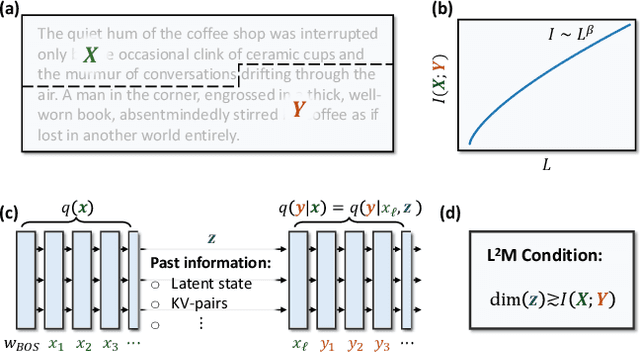
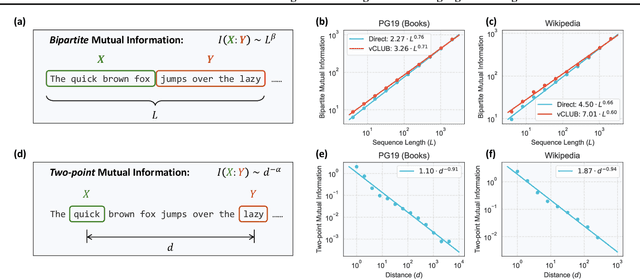
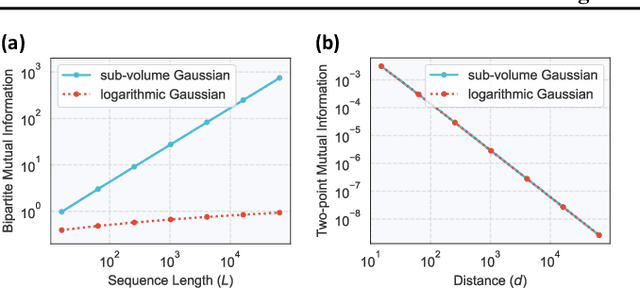
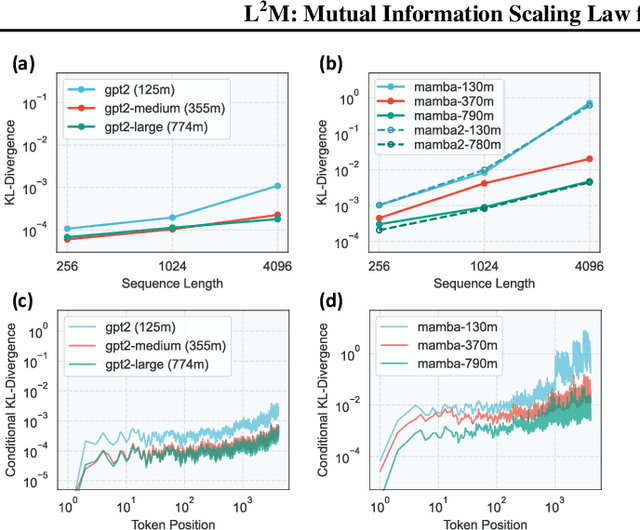
We rigorously establish a bipartite mutual information scaling law in natural language that governs long-range dependencies. This scaling law, which we show is distinct from and scales independently of the conventional two-point mutual information, is the key to understanding long-context language modeling. Using this scaling law, we formulate the Long-context Language Modeling (L$^2$M) condition, which relates a model's capacity for effective long context length modeling to the scaling of its latent state size for storing past information. Our results are validated through experiments on both transformers and state space models. This work establishes a theoretical foundation that guides the development of large language models toward longer context lengths.
Predicting band gap from chemical composition: A simple learned model for a material property with atypical statistics
Jan 06, 2025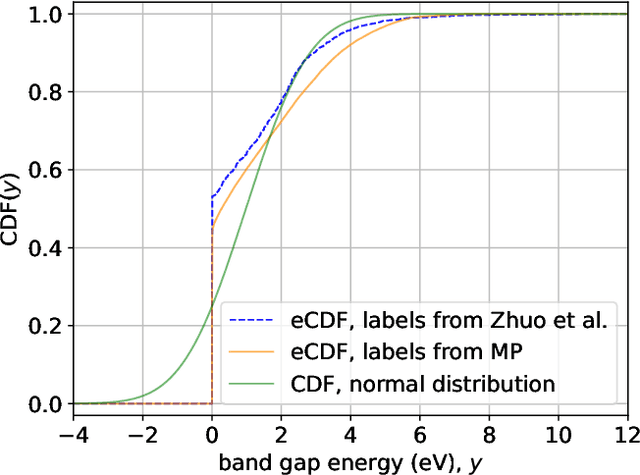
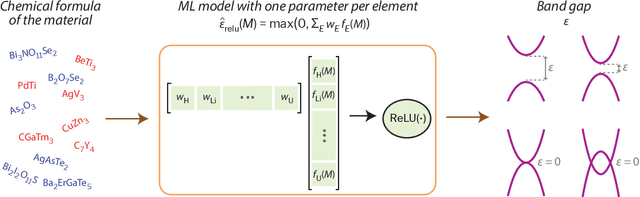

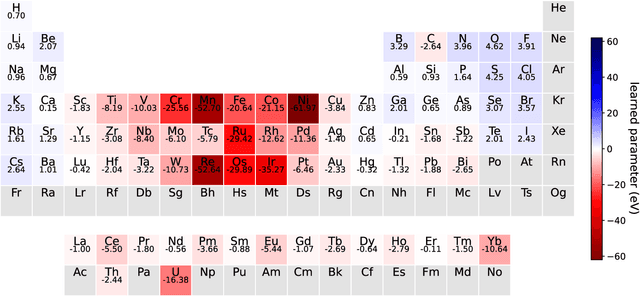
In solid-state materials science, substantial efforts have been devoted to the calculation and modeling of the electronic band gap. While a wide range of ab initio methods and machine learning algorithms have been created that can predict this quantity, the development of new computational approaches for studying the band gap remains an active area of research. Here we introduce a simple machine learning model for predicting the band gap using only the chemical composition of the crystalline material. To motivate the form of the model, we first analyze the empirical distribution of the band gap, which sheds new light on its atypical statistics. Specifically, our analysis enables us to frame band gap prediction as a task of modeling a mixed random variable, and we design our model accordingly. Our model formulation incorporates thematic ideas from chemical heuristic models for other material properties in a manner that is suited towards the band gap modeling task. The model has exactly one parameter corresponding to each element, which is fit using data. To predict the band gap for a given material, the model computes a weighted average of the parameters associated with its constituent elements and then takes the maximum of this quantity and zero. The model provides heuristic chemical interpretability by intuitively capturing the associations between the band gap and individual chemical elements.