 Add to Chrome
 Add to Firefox
 Add to Edge
MINDGAMES: A Live Arena for Evaluating Social and Strategic Reasoning in Multi-Agent LLMs
May 28, 2026
Large language models (LLMs) are increasingly deployed as interactive agents, yet their capacity for social and strategic reasoning over extended interaction remains poorly understood. Existing evaluations rely on static vignettes or single-game benchmarks that cannot capture the sustained, multi-faceted reasoning that real-world multi-agent settings demand. We introduce Mindgames, a multi-game arena and evaluation platform for LLM agents that operationalizes complementary reasoning demands relevant to ``theory of mind'': belief attribution under hidden information, opponent modeling through repeated strategic interaction, cooperative inference under knowledge asymmetries, and sustained deception in social deduction. Built on TextArena, Mindgames provides a unified interaction interface, TrueSkill-based rating, and full trajectory logging across four game environments. We instantiate Mindgames through a 2025 competition cycle hosted at a major AI conference, which assessed 944 submitted agents from 76 teams across four games: Colonel Blotto, Iterated Prisoner's Dilemma, Codenames, and Secret Mafia. Our analysis surfaces both agent-level and evaluation-level limitations: brittle rule adherence remains a major bottleneck, top-performing systems repeatedly rely on explicit structural scaffolding, and leaderboard validity differs sharply across environments. In particular, failure-heavy environments can reward robustness to opponent errors as much as strategic ability, with Secret Mafia exhibiting a pronounced error-survival confound in this cycle. We release a dataset of 29,571 multi-agent games with turn-level observations, actions, and rewards, together with MG-Ref, a deterministic offline tournament protocol that scores new agents against a frozen reference pool of top-ranked, low-error Stage~II submissions under the same error-attribution lens used in this analysis.

MEMO: Memory-Augmented Model Context Optimization for Robust Multi-Turn Multi-Agent LLM Games
Mar 09, 2026Multi-turn, multi-agent LLM game evaluations often exhibit substantial run-to-run variance. In long-horizon interactions, small early deviations compound across turns and are amplified by multi-agent coupling. This biases win rate estimates and makes rankings unreliable across repeated tournaments. Prompt choice worsens this further by producing different effective policies. We address both instability and underperformance with MEMO (Memory-augmented MOdel context optimization), a self-play framework that optimizes inference-time context by coupling retention and exploration. Retention maintains a persistent memory bank that stores structured insights from self-play trajectories and injects them as priors during later play. Exploration runs tournament-style prompt evolution with uncertainty-aware selection via TrueSkill, and uses prioritized replay to revisit rare and decisive states. Across five text-based games, MEMO raises mean win rate from 25.1% to 49.5% for GPT-4o-mini and from 20.9% to 44.3% for Qwen-2.5-7B-Instruct, using $2,000$ self-play games per task. Run-to-run variance also drops, giving more stable rankings across prompt variations. These results suggest that multi-agent LLM game performance and robustness have substantial room for improvement through context optimization. MEMO achieves the largest gains in negotiation and imperfect-information games, while RL remains more effective in perfect-information settings.
TextArena
Apr 15, 2025
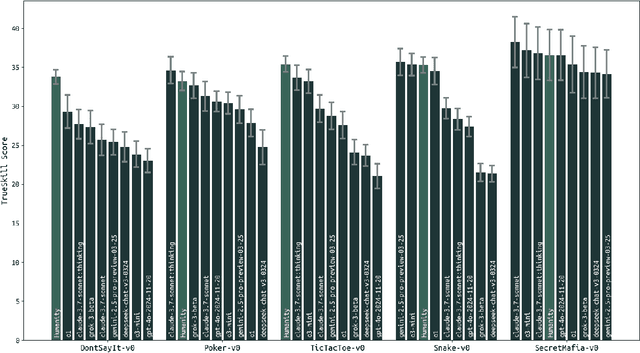
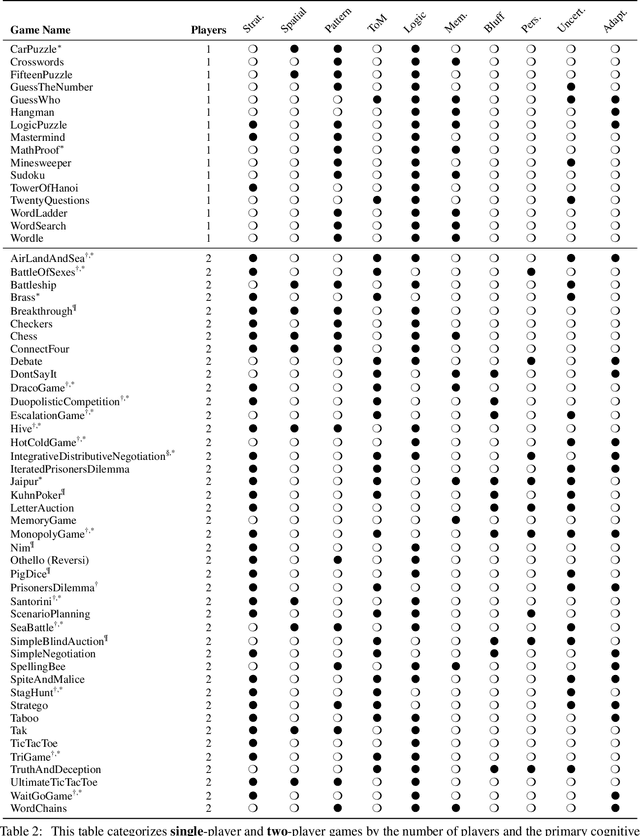
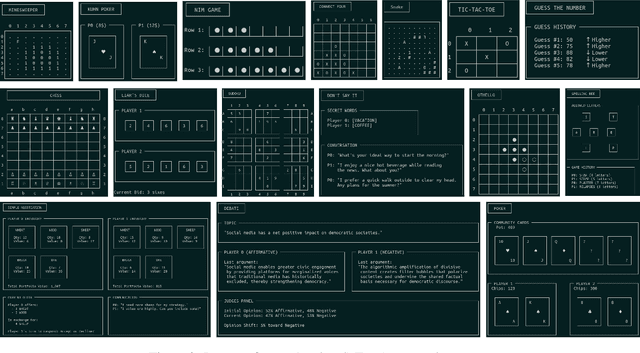
TextArena is an open-source collection of competitive text-based games for training and evaluation of agentic behavior in Large Language Models (LLMs). It spans 57+ unique environments (including single-player, two-player, and multi-player setups) and allows for easy evaluation of model capabilities via an online-play system (against humans and other submitted models) with real-time TrueSkill scores. Traditional benchmarks rarely assess dynamic social skills such as negotiation, theory of mind, and deception, creating a gap that TextArena addresses. Designed with research, community and extensibility in mind, TextArena emphasizes ease of adding new games, adapting the framework, testing models, playing against the models, and training models. Detailed documentation of environments, games, leaderboard, and examples are available on https://github.com/LeonGuertler/TextArena and https://www.textarena.ai/.
STLM Engineering Report: Dropout
Sep 09, 2024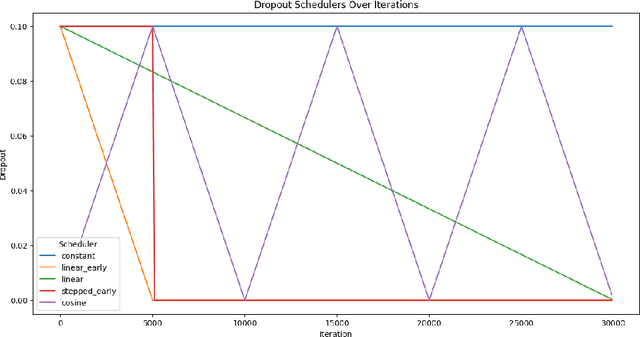
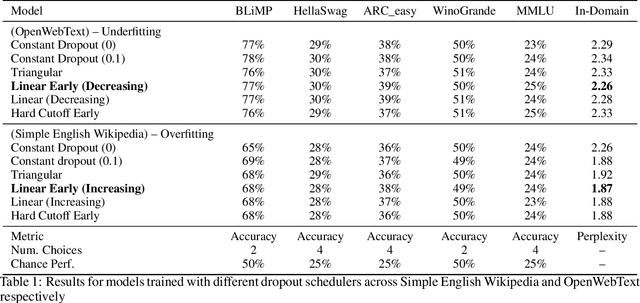
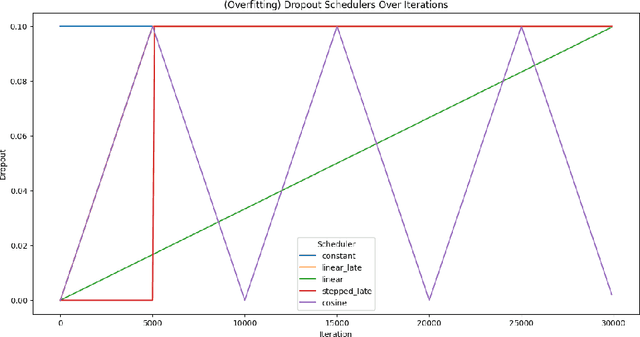
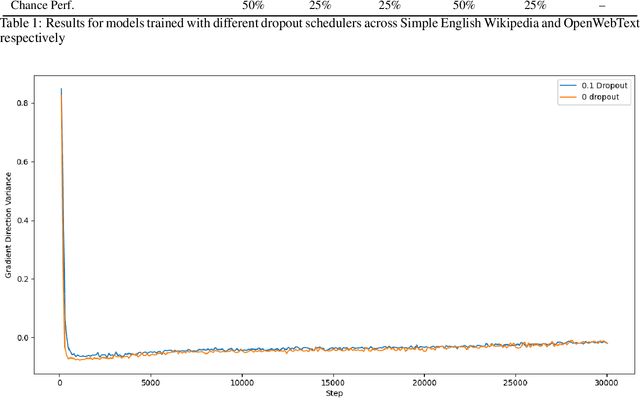
In this work we explore the relevance of dropout for modern language models, particularly in the context of models on the scale of <100M parameters. We explore it's relevance firstly in the regime of improving the sample efficiency of models given small, high quality datasets, and secondly in the regime of improving the quality of its fit on larger datasets where models may underfit. We find that concordant with conventional wisdom, dropout remains effective in the overfitting scenario, and that furthermore it may have some relevance for improving the fit of models even in the case of excess data, as suggested by previous research. In the process we find that the existing explanation for the mechanism behind this performance gain is not applicable in the case of language modelling.
Super Tiny Language Models
May 23, 2024The rapid advancement of large language models (LLMs) has led to significant improvements in natural language processing but also poses challenges due to their high computational and energy demands. This paper introduces a series of research efforts focused on Super Tiny Language Models (STLMs), which aim to deliver high performance with significantly reduced parameter counts. We explore innovative techniques such as byte-level tokenization with a pooling mechanism, weight tying, and efficient training strategies. These methods collectively reduce the parameter count by $90\%$ to $95\%$ compared to traditional models while maintaining competitive performance. This series of papers will explore into various subproblems, including tokenizer-free models, self-play based training, and alternative training objectives, targeting models with 10M, 50M, and 100M parameters. Our ultimate goal is to make high-performance language models more accessible and practical for a wide range of applications.