 Add to Chrome
 Add to Firefox
 Add to Edge
AgentPanel: Toward a New Paradigm for Human--AI Collaboration in Exploring Scientific Questions
Aug 04, 2026
Identifying promising scientific ideas remains an important challenge in research practice. Researchers commonly rely on small-group discussions or one-to-one interactions with a single large language model, yet these approaches often expose them to only a limited range of perspectives and directions. We present AgentPanel, a multi-agent forum for human--AI collaboration in scientific exploration. Heterogeneous agents asynchronously discuss scientific questions in a forum-style environment, while researchers can submit questions, browse and organize candidate ideas, engage agents in follow-up interactions, and optionally generate post-hoc summary reports. We evaluate AgentPanel in terms of idea quality, exploration breadth, interaction effectiveness, candidate-selection efficiency, and practical utility. Offline experiments show that AgentPanel outperforms a centralized multi-agent debate baseline. A human study with 20 participants further shows that users value AgentPanel for perspective diversity and exploration support. In experience-based comparisons with commonly used LLM tools, 65\% of participants favored AgentPanel for both breadth of research directions and overall suitability for early-stage exploration. The platform is publicly available at https://agentpanel.cc/.

SKT: Skill-Use Training at Scale via Verified Synthetic Data Generation
Aug 03, 2026Agent skills have become an important mechanism for equipping language-model agents with reusable procedural knowledge. However, providing skills alone does not guarantee that current models can effectively identify, apply, and coordinate them. To improve skill-use capabilities, we introduce SKT, a verified data synthesis pipeline that constructs skill-grounded tasks and executable trajectories from large collections of agent skills. SKT selects suitable single-skill and multi-skill configurations, synthesizes tasks through rule-based and agent-based verification with feedback-guided repair, and retains only successful trajectories that substantially use every required skill. Using 2,000 public skills, SKT produces 4,000 task packages and 27,164 verified trajectories. Based on the same pipeline and a disjoint test pool, we further construct SkillEval, a held-out executable benchmark for evaluating skill use. Experiments across diverse models, benchmarks, and agent harnesses show that supervised fine-tuning on SKT-generated trajectories consistently improves skill-use performance. Verification ablations, cross-harness evaluation, and scaling experiments further demonstrate that these gains depend on high-quality supervision, extend beyond a single agent interface, and increase with broader skill coverage. Together, these results establish verified data synthesis as an effective and scalable approach for skill-use training.
Scaling the Horizon, Not the Parameters: Reaching Trillion-Parameter Performance with a 35B Agent
Jun 29, 2026We introduce Agents-A1, a 35B Mixture-of-Experts Agentic Model that reaches trillion-parameter-level performance by scaling the agent horizon. We investigate agent-horizon scaling from two perspectives: scaling long-horizon trajectories and scaling heterogeneous agent abilities. To support this goal, we build a long-horizon knowledge-action infrastructure that connects external knowledge, actions, observations, and verifier outcomes, producing agentic trajectories with an average length of 45K tokens. Based on this, we train Agents-A1 with a three-stage recipe. First, we perform full-domain supervised fine-tuning to align the base model with broad agentic behaviors. Second, we train domain-level teacher models to capture specialized expertise in each domain. Third, we propose a multi-teacher domain-routed on-policy distillation with salient vocabulary alignment to improve knowledge transfer efficiency across different domains, unifying six heterogeneous domains into one deployable student model. Agents-A1 achieves strong and broad performance for long-horizon agent benchmarks. Compared with 1T-parameter model such as Kimi-K2.6 and DeepSeek-V4-pro, Agents-A1 achieves leading results on SEAL-0 (56.4), IFBench (80.6), HiPhO (46.4), FrontierScience-Olympiad (79.0), and MolBench-Bind (56.8), and remains highly competitive on SciCode (44.3), HLE (47.6) and BrowseComp (75.5). We hope this work provides the community with a practical path for scaling the horizon using a 35B agent that can reach or match the performance of 1T models on long-horizon tasks.
Organizing, Orchestrating, and Benchmarking Agent Skills at Ecosystem Scale
Mar 02, 2026The rapid proliferation of Claude agent skills has raised the central question of how to effectively leverage, manage, and scale the agent skill ecosystem. In this paper, we propose AgentSkillOS, the first principled framework for skill selection, orchestration, and ecosystem-level management. AgentSkillOS comprises two stages: (i) Manage Skills, which organizes skills into a capability tree via node-level recursive categorization for efficient discovery; and (ii) Solve Tasks, which retrieves, orchestrates, and executes multiple skills through DAG-based pipelines. To evaluate the agent's ability to invoke skills, we construct a benchmark of 30 artifact-rich tasks across five categories: data computation, document creation, motion video, visual design, and web interaction. We assess the quality of task outputs using LLM-based pairwise evaluation, and the results are aggregated via a Bradley-Terry model to produce unified quality scores. Experiments across three skill ecosystem scales (200 to 200K skills) show that tree-based retrieval effectively approximates oracle skill selection, and that DAG-based orchestration substantially outperforms native flat invocation even when given the identical skill set. Our findings confirm that structured composition is the key to unlocking skill potential. Our GitHub repository is available at:https://github.com/ynulihao/AgentSkillOS.
PerPilot: Personalizing VLM-based Mobile Agents via Memory and Exploration
Aug 25, 2025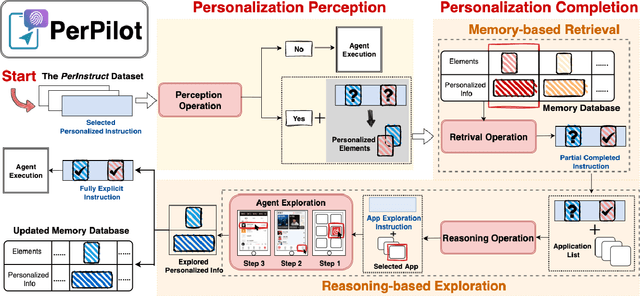


Vision language model (VLM)-based mobile agents show great potential for assisting users in performing instruction-driven tasks. However, these agents typically struggle with personalized instructions -- those containing ambiguous, user-specific context -- a challenge that has been largely overlooked in previous research. In this paper, we define personalized instructions and introduce PerInstruct, a novel human-annotated dataset covering diverse personalized instructions across various mobile scenarios. Furthermore, given the limited personalization capabilities of existing mobile agents, we propose PerPilot, a plug-and-play framework powered by large language models (LLMs) that enables mobile agents to autonomously perceive, understand, and execute personalized user instructions. PerPilot identifies personalized elements and autonomously completes instructions via two complementary approaches: memory-based retrieval and reasoning-based exploration. Experimental results demonstrate that PerPilot effectively handles personalized tasks with minimal user intervention and progressively improves its performance with continued use, underscoring the importance of personalization-aware reasoning for next-generation mobile agents. The dataset and code are available at: https://github.com/xinwang-nwpu/PerPilot
If Multi-Agent Debate is the Answer, What is the Question?
Feb 12, 2025Multi-agent debate (MAD) has emerged as a promising approach to enhance the factual accuracy and reasoning quality of large language models (LLMs) by engaging multiple agents in iterative discussions during inference. Despite its potential, we argue that current MAD research suffers from critical shortcomings in evaluation practices, including limited dataset overlap and inconsistent baselines, raising significant concerns about generalizability. Correspondingly, this paper presents a systematic evaluation of five representative MAD methods across nine benchmarks using four foundational models. Surprisingly, our findings reveal that MAD methods fail to reliably outperform simple single-agent baselines such as Chain-of-Thought and Self-Consistency, even when consuming additional inference-time computation. From our analysis, we found that model heterogeneity can significantly improve MAD frameworks. We propose Heter-MAD enabling a single LLM agent to access the output from heterogeneous foundation models, which boosts the performance of current MAD frameworks. Finally, we outline potential directions for advancing MAD, aiming to spark a broader conversation and inspire future work in this area.
Emergence of Social Norms in Large Language Model-based Agent Societies
Mar 13, 2024The emergence of social norms has attracted much interest in a wide array of disciplines, ranging from social science and cognitive science to artificial intelligence. In this paper, we propose the first generative agent architecture that empowers the emergence of social norms within a population of large language model-based agents. Our architecture, named CRSEC, consists of four modules: Creation & Representation, Spreading, Evaluation, and Compliance. Our architecture addresses several important aspects of the emergent processes all in one: (i) where social norms come from, (ii) how they are formally represented, (iii) how they spread through agents' communications and observations, (iv) how they are examined with a sanity check and synthesized in the long term, and (v) how they are incorporated into agents' planning and actions. Our experiments deployed in the Smallville sandbox game environment demonstrate the capability of our architecture to establish social norms and reduce social conflicts within large language model-based multi-agent systems. The positive outcomes of our human evaluation, conducted with 30 evaluators, further affirm the effectiveness of our approach.