 Add to Chrome
 Add to Firefox
 Add to Edge
Advancing Narrative Long Video Generation via Training-Free Identity-Aware Memory
May 18, 2026
Autoregressive video generation has improved rapidly in visual fidelity and interactivity, but it still suffers from long-term inconsistency and memory degradation. Most existing solutions either compress historical frames using predefined strategies or retrieve keyframes based on coarse implicit attention signals, both of which fail to handle evolving prompts with shifting entity references, leading to identity drift, character duplication, and attribute loss. To address this, we propose IAMFlow, a training-free identity-aware memory framework that explicitly models and tracks persistent entity identities, enabling consistent generation across prompt transitions. Specifically, an LLM extracts entities with visual attributes from each prompt and assigns unique global IDs for identity-aware memory, while a VLM asynchronously verifies and refines attributes from rendered frames, enabling explicit entity tracking in place of implicit similarity-based matching. To keep the proposed framework computationally practical, we design a systematic inference acceleration pipeline, including asynchronous visual verification, adaptive prompt transition, and model quantization, which achieves faster generation than existing baselines. Furthermore, we introduce NarraStream-Bench, a benchmark for narrative streaming video generation that features 324 multi-prompt scripts spanning six dimensions and a three-dimensional evaluation protocol that integrates both traditional metrics and multimodal large language model-based assessments. Extensive experiments show that IAMFlow, despite being training-free, achieves the best overall performance on NarraStream-Bench, outperforming the strongest baseline by 2.56 points, while achieving a 1.39$\times$ speedup over the most efficient baseline in the 60-second multi-prompt setting.

SPIKE: An Adaptive Dual Controller Framework for Cost-Efficient Long-Horizon Game Agents
May 18, 2026Long-horizon multimodal agents in open-world games must stay goal-directed across many low-level interactions under tight token and latency budgets. Existing approaches often trade off costly per-step reasoning against reactive execution that can drift, repeat failures, and recover poorly. Our key idea is to reuse strategic reasoning across locally stable segments and reinvoke it at event boundaries. We present SPIKE, an adaptive dual controller framework for cost-efficient long-horizon game control. Its Strategic Controller performs low-frequency global planning, failure analysis, and recovery, while its Reactive Controller handles fast local execution under a strict token budget. An Event Trigger monitors visual change, task progress, repeated actions, and failure signals to decide when control should stay reactive or escalate to strategic reasoning. Hierarchical Memory separates short-term experience reuse in the State-Action Memory Bank (SA-MB) from structured evidence in the State Action Knowledge Graph (SA-KG), allowing each controller to retrieve the context it needs. This design reuses strategic proposals over multiple reactive steps, supports local override when plans become stale, and reserves expensive reasoning for moments where extra deliberation is useful. On the Lite-100 split of StarDojo, SPIKE improves Lite-100 success rate (SR) by 5.0 percentage points (38.5% relative) over the strongest Lite-100 baseline and Budgeted SR by 9.3 points (75.6% relative) over the strongest budgeted baseline. It also reduces token consumption by 54.9% and latency by 40.8%. Ablations show that event triggering, reactive override, and heterogeneous memory each contribute to success and recovery, supporting selective reasoning rather than reasoning at every step.
Large-Scale Multidimensional Knowledge Profiling of Scientific Literature
Jan 21, 2026The rapid expansion of research across machine learning, vision, and language has produced a volume of publications that is increasingly difficult to synthesize. Traditional bibliometric tools rely mainly on metadata and offer limited visibility into the semantic content of papers, making it hard to track how research themes evolve over time or how different areas influence one another. To obtain a clearer picture of recent developments, we compile a unified corpus of more than 100,000 papers from 22 major conferences between 2020 and 2025 and construct a multidimensional profiling pipeline to organize and analyze their textual content. By combining topic clustering, LLM-assisted parsing, and structured retrieval, we derive a comprehensive representation of research activity that supports the study of topic lifecycles, methodological transitions, dataset and model usage patterns, and institutional research directions. Our analysis highlights several notable shifts, including the growth of safety, multimodal reasoning, and agent-oriented studies, as well as the gradual stabilization of areas such as neural machine translation and graph-based methods. These findings provide an evidence-based view of how AI research is evolving and offer a resource for understanding broader trends and identifying emerging directions. Code and dataset: https://github.com/xzc-zju/Profiling_Scientific_Literature
PerPilot: Personalizing VLM-based Mobile Agents via Memory and Exploration
Aug 25, 2025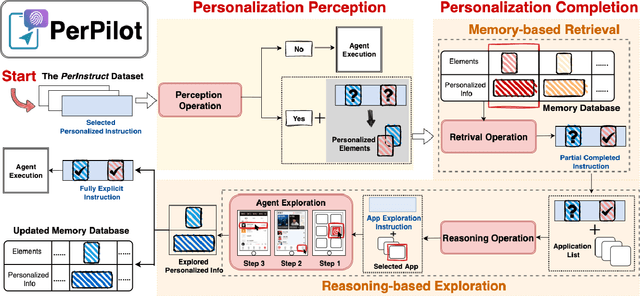


Vision language model (VLM)-based mobile agents show great potential for assisting users in performing instruction-driven tasks. However, these agents typically struggle with personalized instructions -- those containing ambiguous, user-specific context -- a challenge that has been largely overlooked in previous research. In this paper, we define personalized instructions and introduce PerInstruct, a novel human-annotated dataset covering diverse personalized instructions across various mobile scenarios. Furthermore, given the limited personalization capabilities of existing mobile agents, we propose PerPilot, a plug-and-play framework powered by large language models (LLMs) that enables mobile agents to autonomously perceive, understand, and execute personalized user instructions. PerPilot identifies personalized elements and autonomously completes instructions via two complementary approaches: memory-based retrieval and reasoning-based exploration. Experimental results demonstrate that PerPilot effectively handles personalized tasks with minimal user intervention and progressively improves its performance with continued use, underscoring the importance of personalization-aware reasoning for next-generation mobile agents. The dataset and code are available at: https://github.com/xinwang-nwpu/PerPilot
Regret Minimization in Population Network Games: Vanishing Heterogeneity and Convergence to Equilibria
Jul 23, 2025Understanding and predicting the behavior of large-scale multi-agents in games remains a fundamental challenge in multi-agent systems. This paper examines the role of heterogeneity in equilibrium formation by analyzing how smooth regret-matching drives a large number of heterogeneous agents with diverse initial policies toward unified behavior. By modeling the system state as a probability distribution of regrets and analyzing its evolution through the continuity equation, we uncover a key phenomenon in diverse multi-agent settings: the variance of the regret distribution diminishes over time, leading to the disappearance of heterogeneity and the emergence of consensus among agents. This universal result enables us to prove convergence to quantal response equilibria in both competitive and cooperative multi-agent settings. Our work advances the theoretical understanding of multi-agent learning and offers a novel perspective on equilibrium selection in diverse game-theoretic scenarios.