 Add to Chrome
 Add to Firefox
 Add to Edge
Adaptive Theory of Mind for LLM-based Multi-Agent Coordination
Mar 17, 2026
Theory of Mind (ToM) refers to the ability to reason about others' mental states, and higher-order ToM involves considering that others also possess their own ToM. Equipping large language model (LLM)-driven agents with ToM has long been considered to improve their coordination in multiagent collaborative tasks. However, we find that misaligned ToM orders-mismatches in the depth of ToM reasoning between agents-can lead to insufficient or excessive reasoning about others, thereby impairing their coordination. To address this issue, we design an adaptive ToM (A-ToM) agent, which can align in ToM orders with its partner. Based on prior interactions, the agent estimates the partner's likely ToM order and leverages this estimation to predict the partner's action, thereby facilitating behavioral coordination. We conduct empirical evaluations on four multi-agent coordination tasks: a repeated matrix game, two grid navigation tasks and an Overcooked task. The results validate our findings on ToM alignment and demonstrate the effectiveness of our A-ToM agent. Furthermore, we discuss the generalizability of our A-ToM to non-LLM-based agents, as well as what would diminish the importance of ToM alignment.

PerPilot: Personalizing VLM-based Mobile Agents via Memory and Exploration
Aug 25, 2025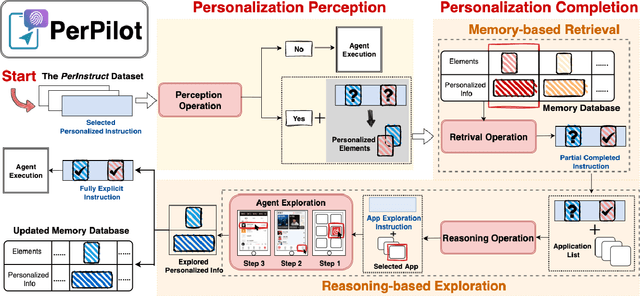


Vision language model (VLM)-based mobile agents show great potential for assisting users in performing instruction-driven tasks. However, these agents typically struggle with personalized instructions -- those containing ambiguous, user-specific context -- a challenge that has been largely overlooked in previous research. In this paper, we define personalized instructions and introduce PerInstruct, a novel human-annotated dataset covering diverse personalized instructions across various mobile scenarios. Furthermore, given the limited personalization capabilities of existing mobile agents, we propose PerPilot, a plug-and-play framework powered by large language models (LLMs) that enables mobile agents to autonomously perceive, understand, and execute personalized user instructions. PerPilot identifies personalized elements and autonomously completes instructions via two complementary approaches: memory-based retrieval and reasoning-based exploration. Experimental results demonstrate that PerPilot effectively handles personalized tasks with minimal user intervention and progressively improves its performance with continued use, underscoring the importance of personalization-aware reasoning for next-generation mobile agents. The dataset and code are available at: https://github.com/xinwang-nwpu/PerPilot