 Add to Chrome
 Add to Firefox
 Add to Edge
Every Picture Tells a Dangerous Story: Memory-Augmented Multi-Agent Jailbreak Attacks on VLMs
Apr 14, 2026
The rapid evolution of Vision-Language Models (VLMs) has catalyzed unprecedented capabilities in artificial intelligence; however, this continuous modal expansion has inadvertently exposed a vastly broadened and unconstrained adversarial attack surface. Current multimodal jailbreak strategies primarily focus on surface-level pixel perturbations and typographic attacks or harmful images; however, they fail to engage with the complex semantic structures intrinsic to visual data. This leaves the vast semantic attack surface of original, natural images largely unscrutinized. Driven by the need to expose these deep-seated semantic vulnerabilities, we introduce \textbf{MemJack}, a \textbf{MEM}ory-augmented multi-agent \textbf{JA}ilbreak atta\textbf{CK} framework that explicitly leverages visual semantics to orchestrate automated jailbreak attacks. MemJack employs coordinated multi-agent cooperation to dynamically map visual entities to malicious intents, generate adversarial prompts via multi-angle visual-semantic camouflage, and utilize an Iterative Nullspace Projection (INLP) geometric filter to bypass premature latent space refusals. By accumulating and transferring successful strategies through a persistent Multimodal Experience Memory, MemJack maintains highly coherent extended multi-turn jailbreak attack interactions across different images, thereby improving the attack success rate (ASR) on new images. Extensive empirical evaluations across full, unmodified COCO val2017 images demonstrate that MemJack achieves a 71.48\% ASR against Qwen3-VL-Plus, scaling to 90\% under extended budgets. Furthermore, to catalyze future defensive alignment research, we will release \textbf{MemJack-Bench}, a comprehensive dataset comprising over 113,000 interactive multimodal jailbreak attack trajectories, establishing a vital foundation for developing inherently robust VLMs.

ContiGuard: A Framework for Continual Toxicity Detection Against Evolving Evasive Perturbations
Mar 16, 2026Toxicity detection mitigates the dissemination of toxic content (e.g., hateful comments, posts, and messages within online social actions) to safeguard a healthy online social environment. However, malicious users persistently develop evasive perturbations to disguise toxic content and evade detectors. Traditional detectors or methods are static over time and are inadequate in addressing these evolving evasion tactics. Thus, continual learning emerges as a logical approach to dynamically update detection ability against evolving perturbations. Nevertheless, disparities across perturbations hinder the detector's continual learning on perturbed text. More importantly, perturbation-induced noises distort semantics to degrade comprehension and also impair critical feature learning to render detection sensitive to perturbations. These amplify the challenge of continual learning against evolving perturbations. In this work, we present ContiGuard, the first framework tailored for continual learning of the detector on time-evolving perturbed text (termed continual toxicity detection) to enable the detector to continually update capability and maintain sustained resilience against evolving perturbations. Specifically, to boost the comprehension, we present an LLM-powered semantic enriching strategy, where we dynamically incorporate possible meaning and toxicity-related clues excavated by LLM into the perturbed text to improve the comprehension. To mitigate non-critical features and amplify critical ones, we propose a discriminability-driven feature learning strategy, where we strengthen discriminative features while suppressing the less-discriminative ones to shape a robust classification boundary for detection...
Organizing, Orchestrating, and Benchmarking Agent Skills at Ecosystem Scale
Mar 02, 2026The rapid proliferation of Claude agent skills has raised the central question of how to effectively leverage, manage, and scale the agent skill ecosystem. In this paper, we propose AgentSkillOS, the first principled framework for skill selection, orchestration, and ecosystem-level management. AgentSkillOS comprises two stages: (i) Manage Skills, which organizes skills into a capability tree via node-level recursive categorization for efficient discovery; and (ii) Solve Tasks, which retrieves, orchestrates, and executes multiple skills through DAG-based pipelines. To evaluate the agent's ability to invoke skills, we construct a benchmark of 30 artifact-rich tasks across five categories: data computation, document creation, motion video, visual design, and web interaction. We assess the quality of task outputs using LLM-based pairwise evaluation, and the results are aggregated via a Bradley-Terry model to produce unified quality scores. Experiments across three skill ecosystem scales (200 to 200K skills) show that tree-based retrieval effectively approximates oracle skill selection, and that DAG-based orchestration substantially outperforms native flat invocation even when given the identical skill set. Our findings confirm that structured composition is the key to unlocking skill potential. Our GitHub repository is available at:https://github.com/ynulihao/AgentSkillOS.
OpenMic: A Multi-Agent-Based Stand-Up Comedy Generation System
Jan 13, 2026Chinese stand-up comedy generation goes beyond plain text generation, requiring culturally grounded humor, precise timing, stage-performance cues, and implicit multi-step reasoning. Moreover, commonly used Chinese humor datasets are often better suited for humor understanding and evaluation than for long-form stand-up generation, making direct supervision misaligned with the target task. To address these challenges, we present OpenMic, an end-to-end multi-agent system built on AutoGen that transforms a user-provided life topic into a 3-5 minute Chinese stand-up performance and further produces a narrated comedy video. OpenMic orchestrates multiple specialized agents in a multi-round iterative loop-planning to jointly optimize humor, timing, and performability. To mitigate the dataset-task mismatch, we augment generation with retrieval-augmented generation (RAG) for material grounding and idea expansion, and we fine-tune a dedicated JokeWriter to better internalize stand-up-specific setup-punchline structures and long-range callbacks.
Can a Small Model Learn to Look Before It Leaps? Dynamic Learning and Proactive Correction for Hallucination Detection
Nov 08, 2025Hallucination in large language models (LLMs) remains a critical barrier to their safe deployment. Existing tool-augmented hallucination detection methods require pre-defined fixed verification strategies, which are crucial to the quality and effectiveness of tool calls. Some methods directly employ powerful closed-source LLMs such as GPT-4 as detectors, which are effective but too costly. To mitigate the cost issue, some methods adopt the teacher-student architecture and finetune open-source small models as detectors via agent tuning. However, these methods are limited by fixed strategies. When faced with a dynamically changing execution environment, they may lack adaptability and inappropriately call tools, ultimately leading to detection failure. To address the problem of insufficient strategy adaptability, we propose the innovative ``Learning to Evaluate and Adaptively Plan''(LEAP) framework, which endows an efficient student model with the dynamic learning and proactive correction capabilities of the teacher model. Specifically, our method formulates the hallucination detection problem as a dynamic strategy learning problem. We first employ a teacher model to generate trajectories within the dynamic learning loop and dynamically adjust the strategy based on execution failures. We then distill this dynamic planning capability into an efficient student model via agent tuning. Finally, during strategy execution, the student model adopts a proactive correction mechanism, enabling it to propose, review, and optimize its own verification strategies before execution. We demonstrate through experiments on three challenging benchmarks that our LEAP-tuned model outperforms existing state-of-the-art methods.
Learning Compact Representations of LLM Abilities via Item Response Theory
Oct 01, 2025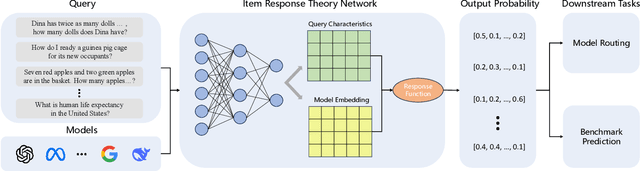

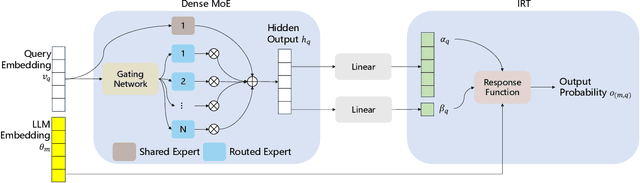

Recent years have witnessed a surge in the number of large language models (LLMs), yet efficiently managing and utilizing these vast resources remains a significant challenge. In this work, we explore how to learn compact representations of LLM abilities that can facilitate downstream tasks, such as model routing and performance prediction on new benchmarks. We frame this problem as estimating the probability that a given model will correctly answer a specific query. Inspired by the item response theory (IRT) in psychometrics, we model this probability as a function of three key factors: (i) the model's multi-skill ability vector, (2) the query's discrimination vector that separates models of differing skills, and (3) the query's difficulty scalar. To learn these parameters jointly, we introduce a Mixture-of-Experts (MoE) network that couples model- and query-level embeddings. Extensive experiments demonstrate that our approach leads to state-of-the-art performance in both model routing and benchmark accuracy prediction. Moreover, analysis validates that the learned parameters encode meaningful, interpretable information about model capabilities and query characteristics.
Beyond GPT-5: Making LLMs Cheaper and Better via Performance-Efficiency Optimized Routing
Aug 18, 2025Balancing performance and efficiency is a central challenge in large language model (LLM) advancement. GPT-5 addresses this with test-time routing, dynamically assigning queries to either an efficient or a high-capacity model during inference. In this work, we present Avengers-Pro, a test-time routing framework that ensembles LLMs of varying capacities and efficiencies, providing a unified solution for all performance-efficiency tradeoffs. The Avengers-Pro embeds and clusters incoming queries, then routes each to the most suitable model based on a performance-efficiency score. Across 6 challenging benchmarks and 8 leading models -- including GPT-5-medium, Gemini-2.5-pro, and Claude-opus-4.1 -- Avengers-Pro achieves state-of-the-art results: by varying a performance-efficiency trade-off parameter, it can surpass the strongest single model (GPT-5-medium) by +7% in average accuracy. Moreover, it can match the average accuracy of the strongest single model at 27% lower cost, and reach ~90% of that performance at 63% lower cost. Last but not least, it achieves a Pareto frontier, consistently yielding the highest accuracy for any given cost, and the lowest cost for any given accuracy, among all single models. Code is available at https://github.com/ZhangYiqun018/AvengersPro.
CAVGAN: Unifying Jailbreak and Defense of LLMs via Generative Adversarial Attacks on their Internal Representations
Jul 08, 2025Security alignment enables the Large Language Model (LLM) to gain the protection against malicious queries, but various jailbreak attack methods reveal the vulnerability of this security mechanism. Previous studies have isolated LLM jailbreak attacks and defenses. We analyze the security protection mechanism of the LLM, and propose a framework that combines attack and defense. Our method is based on the linearly separable property of LLM intermediate layer embedding, as well as the essence of jailbreak attack, which aims to embed harmful problems and transfer them to the safe area. We utilize generative adversarial network (GAN) to learn the security judgment boundary inside the LLM to achieve efficient jailbreak attack and defense. The experimental results indicate that our method achieves an average jailbreak success rate of 88.85\% across three popular LLMs, while the defense success rate on the state-of-the-art jailbreak dataset reaches an average of 84.17\%. This not only validates the effectiveness of our approach but also sheds light on the internal security mechanisms of LLMs, offering new insights for enhancing model security The code and data are available at https://github.com/NLPGM/CAVGAN.
Do We Truly Need So Many Samples? Multi-LLM Repeated Sampling Efficiently Scales Test-Time Compute
Apr 02, 2025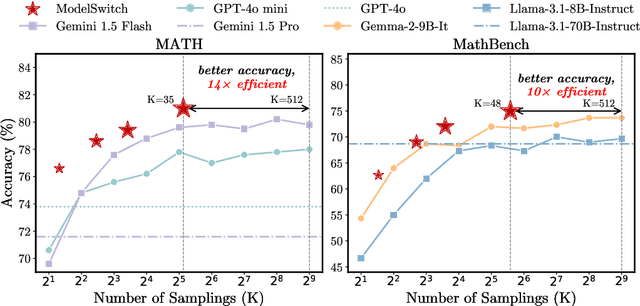

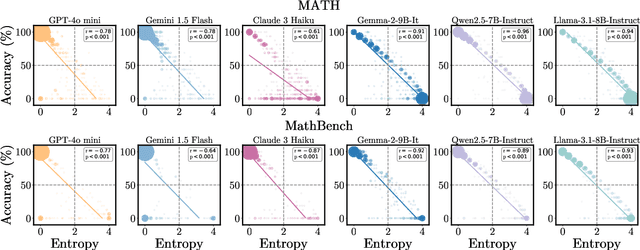
This paper presents a simple, effective, and cost-efficient strategy to improve LLM performance by scaling test-time compute. Our strategy builds upon the repeated-sampling-then-voting framework, with a novel twist: incorporating multiple models, even weaker ones, to leverage their complementary strengths that potentially arise from diverse training data and paradigms. By using consistency as a signal, our strategy dynamically switches between models. Theoretical analysis highlights the efficiency and performance advantages of our strategy. Extensive experiments on six datasets demonstrate that our strategy not only outperforms self-consistency and state-of-the-art multi-agent debate approaches, but also significantly reduces inference costs. Additionally, ModelSwitch requires only a few comparable LLMs to achieve optimal performance and can be extended with verification methods, demonstrating the potential of leveraging multiple LLMs in the generation-verification paradigm.
Reasoning based on symbolic and parametric knowledge bases: a survey
Jan 02, 2025Reasoning is fundamental to human intelligence, and critical for problem-solving, decision-making, and critical thinking. Reasoning refers to drawing new conclusions based on existing knowledge, which can support various applications like clinical diagnosis, basic education, and financial analysis. Though a good number of surveys have been proposed for reviewing reasoning-related methods, none of them has systematically investigated these methods from the viewpoint of their dependent knowledge base. Both the scenarios to which the knowledge bases are applied and their storage formats are significantly different. Hence, investigating reasoning methods from the knowledge base perspective helps us better understand the challenges and future directions. To fill this gap, this paper first classifies the knowledge base into symbolic and parametric ones. The former explicitly stores information in human-readable symbols, and the latter implicitly encodes knowledge within parameters. Then, we provide a comprehensive overview of reasoning methods using symbolic knowledge bases, parametric knowledge bases, and both of them. Finally, we identify the future direction toward enhancing reasoning capabilities to bridge the gap between human and machine intelligence.