 Add to Chrome
 Add to Firefox
 Add to Edge
Redco: A Lightweight Tool to Automate Distributed Training of LLMs on Any GPU/TPUs
Oct 25, 2023
The recent progress of AI can be largely attributed to large language models (LLMs). However, their escalating memory requirements introduce challenges for machine learning (ML) researchers and engineers. Addressing this requires developers to partition a large model to distribute it across multiple GPUs or TPUs. This necessitates considerable coding and intricate configuration efforts with existing model parallel tools, such as Megatron-LM, DeepSpeed, and Alpa. These tools require users' expertise in machine learning systems (MLSys), creating a bottleneck in LLM development, particularly for developers without MLSys background. In this work, we present Redco, a lightweight and user-friendly tool crafted to automate distributed training and inference for LLMs, as well as to simplify ML pipeline development. The design of Redco emphasizes two key aspects. Firstly, to automate model parallism, our study identifies two straightforward rules to generate tensor parallel strategies for any given LLM. Integrating these rules into Redco facilitates effortless distributed LLM training and inference, eliminating the need of additional coding or complex configurations. We demonstrate the effectiveness by applying Redco on a set of LLM architectures, such as GPT-J, LLaMA, T5, and OPT, up to the size of 66B. Secondly, we propose a mechanism that allows for the customization of diverse ML pipelines through the definition of merely three functions, eliminating redundant and formulaic code like multi-host related processing. This mechanism proves adaptable across a spectrum of ML algorithms, from foundational language modeling to complex algorithms like meta-learning and reinforcement learning. Consequently, Redco implementations exhibit much fewer code lines compared to their official counterparts.

Text Alignment Is An Efficient Unified Model for Massive NLP Tasks
Jul 06, 2023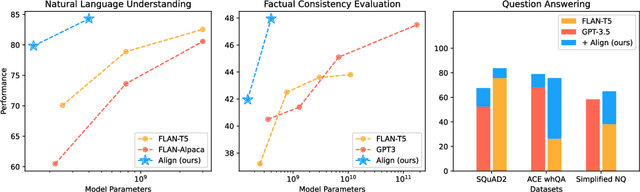
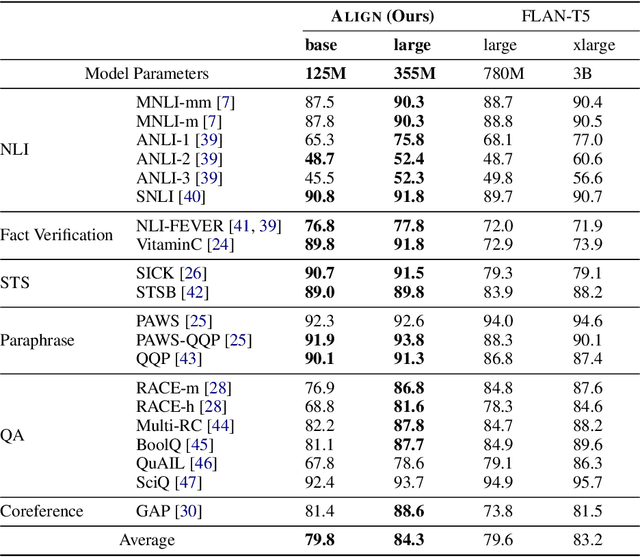
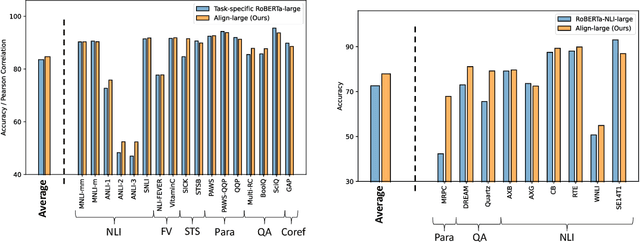
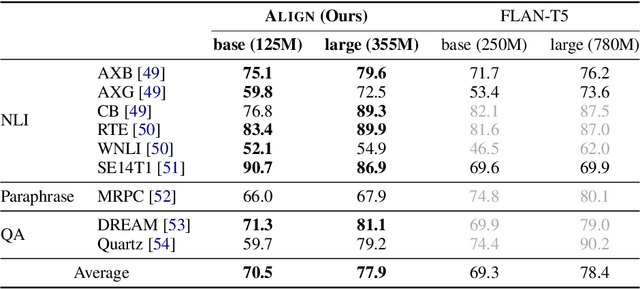
Large language models (LLMs), typically designed as a function of next-word prediction, have excelled across extensive NLP tasks. Despite the generality, next-word prediction is often not an efficient formulation for many of the tasks, demanding an extreme scale of model parameters (10s or 100s of billions) and sometimes yielding suboptimal performance. In practice, it is often desirable to build more efficient models -- despite being less versatile, they still apply to a substantial subset of problems, delivering on par or even superior performance with much smaller model sizes. In this paper, we propose text alignment as an efficient unified model for a wide range of crucial tasks involving text entailment, similarity, question answering (and answerability), factual consistency, and so forth. Given a pair of texts, the model measures the degree of alignment between their information. We instantiate an alignment model (Align) through lightweight finetuning of RoBERTa (355M parameters) using 5.9M examples from 28 datasets. Despite its compact size, extensive experiments show the model's efficiency and strong performance: (1) On over 20 datasets of aforementioned diverse tasks, the model matches or surpasses FLAN-T5 models that have around 2x or 10x more parameters; the single unified model also outperforms task-specific models finetuned on individual datasets; (2) When applied to evaluate factual consistency of language generation on 23 datasets, our model improves over various baselines, including the much larger GPT-3.5 (ChatGPT) and sometimes even GPT-4; (3) The lightweight model can also serve as an add-on component for LLMs such as GPT-3.5 in question answering tasks, improving the average exact match (EM) score by 17.94 and F1 score by 15.05 through identifying unanswerable questions.
AlignScore: Evaluating Factual Consistency with a Unified Alignment Function
May 26, 2023Many text generation applications require the generated text to be factually consistent with input information. Automatic evaluation of factual consistency is challenging. Previous work has developed various metrics that often depend on specific functions, such as natural language inference (NLI) or question answering (QA), trained on limited data. Those metrics thus can hardly assess diverse factual inconsistencies (e.g., contradictions, hallucinations) that occur in varying inputs/outputs (e.g., sentences, documents) from different tasks. In this paper, we propose AlignScore, a new holistic metric that applies to a variety of factual inconsistency scenarios as above. AlignScore is based on a general function of information alignment between two arbitrary text pieces. Crucially, we develop a unified training framework of the alignment function by integrating a large diversity of data sources, resulting in 4.7M training examples from 7 well-established tasks (NLI, QA, paraphrasing, fact verification, information retrieval, semantic similarity, and summarization). We conduct extensive experiments on large-scale benchmarks including 22 evaluation datasets, where 19 of the datasets were never seen in the alignment training. AlignScore achieves substantial improvement over a wide range of previous metrics. Moreover, AlignScore (355M parameters) matches or even outperforms metrics based on ChatGPT and GPT-4 that are orders of magnitude larger.
Reasoning with Language Model is Planning with World Model
May 24, 2023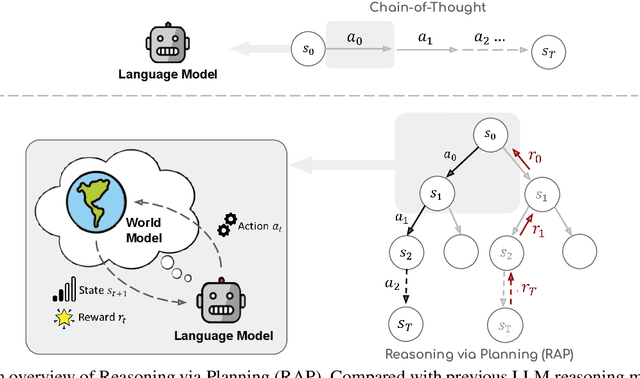
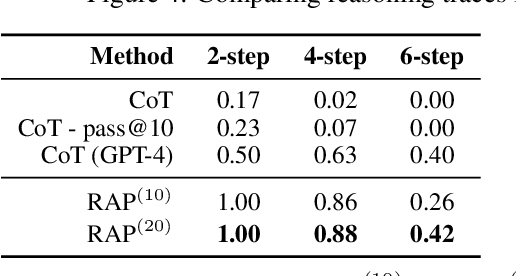
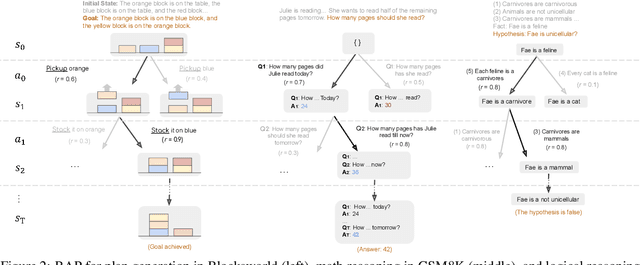
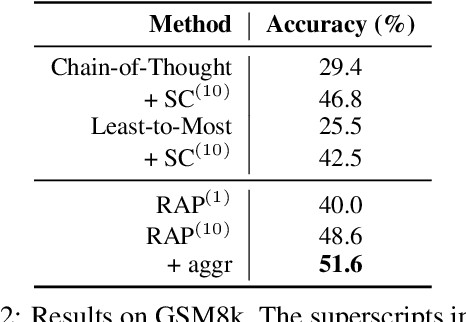
Large language models (LLMs) have shown remarkable reasoning capabilities, especially when prompted to generate intermediate reasoning steps (e.g., Chain-of-Thought, CoT). However, LLMs can still struggle with problems that are easy for humans, such as generating action plans for executing tasks in a given environment, or performing complex math, logical, and commonsense reasoning. The deficiency stems from the key fact that LLMs lack an internal $\textit{world model}$ to predict the world $\textit{state}$ (e.g., environment status, intermediate variable values) and simulate long-term outcomes of actions. This prevents LLMs from performing deliberate planning akin to human brains, which involves exploring alternative reasoning paths, anticipating future states and rewards, and iteratively refining existing reasoning steps. To overcome the limitations, we propose a new LLM reasoning framework, $\underline{R}\textit{easoning vi}\underline{a} \underline{P}\textit{lanning}$ $\textbf{(RAP)}$. RAP repurposes the LLM as both a world model and a reasoning agent, and incorporates a principled planning algorithm (based on Monto Carlo Tree Search) for strategic exploration in the vast reasoning space. During reasoning, the LLM (as agent) incrementally builds a reasoning tree under the guidance of the LLM (as world model) and task-specific rewards, and obtains a high-reward reasoning path efficiently with a proper balance between exploration $\textit{vs.}$ exploitation. We apply RAP to a variety of challenging reasoning problems including plan generation, math reasoning, and logical inference. Empirical results on these tasks demonstrate the superiority of RAP over various strong baselines, including CoT and least-to-most prompting with self-consistency. RAP on LLAMA-33B surpasses CoT on GPT-4 with 33% relative improvement in a plan generation setting.
Language Models Meet World Models: Embodied Experiences Enhance Language Models
May 22, 2023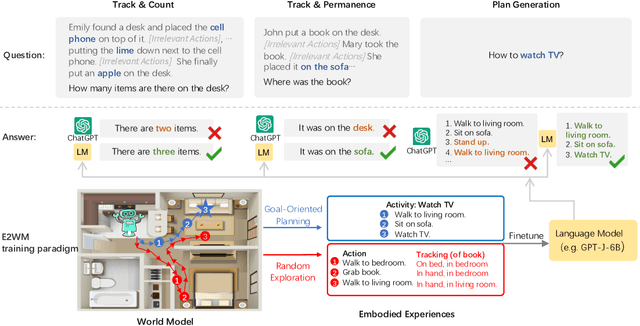

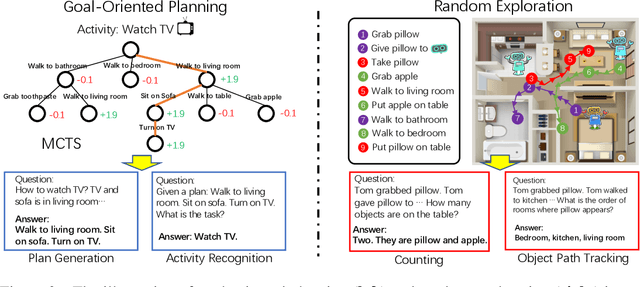
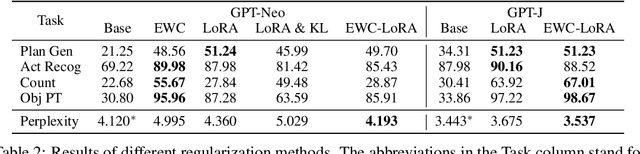
While large language models (LMs) have shown remarkable capabilities across numerous tasks, they often struggle with simple reasoning and planning in physical environments, such as understanding object permanence or planning household activities. The limitation arises from the fact that LMs are trained only on written text and miss essential embodied knowledge and skills. In this paper, we propose a new paradigm of enhancing LMs by finetuning them with world models, to gain diverse embodied knowledge while retaining their general language capabilities. Our approach deploys an embodied agent in a world model, particularly a simulator of the physical world (VirtualHome), and acquires a diverse set of embodied experiences through both goal-oriented planning and random exploration. These experiences are then used to finetune LMs to teach diverse abilities of reasoning and acting in the physical world, e.g., planning and completing goals, object permanence and tracking, etc. Moreover, it is desirable to preserve the generality of LMs during finetuning, which facilitates generalizing the embodied knowledge across tasks rather than being tied to specific simulations. We thus further introduce the classical elastic weight consolidation (EWC) for selective weight updates, combined with low-rank adapters (LoRA) for training efficiency. Extensive experiments show our approach substantially improves base LMs on 18 downstream tasks by 64.28% on average. In particular, the small LMs (1.3B and 6B) enhanced by our approach match or even outperform much larger LMs (e.g., ChatGPT).
ToolkenGPT: Augmenting Frozen Language Models with Massive Tools via Tool Embeddings
May 19, 2023Augmenting large language models (LLMs) with external tools has emerged as a promising approach to solving complex problems. However, traditional methods, which finetune LLMs with tool demonstration data, can be both costly and restricted to a predefined set of tools. Recent in-context learning paradigm alleviates these issues, but the limited context length only allows for a few shots of demonstrations, leading to suboptimal understandings of the tools. Moreover, when there are numerous tools to choose from, in-context learning could completely fail to work. In this paper, we propose an alternative approach, $\textbf{ToolkenGPT}$, which combines the benefits of both sides. Our approach represents each $\underline{tool}$ as a to$\underline{ken}$ ($\textit{toolken}$) and learns an embedding for it, enabling tool calls in the same way as generating a regular word token. Once a toolken is triggered, the LLM is prompted to complete arguments for the tool to execute. ToolkenGPT offers the flexibility to plug in an arbitrary number of tools by expanding the set of toolkens on the fly. In addition, it improves tool use by allowing extensive demonstration data for learning the toolken embeddings. In diverse domains, including numerical reasoning, knowledge-based question answering, and embodied plan generation, our approach effectively augments LLMs with tools and substantially outperforms various latest baselines. ToolkenGPT demonstrates the promising ability to use relevant tools from a large tool set in complex scenarios.
ASDOT: Any-Shot Data-to-Text Generation with Pretrained Language Models
Oct 11, 2022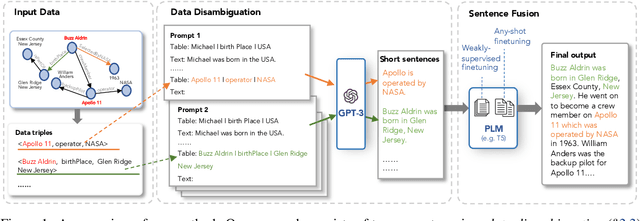
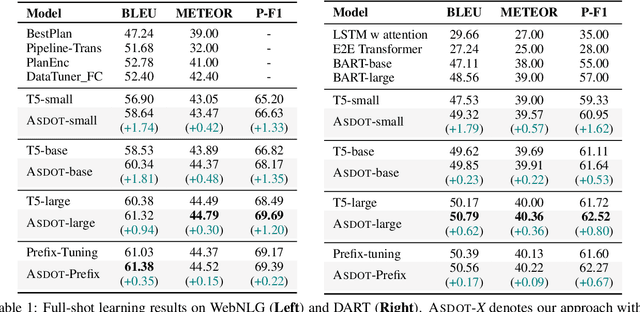
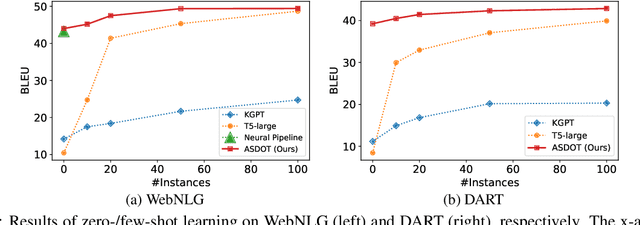
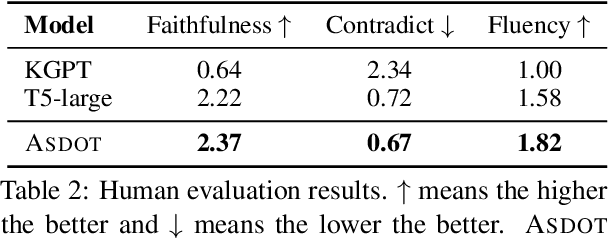
Data-to-text generation is challenging due to the great variety of the input data in terms of domains (e.g., finance vs sports) or schemata (e.g., diverse predicates). Recent end-to-end neural methods thus require substantial training examples to learn to disambiguate and describe the data. Yet, real-world data-to-text problems often suffer from various data-scarce issues: one may have access to only a handful of or no training examples, and/or have to rely on examples in a different domain or schema. To fill this gap, we propose Any-Shot Data-to-Text (ASDOT), a new approach flexibly applicable to diverse settings by making efficient use of any given (or no) examples. ASDOT consists of two steps, data disambiguation and sentence fusion, both of which are amenable to be solved with off-the-shelf pretrained language models (LMs) with optional finetuning. In the data disambiguation stage, we employ the prompted GPT-3 model to understand possibly ambiguous triples from the input data and convert each into a short sentence with reduced ambiguity. The sentence fusion stage then uses an LM like T5 to fuse all the resulting sentences into a coherent paragraph as the final description. We evaluate extensively on various datasets in different scenarios, including the zero-/few-/full-shot settings, and generalization to unseen predicates and out-of-domain data. Experimental results show that ASDOT consistently achieves significant improvement over baselines, e.g., a 30.81 BLEU gain on the DART dataset under the zero-shot setting.
Composable Text Control Operations in Latent Space with Ordinary Differential Equations
Aug 01, 2022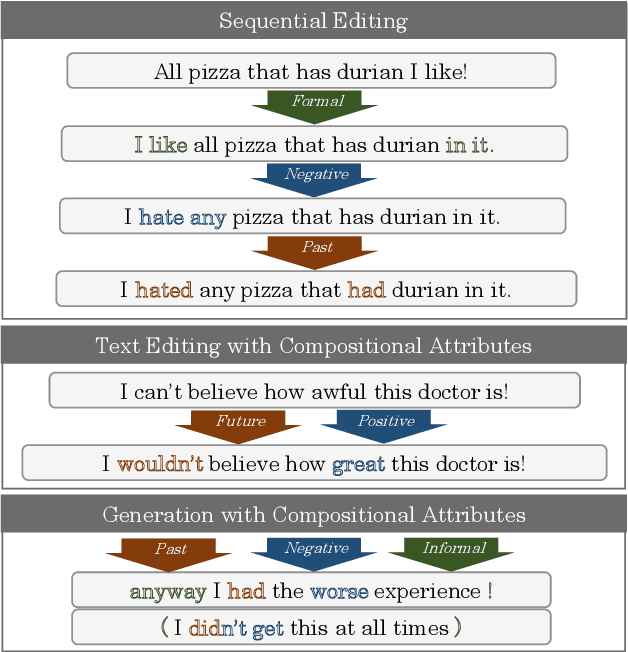
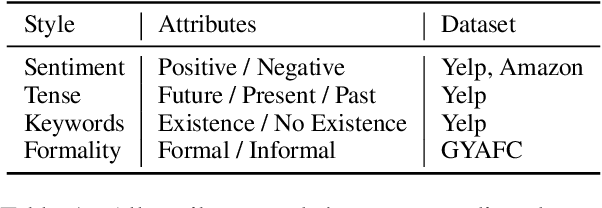

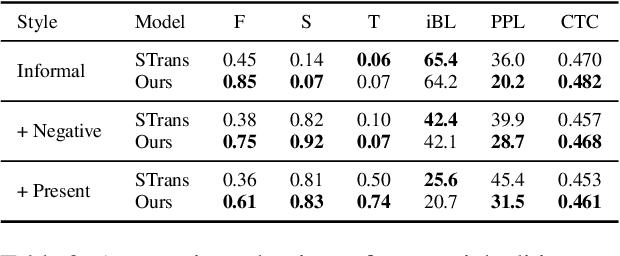
Real-world text applications often involve composing a wide range of text control operations, such as editing the text w.r.t. an attribute, manipulating keywords and structure, and generating new text of desired properties. Prior work typically learns/finetunes a language model (LM) to perform individual or specific subsets of operations. Recent research has studied combining operations in a plug-and-play manner, often with costly search or optimization in the complex sequence space. This paper proposes a new efficient approach for composable text operations in the compact latent space of text. The low-dimensionality and differentiability of the text latent vector allow us to develop an efficient sampler based on ordinary differential equations (ODEs) given arbitrary plug-in operators (e.g., attribute classifiers). By connecting pretrained LMs (e.g., GPT2) to the latent space through efficient adaption, we then decode the sampled vectors into desired text sequences. The flexible approach permits diverse control operators (sentiment, tense, formality, keywords, etc.) acquired using any relevant data from different domains. Experiments show that composing those operators within our approach manages to generate or edit high-quality text, substantially improving over previous methods in terms of generation quality and efficiency.
BertNet: Harvesting Knowledge Graphs from Pretrained Language Models
Jun 28, 2022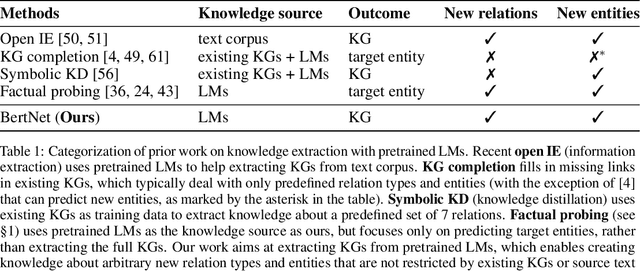
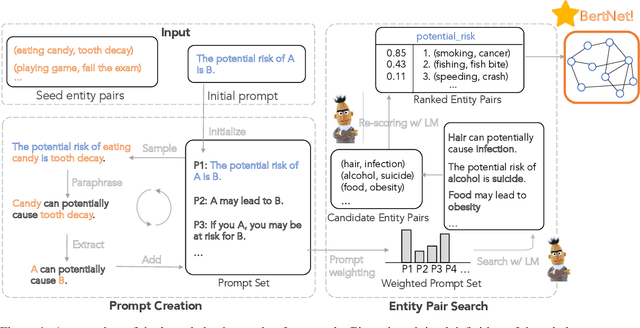
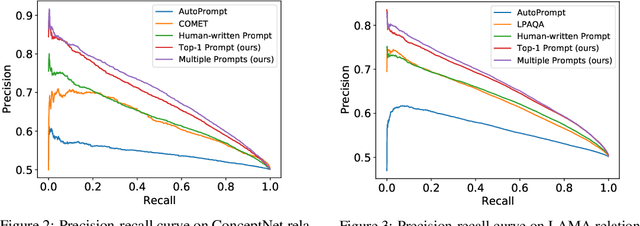
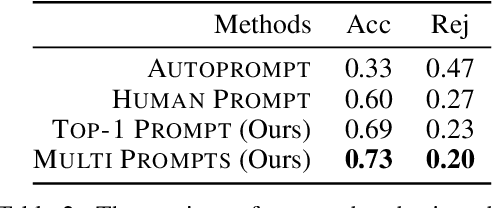
Symbolic knowledge graphs (KGs) have been constructed either by expensive human crowdsourcing or with domain-specific complex information extraction pipelines. The emerging large pretrained language models (LMs), such as Bert, have shown to implicitly encode massive knowledge which can be queried with properly designed prompts. However, compared to the explicit KGs, the implict knowledge in the black-box LMs is often difficult to access or edit and lacks explainability. In this work, we aim at harvesting symbolic KGs from the LMs, a new framework for automatic KG construction empowered by the neural LMs' flexibility and scalability. Compared to prior works that often rely on large human annotated data or existing massive KGs, our approach requires only the minimal definition of relations as inputs, and hence is suitable for extracting knowledge of rich new relations not available before.The approach automatically generates diverse prompts, and performs efficient knowledge search within a given LM for consistent and extensive outputs. The harvested knowledge with our approach is substantially more accurate than with previous methods, as shown in both automatic and human evaluation. As a result, we derive from diverse LMs a family of new KGs (e.g., BertNet and RoBERTaNet) that contain a richer set of commonsense relations, including complex ones (e.g., "A is capable of but not good at B"), than the human-annotated KGs (e.g., ConceptNet). Besides, the resulting KGs also serve as a vehicle to interpret the respective source LMs, leading to new insights into the varying knowledge capability of different LMs.
RLPrompt: Optimizing Discrete Text Prompts With Reinforcement Learning
May 25, 2022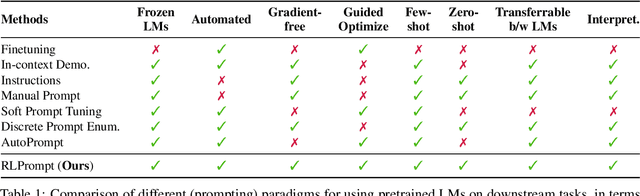
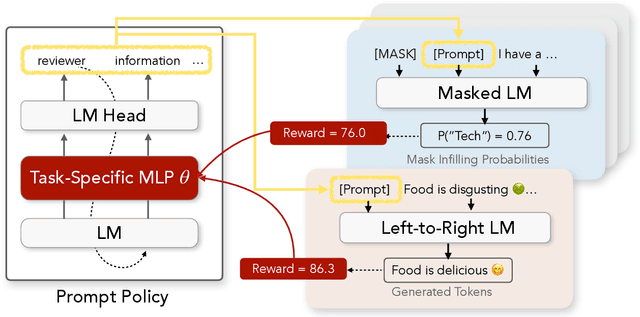
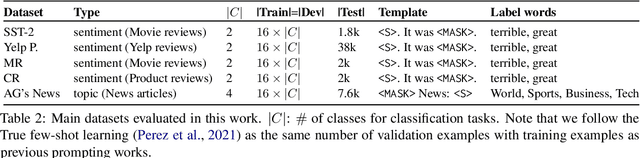
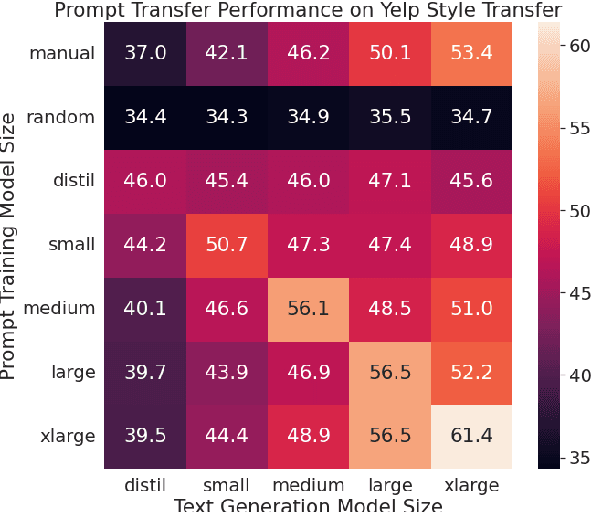
Prompting has shown impressive success in enabling large pretrained language models (LMs) to perform diverse NLP tasks, especially when only few downstream data are available. Automatically finding the optimal prompt for each task, however, is challenging. Most existing work resorts to tuning soft prompt (e.g., embeddings) which falls short of interpretability, reusability across LMs, and applicability when gradients are not accessible. Discrete prompt, on the other hand, is difficult to optimize, and is often created by "enumeration (e.g., paraphrasing)-then-selection" heuristics that do not explore the prompt space systematically. This paper proposes RLPrompt, an efficient discrete prompt optimization approach with reinforcement learning (RL). RLPrompt formulates a parameter-efficient policy network that generates the desired discrete prompt after training with reward. To overcome the complexity and stochasticity of reward signals by the large LM environment, we incorporate effective reward stabilization that substantially enhances the training efficiency. RLPrompt is flexibly applicable to different types of LMs, such as masked (e.g., BERT) and left-to-right models (e.g., GPTs), for both classification and generation tasks. Experiments on few-shot classification and unsupervised text style transfer show superior performance over a wide range of existing finetuning or prompting methods. Interestingly, the resulting optimized prompts are often ungrammatical gibberish text; and surprisingly, those gibberish prompts are transferrable between different LMs to retain significant performance, indicating LM prompting may not follow human language patterns.