 Add to Chrome
 Add to Firefox
 Add to Edge
AgentDoG 1.5: A Lightweight and Scalable Alignment Framework for AI Agent Safety and Security
May 28, 2026
Modern open-world agents such as OpenClaw exhibit powerful cross-environment execution capabilities yet introduce broad new safety risk sources. Meanwhile, advanced frontier AI models drastically lower attack barriers, rendering current agent alignment frameworks inadequate for real-world deployment. To tackle these emerging threats, we propose a lightweight and scalable agent safety alignment framework. Specifically, we update the agent safety taxonomy to accommodate emergent risks from Codex and OpenClaw execution scenarios. We further build a taxonomy-guided data engine with influence-function purification to train lightweight AgentDoG 1.5 variants (0.8B, 2B, 4B, and 8B parameters) using only around 1k samples, achieving comparable performance with leading closed-source models (e.g., GPT-5.4). Based on AgentDoG 1.5, we construct a highly efficient agentic safety SFT and RL training environment, which reduces deployment overhead in Docker-level environments by two orders of magnitude. Finally, we deploy AgentDoG 1.5 as a training-free online guardrail for real-time safety moderation. Extensive experimental results indicate that AgentDoG 1.5 achieves state-of-the-art performance in diverse and complex interactive agentic scenarios. All models and datasets are openly released.

Mitigating Action-Relation Hallucinations in LVLMs via Relation-aware Visual Enhancement
May 12, 2026Large Vision-Language Models (LVLMs) have achieved remarkable performance on diverse vision-language tasks. However, LVLMs still suffer from hallucinations, generating text that contradicts the visual input. Existing research has primarily focused on mitigating object hallucinations, but often overlooks more complex relation hallucinations, particularly action relations involving interactions between objects. In this study, we empirically observe that the primary cause of action-relation hallucinations in LVLMs is the insufficient attention allocated to visual information. Thus, we propose a framework to locate action-relevant image regions and enhance the LVLM's attention to those regions. Specifically, we define the Action-Relation Sensitivity (ARS) score to identify attention heads that are most sensitive to action-relation changes, thereby localizing action-relevant image regions that contain key visual cues. Then, we propose the Relation-aware Visual Enhancement (RVE) method to enhance the LVLM's attention to these action-relevant image regions. Extensive experiments demonstrate that, compared to existing baselines, our method achieves superior performance in mitigating action-relation hallucinations with negligible additional inference cost. Furthermore, it effectively generalizes to spatial-relation hallucinations and object hallucinations.
Multilingual Safety Alignment via Self-Distillation
May 03, 2026Large language models (LLMs) exhibit severe multilingual safety misalignment: they possess strong safeguards in high-resource languages but remain highly vulnerable to jailbreak attacks in low-resource languages. Current safety alignment methods generally rely on high-quality response data for each target language, which is expensive and difficult to generate. In this paper, we propose a cross-lingual safeguard transfer framework named Multilingual Self-Distillation (MSD). This framework transfers an LLM's inherent safety capabilities from high-resource (e.g., English) to low-resource (e.g., Javanese) languages, overcoming the need for response data in any language. Our framework is flexible and can be integrated with different self-distillation strategies. Specifically, we implement two concrete methods -- on-policy MSD and off-policy MSD -- both of which enable effective cross-lingual safety transfer using only multilingual queries. Furthermore, we propose Dual-Perspective Safety Weighting (DPSW), a divergence measure to optimize the distillation objective. By jointly considering the perspectives of both the teacher and the student, DPSW adaptively increases the penalty weights on safety-critical tokens while reducing the weights on non-critical tokens. Extensive experiments on representative LLMs across diverse multilingual jailbreak and utility benchmarks demonstrate that our method consistently achieves superior multilingual safety performance. Notably, it generalizes effectively to more challenging datasets and unseen languages while preserving the model's general capabilities.
Toward Accountable AI-Generated Content on Social Platforms: Steganographic Attribution and Multimodal Harm Detection
Apr 12, 2026The rapid growth of generative AI has introduced new challenges in content moderation and digital forensics. In particular, benign AI-generated images can be paired with harmful or misleading text, creating difficult-to-detect misuse. This contextual misuse undermines the traditional moderation framework and complicates attribution, as synthetic images typically lack persistent metadata or device signatures. We introduce a steganography enabled attribution framework that embeds cryptographically signed identifiers into images at creation time and uses multimodal harmful content detection as a trigger for attribution verification. Our system evaluates five watermarking methods across spatial, frequency, and wavelet domains. It also integrates a CLIP-based fusion model for multimodal harmful-content detection. Experiments demonstrate that spread-spectrum watermarking, especially in the wavelet domain, provides strong robustness under blur distortions, and our multimodal fusion detector achieves an AUC-ROC of 0.99, enabling reliable cross-modal attribution verification. These components form an end-to-end forensic pipeline that enables reliable tracing of harmful deployments of AI-generated imagery, supporting accountability in modern synthetic media environments. Our code is available at GitHub: https://github.com/bli1/steganography
TME-PSR: Time-aware, Multi-interest, and Explanation Personalization for Sequential Recommendation
Apr 10, 2026In this paper, we propose a sequential recommendation model that integrates Time-aware personalization, Multi-interest personalization, and Explanation personalization for Personalized Sequential Recommendation (TME-PSR). That is, we consider the differences across different users in temporal rhythm preference, multiple fine-grained latent interests, and the personalized semantic alignment between recommendations and explanations. Specifically, the proposed TME-PSR model employs a dual-view gated time encoder to capture personalized temporal rhythms, a lightweight multihead Linear Recurrent Unit architecture that enables fine-grained sub-interest modeling with improved efficiency, and a dynamic dual-branch mutual information weighting mechanism to achieve personalized alignment between recommendations and explanations. Extensive experiments on real-world datasets demonstrate that our method consistently improves recommendation accuracy and explanation quality, at a lower computational cost.
Combating Partial Perception Deficit in Autonomous Driving with Multimodal LLM Commonsense
Mar 10, 2025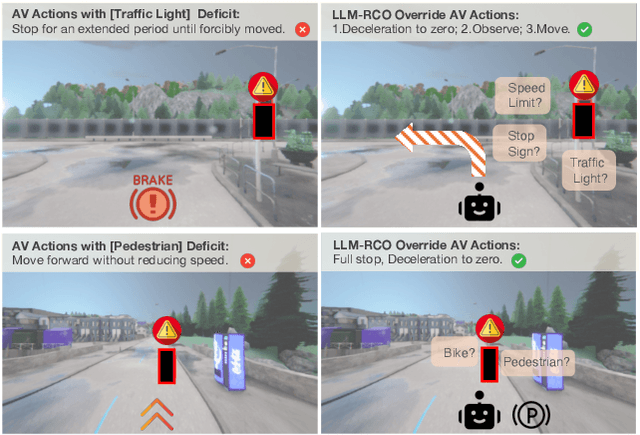
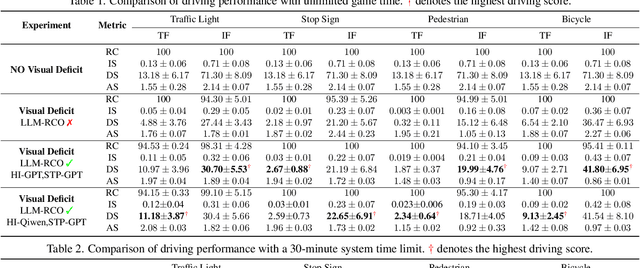
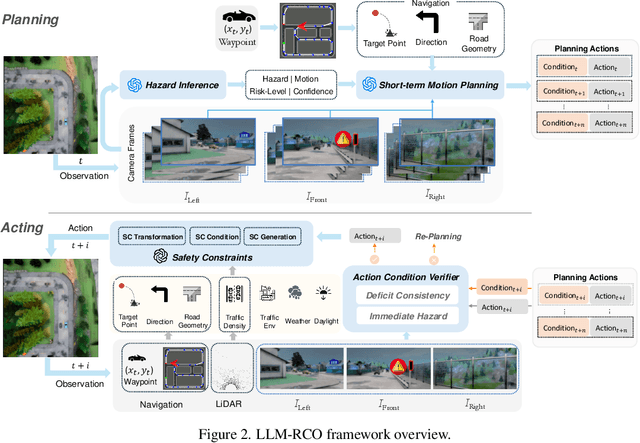
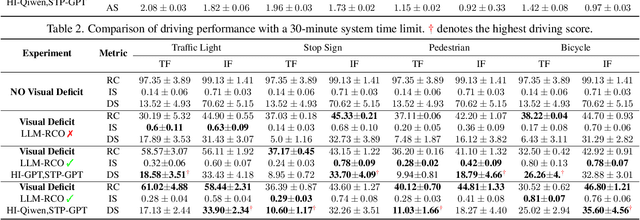
Partial perception deficits can compromise autonomous vehicle safety by disrupting environmental understanding. Current protocols typically respond with immediate stops or minimal-risk maneuvers, worsening traffic flow and lacking flexibility for rare driving scenarios. In this paper, we propose LLM-RCO, a framework leveraging large language models to integrate human-like driving commonsense into autonomous systems facing perception deficits. LLM-RCO features four key modules: hazard inference, short-term motion planner, action condition verifier, and safety constraint generator. These modules interact with the dynamic driving environment, enabling proactive and context-aware control actions to override the original control policy of autonomous agents. To improve safety in such challenging conditions, we construct DriveLM-Deficit, a dataset of 53,895 video clips featuring deficits of safety-critical objects, complete with annotations for LLM-based hazard inference and motion planning fine-tuning. Extensive experiments in adverse driving conditions with the CARLA simulator demonstrate that systems equipped with LLM-RCO significantly improve driving performance, highlighting its potential for enhancing autonomous driving resilience against adverse perception deficits. Our results also show that LLMs fine-tuned with DriveLM-Deficit can enable more proactive movements instead of conservative stops in the context of perception deficits.
Recognize Any Surgical Object: Unleashing the Power of Weakly-Supervised Data
Jan 25, 2025
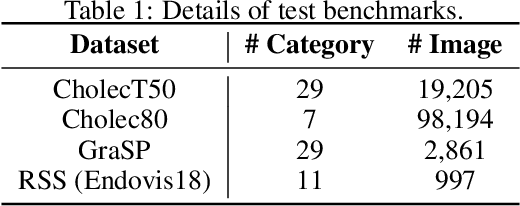

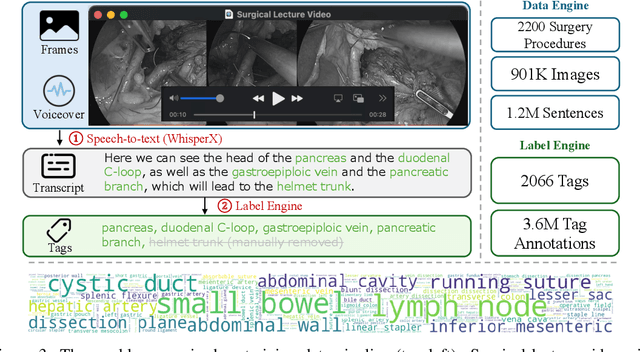
We present RASO, a foundation model designed to Recognize Any Surgical Object, offering robust open-set recognition capabilities across a broad range of surgical procedures and object classes, in both surgical images and videos. RASO leverages a novel weakly-supervised learning framework that generates tag-image-text pairs automatically from large-scale unannotated surgical lecture videos, significantly reducing the need for manual annotations. Our scalable data generation pipeline gatherers to 2,200 surgical procedures and produces 3.6 million tag annotations across 2,066 unique surgical tags. Our experiments show that RASO achieves improvements of 2.9 mAP, 4.5 mAP, 10.6 mAP, and 7.2 mAP on four standard surgical benchmarks respectively in zero-shot settings, and surpasses state-of-the-art models in supervised surgical action recognition tasks. We will open-source our code, model, and dataset to facilitate further research.
Tiny-Align: Bridging Automatic Speech Recognition and Large Language Model on the Edge
Nov 21, 2024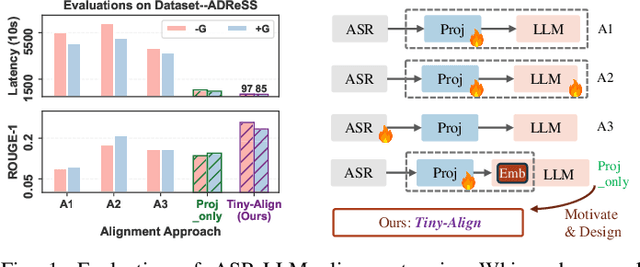


The combination of Large Language Models (LLM) and Automatic Speech Recognition (ASR), when deployed on edge devices (called edge ASR-LLM), can serve as a powerful personalized assistant to enable audio-based interaction for users. Compared to text-based interaction, edge ASR-LLM allows accessible and natural audio interactions. Unfortunately, existing ASR-LLM models are mainly trained in high-performance computing environments and produce substantial model weights, making them difficult to deploy on edge devices. More importantly, to better serve users' personalized needs, the ASR-LLM must be able to learn from each distinct user, given that audio input often contains highly personalized characteristics that necessitate personalized on-device training. Since individually fine-tuning the ASR or LLM often leads to suboptimal results due to modality-specific limitations, end-to-end training ensures seamless integration of audio features and language understanding (cross-modal alignment), ultimately enabling a more personalized and efficient adaptation on edge devices. However, due to the complex training requirements and substantial computational demands of existing approaches, cross-modal alignment between ASR audio and LLM can be challenging on edge devices. In this work, we propose a resource-efficient cross-modal alignment framework that bridges ASR and LLMs on edge devices to handle personalized audio input. Our framework enables efficient ASR-LLM alignment on resource-constrained devices like NVIDIA Jetson Orin (8GB RAM), achieving 50x training time speedup while improving the alignment quality by more than 50\%. To the best of our knowledge, this is the first work to study efficient ASR-LLM alignment on resource-constrained edge devices.
NVCiM-PT: An NVCiM-assisted Prompt Tuning Framework for Edge LLMs
Nov 12, 2024


Large Language Models (LLMs) deployed on edge devices, known as edge LLMs, need to continuously fine-tune their model parameters from user-generated data under limited resource constraints. However, most existing learning methods are not applicable for edge LLMs because of their reliance on high resources and low learning capacity. Prompt tuning (PT) has recently emerged as an effective fine-tuning method for edge LLMs by only modifying a small portion of LLM parameters, but it suffers from user domain shifts, resulting in repetitive training and losing resource efficiency. Conventional techniques to address domain shift issues often involve complex neural networks and sophisticated training, which are incompatible for PT for edge LLMs. Therefore, an open research question is how to address domain shift issues for edge LLMs with limited resources. In this paper, we propose a prompt tuning framework for edge LLMs, exploiting the benefits offered by non-volatile computing-in-memory (NVCiM) architectures. We introduce a novel NVCiM-assisted PT framework, where we narrow down the core operations to matrix-matrix multiplication, which can then be accelerated by performing in-situ computation on NVCiM. To the best of our knowledge, this is the first work employing NVCiM to improve the edge LLM PT performance.
An Adaptive System for Wearable Devices to Detect Stress Using Physiological Signals
Jul 21, 2024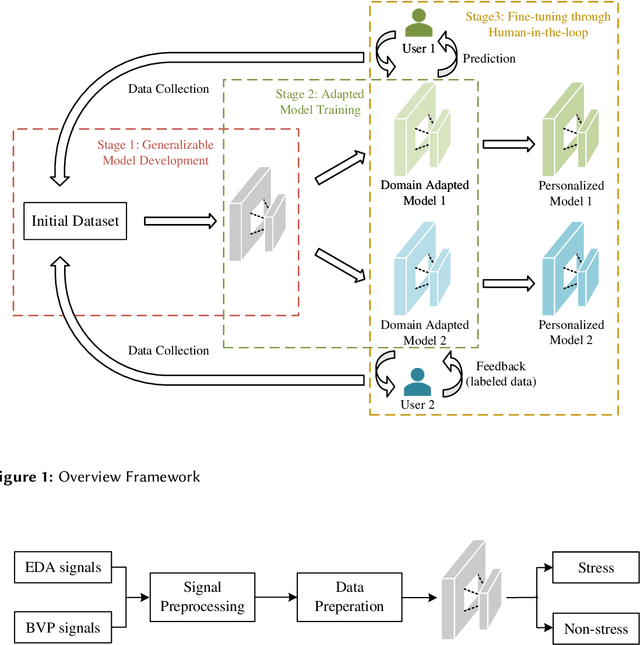

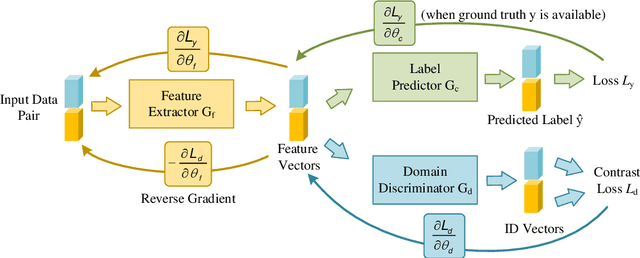
Timely stress detection is crucial for protecting vulnerable groups from long-term detrimental effects by enabling early intervention. Wearable devices, by collecting real-time physiological signals, offer a solution for accurate stress detection accommodating individual differences. This position paper introduces an adaptive framework for personalized stress detection using PPG and EDA signals. Unlike traditional methods that rely on a generalized model, which may suffer performance drops when applied to new users due to domain shifts, this framework aims to provide each user with a personalized model for higher stress detection accuracy. The framework involves three stages: developing a generalized model offline with an initial dataset, adapting the model to the user's unlabeled data, and fine-tuning it with a small set of labeled data obtained through user interaction. This approach not only offers a foundation for mobile applications that provide personalized stress detection and intervention but also has the potential to address a wider range of mental health issues beyond stress detection using physiological signals.