 Add to Chrome
 Add to Firefox
 Add to Edge
CausalVAD: De-confounding End-to-End Autonomous Driving via Causal Intervention
Mar 19, 2026
Planning-oriented end-to-end driving models show great promise, yet they fundamentally learn statistical correlations instead of true causal relationships. This vulnerability leads to causal confusion, where models exploit dataset biases as shortcuts, critically harming their reliability and safety in complex scenarios. To address this, we introduce CausalVAD, a de-confounding training framework that leverages causal intervention. At its core, we design the sparse causal intervention scheme (SCIS), a lightweight, plug-and-play module to instantiate the backdoor adjustment theory in neural networks. SCIS constructs a dictionary of prototypes representing latent driving contexts. It then uses this dictionary to intervene on the model's sparse vectorized queries. This step actively eliminates spurious associations induced by confounders, thereby eliminating spurious factors from the representations for downstream tasks. Extensive experiments on benchmarks like nuScenes show CausalVAD achieves state-of-the-art planning accuracy and safety. Furthermore, our method demonstrates superior robustness against both data bias and noisy scenarios configured to induce causal confusion.

DynamicVGGT: Learning Dynamic Point Maps for 4D Scene Reconstruction in Autonomous Driving
Mar 09, 2026Dynamic scene reconstruction in autonomous driving remains a fundamental challenge due to significant temporal variations, moving objects, and complex scene dynamics. Existing feed-forward 3D models have demonstrated strong performance in static reconstruction but still struggle to capture dynamic motion. To address these limitations, we propose DynamicVGGT, a unified feed-forward framework that extends VGGT from static 3D perception to dynamic 4D reconstruction. Our goal is to model point motion within feed-forward 3D models in a dynamic and temporally coherent manner. To this end, we jointly predict the current and future point maps within a shared reference coordinate system, allowing the model to implicitly learn dynamic point representations through temporal correspondence. To efficiently capture temporal dependencies, we introduce a Motion-aware Temporal Attention (MTA) module that learns motion continuity. Furthermore, we design a Dynamic 3D Gaussian Splatting Head that explicitly models point motion by predicting Gaussian velocities using learnable motion tokens under scene flow supervision. It refines dynamic geometry through continuous 3D Gaussian optimization. Extensive experiments on autonomous driving datasets demonstrate that DynamicVGGT significantly outperforms existing methods in reconstruction accuracy, achieving robust feed-forward 4D dynamic scene reconstruction under complex driving scenarios.
Vision-Language Feature Alignment for Road Anomaly Segmentation
Mar 01, 2026Safe autonomous systems in complex environments require robust road anomaly segmentation to identify unknown obstacles. However, existing approaches often rely on pixel-level statistics to determine whether a region appears anomalous. This reliance leads to high false-positive rates on semantically normal background regions such as sky or vegetation, and poor recall of true Out-of-distribution (OOD) instances, thereby posing safety risks for robotic perception and decision-making. To address these challenges, we propose VL-Anomaly, a vision-language anomaly segmentation framework that incorporates semantic priors from pre-trained Vision-Language Models (VLMs). Specifically, we design a prompt learning-driven alignment module that adapts Mask2Forme's visual features to CLIP text embeddings of known categories, effectively suppressing spurious anomaly responses in background regions. At inference time, we further introduce a multi-source inference strategy that integrates text-guided similarity, CLIP-based image-text similarity and detector confidence, enabling more reliable anomaly prediction by leveraging complementary information sources. Extensive experiments demonstrate that VL-Anomaly achieves state-of-the-art performance on benchmark datasets including RoadAnomaly, SMIYC and Fishyscapes.Code is released on https://github.com/NickHezhuolin/VL-aligner-Road-anomaly-segment.
Detecting OOD Samples via Optimal Transport Scoring Function
Feb 22, 2025To deploy machine learning models in the real world, researchers have proposed many OOD detection algorithms to help models identify unknown samples during the inference phase and prevent them from making untrustworthy predictions. Unlike methods that rely on extra data for outlier exposure training, post hoc methods detect Out-of-Distribution (OOD) samples by developing scoring functions, which are model agnostic and do not require additional training. However, previous post hoc methods may fail to capture the geometric cues embedded in network representations. Thus, in this study, we propose a novel score function based on the optimal transport theory, named OTOD, for OOD detection. We utilize information from features, logits, and the softmax probability space to calculate the OOD score for each test sample. Our experiments show that combining this information can boost the performance of OTOD with a certain margin. Experiments on the CIFAR-10 and CIFAR-100 benchmarks demonstrate the superior performance of our method. Notably, OTOD outperforms the state-of-the-art method GEN by 7.19% in the mean FPR@95 on the CIFAR-10 benchmark using ResNet-18 as the backbone, and by 12.51% in the mean FPR@95 using WideResNet-28 as the backbone. In addition, we provide theoretical guarantees for OTOD. The code is available in https://github.com/HengGao12/OTOD.
Towards Open-set Camera 3D Object Detection
Jun 25, 2024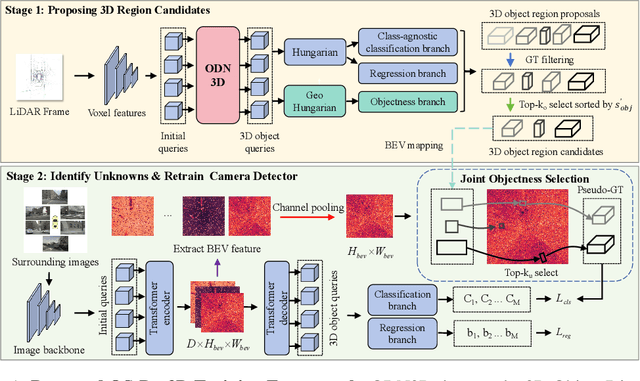
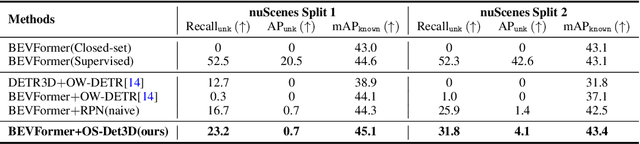
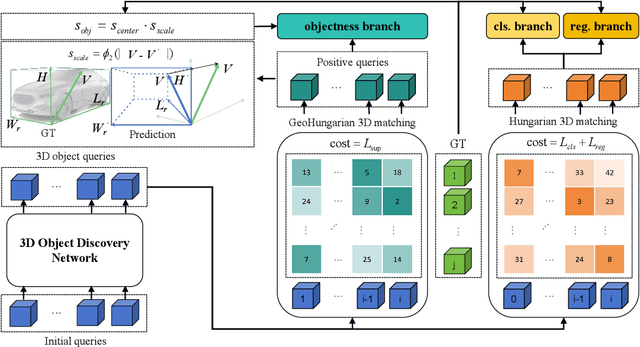
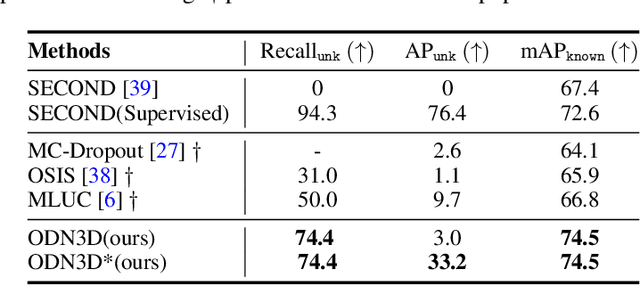
Traditional camera 3D object detectors are typically trained to recognize a predefined set of known object classes. In real-world scenarios, these detectors may encounter unknown objects outside the training categories and fail to identify them correctly. To address this gap, we present OS-Det3D (Open-set Camera 3D Object Detection), a two-stage training framework enhancing the ability of camera 3D detectors to identify both known and unknown objects. The framework involves our proposed 3D Object Discovery Network (ODN3D), which is specifically trained using geometric cues such as the location and scale of 3D boxes to discover general 3D objects. ODN3D is trained in a class-agnostic manner, and the provided 3D object region proposals inherently come with data noise. To boost accuracy in identifying unknown objects, we introduce a Joint Objectness Selection (JOS) module. JOS selects the pseudo ground truth for unknown objects from the 3D object region proposals of ODN3D by combining the ODN3D objectness and camera feature attention objectness. Experiments on the nuScenes and KITTI datasets demonstrate the effectiveness of our framework in enabling camera 3D detectors to successfully identify unknown objects while also improving their performance on known objects.
OAML: Outlier Aware Metric Learning for OOD Detection Enhancement
Jun 24, 2024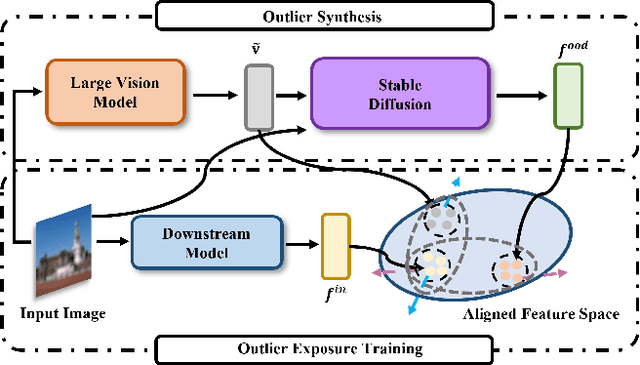
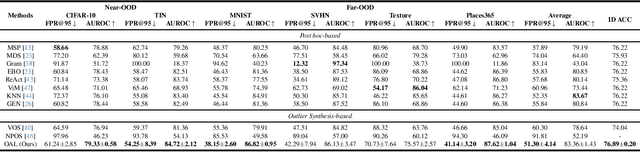
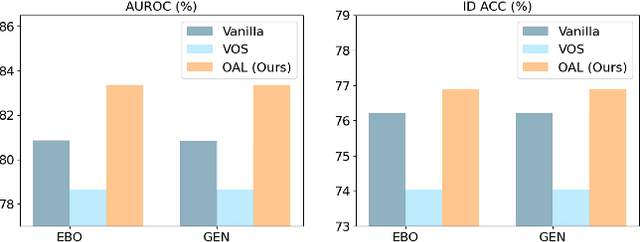
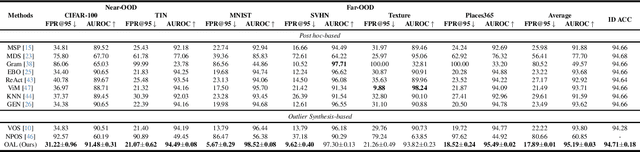
Out-of-distribution (OOD) detection methods have been developed to identify objects that a model has not seen during training. The Outlier Exposure (OE) methods use auxiliary datasets to train OOD detectors directly. However, the collection and learning of representative OOD samples may pose challenges. To tackle these issues, we propose the Outlier Aware Metric Learning (OAML) framework. The main idea of our method is to use the k-NN algorithm and Stable Diffusion model to generate outliers for training at the feature level without making any distributional assumptions. To increase feature discrepancies in the semantic space, we develop a mutual information-based contrastive learning approach for learning from OOD data effectively. Both theoretical and empirical results confirm the effectiveness of this contrastive learning technique. Furthermore, we incorporate knowledge distillation into our learning framework to prevent degradation of in-distribution classification accuracy. The combination of contrastive learning and knowledge distillation algorithms significantly enhances the performance of OOD detection. Experimental results across various datasets show that our method significantly outperforms previous OE methods.