 Add to Chrome
 Add to Firefox
 Add to Edge
Enhancing Video Physical Consistency via Role-aware Joint Training and Modality-decoupled Denoising
Jul 06, 2026
While modern video diffusion models excel in visual fidelity, maintaining long-range physical consistency remains a formidable challenge. Conventional pixel-reconstruction objectives mainly focus on appearance details and often fail to capture the underlying dynamics of a scene. To mitigate this, recent efforts have integrated auxiliary modalities (e.g., optical flow) to introduce physics priors via joint training with video appearance. However, these methods have three main limitations: (1) they do not distinguish the different motion patterns of different entity types; (2) joint modeling of visual and auxiliary modalities can cause capacity conflicts and weaken the pretrained visual prior; and (3) auxiliary modalities may accumulate errors during inference. To address these issues, we propose \textbf{VPT}, a fine-tuning framework for improving physical consistency in video diffusion models. VPT introduces a role-aware signal that groups entities into agents, controlled objects, passive objects, and background, so that different physical roles can be modeled more clearly. We further propose a modality-decoupled denoising strategy, where the visual and auxiliary channels are assigned independent noise levels. Together with a loss-weight decay strategy, this design makes auxiliary modalities serve as soft constraints rather than strong dependencies, mitigating recursive prediction errors during inference. We also introduce cross-step auto-guidance to further strengthen physical dynamics. Experiments show that VPT improves physical consistency while preserving visual quality, achieving relative gains of 39.4\% in SA and 17.9\% in PC on VideoPhy benchmark over Wan2.1-T2V-1.3B, and consistent improvements on VideoPhy-2 benchmark. The project page is available at https://tom-zgt.github.io/VPT.

MoECa: Aligning Feature Reuse with Expert Decomposition in Diffusion Transformers
Jun 14, 2026Diffusion Transformers with Mixture-of-Experts (DiT-MoE) improve model capacity under sparse activation, but diffusion inference is still bottlenecked by redundant computation across timesteps. Existing caching methods mainly operate at the token level, which becomes suboptimal in DiT-MoE because each token update is internally decomposed into multiple routed expert branches. Our analysis shows that cross-timestep redundancy in DiT-MoE is better characterized at the expert-branch level than at the whole-token level. Based on this observation, we propose MoECa, a fine-grained caching framework that performs branch-level feature reuse across timesteps. MoECa further introduces expert-aware adaptive control and synchronized cache updates across MoE and attention paths to maintain stable intermediate states. Experiments on multiple DiT-MoE models show that MoECa consistently achieves a better speed-quality trade-off than prior caching methods, with up to 2.83$\times$ inference speedup and minimal quality degradation.
ORSIFlow: Saliency-Guided Rectified Flow for Optical Remote Sensing Salient Object Detection
Mar 30, 2026Optical Remote Sensing Image Salient Object Detection (ORSI-SOD) remains challenging due to complex backgrounds, low contrast, irregular object shapes, and large variations in object scale. Existing discriminative methods directly regress saliency maps, while recent diffusion-based generative approaches suffer from stochastic sampling and high computational cost. In this paper, we propose ORSIFlow, a saliency-guided rectified flow framework that reformulates ORSI-SOD as a deterministic latent flow generation problem. ORSIFlow performs saliency mask generation in a compact latent space constructed by a frozen variational autoencoder, enabling efficient inference with only a few steps. To enhance saliency awareness, we design a Salient Feature Discriminator for global semantic discrimination and a Salient Feature Calibrator for precise boundary refinement. Extensive experiments on multiple public benchmarks show that ORSIFlow achieves state-of-the-art performance with significantly improved efficiency. Codes are available at: https://github.com/Ch3nSir/ORSIFlow.
PAKAN: Pixel Adaptive Kolmogorov-Arnold Network Modules for Pansharpening
Mar 16, 2026Pansharpening aims to fuse high-resolution spatial details from panchromatic images with the rich spectral information of multispectral images. Existing deep neural networks for this task typically rely on static activation functions, which limit their ability to dynamically model the complex, non-linear mappings required for optimal spatial-spectral fusion. While the recently introduced Kolmogorov-Arnold Network (KAN) utilizes learnable activation functions, traditional KANs lack dynamic adaptability during inference. To address this limitation, we propose a Pixel Adaptive Kolmogorov-Arnold Network framework. Starting from KAN, we design two adaptive variants: a 2D Adaptive KAN that generates spline summation weights across spatial dimensions and a 1D Adaptive KAN that generates them across spectral channels. These two components are then assembled into PAKAN 2to1 for feature fusion and PAKAN 1to1 for feature refinement. Extensive experiments demonstrate that our proposed modules significantly enhance network performance, proving the effectiveness and superiority of pixel-adaptive activation in pansharpening tasks.
MiCEval: Unveiling Multimodal Chain of Thought's Quality via Image Description and Reasoning Steps
Oct 18, 2024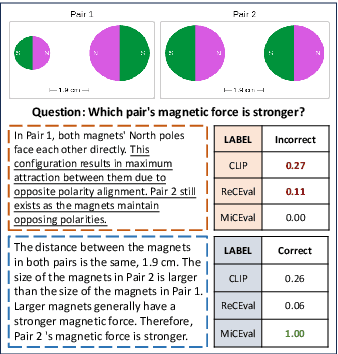


Multimodal Chain of Thought (MCoT) is a popular prompting strategy for improving the performance of multimodal large language models (MLLMs) across a range of complex reasoning tasks. Despite its popularity, there is a notable absence of automated methods for evaluating the quality of reasoning steps in MCoT. To address this gap, we propose Multimodal Chain-of-Thought Evaluation (MiCEval), a framework designed to assess the correctness of reasoning chains by evaluating the quality of both the description and each reasoning step. The evaluation of the description component focuses on the accuracy of the image descriptions, while the reasoning step evaluates the quality of each step as it is conditionally generated based on the preceding steps. MiCEval is built upon a fine-grained dataset with annotations that rate each step according to correctness, relevance, and informativeness. Extensive experiments on four state-of-the-art MLLMs show that step-wise evaluations using MiCEval align more closely with human judgments compared to existing methods based on cosine similarity or fine-tuning approaches. MiCEval datasets and code can be found in https://github.com/alenai97/MiCEval.