 Add to Chrome
 Add to Firefox
 Add to Edge
GigaBrain-0.7: Scaling Embodied Foundation Models to Emergent Capabilities with a Three-System Architecture
Aug 16, 2026
Vision-language-action (VLA) models have become a dominant paradigm for generalist embodied agents, demonstrating strong complex and long-horizon task completion in structured settings. Yet it remains an open question whether current VLA systems can benefit from more effective architectural design, scale to substantially larger and more heterogeneous data regimes, and achieve broader generalization across tasks and embodiments. To this end, we present GigaBrain-0.7, an embodied foundation model with substantially improved generalization across diverse robot embodiments. Specifically, GigaBrain-0.7 unifies understanding, prediction, and action through a three-system architecture, scales pretraining to over 37,000 hours of heterogeneous embodied data, and introduces one-stage alignment training that jointly optimizes vision-language understanding and multi-embodiment action generation. Compared with the preceding GigaBrain-0 series and prior state-of-the-art models including $π_{0.5}$, GigaBrain-0.7 achieves substantial improvements in foundation zero-shot capabilities, language-conditioned instruction following, and post-training task success rates. In particular, on our in-house Maker H01 platform and mainstream robot embodiments, GigaBrain-0.7 demonstrates strong task adaptability and completion ability across both home and industrial scenarios. All training code and pretrained model weights will be released.

Long-Horizon-Terminal-Bench: Testing the Limits of Agents on Long-Horizon Terminal Tasks with Dense Reward-Based Grading
Jul 13, 2026AI agents have become capable of autonomously completing short, well-specified tasks. However, existing terminal benchmarks largely focus on simple problems that finish within minutes and are evaluated only by their final outcome. This setup overlooks intermediate progress and partial solutions, yielding sparse reward signals and an incomplete picture of agent capability. We introduce Long-Horizon-Terminal-Bench, a terminal benchmark of 46 long-horizon tasks spanning nine categories, including experiment reproduction, software engineering, multimodal analysis, interactive games, and scientific computing. Each task follows a Terminal-Bench-style setup with a reference solution or simulation engine, but is further decomposed into fine-grained graded subtasks. This design enables dense intermediate rewards and partial credit, allowing evaluation to capture not only whether an agent reaches the final goal, but also how far it progresses on open-ended workflows. Tasks in Long-Horizon-Terminal-Bench typically require hundreds of episodes and minutes to hours of execution, stressing long-horizon planning, long-context management, and iterative debugging rather than one-shot problem solving. We evaluate 15 frontier models and find that agents consume on average 9.9M tokens per task, with roughly 231 episodes and 85.3 minutes of execution time per run, making Long-Horizon-Terminal-Bench more demanding than prior terminal-based benchmarks. Even the strongest tested model achieves 15.2% pass@1 at a partial-reward threshold of 0.95 and 10.9% at a perfect-reward threshold of 1.0, while the mean pass rate across models is 4.3% and 1.7% under the two thresholds, respectively. These results reveal headroom for improvement. We further analyze failure modes and error patterns, and release Long-Horizon-Terminal-Bench to support future progress on long-horizon terminal agents.
GigaWorld-Policy: An Efficient Action-Centered World--Action Model
Mar 18, 2026World-Action Models (WAM) initialized from pre-trained video generation backbones have demonstrated remarkable potential for robot policy learning. However, existing approaches face two critical bottlenecks that hinder performance and deployment. First, jointly reasoning over future visual dynamics and corresponding actions incurs substantial inference overhead. Second, joint modeling often entangles visual and motion representations, making motion prediction accuracy heavily dependent on the quality of future video forecasts. To address these issues, we introduce GigaWorld-Policy, an action-centered WAM that learns 2D pixel-action dynamics while enabling efficient action decoding, with optional video generation. Specifically, we formulate policy training into two coupled components: the model predicts future action sequences conditioned on the current observation, and simultaneously generates future videos conditioned on the predicted actions and the same observation. The policy is supervised by both action prediction and video generation, providing richer learning signals and encouraging physically plausible actions through visual-dynamics constraints. With a causal design that prevents future-video tokens from influencing action tokens, explicit future-video generation is optional at inference time, allowing faster action prediction during deployment. To support this paradigm, we curate a diverse, large-scale robot dataset to pre-train an action-centered video generation model, which is then adapted as the backbone for robot policy learning. Experimental results on real-world robotic platforms show that GigaWorld-Policy runs 9x faster than the leading WAM baseline, Motus, while improving task success rates by 7%. Moreover, compared with pi-0.5, GigaWorld-Policy improves performance by 95% on RoboTwin 2.0.
MM-Zero: Self-Evolving Multi-Model Vision Language Models From Zero Data
Mar 10, 2026Self-evolving has emerged as a key paradigm for improving foundational models such as Large Language Models (LLMs) and Vision Language Models (VLMs) with minimal human intervention. While recent approaches have demonstrated that LLM agents can self-evolve from scratch with little to no data, VLMs introduce an additional visual modality that typically requires at least some seed data, such as images, to bootstrap the self-evolution process. In this work, we present Multi-model Multimodal Zero (MM-Zero), the first RL-based framework to achieve zero-data self-evolution for VLM reasoning. Moving beyond prior dual-role (Proposer and Solver) setups, MM-Zero introduces a multi-role self-evolving training framework comprising three specialized roles: a Proposer that generates abstract visual concepts and formulates questions; a Coder that translates these concepts into executable code (e.g., Python, SVG) to render visual images; and a Solver that performs multimodal reasoning over the generated visual content. All three roles are initialized from the same base model and trained using Group Relative Policy Optimization (GRPO), with carefully designed reward mechanisms that integrate execution feedback, visual verification, and difficulty balancing. Our experiments show that MM-Zero improves VLM reasoning performance across a wide range of multimodal benchmarks. MM-Zero establishes a scalable path toward self-evolving multi-model systems for multimodal models, extending the frontier of self-improvement beyond the conventional two-model paradigm.
GigaBrain-0.5M*: a VLA That Learns From World Model-Based Reinforcement Learning
Feb 12, 2026Vision-language-action (VLA) models that directly predict multi-step action chunks from current observations face inherent limitations due to constrained scene understanding and weak future anticipation capabilities. In contrast, video world models pre-trained on web-scale video corpora exhibit robust spatiotemporal reasoning and accurate future prediction, making them a natural foundation for enhancing VLA learning. Therefore, we propose \textit{GigaBrain-0.5M*}, a VLA model trained via world model-based reinforcement learning. Built upon \textit{GigaBrain-0.5}, which is pre-trained on over 10,000 hours of robotic manipulation data, whose intermediate version currently ranks first on the international RoboChallenge benchmark. \textit{GigaBrain-0.5M*} further integrates world model-based reinforcement learning via \textit{RAMP} (Reinforcement leArning via world Model-conditioned Policy) to enable robust cross-task adaptation. Empirical results demonstrate that \textit{RAMP} achieves substantial performance gains over the RECAP baseline, yielding improvements of approximately 30\% on challenging tasks including \texttt{Laundry Folding}, \texttt{Box Packing}, and \texttt{Espresso Preparation}. Critically, \textit{GigaBrain-0.5M$^*$} exhibits reliable long-horizon execution, consistently accomplishing complex manipulation tasks without failure as validated by real-world deployment videos on our \href{https://gigabrain05m.github.io}{project page}.
Towards Long-Horizon Interpretability: Efficient and Faithful Multi-Token Attribution for Reasoning LLMs
Feb 02, 2026Token attribution methods provide intuitive explanations for language model outputs by identifying causally important input tokens. However, as modern LLMs increasingly rely on extended reasoning chains, existing schemes face two critical challenges: (1) efficiency bottleneck, where attributing a target span of M tokens within a context of length N requires O(M*N) operations, making long-context attribution prohibitively slow; and (2) faithfulness drop, where intermediate reasoning tokens absorb attribution mass, preventing importance from propagating back to the original input. To address these, we introduce FlashTrace, an efficient multi-token attribution method that employs span-wise aggregation to compute attribution over multi-token targets in a single pass, while maintaining faithfulness. Moreover, we design a recursive attribution mechanism that traces importance through intermediate reasoning chains back to source inputs. Extensive experiments on long-context retrieval (RULER) and multi-step reasoning (MATH, MorehopQA) tasks demonstrate that FlashTrace achieves over 130x speedup over existing baselines while maintaining superior faithfulness. We further analyze the dynamics of recursive attribution, showing that even a single recursive hop improves faithfulness by tracing importance through the reasoning chain.
First Frame Is the Place to Go for Video Content Customization
Nov 19, 2025What role does the first frame play in video generation models? Traditionally, it's viewed as the spatial-temporal starting point of a video, merely a seed for subsequent animation. In this work, we reveal a fundamentally different perspective: video models implicitly treat the first frame as a conceptual memory buffer that stores visual entities for later reuse during generation. Leveraging this insight, we show that it's possible to achieve robust and generalized video content customization in diverse scenarios, using only 20-50 training examples without architectural changes or large-scale finetuning. This unveils a powerful, overlooked capability of video generation models for reference-based video customization.
Humanoid Occupancy: Enabling A Generalized Multimodal Occupancy Perception System on Humanoid Robots
Jul 27, 2025Humanoid robot technology is advancing rapidly, with manufacturers introducing diverse heterogeneous visual perception modules tailored to specific scenarios. Among various perception paradigms, occupancy-based representation has become widely recognized as particularly suitable for humanoid robots, as it provides both rich semantic and 3D geometric information essential for comprehensive environmental understanding. In this work, we present Humanoid Occupancy, a generalized multimodal occupancy perception system that integrates hardware and software components, data acquisition devices, and a dedicated annotation pipeline. Our framework employs advanced multi-modal fusion techniques to generate grid-based occupancy outputs encoding both occupancy status and semantic labels, thereby enabling holistic environmental understanding for downstream tasks such as task planning and navigation. To address the unique challenges of humanoid robots, we overcome issues such as kinematic interference and occlusion, and establish an effective sensor layout strategy. Furthermore, we have developed the first panoramic occupancy dataset specifically for humanoid robots, offering a valuable benchmark and resource for future research and development in this domain. The network architecture incorporates multi-modal feature fusion and temporal information integration to ensure robust perception. Overall, Humanoid Occupancy delivers effective environmental perception for humanoid robots and establishes a technical foundation for standardizing universal visual modules, paving the way for the widespread deployment of humanoid robots in complex real-world scenarios.
Confidence Adjusted Surprise Measure for Active Resourceful Trials (CA-SMART): A Data-driven Active Learning Framework for Accelerating Material Discovery under Resource Constraints
Mar 27, 2025Accelerating the discovery and manufacturing of advanced materials with specific properties is a critical yet formidable challenge due to vast search space, high costs of experiments, and time-intensive nature of material characterization. In recent years, active learning, where a surrogate machine learning (ML) model mimics the scientific discovery process of a human scientist, has emerged as a promising approach to address these challenges by guiding experimentation toward high-value outcomes with a limited budget. Among the diverse active learning philosophies, the concept of surprise (capturing the divergence between expected and observed outcomes) has demonstrated significant potential to drive experimental trials and refine predictive models. Scientific discovery often stems from surprise thereby making it a natural driver to guide the search process. Despite its promise, prior studies leveraging surprise metrics such as Shannon and Bayesian surprise lack mechanisms to account for prior confidence, leading to excessive exploration of uncertain regions that may not yield useful information. To address this, we propose the Confidence-Adjusted Surprise Measure for Active Resourceful Trials (CA-SMART), a novel Bayesian active learning framework tailored for optimizing data-driven experimentation. On a high level, CA-SMART incorporates Confidence-Adjusted Surprise (CAS) to dynamically balance exploration and exploitation by amplifying surprises in regions where the model is more certain while discounting them in highly uncertain areas. We evaluated CA-SMART on two benchmark functions (Six-Hump Camelback and Griewank) and in predicting the fatigue strength of steel. The results demonstrate superior accuracy and efficiency compared to traditional surprise metrics, standard Bayesian Optimization (BO) acquisition functions and conventional ML methods.
In-Situ Melt Pool Characterization via Thermal Imaging for Defect Detection in Directed Energy Deposition Using Vision Transformers
Nov 18, 2024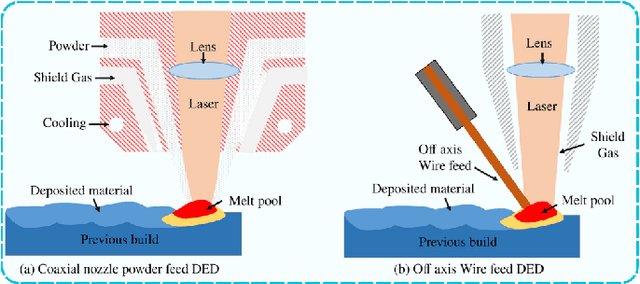
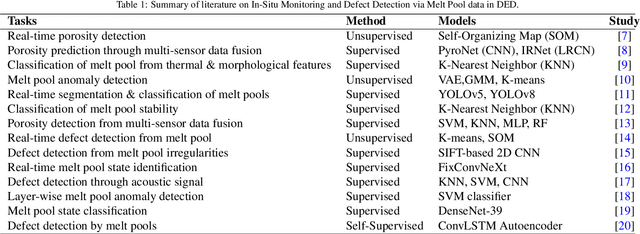
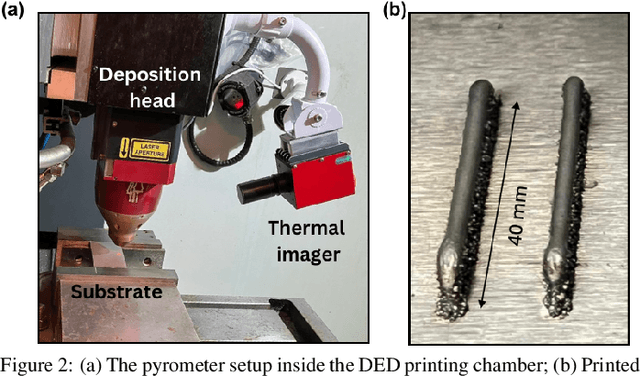
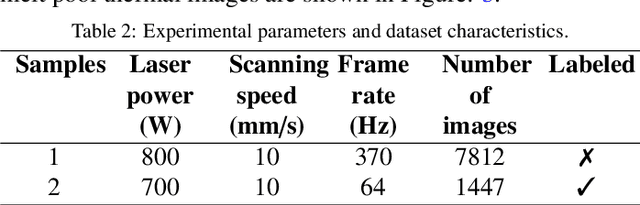
Directed Energy Deposition (DED) offers significant potential for manufacturing complex and multi-material parts. However, internal defects such as porosity and cracks can compromise mechanical properties and overall performance. This study focuses on in-situ monitoring and characterization of melt pools associated with porosity, aiming to improve defect detection and quality control in DED-printed parts. Traditional machine learning approaches for defect identification rely on extensive labeled datasets, often scarce and expensive to generate in real-world manufacturing. To address this, our framework employs self-supervised learning on unlabeled melt pool data using a Vision Transformer-based Masked Autoencoder (MAE) to produce highly representative embeddings. These fine-tuned embeddings are leveraged via transfer learning to train classifiers on a limited labeled dataset, enabling the effective identification of melt pool anomalies. We evaluate two classifiers: (1) a Vision Transformer (ViT) classifier utilizing the fine-tuned MAE Encoder's parameters and (2) the fine-tuned MAE Encoder combined with an MLP classifier head. Our framework achieves overall accuracy ranging from 95.44% to 99.17% and an average F1 score exceeding 80%, with the ViT Classifier slightly outperforming the MAE Encoder Classifier. This demonstrates the scalability and cost-effectiveness of our approach for automated quality control in DED, effectively detecting defects with minimal labeled data.