 Add to Chrome
 Add to Firefox
 Add to Edge
Unsupervised Keypoints for Real-Time Fall Detection: Comparative Analysis Under Real-world Conditions with Predictive Bandwidth Reduction
Jul 20, 2026
Falls among older adults are a major safety challenge, but continuous monitoring is difficult to sustain. Video captures fall-related posture and motion, yet deployment is limited by privacy, computation, and bandwidth. Supervised pose estimation is anatomically interpretable but vulnerable to occlusion and partial body visibility. We propose a privacy-preserving framework that replaces RGB transmission with compact motion representations based on unsupervised keypoints and predictive temporal modeling. Local processing performs segmentation and keypoint extraction; variational recurrent prediction and sequence classification then detect falls from observed and forecasted motion. We evaluate the framework on the UR Fall Detection and Human Fall datasets using random, subject-disjoint, and occlusion-based splits. Under random splits, neither representation consistently dominates, suggesting that standard protocols may hide meaningful differences. Under subject-disjoint evaluation, supervised keypoints show a statistically significant advantage, but performance varies by subject: they perform better when anatomical landmarks are visible, whereas unsupervised keypoints are more robust to occlusion and partial visibility, though they produce more false positives for complex activities. Under occlusion-based evaluation, supervised keypoints miss nearly half of all falls, while unsupervised keypoints retain strong sensitivity and substantially outperform them. Their anatomical independence allows spatial anchors to adapt to visible body structure rather than fail on absent landmarks. The gap widens under bandwidth constraints, where supervised localization errors compound through the temporal model. These findings show that representation choice should reflect expected visual conditions and that unsupervised keypoints offer an advantage when body visibility is compromised.

XCT-SAM: Sequential Parameter-Efficient Domain Adaptation of SAM for Industrial XCT Defect Segmentation
Jul 15, 2026Defect segmentation in additive manufacturing (AM) X-ray computed tomography (XCT) images remains challenging due to severe class imbalance and large distribution shifts across scan conditions. Although recent foundation models such as the Segment Anything Model (SAM) provide strong general-purpose segmentation priors, their natural-image pre-training transfers poorly to the AM XCT domain, where defects appear as subtle non-semantic microstructural anomalies. Moreover, adapting SAM to the AM domain is further limited by the large domain gap and scarcity of labeled real XCT data. We present XCT-SAM, a sequential parameter-efficient adaptation framework for AM XCT defect segmentation. Instead of adapting SAM directly from natural images to XCT data, we first fine-tune Conv-LoRA adapters on an alloy-microstructure dataset and subsequently transfer the adapted model to XCT images, progressively bridging the domain gap. Using Conv-LoRA adapters with rank r=2, the framework injects convolutional spatial inductive bias into SAM's backbone while training approximately 4.15M parameters and keeping over 99% of the model frozen. We evaluate XCT-SAM on out-of-distribution CycleGAN-XCT benchmarks and real-world NIST XCT scans. Across both settings, XCT-SAM consistently outperforms zero-shot SAM and other domain-adapted SAM baselines, achieving the best overall IoU and Dice scores. These results demonstrate the effectiveness of intermediate domain adaptation with parameter-efficient adapters for industrial XCT defect segmentation. The source code is publicly available at https://github.com/Mahedi-61/XCT-SAM.git
MPSelectTune: Prompt-type Selection for Fine-tuning improves Concept Unlearning in LLMs
Jul 04, 2026LLMs can be conveniently adapted to a diverse set of tasks, e.g, prediction, question-answering tasks, etc, using appropriate prompts with few-shot examples. Biased or harmful concepts, e.g. gender or bio-weapons, present in pre-trained LLMs can lead to unsafe or unethical responses for many such prompts. Removing such undesirable concepts robustly across different prompt types remains a challenging problem, since existing unlearning methods typically ignore the impact of prompt variation. In this paper, we explore a novel adversarial approach to use a joint prompt for the main task and concept task prediction. We show that fine-tuning using the ``worst prompt type'' for concept prediction (with the highest concept accuracy) improves the average unlearning performance over a fine-tuning method that uses a combination of all prompt types. Our proposed method, MPSelectTune, is a two-stage approach that minimizes the concept accuracy of the highest accuracy-prompt type, after fine-tuning using a novel multi-task loss using multiple prompt types. Experimental results on four benchmarks show $2 - 15\%$ main task accuracy improvements over recent baselines and while reducing the worst-case concept accuracy by up to $17\%$ compared to recent baselines.
Multimodal Transformer Based Generic Mixture Density Network for Scattering Timescale Estimation of Fast Radio Bursts
Jun 02, 2026The discovery rate of fast radio bursts (FRBs) continues to increase with the advent of new radio facilities and yet extracting their astrophysical parameters such as scattering timescale ($τ$) remains a significant bottleneck. Current $τ$ measurement approaches like fitting analytic template models and scattering aware de-convolution are accurate but slow, sensitive to initialization, limited by low signal to noise and often require manual supervision. These limitations inspired us to explore fast, robust and scalable machine learning methods to estimate the astrophysical parameter value. We present a deep learning approach named Multimodal Transformer Based Generic Mixture Density Network (MT-GMDN) which ingests FRB dynamic spectrum and its corresponding timeseries profile through parallel transformer encoders, fuses their latent representations and predicts the distribution of $τ$ with probabilistic output derived from generic mixture-density formulation. This formulation not only estimates the value of $τ$ but also captures the (zero inflated) nature of FRB populations where a significant fraction of bursts exhibit unresolvable scattering. We trained MT-GMDN on $\sim3500$ FRBs from CHIME/FRB \cattwo while holding out some fraction of FRBs for validation during training and for testing after the training completes. The model achieves a coefficient of determination ($R^2$) value of $94\%$ on the expected value of $τ$ for the events with measurable scattering with an excellent recall value of $90\%$ on the test data set. The model was also able to incorporate heteroskedastic errors enabling us the construction of a confidence interval for the predictions.
GIF: Generative Inspiration for Face Recognition at Scale
May 05, 2025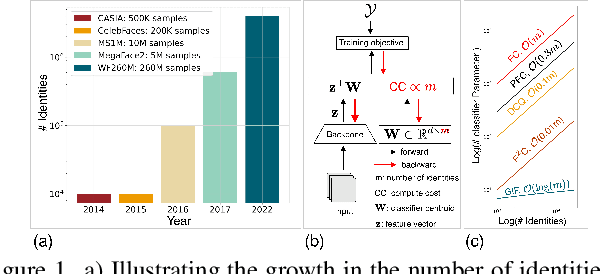
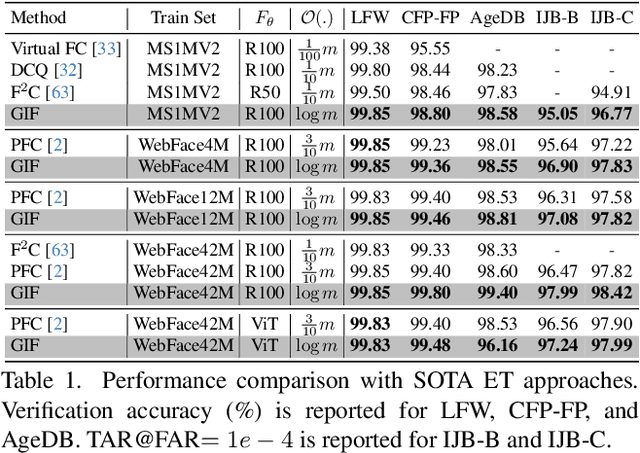
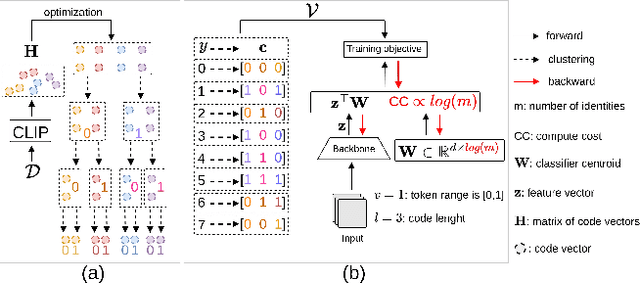
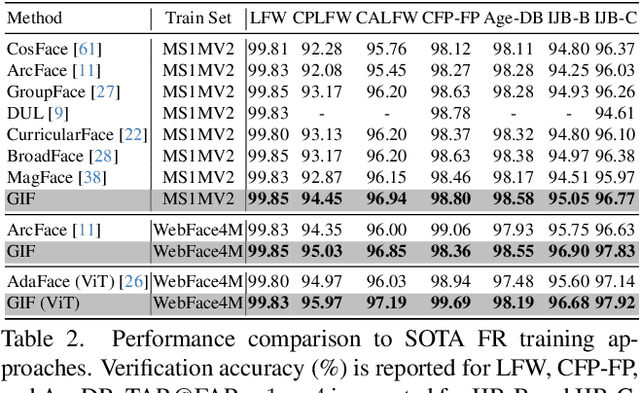
Aiming to reduce the computational cost of Softmax in massive label space of Face Recognition (FR) benchmarks, recent studies estimate the output using a subset of identities. Although promising, the association between the computation cost and the number of identities in the dataset remains linear only with a reduced ratio. A shared characteristic among available FR methods is the employment of atomic scalar labels during training. Consequently, the input to label matching is through a dot product between the feature vector of the input and the Softmax centroids. Inspired by generative modeling, we present a simple yet effective method that substitutes scalar labels with structured identity code, i.e., a sequence of integers. Specifically, we propose a tokenization scheme that transforms atomic scalar labels into structured identity codes. Then, we train an FR backbone to predict the code for each input instead of its scalar label. As a result, the associated computational cost becomes logarithmic w.r.t. number of identities. We demonstrate the benefits of the proposed method by conducting experiments. In particular, our method outperforms its competitors by 1.52%, and 0.6% at TAR@FAR$=1e-4$ on IJB-B and IJB-C, respectively, while transforming the association between computational cost and the number of identities from linear to logarithmic. See code at https://github.com/msed-Ebrahimi/GIF
Towards Efficient Real-Time Video Motion Transfer via Generative Time Series Modeling
Apr 07, 2025We propose a deep learning framework designed to significantly optimize bandwidth for motion-transfer-enabled video applications, including video conferencing, virtual reality interactions, health monitoring systems, and vision-based real-time anomaly detection. To capture complex motion effectively, we utilize the First Order Motion Model (FOMM), which encodes dynamic objects by detecting keypoints and their associated local affine transformations. These keypoints are identified using a self-supervised keypoint detector and arranged into a time series corresponding to the successive frames. Forecasting is performed on these keypoints by integrating two advanced generative time series models into the motion transfer pipeline, namely the Variational Recurrent Neural Network (VRNN) and the Gated Recurrent Unit with Normalizing Flow (GRU-NF). The predicted keypoints are subsequently synthesized into realistic video frames using an optical flow estimator paired with a generator network, thereby facilitating accurate video forecasting and enabling efficient, low-frame-rate video transmission. We validate our results across three datasets for video animation and reconstruction using the following metrics: Mean Absolute Error, Joint Embedding Predictive Architecture Embedding Distance, Structural Similarity Index, and Average Pair-wise Displacement. Our results confirm that by utilizing the superior reconstruction property of the Variational Autoencoder, the VRNN integrated FOMM excels in applications involving multi-step ahead forecasts such as video conferencing. On the other hand, by leveraging the Normalizing Flow architecture for exact likelihood estimation, and enabling efficient latent space sampling, the GRU-NF based FOMM exhibits superior capabilities for producing diverse future samples while maintaining high visual quality for tasks like real-time video-based anomaly detection.
In-Situ Melt Pool Characterization via Thermal Imaging for Defect Detection in Directed Energy Deposition Using Vision Transformers
Nov 18, 2024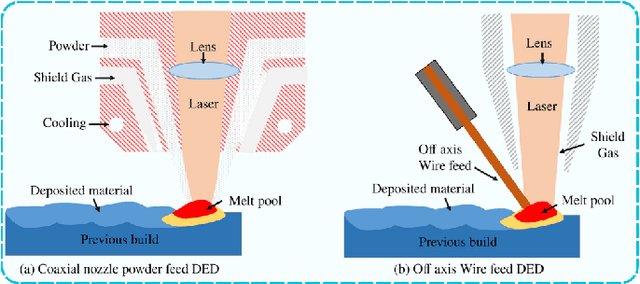
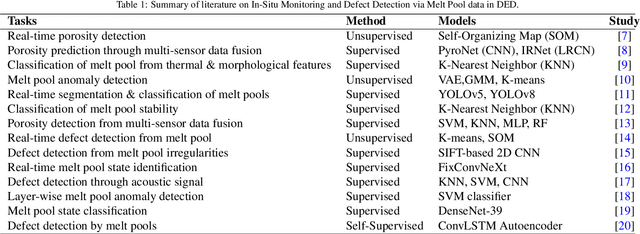
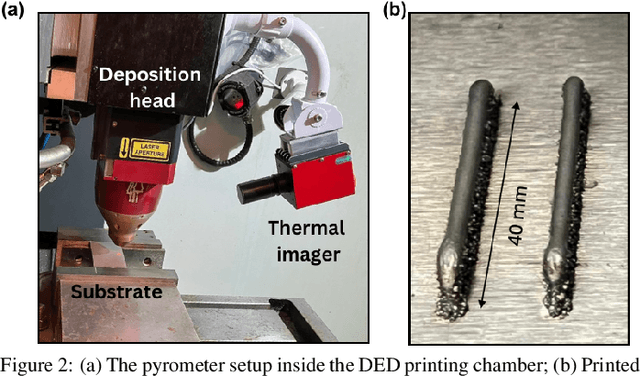
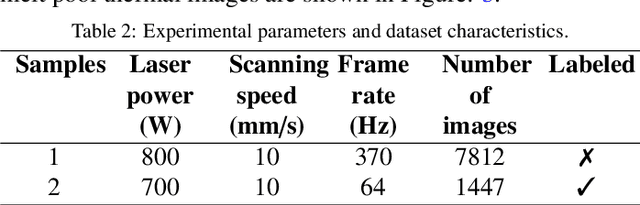
Directed Energy Deposition (DED) offers significant potential for manufacturing complex and multi-material parts. However, internal defects such as porosity and cracks can compromise mechanical properties and overall performance. This study focuses on in-situ monitoring and characterization of melt pools associated with porosity, aiming to improve defect detection and quality control in DED-printed parts. Traditional machine learning approaches for defect identification rely on extensive labeled datasets, often scarce and expensive to generate in real-world manufacturing. To address this, our framework employs self-supervised learning on unlabeled melt pool data using a Vision Transformer-based Masked Autoencoder (MAE) to produce highly representative embeddings. These fine-tuned embeddings are leveraged via transfer learning to train classifiers on a limited labeled dataset, enabling the effective identification of melt pool anomalies. We evaluate two classifiers: (1) a Vision Transformer (ViT) classifier utilizing the fine-tuned MAE Encoder's parameters and (2) the fine-tuned MAE Encoder combined with an MLP classifier head. Our framework achieves overall accuracy ranging from 95.44% to 99.17% and an average F1 score exceeding 80%, with the ViT Classifier slightly outperforming the MAE Encoder Classifier. This demonstrates the scalability and cost-effectiveness of our approach for automated quality control in DED, effectively detecting defects with minimal labeled data.
A Data-Efficient Sequential Learning Framework for Melt Pool Defect Classification in Laser Powder Bed Fusion
Nov 16, 2024Ensuring the quality and reliability of Metal Additive Manufacturing (MAM) components is crucial, especially in the Laser Powder Bed Fusion (L-PBF) process, where melt pool defects such as keyhole, balling, and lack of fusion can significantly compromise structural integrity. This study presents SL-RF+ (Sequentially Learned Random Forest with Enhanced Sampling), a novel Sequential Learning (SL) framework for melt pool defect classification designed to maximize data efficiency and model accuracy in data-scarce environments. SL-RF+ utilizes RF classifier combined with Least Confidence Sampling (LCS) and Sobol sequence-based synthetic sampling to iteratively select the most informative samples to learn from, thereby refining the model's decision boundaries with minimal labeled data. Results show that SL-RF+ outperformed traditional machine learning models across key performance metrics, including accuracy, precision, recall, and F1 score, demonstrating significant robustness in identifying melt pool defects with limited data. This framework efficiently captures complex defect patterns by focusing on high-uncertainty regions in the process parameter space, ultimately achieving superior classification performance without the need for extensive labeled datasets. While this study utilizes pre-existing experimental data, SL-RF+ shows strong potential for real-world applications in pure sequential learning settings, where data is acquired and labeled incrementally, mitigating the high costs and time constraints of sample acquisition.
Enhancing Bandwidth Efficiency for Video Motion Transfer Applications using Deep Learning Based Keypoint Prediction
Mar 17, 2024We propose a deep learning based novel prediction framework for enhanced bandwidth reduction in motion transfer enabled video applications such as video conferencing, virtual reality gaming and privacy preservation for patient health monitoring. To model complex motion, we use the First Order Motion Model (FOMM) that represents dynamic objects using learned keypoints along with their local affine transformations. Keypoints are extracted by a self-supervised keypoint detector and organized in a time series corresponding to the video frames. Prediction of keypoints, to enable transmission using lower frames per second on the source device, is performed using a Variational Recurrent Neural Network (VRNN). The predicted keypoints are then synthesized to video frames using an optical flow estimator and a generator network. This efficacy of leveraging keypoint based representations in conjunction with VRNN based prediction for both video animation and reconstruction is demonstrated on three diverse datasets. For real-time applications, our results show the effectiveness of our proposed architecture by enabling up to 2x additional bandwidth reduction over existing keypoint based video motion transfer frameworks without significantly compromising video quality.
Binary Gaussian Copula Synthesis: A Novel Data Augmentation Technique to Advance ML-based Clinical Decision Support Systems for Early Prediction of Dialysis Among CKD Patients
Mar 01, 2024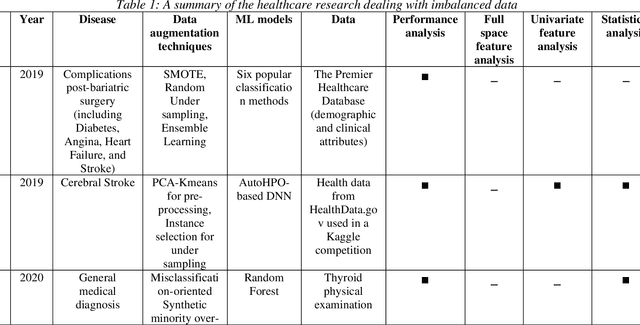
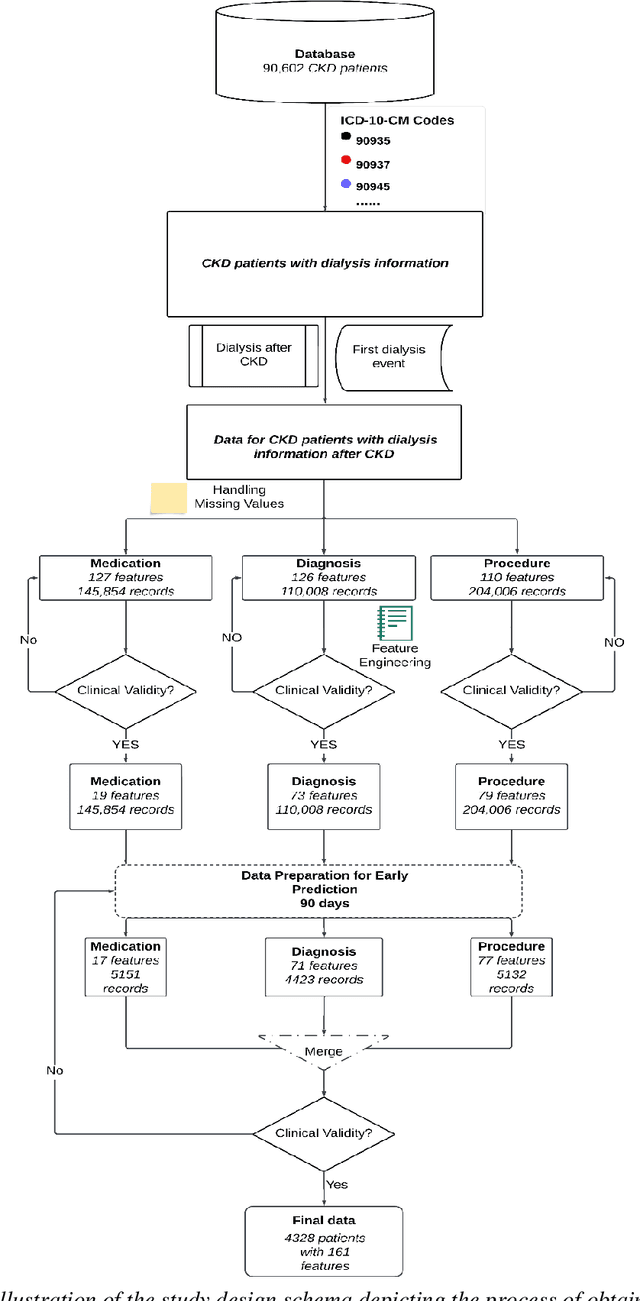
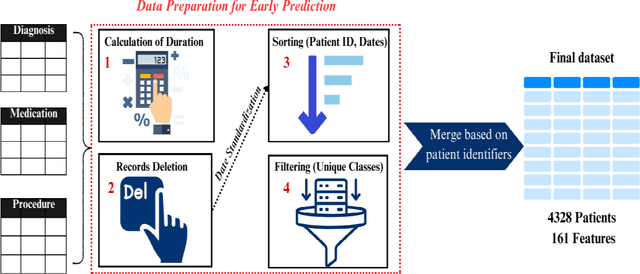
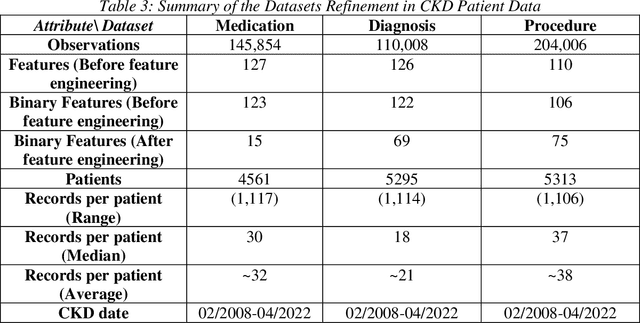
The Center for Disease Control estimates that over 37 million US adults suffer from chronic kidney disease (CKD), yet 9 out of 10 of these individuals are unaware of their condition due to the absence of symptoms in the early stages. It has a significant impact on patients' quality of life, particularly when it progresses to the need for dialysis. Early prediction of dialysis is crucial as it can significantly improve patient outcomes and assist healthcare providers in making timely and informed decisions. However, developing an effective machine learning (ML)-based Clinical Decision Support System (CDSS) for early dialysis prediction poses a key challenge due to the imbalanced nature of data. To address this challenge, this study evaluates various data augmentation techniques to understand their effectiveness on real-world datasets. We propose a new approach named Binary Gaussian Copula Synthesis (BGCS). BGCS is tailored for binary medical datasets and excels in generating synthetic minority data that mirrors the distribution of the original data. BGCS enhances early dialysis prediction by outperforming traditional methods in detecting dialysis patients. For the best ML model, Random Forest, BCGS achieved a 72% improvement, surpassing the state-of-the-art augmentation approaches. Also, we present a ML-based CDSS, designed to aid clinicians in making informed decisions. CDSS, which utilizes decision tree models, is developed to improve patient outcomes, identify critical variables, and thereby enable clinicians to make proactive decisions, and strategize treatment plans effectively for CKD patients who are more likely to require dialysis in the near future. Through comprehensive feature analysis and meticulous data preparation, we ensure that the CDSS's dialysis predictions are not only accurate but also actionable, providing a valuable tool in the management and treatment of CKD.