 Add to Chrome
 Add to Firefox
 Add to Edge
DynamicWAM: Dual-Path Motion Conditioning for World-Action Models in Dynamic Manipulation
Aug 01, 2026
Dynamic manipulation requires robots to infer target motion and respond promptly, yet existing World-Action Models (WAMs) typically condition only on the current frame and execute large backbones synchronously, limiting motion awareness and responsive control in dynamic scenes. We propose DynamicWAM, a compact WAM for dynamic object manipulation with dual-path motion conditioning. DynamicWAM introduces history-flow conditioning, encoding temporally aligned optical-flow frames alongside the current observation through a frozen pretrained video VAE to preserve spatial motion structure, while injecting kinematic descriptors of displacement, duration, velocity, and acceleration into the action expert to provide motion magnitude and timing. The two complementary paths are fused through joint world-action attention. A distilled compact backbone and real-time chunking (RTC)-based asynchronous execution further enable responsive control. On DOMINO, DynamicWAM achieves a 38.2% success rate and a 53.2 manipulation score, outperforming all evaluated baselines. Across 12 real-world tasks spanning linear, circular, and compound target motion, it achieves a 46.7% average success rate, exceeding the strongest baseline by 22.9 percentage points.

Data Pyramid for Embodied Manipulation
Jul 27, 2026Multimodal foundation models learned to see and to speak by consuming the whole internet. Embodied agents admit no such shortcut, since they require data that couple observations with physical states and actions. These signals can be provided, to varying degrees, by multiple data sources. In this work, we organize the embodied data ecosystem as a "pyramid" spanning five complementary sources: real-robot data, UMI-style data, egocentric and exocentric data, simulation data, and general vision-language data. We organize the pyramid around the tension between scalability and robot alignment, and further characterize each source in terms of data quality, diversity, reusability, and physical fidelity. We then analyze recent embodied foundation models through the lens of their data recipes, examining how different sources are selected, aligned, and mixed during pretraining. For embodied brain models, vision-language-action models, and world-action models alike, we relate data composition to capabilities in perception, reasoning, planning, action generation, and world prediction. We close by discussing six open challenges: building large-scale tactile datasets, collecting failure and recovery data, developing scalable data-collection pipelines, aligning actions across embodiments, leveraging egocentric data for dexterous manipulation, and designing principled data recipes for robot learning. We hope this work paves the foundation for the design of next-generation embodied systems.
Mitigating Gradient Pathology in PINNs through Aligned Constraint
May 24, 2026While Physics-Informed Neural Networks (PINNs) are powerful for solving Partial Differential Equations (PDEs), their training is often paralyzed by gradient pathology. The gradients from the PDE residuals and boundary constraints oppose each other, trapping the model in local minima. Current solutions, such as adaptive weighting or hard constraints, either fail to fundamentally resolve this ill-conditioning or are limited to simple geometries. In this study, we systematically analyze the possible causes of this gradient pathology from the perspectives of loss landscapes and optimization dynamics. Based on the obtained conclusion, we propose Constraint-Aligned loss with Manifold Lifting (CAML). By reformulating all zeroth-order terms into aligned constraints, our method effectively mitigates gradient conflicts. In addition, we introduce a delay factor to help the optimizer skip the high-curvature area. Experiments demonstrate that our CAML significantly enhances numerical stability and efficiency in highly complex PINN problems. Our code is open-sourced on https://github.com/YichenLuo-0/CAML.
Safety-guaranteed and Goal-oriented Semantic Sensing, Communication, and Control for Robotics
Mar 13, 2026Wirelessly-connected robotic system empowers robots with real-time intelligence by leveraging remote computing resources for decision-making. However, the data exchange between robots and base stations often overwhelms communication links, introducing latency that undermines real-time response. To tackle this, goal-oriented semantic communication (GSC) has been introduced into wirelessly-connected robotic systems to extract and transmit only goal-relevant semantic representations, enhancing communication efficiency and task effectiveness. However, existing GSC approaches focused primarily on optimizing effectiveness metrics while overlooking safety requirements, which should be treated as the top priority in real-world robotic systems. To bridge this gap, we propose safety-guaranteed and goal-oriented semantic communication for wirelessly-connected robotic system, aiming to maximize the robotic task effectiveness subject to practical operational safety requirements. We first summarize the general safety requirements and effectiveness metrics across typical robotic tasks, including robot arm grasping, unmanned aerial vehicle (UAV)-assisted tasks, and multi-robot exploration. We then systematically analyze the unique safety and effectiveness challenges faced by wirelessly-connected robotic system in sensing, communication, and control. Based on these, we further present potential safety-guaranteed and goal-oriented sensing, communication, and control solutions. Finally, a UAV target tracking case study validates that our proposed GSC solutions can significantly improve safety rate and tracking success rate by more than 2 times and 4.5 times, respectively.
Millimeter-Wave ISAC Testbed Using Programmable Digital Coding Dynamic Metasurface Antenna: Practical Design and Implementation
Feb 19, 2025Dynamic Metasurface Antennas (DMAs) are transforming reconfigurable antenna technology by enabling energy-efficient, cost-effective beamforming through programmable meta-elements, eliminating the need for traditional phase shifters and delay lines. This breakthrough technology is emerging to revolutionize beamforming for next-generation wireless communication and sensing networks. In this paper, we present the design and real-world implementation of a DMA-assisted wireless communication platform operating in the license-free 60 GHz millimeter-wave (mmWave) band. Our system employs high-speed binary-coded sequences generated via a field-programmable gate array (FPGA), enabling real-time beam steering for spatial multiplexing and independent data transmission. A proof-of-concept experiment successfully demonstrates high-definition quadrature phase-shift keying (QPSK) modulated video transmission at 62 GHz. Furthermore, leveraging the DMA's multi-beam capability, we simultaneously transmit video to two spatially separated receivers, achieving accurate demodulation. We envision the proposed mmWave testbed as a platform for enabling the seamless integration of sensing and communication by allowing video transmission to be replaced with sensing data or utilizing an auxiliary wireless channel to transmit sensing information to multiple receivers. This synergy paves the way for advancing integrated sensing and communication (ISAC) in beyond-5G and 6G networks. Additionally, our testbed demonstrates potential for real-world use cases, including mmWave backhaul links and massive multiple-input multiple-output (MIMO) mmWave base stations.
On Chernoff Lower-Bound of Outage Threshold for Non-Central $χ^2$-Distributed Beamforming Gain in URLLC Systems
Dec 28, 2023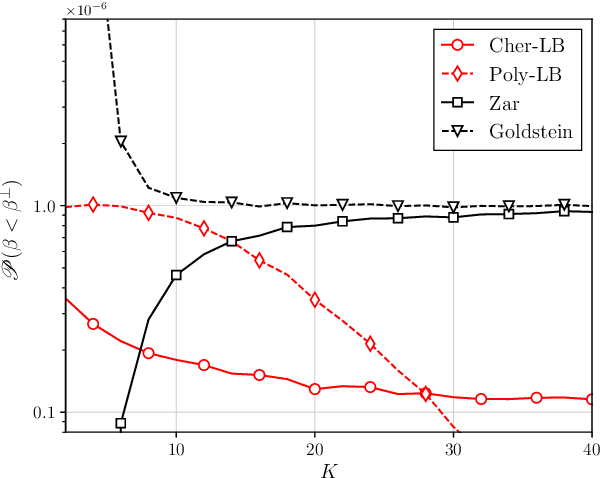

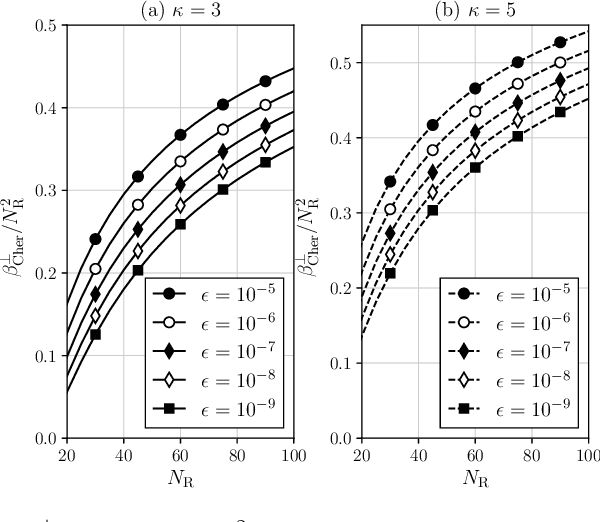
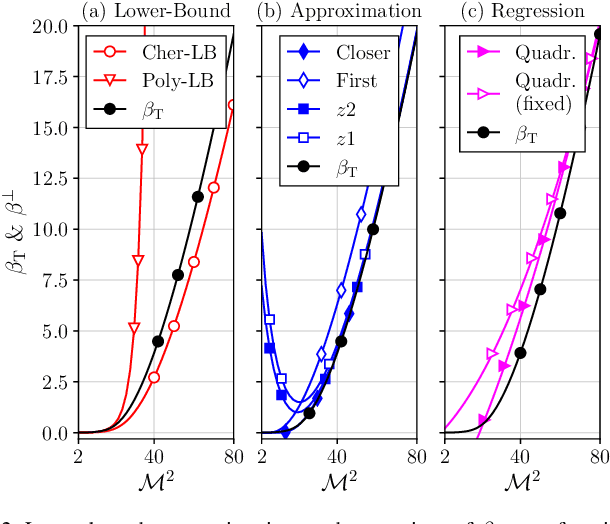
The cumulative distribution function (CDF) of a non-central $\chi^2$-distributed random variable (RV) is often used when measuring the outage probability of communication systems. For ultra-reliable low-latency communication (URLLC), it is important but mathematically challenging to determine the outage threshold for an extremely small outage target. This motivates us to investigate lower bounds of the outage threshold, and it is found that the one derived from the Chernoff inequality (named Cher-LB) is the most effective lower bound. This finding is associated with three rigorously established properties of the Cher-LB with respect to the mean, variance, reliability requirement, and degrees of freedom of the non-central $\chi^2$-distributed RV. The Cher-LB is then employed to predict the beamforming gain in URLLC for both conventional multi-antenna systems (i.e., MIMO) under first-order Markov time-varying channel and reconfigurable intellgent surface (RIS) systems. It is exhibited that, with the proposed Cher-LB, the pessimistic prediction of the beamforming gain is made sufficiently accurate for guaranteed reliability as well as the transmit-energy efficiency.
IRS Assisted Federated Learning A Broadband Over-the-Air Aggregation Approach
Oct 11, 2023We consider a broadband over-the-air computation empowered model aggregation approach for wireless federated learning (FL) systems and propose to leverage an intelligent reflecting surface (IRS) to combat wireless fading and noise. We first investigate the conventional node-selection based framework, where a few edge nodes are dropped in model aggregation to control the aggregation error. We analyze the performance of this node-selection based framework and derive an upper bound on its performance loss, which is shown to be related to the selected edge nodes. Then, we seek to minimize the mean-squared error (MSE) between the desired global gradient parameters and the actually received ones by optimizing the selected edge nodes, their transmit equalization coefficients, the IRS phase shifts, and the receive factors of the cloud server. By resorting to the matrix lifting technique and difference-of-convex programming, we successfully transform the formulated optimization problem into a convex one and solve it using off-the-shelf solvers. To improve learning performance, we further propose a weight-selection based FL framework. In such a framework, we assign each edge node a proper weight coefficient in model aggregation instead of discarding any of them to reduce the aggregation error, i.e., amplitude alignment of the received local gradient parameters from different edge nodes is not required. We also analyze the performance of this weight-selection based framework and derive an upper bound on its performance loss, followed by minimizing the MSE via optimizing the weight coefficients of the edge nodes, their transmit equalization coefficients, the IRS phase shifts, and the receive factors of the cloud server. Furthermore, we use the MNIST dataset for simulations to evaluate the performance of both node-selection and weight-selection based FL frameworks.
Hardware-in-the-Loop Simulation for Evaluating Communication Impacts on the Wireless-Network-Controlled Robots
Jul 14, 2022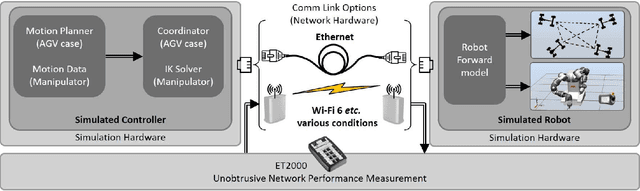
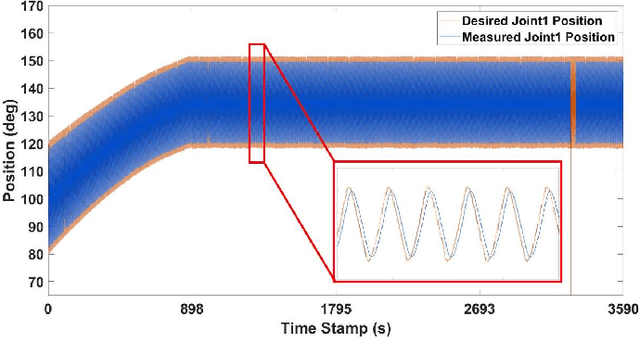
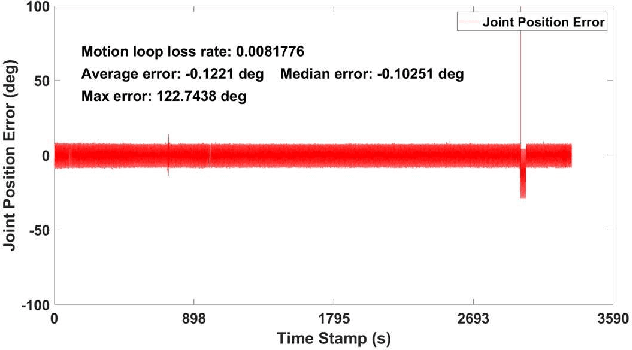
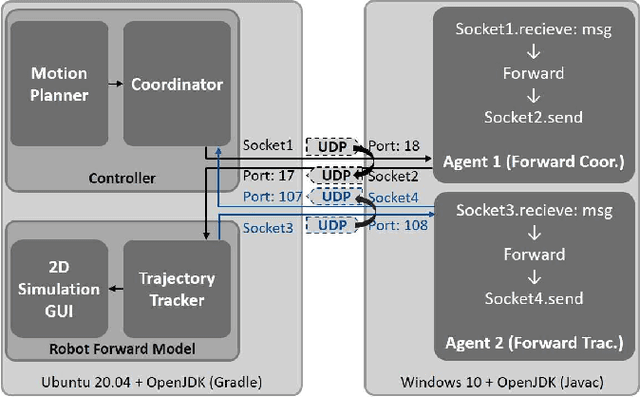
More and more robot automation applications have changed to wireless communication, and network performance has a growing impact on robotic systems. This study proposes a hardware-in-the-loop (HiL) simulation methodology for connecting the simulated robot platform to real network devices. This project seeks to provide robotic engineers and researchers with the capability to experiment without heavily modifying the original controller and get more realistic test results that correlate with actual network conditions. We deployed this HiL simulation system in two common cases for wireless-network-controlled robotic applications: (1) safe multi-robot coordination for mobile robots, and (2) human-motion-based teleoperation for manipulators. The HiL simulation system is deployed and tested under various network conditions in all circumstances. The experiment results are analyzed and compared with the previous simulation methods, demonstrating that the proposed HiL simulation methodology can identify a more reliable communication impact on robot systems.
Short-Packet Interleaver against Impulse Interference in Practical Industrial Environments
Mar 01, 2022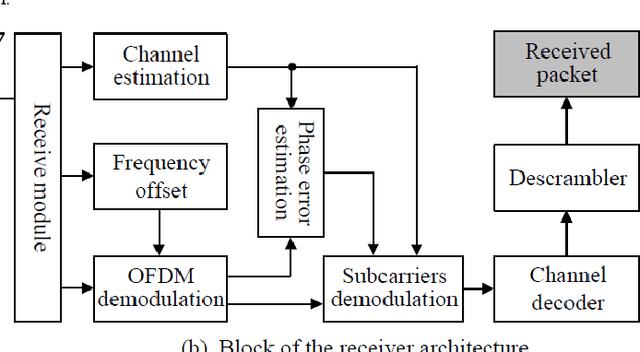
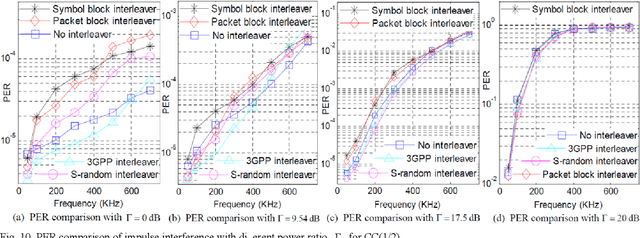
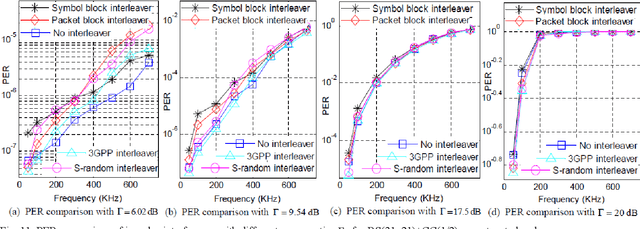
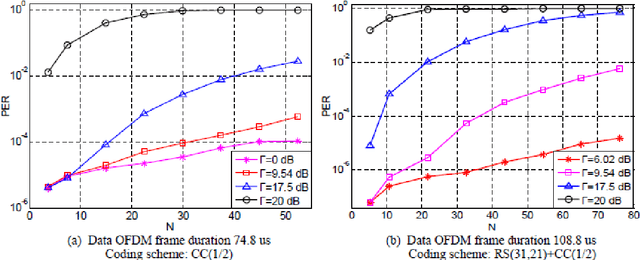
The most common cause of transmission failure in Wireless High Performance (WirelessHP) target industry environments is impulse interference. As interleavers are commonly used to improve the reliability on the Orthogonal Frequency Division Multiplexing (OFDM) symbol level for long packet transmission, this paper considers the feasibility of applying short-packet bit interleaving to enhance the impulse/burst interference resisting capability on both OFDM symbol and frame level. Using the Universal Software Radio Peripherals (USRP) and PC hardware platform, the Packet Error Rate (PER) performance of interleaved coded short-packet transmission with Convolutional Codes (CC), Reed-Solomon codes (RS) and RS+CC concatenated codes are tested and analyzed. Applying the IEEE 1613 standard for impulse interference generation, extensive PER tests of CC(1=2) and RS(31; 21)+CC(1=2) concatenated codes are performed. With practical experiments, we prove the effectiveness of bit in terleaved coded short-packet transmission in real factory environments. We also investigate how PER performance depends on the interleavers, codes and impulse interference power and frequency.
Satellite Based Computing Networks with Federated Learning
Nov 20, 2021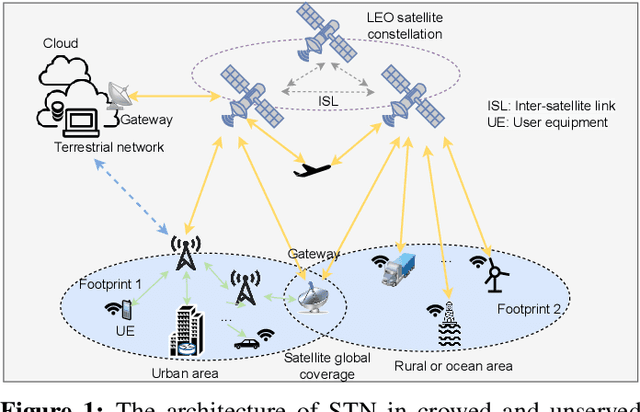
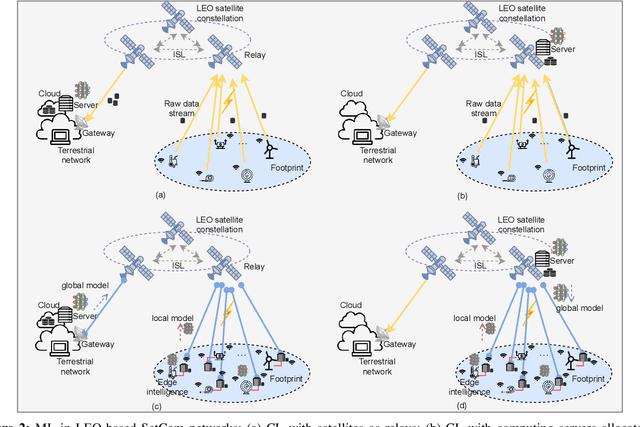
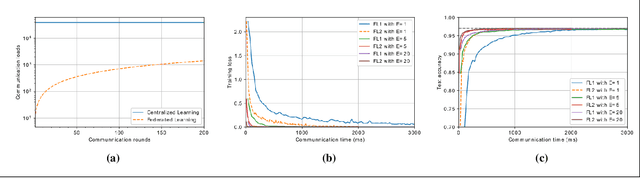

Driven by the ever-increasing penetration and proliferation of data-driven applications, a new generation of wireless communication, the sixth-generation (6G) mobile system enhanced by artificial intelligence (AI), has attracted substantial research interests. Among various candidate technologies of 6G, low earth orbit (LEO) satellites have appealing characteristics of ubiquitous wireless access. However, the costs of satellite communication (SatCom) are still high, relative to counterparts of ground mobile networks. To support massively interconnected devices with intelligent adaptive learning and reduce expensive traffic in SatCom, we propose federated learning (FL) in LEO-based satellite communication networks. We first review the state-of-the-art LEO-based SatCom and related machine learning (ML) techniques, and then analyze four possible ways of combining ML with satellite networks. The learning performance of the proposed strategies is evaluated by simulation and results reveal that FL-based computing networks improve the performance of communication overheads and latency. Finally, we discuss future research topics along this research direction.