 Add to Chrome
 Add to Firefox
 Add to Edge
Mitigating Gradient Pathology in PINNs through Aligned Constraint
May 24, 2026
While Physics-Informed Neural Networks (PINNs) are powerful for solving Partial Differential Equations (PDEs), their training is often paralyzed by gradient pathology. The gradients from the PDE residuals and boundary constraints oppose each other, trapping the model in local minima. Current solutions, such as adaptive weighting or hard constraints, either fail to fundamentally resolve this ill-conditioning or are limited to simple geometries. In this study, we systematically analyze the possible causes of this gradient pathology from the perspectives of loss landscapes and optimization dynamics. Based on the obtained conclusion, we propose Constraint-Aligned loss with Manifold Lifting (CAML). By reformulating all zeroth-order terms into aligned constraints, our method effectively mitigates gradient conflicts. In addition, we introduce a delay factor to help the optimizer skip the high-curvature area. Experiments demonstrate that our CAML significantly enhances numerical stability and efficiency in highly complex PINN problems. Our code is open-sourced on https://github.com/YichenLuo-0/CAML.

Uncertainty-Aware Semantic Decoding for LLM-Based Sequential Recommendation
Aug 10, 2025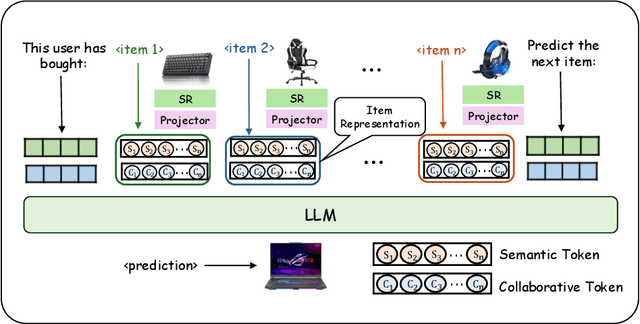
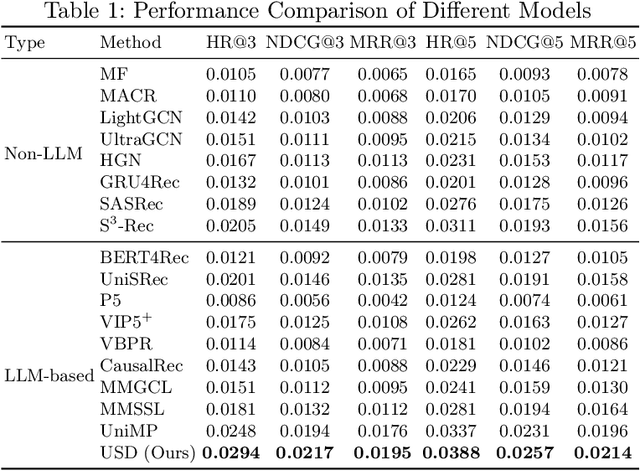
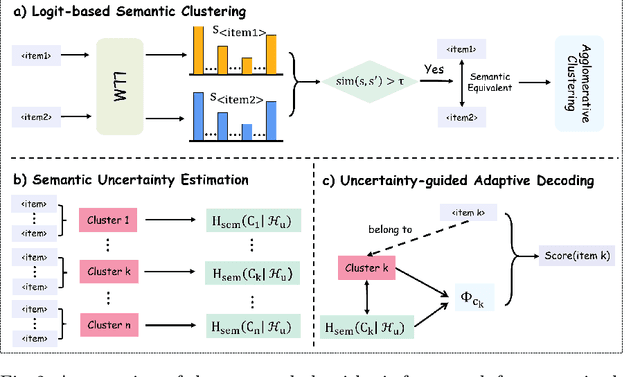

Large language models have been widely applied to sequential recommendation tasks, yet during inference, they continue to rely on decoding strategies developed for natural language processing. This creates a mismatch between text-generation objectives and recommendation next item selection objectives. This paper addresses this limitation by proposing an Uncertainty-aware Semantic Decoding (USD) framework that combines logit-based clustering with adaptive scoring to improve next-item predictions. Our approach clusters items with similar logit vectors into semantic equivalence groups, then redistributes probability mass within these clusters and computes entropy across them to control item scoring and sampling temperature during recommendation inference. Experiments on Amazon Product datasets (six domains) gains of 18.5\% in HR@3, 11.9\% in NDCG@3, and 10.8\% in MRR@3 compared to state-of-the-art baselines. Hyperparameter analysis confirms the optimal parameters among various settings, and experiments on H\&M, and Netflix datasets indicate that the framework can adapt to differing recommendation domains. The experimental results confirm that integrating semantic clustering and uncertainty assessment yields more reliable and accurate recommendations.